Why would a king who drilled armies across Europe choose to live in a palace that barely rises above a vineyard? That question is the best reason to visit Sanssouci Palace in Potsdam, Germany: the place turns Frederick the Great from marble legend into a man with taste, vanity, fatigue, and a sharp eye for light. Today you climb past grape terraces cut into the old "Desolate Hill," hear gravel crack underfoot, and see a long, honey-colored Rococo house stretched low against the sky, as if it would rather converse with the garden than rule it.
Most first-time visitors expect a Prussian Versailles. Sanssouci refuses that script. Records show Frederick II wanted a private summer retreat between 1745 and 1747, not a ceremonial machine, and the palace still feels intimate enough that each window seems placed for one pair of eyes.
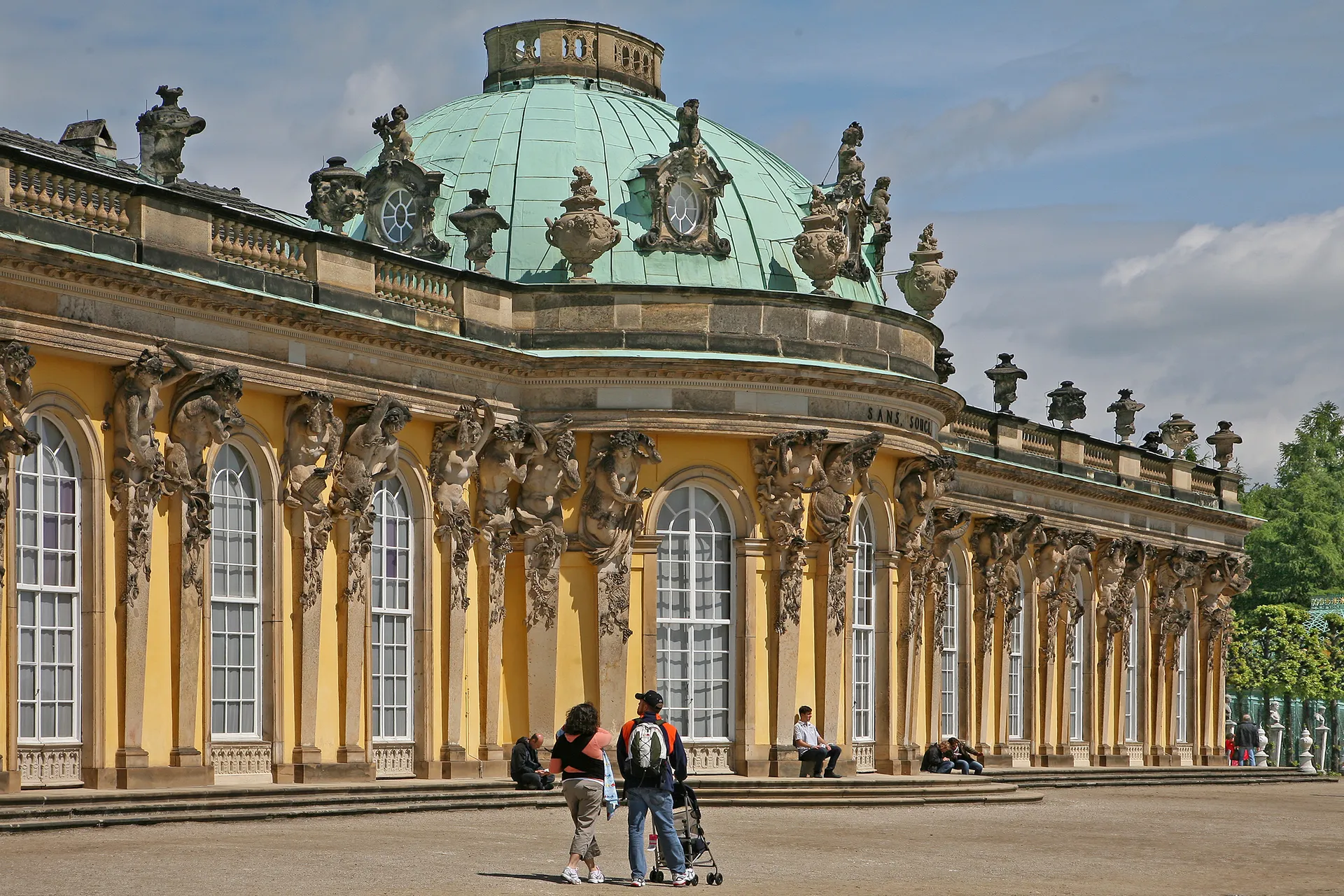
Stand on the south side in late afternoon and the whole idea becomes clear. Stone figures hold the facade like stagehands, vines pull your gaze down the terraces, and the palace seems to grow from the hill instead of sitting on it like a crown.
That is why this place matters. You come for the beauty, yes, but also for the argument built into the walls: power can shout from a fortress, or it can murmur from a garden and still remake a country.
Researched by the Audiala editorial team from historical records, architectural archives, and local expertise.
What to see
Sanssouci Palace and the Vineyard Terraces
Sanssouci works because it refuses to behave like a proper royal palace. Frederick II laid out the vineyard on this so-called desolate hill in 1744, then built the palace between 1745 and 1747 as a one-storey Rococo retreat stretched across the crest like a ribbon rather than a fortress, and the climb up the six terraces makes that decision legible in your legs. From the fountain basin below, the broad stair rises through vines and clipped greenery; by the time you reach the top, gravel crunching underfoot and warm stone giving off the day’s heat, the gilded south facade feels less like a seat of power than a private joke in architectural form. Go inside if you can get a timed entry, because the rooms are surprisingly tight and personal: shell-work curls around mirrors, marble catches the light in the oval hall, and in the second guest room you may hear the faintly off-key flute-clock recording that keeps the original mechanism safe. Then step a few paces to Frederick’s plain grave on the upper terrace, often left with potatoes, and the whole place sharpens into focus: a king who wanted philosophy, music, gardening and, eventually, a very small patch of earth.
The Picture Gallery
Most visitors see the palace, nod approvingly, and keep walking. Bad idea. Frederick had this gallery built in 1755-1763, or possibly 1764 depending on which archival wrinkle you trust, and the exterior keeps its voice low so the interior can do the talking: more than 140 paintings hang close together above yellow-and-white marble floors, with gilded frames, carved ornament and polished stone throwing light back at you from every direction. The room smells faintly of old interiors rather than perfume, footsteps skim across the hard floor, and Caravaggio, Rubens and van Dyck stop feeling like textbook names and start looking like possessions collected by a ruler with sharp taste and no interest in restraint.
A Frederick Walk: Palace, Grave, Windmill, Ruinenberg
Give yourself 90 minutes and do Sanssouci as a sequence rather than a checklist. Start at the fountain basin for the classic full view, climb to the palace and Frederick’s grave, then swing west to the Historic Windmill, where the creak of working machinery cuts through all that polished Prussian elegance, before pushing on to Ruinenberg and the 1846 Norman Tower for the quiet version of the park. Fewer people make it that far. What changes up there is the scale: Sanssouci Park spreads over more than 300 hectares, more than 2 kilometers east to west, and from the hill the whole composition stops looking decorative and starts reading as Frederick’s argument in stone, vines, sightlines and carefully staged illusion.
Plan your visit
Getting There
Sanssouci Palace sits at Maulbeerallee, 14469 Potsdam. From Berlin, take RE1 or S7 to Potsdam, then bus 695 to the stop "Potsdam, Schloss Sanssouci"; with the transfer, count on about 45 to 60 minutes from central Berlin. On foot, the prettiest east-side approach starts at Luisenplatz and follows Allee nach Sanssouci to the Grünes Gitter entrance, while drivers usually use car park P1 Historische Mühle beside the windmill.
Opening Hours
As of 2026, Sanssouci Palace opens Tuesday to Sunday and closes on Monday. Summer hours, April through October, are 10:00 to 17:30; winter hours, November through March, are 10:00 to 16:30, with last admission 30 minutes before closing. Timed entry applies, and SPSG advises rechecking holiday exceptions close to your visit.
Time Needed
Give the palace itself 30 to 45 minutes, then another 30 to 45 if you want the vineyard terraces, Frederick's grave, and time to stand still for the view over Potsdam's roofs. A sensible short visit takes 60 to 90 minutes; a good half-day takes 3 to 4 hours; a full park day can easily stretch to 6 to 8 hours because the grounds cover nearly 300 hectares, a green spread wider than 400 football pitches.
Accessibility
Sanssouci Palace is officially conditionally wheelchair accessible via a temporary ramp about 1 meter wide with roughly 15% gradient, and SPSG recommends visiting with a companion. The park is the harder part: gravel, sand, uneven paving, and slopes above 7% appear on many routes, though SPSG publishes a low-barrier route and lends folding wheelchairs at the Historic Windmill Visitor Centre. A free shuttle runs between Grünes Gitter and Neues Palais from April to October, daily 11:00 to 17:30, weather permitting.
Cost & Tickets
As of 2026, a single Sanssouci Palace ticket costs 14 EUR, reduced 10 EUR. The sanssouci+ day pass costs 22 EUR, reduced 17 EUR, or 49 EUR for a family ticket covering up to 2 adults and 4 children under 19; it usually makes sense if you plan at least one more palace. Book through the official SPSG system for a timed slot, because same-day tickets from the Historic Windmill Visitor Centre depend on what remains.
Photo Gallery
The Rococo facade of Sanssouci Palace stands beneath a bright blue sky in Potsdam. A lone visitor crosses the sunlit gravel courtyard. · Steffen HeilfortA white marble figure stands against the weathered ochre facade of Sanssouci Palace. Strong sunlight casts a crisp shadow across the wall. · Gemeingut im FotoThe yellow Rococo facade of Sanssouci Palace curves beneath its copper-green dome on a bright, clear day. Sculpted figures frame the tall arched windows. · Steffen HeilfortSanssouci Palace stretches across an empty gravel forecourt, its yellow Rococo façade and green copper dome sharply lit beneath a clear blue sky. · Gemeingut im FotoVisitors walk beside the ornate yellow facade and copper-green dome of Sanssouci Palace. Bright daylight reveals the palace's sculpted figures and formal gardens. · W. BulachThe yellow Rococo façade of Sanssouci Palace stretches beneath a vivid blue sky in Potsdam. Sculpted figures and a copper dome frame the sunlit courtyard. · Steffen HeilfortSanssouci Palace rises beyond its geometric vineyard terraces, fountain basin and classical statues. Mature trees frame the historic black-and-white view. · Unknown authorUnknown author
History
The King Who Wanted Less, and the Architect Who Wanted More
Sanssouci makes the most sense when you read it through Frederick II. Records show the Prussian king ordered the vineyard terraces in 1744 on what locals called the Wusten Berg, the Desolate Hill, then laid the palace's first stone on 14 April 1745. He wanted retreat after war, music after court ritual, and a place where conversation could outrank ceremony.
But one life does not make a building by itself. Georg Wenzeslaus von Knobelsdorff, the soldier-turned-artist who became Frederick's architect, gave the king's taste material form, and their clash shaped what you see now more than most visitors realize.
The turning point
The Palace Was Supposed to Sit Higher
At first glance, Sanssouci looks like a perfect expression of Frederick's will: a low Rococo retreat, precisely measured, perfectly self-possessed. Most visitors accept that surface story and move on, assuming the architect simply obeyed.
The doubt starts with the building's strange humility. Why does a royal palace sink so close to the vineyard terraces, almost hiding its own facade? Sources describe a dispute between Frederick and Knobelsdorff over exactly that point, and the stakes for Knobelsdorff were personal: royal favor was his career, his income, and the proof that a former officer and painter could stand among Europe's serious architects.
The revelation is that Sanssouci survives as a compromise tilted toward the king. Frederick wanted his 'vineyard house' pressed into the hill, intimate and direct; Knobelsdorff argued for a higher placement that would have given the palace more authority and cleaner architectural command. The turning point came during construction in 1746 or 1747, according to later accounts, when their disagreement became irreconcilable and Knobelsdorff lost control of the project while Jan Bouman carried it forward.
Once you know that, the facade changes. The palace stops looking merely elegant and starts looking argumentative, a built record of one brilliant man insisting on ease and another seeing the grandeur being trimmed away in real time.
Early Life & Vision
Frederick II was born in 1712 into a court that prized obedience, drilling, and display; records from his reign show he spent the rest of his life pushing against that inheritance even while using it. Sanssouci was his answer in stone. He sketched ideas himself, chose a single-story form that broke with the usual royal staircase theatrics, and treated the south terraces less like decoration than like philosophy made visible: cultivation, order, pleasure, all under a demanding eye.
Legacy & Influence
Frederick died at Sanssouci on 17 August 1786, and the palace fell quiet enough that later rulers had to decide what, exactly, to do with such a personal place. Records show Frederick William IV revived it as a summer residence after 1840, Wilhelm I opened it as a museum in 1873, and Frederick's remains were finally buried on the upper terrace in 1991, fulfilling his wish at last. That long afterlife matters, because Sanssouci became more than a king's retreat: it turned into Prussia's self-portrait, then Germany's inheritance, then a UNESCO-listed argument for why intimacy can carry as much historical weight as scale.
Tips for visitors
Shoot Lightly
Handheld personal photos and video are allowed, but extra gear or a crew needs permission. Leave the tripod and drone behind; SPSG grounds are no place for either, and staff do enforce that rule.
Pack Small
Sanssouci Palace has no baggage storage, and bulky or wet items are not welcome in the rooms. Strollers are also barred from the exhibition spaces, so large bags turn into a problem fast.
Beat The Rush
Book the first or last slot you can get. Midday brings the coach groups, and the terraces lose their hush; early light on the south-facing vineyard steps is softer, with long shadows falling across the vines like piano keys.
Eat Nearby
For a sit-down meal, Drachenhaus Restaurant & Café on Maulbeerallee is the most atmospheric mid-range stop at about 15 to 30 EUR. Closer to the entrance, Zur Historischen Mühle works for coffee, cake, or a light lunch in the 8 to 18 EUR range; if those prices annoy you, walk a few minutes toward Weinbergstraße for better-value bakeries.
Combine Smartly
Don't treat Sanssouci as one building with a garden attached. Pair the palace with the terraces and Frederick the Great's grave for a short visit, or keep walking west toward the New Palace if you bought the sanssouci+ pass; the full east-west park axis runs more than 2 kilometers, about 25 football fields laid end to end.
Book Officially
Unofficial ticket sites often add markups or muddy the timed-entry rules. Buy through SPSG, and if you want more than the palace, the 22 EUR sanssouci+ pass usually beats paying for separate interiors.
Where to Eat
local_dining
Don't Leave Without Trying
Potato dishes, tied to Potsdam's Prussian potato history and the tradition of leaving potatoes at Frederick the Great's graveGerman food with Dutch influence in the Dutch QuarterMatjesKniepertjesJenever
LOKAL Potsdam
cafe
Brunch cafe with house cakes, breakfast plates, and coffee€€star4.7(694)
Order: Go for breakfast and save room for cake, especially the birthday layer cake that shows up again and again in reviews.
This feels like the kind of place people return to, not a one-off tourist stop. Reviews keep pointing to the careful little details in the breakfast dishes, friendly service, and cakes that have built a real local following.
Seasonal lunch restaurant with rotating daily specials, cakes, and wine€€star4.7(755)
Order: Order the daily lunch special and ask what is strongest that day; one reviewer still talks about an exceptional pasta bolognese, and the cakes get their own praise.
The appeal here is the daily rhythm: a short menu, fresh cooking, and a room calm enough for an actual conversation. It sounds more like a neighborhood lunch institution than a place chasing trends.
Vegan cafe for brunch, pastries, coffee, and homemade savory plates€€star4.7(163)
Order: Try the vegan meatballs and one of the cakes or pastries; reviews make clear that the baking is a strong reason to come.
This is the pick for anyone who wants plant-based food that does not feel dutiful. Guests talk about homemade cooking, warm staff, and brunch good enough to pull people back across town on repeat visits.
German restaurant with regional dishes, seasonal game, soups, and lakeside dining€€star4.6(2855)
Order: Order classic hearty dishes like the fish soup or soljanka, and if you want something more substantial, the venison medallions are a strong bet from the reviews.
This is the most rooted, old-school meal in the group: big plates, a fireplace inside, and a lakeside terrace outside. Reviews suggest a place people choose when they want regional cooking with a bit of occasion to it.
checkTipping in Germany is customary but not compulsory.
checkIf you pay by credit card, give the tip in cash if possible.
checkCarry cash, especially for tips.
checkSanssouci Palace is closed on Mondays, so pair meal plans with sightseeing accordingly.
checkThe Historic Windmill Visitor Centre is closed on Mondays.
checkThe New Palace Visitor Centre is closed on Tuesdays.
Food districts:Dutch Quarter for German food with Dutch influence
Restaurant data powered by Google
Watch & Explore Sanssouci Palace.
I Spent a Day in Germany’s Royal City ✨ (Potsdam & Sanssouci Palace)
Rayzodd22 min9K
Explore Potsdam
Potsdam Complete City Travel Guide - Top Attractions, Public Transport & More - Historic Germany
Ultimate Bucket List12 min6K
Explore Potsdam
Potsdam | Top 6 Sehenswürdigkeiten der Stadt präsentiert von Stadtfuehrung.de
StadtfuehrungDE11 min26K
Frequently asked
Is Sanssouci Palace worth visiting?
Yes, especially if you want a royal palace that feels personal rather than overblown. Frederick the Great built it between 1745 and 1747 as a retreat above six vineyard terraces, so the place reads more like a cultivated hillside villa than a throne room with delusions. Stand below the south facade and the palace seems to hover above the vines, light as a stage set.
How long do you need at Sanssouci Palace?
Plan on 60 to 90 minutes for the palace and immediate terraces, and 3 to 4 hours if you want the grounds to make sense. Sanssouci Park covers nearly 300 hectares, about 420 soccer fields, so distances stretch more than the map suggests. Feet will notice first.
How do I get to Sanssouci Palace from Potsdam?
From Potsdam Hauptbahnhof, the easiest route is local bus to the stop "Potsdam, Schloss Sanssouci," then a short walk to the palace at Maulbeerallee. If you prefer arriving on foot, walk from Luisenplatz along Allee nach Sanssouci to the Grünes Gitter entrance; the shift from city streets to gravel paths and clipped terraces is half the pleasure. Bus 695 is the most clearly documented direct connection.
What is the best time to visit Sanssouci Palace?
Spring and early summer are the best seasons, and early morning is the best hour. The formal parterre below the palace is planted with more than 230,000 flowers in seasonal schemes, while the lower light catches the gold and pale stone before the tour groups thicken. Winter has its own severity, but many side buildings close then.
Can you visit Sanssouci Palace for free?
You can visit Sanssouci Park for free, but the palace interior is not generally free. Standard admission is 14 EUR, with reduced tickets at 10 EUR, and timed entry matters because daily capacity is limited. A few categories get free admission, including children under 7 and some visitors with disability or social-benefit status.
What should I not miss at Sanssouci Palace?
Don’t miss the vineyard-terrace approach, Frederick the Great’s grave on the upper terrace, and the Marble Hall inside. Also make time for the Voltaire Room, where yellow walls bloom with carved birds, fruit, and garlands, and listen for the slightly off-key flute-clock sound documented in the second guest room. That odd little note changes the palace from pretty object to lived place.
Sources & attribution10
Researched and written by the Audiala editorial team from historical records, architectural archives, and local expertise. Last updated July 2026.
UNESCO World Heritage Centre — World Heritage listing used for first-stone date, overall significance, and the larger heritage frame of Sanssouci within Potsdam and Berlin.
City of Potsdam (Sanssouci Palace) — Municipal overview confirming the palace's role as Frederick's retreat and supporting the description of its intimate scale and hilltop setting.
Saved and recently read places — kept on this device only.
Photo credits (14)
.00 3591 Schloss Sanssouci in Potsdam — W. Bulach — CC BY-SA 4.0 (https://creativecommons.org/licenses/by-sa/4.0/) — Source: https://commons.wikimedia.org/wiki/File:.00_3591_Schloss_Sanssouci_in_Potsdam.jpg
Potsdam neue kammern — Dieter Brügmann — CC BY-SA 3.0 (https://creativecommons.org/licenses/by-sa/3.0/) — Source: https://commons.wikimedia.org/wiki/File:Potsdam_neue_kammern.jpg
PotsdamSanssouciChineseHouse — Andreas Tille — CC BY-SA 4.0 (https://creativecommons.org/licenses/by-sa/4.0/) — Source: https://commons.wikimedia.org/wiki/File:PotsdamSanssouciChineseHouse.jpg
New Palace in Potsdam 01 — Itsdomi — CC BY-SA 4.0 (https://creativecommons.org/licenses/by-sa/4.0/) — Source: https://commons.wikimedia.org/wiki/File:New_Palace_in_Potsdam_01.jpg
Aerial image of the Sanssouci Palace (view from the south) — Carsten Steger — CC BY-SA 4.0 (https://creativecommons.org/licenses/by-sa/4.0/) — Source: https://commons.wikimedia.org/wiki/File:Aerial_image_of_the_Sanssouci_Palace_(view_from_the_south).jpg
.00 2522 Schloss Sanssouci in Potsdam — W. Bulach — CC BY-SA 4.0 (https://creativecommons.org/licenses/by-sa/4.0/) — Source: https://commons.wikimedia.org/wiki/File:.00_2522_Schloss_Sanssouci_in_Potsdam.jpg
1036. Schloß Sanssouci(frz.sans souci = ohne Sorge) am Hang eines Weinberg 1745-1747 Steffen Heilfort — Steffen Heilfort — CC BY-SA 3.0 (https://creativecommons.org/licenses/by-sa/3.0/) — Source: https://commons.wikimedia.org/wiki/File:1036._Schloß_Sanssouci(frz.sans_souci_=_ohne_Sorge)_am_Hang_eines_Weinberg_1745-1747_Steffen_Heilfort.JPG
999.Schloß Sanssouci(frz.sans souci = ohne Sorge) am Hang eines Weinberg 1745-1747 Steffen Heilfort — Steffen Heilfort — CC BY-SA 3.0 (https://creativecommons.org/licenses/by-sa/3.0/) — Source: https://commons.wikimedia.org/wiki/File:999.Schloß_Sanssouci(frz.sans_souci_=_ohne_Sorge)_am_Hang_eines_Weinberg_1745-1747_Steffen_Heilfort.JPG
Potsdam - Schloss Sanssouci — Raimond Spekking — CC BY-SA 4.0 (https://creativecommons.org/licenses/by-sa/4.0/) — Source: https://commons.wikimedia.org/wiki/File:Potsdam_-_Schloss_Sanssouci.jpg
998.Schloß Sanssouci(frz.sans souci = ohne Sorge) am Hang eines Weinberg 1745-1747 Steffen Heilfort — Steffen Heilfort — CC BY-SA 3.0 (https://creativecommons.org/licenses/by-sa/3.0/) — Source: https://commons.wikimedia.org/wiki/File:998.Schloß_Sanssouci(frz.sans_souci_=_ohne_Sorge)_am_Hang_eines_Weinberg_1745-1747_Steffen_Heilfort.JPG
Strictly necessary cookies keep the site working. Analytics (PostHog, Google Analytics) measures how each visitor uses our pages. Marketing loads YouTube videos and walking-route maps without a tap and lets Google Analytics set advertising cookies. We never sell your data. You can change this any time from the footer.
Analytics and marketing cookies are optional and only load if you agree. Details under Customize.
Privacy
Cookie preferences
Pick what you're okay with. You can change this any time from the footer.
Strictly necessary
Always on
Sign-in, language, navigation. Always on.
Product analytics
PostHog (EU) and Google Analytics record which pages you view and how you use them, under a random identifier stored in your browser. Helps us see which pages work and which need fixing. Google's ad personalisation stays off. No selling.
Marketing
Loads YouTube videos and the walking-route maps (OpenFreeMap) without a tap; without it, they load only when you tap them. If analytics is also on, Google Analytics may set advertising cookies. Ad personalisation stays off.