
Imperial Castle Panorama
The Kaiserburg's Sinwell Tower rewards the 100-step climb with a 360° view over a cityscape that still obeys its 14th-century walls. On clear days you can spot the Franconian Jura bruising the horizon like a faint bruise.
The first thing you notice in Nuremberg, Germany, is the smell of beechwood smoke curling up from a 700-year-old bratwurst kitchen. It drifts across a square where half-timbered houses lean like gossiping neighbors and the church clock still performs its noon pantomime—tiny iron figures pirouetting above your head. This is not the Bavaria of dirndls and oompah bands; it’s Franconia, a region that swapped allegiances the way other people change coats and never quite forgave Munich for stealing the spotlight.
NThe first thing you notice in Nuremberg, Germany, is the smell of beechwood smoke curling up from a 700-year-old bratwurst kitchen. It drifts across a square where half-timbered houses lean like gossiping neighbors and the church clock still performs its noon pantomime—tiny iron figures pirouetting above your head. This is not the Bavaria of dirndls and oompah bands; it’s Franconia, a region that swapped allegiances the way other people change coats and never quite forgave Munich for stealing the spotlight.
Between the castle’s sandstone walls and the concrete footprint of the former rally grounds, Nuremberg keeps two centuries in conversation. One minute you’re descending 50 ft into 14th-century beer cellars, the next you’re standing on the balcony where Hitler addressed half a million people. The city doesn’t flinch from either timeline; instead it layers them like the overlapping beams of a medieval roof.
Locals call the place Nämberch and speak a dialect that turns German into a soft, clipped music. They’ll direct you to the artisan courtyard where armorers still forge hinges by hand, then confess that the best lebkuchen comes from a basement bakery that closes at 2 p.m. sharp. Follow their advice and you’ll taste gingerbread warm enough to bend, drink red beer cooled in rock tunnels older than Martin Luther, and realize the city’s real monument is the stubborn continuity of everyday skill.
What makes this place worth slowing down for.
The Kaiserburg's Sinwell Tower rewards the 100-step climb with a 360° view over a cityscape that still obeys its 14th-century walls. On clear days you can spot the Franconian Jura bruising the horizon like a faint bruise.
After a decade-long renovation, the Documentation Center reopens in 2026 with new climate-controlled galleries inside the half-finished Kongresshalle. The concrete shell—never completed in 1945—now echoes with archival film footage instead of marching boots.
Albrecht Dürer’s timber house at Albrecht-Dürer-Straße 39 is the only 16th-century artist’s home north of the Alps where you can still smell linseed oil. Actors in period aprons demonstrate etching techniques on a 1503 press; the copper-plate burin scratches sound like rain on glass.
Nuremberg’s finger-sized bratwurst is protected by EU law—only sausages made within the city walls may bear the name. Order them drei im Weckla (three in a crusty roll) from the 700-year-old Bratwursthäusle beside the Hauptmarkt; the grill smoke drifts straight into the medieval dungeons below.
Not every monument, just the ones we'd walk you past ourselves.

The Germanisches Nationalmuseum (GNM) in Nuremberg, Germany, stands as the largest museum dedicated to the cultural history of the German-speaking world.

Nuremberg Castle (Kaiserburg Nürnberg) stands as one of the most significant and best-preserved medieval fortresses in Europe, prominently overlooking the…

Nestled within the historic city of Nuremberg, the Deutsches Kunstarchiv at the Germanisches Nationalmuseum stands as Germany’s foremost archive dedicated to…

The Nuremberg Transport Museum (Verkehrsmuseum Nürnberg), home to the esteemed DB Museum, stands as a cornerstone of Germany’s railway heritage and one of the…
Nestled in the heart of Nuremberg’s historic Old Town, the Nuremberg Toy Museum (Spielzeugmuseum Nürnberg) stands as a captivating testament to the city’s…
Nestled in the heart of Nuremberg, Germany, the Neues Museum Nürnberg (NMN) stands as a beacon of contemporary art and modern design, seamlessly blending…

The Palace of Justice in Nuremberg, Germany, stands as a monumental symbol in the history of international law and human rights, most famously recognized as…
Where to wander, by quarter — each with its own rhythm.
Inside the 5 km ring wall, cobblestones echo with wagon-wheel memory. The Hauptmarkt hosts a daily produce bazaar where farmers sell white asparagus the width of a finger; side streets hide courtyards whose timber beams were felled in the 1480s. Come dusk, tavern windows glow red from rows of Nürnberger Rostbratwurst hissing over beech coals.
Leafy, quiet, and stubbornly residential. Rose-covered villas face the Pegnitz while the city’s most photogenic cemetery shelters Albrecht Dürer’s plain slab and a colony of red squirrels. Baroque gardens—the Hesperidengärten—open twice a week; their citrus trees spend winter in 18th-century orangeries that smell faintly of orange peel and coal smoke.
A grid of 19th-century factory blocks reborn as spray-painted studios and vegan doner stands. Vintage shops occupy former locksmiths’ vaults; at night, basement bars pour cloudy Franconian IPA to soundtracks that range from krautrock to Kurdish hip-hop. If you’re hunting for a 3 a.m. döner or a gallery that doubles as a skate shop, start here.
Twenty-two half-timbered houses survived 1945 by luck and sand-filled basements. Restored artisans now work behind wavy glass: bookbinders, violin bow makers, a single woman who gold-leafs picture frames using 16th-century rabbit-skin glue. The street smells of pine shavings and fresh coffee; camera shutters click like cicadas at noon.
Bourgeois and hilly, lined with Jugendstil villas whose turrets echo the castle’s silhouette. On Saturdays the Volkshochschule hosts a farmers’ market where beekeepers sell linden honey so pale it looks like liquid wax. The little-known Burgermeistergarten hides behind an iron gate; locals bring picnics to watch sunset spill over red roof tiles toward the Alps.
Tram bells clang along Schweiggerstraße past brick breweries converted into co-working lofts. Corner pubs serve unfiltered Kellerbier drawn from wooden barrels; the foam collapses into lace patterns that vanish in 90 seconds. On summer evenings the Pegnitz riverbank fills with slackliners and Turkish families grilling corn until the streetlights flicker.
From Holy Roman stronghold to courtroom of the world
A parchment records the manumission of a serf named Sigena at 'Noremberg'. The ink is still dark where the scribe pressed too hard, naming a place that would soon command kingdoms.
Frederick II's golden charter arrives on vellum. Nuremberg's merchants can now mint coin, raise armies, and answer only to the Emperor. The castle's shadow lengthens across Europe.
A child's cry echoes in the house on Albrecht-Dürer-Straße. He'll grow up to engrave the city into Europe's imagination, his copper plates harder than steel yet capturing every timber beam.
Hartmann Schedel's massive book rolls off Anton Koberger's presses. 1,809 woodcuts show the world as Nuremberg sees it—Jerusalem looks suspiciously like Franconia.
In a locksmith's workshop near the Pegnitz, small gears click together for the first time. The 'Nuremberg Egg' will tick in every royal pocket.
Luther's pamphlets stack high in bookshops. The council votes Protestant while keeping Catholic artworks—pragmatism wrapped in theology.
Wallenstein's army camps outside for months. Disease and starvation kill 8,000. The Golden Age ends with plague pits in St. Johannis cemetery.
When the Holy Roman Empire dissolves, Nuremberg's imperial banner comes down for the last time. Bavarian officials measure the city walls with new-made rulers.
Steam whistles pierce medieval silence. The 6-kilometer line to Fürth carries 200 passengers at 28 kilometers per hour—faster than any horse.
Albert Speer's concrete grows like a malignant tumor southeast of the old town. 130,000 gather to hear promises that will drown the world in fire.
In the opera house, Hitler signs laws that strip Jews of citizenship. The parchment is crisp. The ink bleeds into history's darkest chapter.
Allied bombs destroy 92% of the medieval core. On April 20, American tanks roll past the castle. Survivors count bodies in a silence broken only by falling masonry.
In Courtroom 600, Göring fidgets with headphones while prosecutors speak of crimes so vast they needed new words. The world watches justice being invented in real time.
Using 15th-century plans, craftsmen replace what bombs erased. Stone by stone, Nuremberg resurrects itself—proof that some cities refuse to die.
In Speer's half-finished Congress Hall, exhibits confront what happened here. The audio guide plays Hitler's voice through headphones—no one speaks for minutes afterward.
The cobbler poet stitches words like leather. 6,000 master songs flow from his workshop on Spitalgasse. Wagner will turn him into opera three centuries later.
The Krakow master brings chisels sharp enough to carve angels. His Annunciation in St. Lorenz makes wood weep. Nuremberg's churches will never be the same.
The merchant crafts the world's oldest surviving globe in his workshop near the castle. America doesn't exist yet. Dragons guard the edges.
The people who shaped the city — and were shaped by it.
He prowled these same cobblestones sketching rhinos he never saw in the flesh; his timber house on Tiergärtnertor still smells of pine and ink. Ask the museum guard to show the 1514 ‘Melencolia I’ copperplate—Dürer’s moody angel stares back like he knows the city will one day stare at itself in guilt.
In a locksmith’s shop near the castle he miniaturized church tower gears into the first ‘Nuremberg Egg’ watch. Today his spirit lingers in the DB Museum’s clock hall—every station platform clock still echoes his heartbeat.
The shoemaker-poet hammered soles by day and 6,000 stanzas by night; his gravestone in St. Johannis is worn smooth because Wagner fans still come to thank the man who inspired ‘Die Meistersinger.’
He carved the suspended Annunciation in St. Lorenz from one limewood trunk, then painted it so the angel’s wings shimmer like wet marble. Touch the darkened pew beneath—five centuries of necks have craned upward in the same spot.
Where locals actually book dinner — not the tourist menus.
Small things that change how the city treats you.
Smaller bratwurst stands and beer cellars still refuse cards. Keep €20 in coins and fives for sausages, toilets, and the 36 sightseeing bus.
Be on the Hauptmarkt steps at 11:58 a.m.; the Frauenkirche glockenspiel starts exactly at noon and the crowd disperses by 12:05, leaving the square empty for photos.
The U2 subway runs every 5–10 min from NUE to Hauptbahnhof; buy the €3.20 VGN ticket before you board—there’s no barrier, but inspectors are relentless.
Ignore the tourist-crowded front rings of the Schöner Brunnen; walk around to the river-facing side, spin the brass ring there, and you’ll get the luck without the queue.
After 23:00, leave Hauptbahnhof via the upper level bridge exits; they empty onto well-lit streets and skip the dim ground-floor taxi rank reported for pickpockets.
A few films to set the scene before you go.
The city, as it actually looks.

The intricate gold details of the Schöner Brunnen fountain stand in the foreground, framed by the historic Frauenkirche in Nuremberg's main market square.
Alexander Popadin on Pexels

A stunning aerial perspective of Nuremberg, Germany, highlighting the city's iconic red-roofed architecture and historic skyline.
Karolina on Pexels

The iconic spires of Nuremberg rise above the city's traditional rooftops, bathed in the warm, golden light of a clear day.
Alexey K. on Pexels

A picturesque view of a historic street in Nuremberg, Germany, showcasing traditional architecture, a prominent bull statue, and the city's vibrant atmosphere.
Linh Bo on Pexels
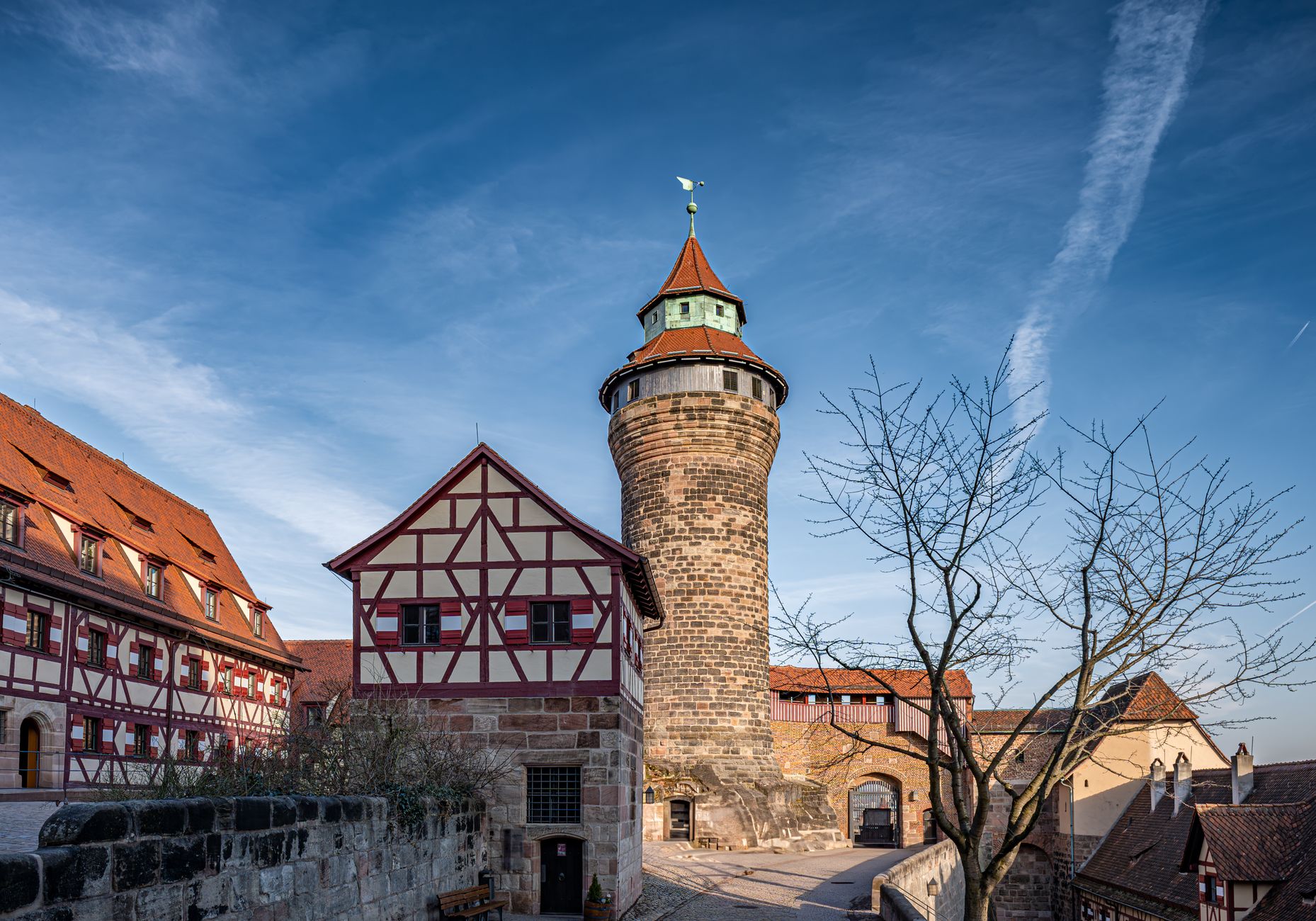
The iconic Sinwell Tower stands tall above the traditional timber-framed buildings of the historic Nuremberg Castle in Germany.
Sabine Freiberger on Pexels

The picturesque Henkersteg, a historic covered wooden bridge, spans the Pegnitz river in the heart of Nuremberg, Germany.
Travel Photographer on Pexels

The iconic Nuremberg Castle stands proudly above the city, showcasing its distinct medieval architecture and historic red-tiled roof.
Artur Roman on Pexels

The historic stone facade of the Zum Spiessgesellen restaurant in Nuremberg, Germany, showcases impressive Renaissance-style architecture and detailed stone carvings.
Arlind D on Pexels

The stunning Gothic facade of St. Sebaldus Church in Nuremberg, Germany, illuminated by the warm glow of the afternoon sun.
Alexey K. on Pexels

The charming Bratwursthäusle restaurant in Nuremberg, Germany, offers a traditional dining atmosphere in the heart of the historic city.
Arlind D on Pexels
Yes—one city layers an imperial castle, a Dürer-filled golden age, and the raw evidence of Nazi rallies. You can see 1,000 years of European highs and lows in a single walkable old town.
Two full days cover the castle, trials documentation, and a bratwurst crawl. Add a third if you want day-trips to Bamberg or Regensburg, both under an hour by regional train.
The 48-hour Nürnberg Card costs €33 and bundles all public transport plus free entry to 36 museums; it pays for itself after one palace and one museum.
Menus in the old town are bilingual and servers switch to English without prompting. Venture into Gostenhof’s pubs and you’ll need ‘Ein Bier, bitte’ and a smile.
The Nazi Rally Grounds museum is closed until 2026; the outdoor parade field and half-finished Congress Hall are still accessible for self-guided walks.
Ready to book?
Nürnberg Airport (NUE) sits 12 minutes north on the U2 subway line. ICE trains stop at Nürnberg Hauptbahnhof hourly from Munich (1h 10min) and Berlin (2h 45min). Drivers arrive via A3 (Frankfurt–Passau) or A9 (Berlin–Munich) junctions 82–85.
VGN network: 3 U-Bahn lines (U1/U2/U3), 3 trams, 4 S-Bahn lines, 46 bus routes. Nürnberg Card €34 (2026) covers 48h public transport plus 49 museum entries. The No. 36 bus loops 36 tourist stops every 15 minutes May–October.
May–June: 12–24°C, lilac blooming in the castle moat. July peaks at 25°C but brings 70mm rain. September: 20°C and wine-cellars open for Federweißer. December markets run at –2°C; pack gloves for the outdoor Glühwein stands.
German is standard; expect East-Franconian ‘Grüß Gott’ in beer gardens. Cards accepted everywhere except at public toilets (€0.70) and some bratwurst stands—carry €10 in coins. Tipping: round up to the next euro or add 5% in restaurants.
Nuremberg ranks in Germany’s lowest crime quartile. Pickpockets target the Saturday Hauptmarkt; keep bags zipped. Around the Hauptbahnhof after 23:00 use the well-lit east-side exit toward Königstor; the west-side tunnel can feel empty.
130 places, one continuous walking route. Free with your first city.
130 places to discover


Showing 48 of 130 — search any place to jump straight there.


