Introduction
The Kardinal-von-Galen-Denkmal stands at the spiritual and historical heart of Münster, Germany, as a testament to Clemens August Graf von Galen—“The Lion of Münster.” Renowned for his staunch resistance to Nazi atrocities, notably the euthanasia program, Cardinal von Galen’s legacy of moral courage endures through this imposing monument. Located at Domplatz, right beside the St. Paulus Cathedral, the site is a cornerstone of Münster’s cultural memory and a focal point for reflection on human rights, resistance, and ethical responsibility (stadt-muenster.de, Vatican).
This guide provides a detailed overview of the monument’s history, visiting hours, accessibility, and its role within Münster’s broader landscape of historical sites. Whether you’re a history enthusiast, pilgrim, or casual traveler, you’ll find valuable information for planning a meaningful and insightful visit.
Historical Context of Clemens August Graf von Galen
Early Life and Ecclesiastical Career
Clemens August Graf von Galen was born in 1878 into the Westphalian nobility at Dinklage Castle. Raised in a deeply Catholic family, he was educated at Jesuit and Catholic institutions, reflecting the church-state tensions of late 19th-century Germany. Ordained in 1904, he served as a parish priest and later became Bishop of Münster in 1933 (Vatican; Britannica).
Resistance to National Socialism
Von Galen is most celebrated for his fearless opposition to the Nazi regime’s policies. In 1941, he delivered a series of sermons denouncing the euthanasia program and state-perpetrated violence, which were widely disseminated and instrumental in prompting the temporary suspension of the killings. His outspokenness made him a symbol of moral bravery and a defender of human dignity within the Catholic Church and beyond (Wikipedia, Vatican).
The Monument: Design, Symbolism, and Setting
Location and Architectural Details
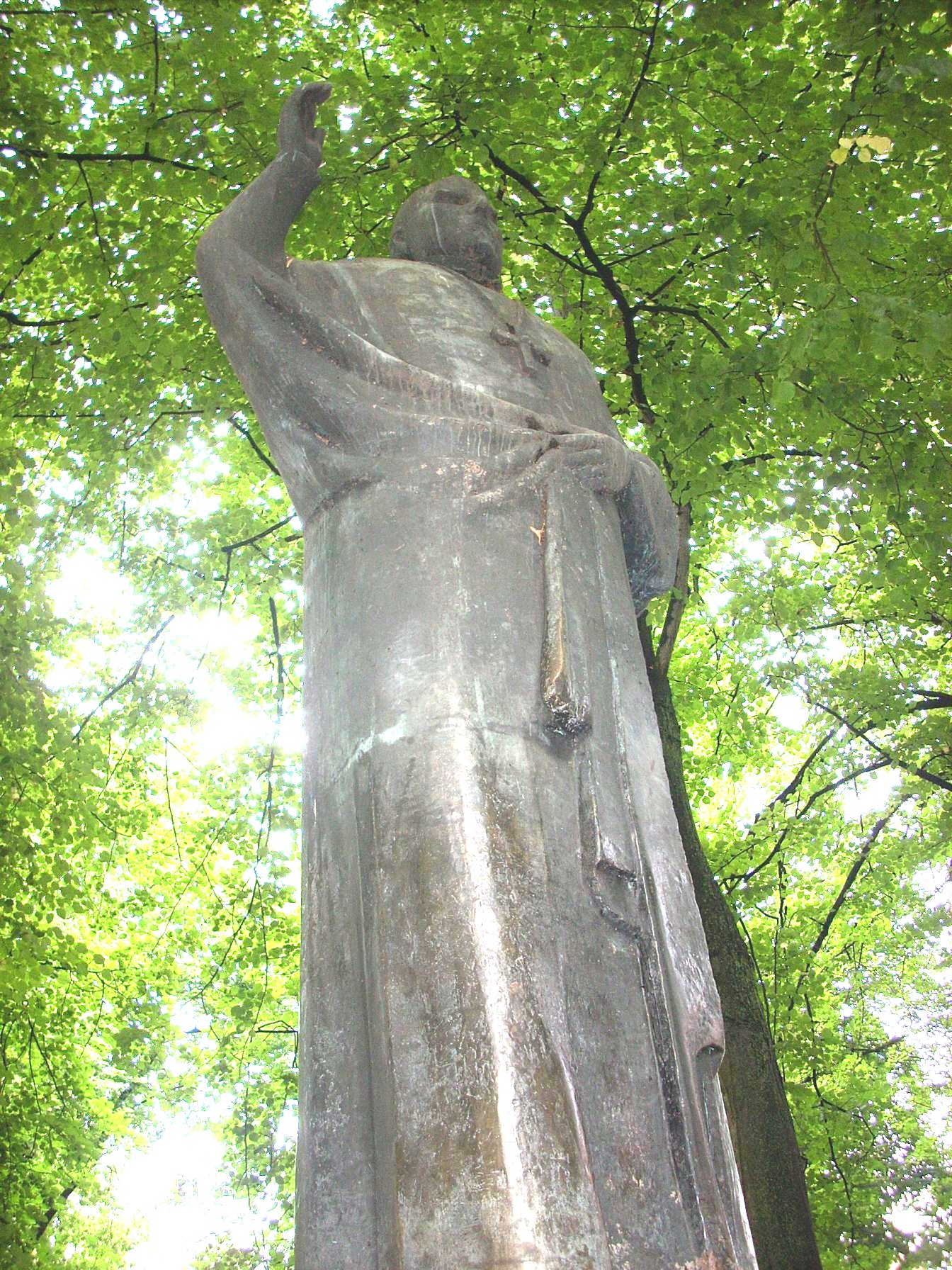
The Kardinal-von-Galen-Denkmal is prominently positioned on the Domplatz, adjacent to the St. Paulus Cathedral, anchoring it within Münster’s religious and civic center (stadt-muenster.de). Designed by sculptor Toni Schneider-Manzell and unveiled in 1978, the monument consists of a 3.6-meter bronze figure on a stone pedestal, totaling 4.8 meters in height (skulpturen.kulturraum.nrw).
Symbolism and Artistic Choices
The statue’s minimalist aesthetic—eschewing episcopal regalia in favor of simple clerical garb—emphasizes von Galen’s humanity and his role as a courageous citizen. With one hand raised in both blessing and protest, the figure conveys themes of resistance and moral admonition. Four bronze plaques at the base bear inscriptions: biographical details, a quote from his 1941 sermon, and biblical passages from Hebrews and Jeremiah, each reinforcing his steadfastness and spiritual resolve (stadt-muenster.de).
Visiting Information: Hours, Tickets, Accessibility
- Opening Hours: The monument is in a public square and accessible 24/7, year-round.
- Admission: There is no entrance fee.
- Guided Tours: Available via the Münster Tourist Office for a small charge; group and thematic tours often include the monument (Münster Tourism).
- Accessibility: The site is wheelchair accessible, with flat, paved surfaces and curb cuts. Accessible restrooms are nearby at the LWL Museum and Münster Cathedral visitor center. Tactile maps and assistance are offered by the tourist office as needed.
Getting There
- Public Transit: Bus stops at "Domplatz" or "Prinzipalmarkt" are a 5-minute walk from the monument. Münster Hauptbahnhof is approximately 1.2 km away.
- Parking: Underground parking is available at “Domplatz” and “Aegidiimarkt.”
- Cycling: Münster is known as Germany’s “bicycle capital” with dedicated bike lanes and rental options.
Guided Tours, Educational Programs, and Events
- Guided Tours: City and themed tours regularly include the monument, providing historical context about von Galen and Nazi-era resistance (Münster Marketing).
- Educational Programs: Local schools and the University of Münster integrate visits into their curricula, fostering discussion on ethics, history, and civil courage.
- Commemorative Events: Annually on von Galen’s birthday and beatification, ceremonies and educational events take place, often with speeches, music, and readings (stadt-muenster.de).
Practical Visitor Tips
- Best Times to Visit: Early mornings or late afternoons offer optimal lighting and a quieter ambiance. Market days (Wednesday and Saturday) bring energy but may obscure views.
- Photography: Permitted for non-commercial use; the monument is particularly photogenic against the cathedral backdrop.
- Nearby Amenities: Cafés, restaurants, and benches are plentiful around Domplatz. The cathedral visitor center offers restrooms, information, and a gift shop.
- Safety: Münster is considered safe. Exercise standard caution on crowded market days.
Nearby Münster Historical Sites
- St. Paulus Cathedral (St.-Paulus-Dom): Münster’s architectural jewel, open to the public.
- St. Lambert’s Church: Where von Galen served as parish priest.
- LWL Museum of Art and Culture: Features exhibitions on religious and regional history.
- Prinzipalmarkt: Historic shopping street with arcades and gabled houses.
- Villa ten Hompel: Museum on resistance and moral responsibility during the Nazi era.
FAQs
Q: Is there an entrance fee?
A: No, the monument is free and open at all times.
Q: Are guided tours available?
A: Yes, through Münster Tourist Information; tours are available in several languages.
Q: Is the monument accessible for wheelchair users?
A: Yes, the area is barrier-free.
Q: Can I take photos?
A: Yes, non-commercial photography is welcome.
Q: What is the best time to visit?
A: Early morning or late afternoon for fewer crowds and the best lighting.
Listen to the full story in the app
Your Personal Curator, in Your Pocket.
Audio guides for 1,100+ cities across 96 countries. History, stories, and local insight — offline ready.
Audiala App
Available on iOS & Android
Join 50k+ Curators
Sources
- verified
- verified
- verified
- verified
- verified
- verified
Last reviewed:


