Plan and listen to Stolperstein Dedicated To Eduard Hirsch with Audiala.
Audio guide in your pocket, itinerary in your browser. Built for the way you actually visit.
Introduction
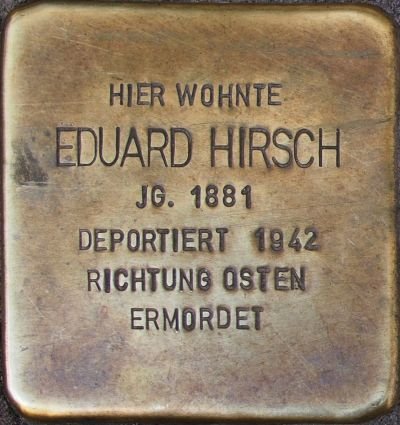
The Stolperstein (“stumbling stone”) dedicated to Eduard Hirsch in Mainz, Germany, is a subtle yet profoundly moving memorial that connects visitors directly to the personal stories underlying the Holocaust. Stolpersteine are brass plaques embedded in sidewalks across Europe, each commemorating a victim of Nazi persecution at their last freely chosen residence. Eduard Hirsch’s stone is located in Mainz’s historic Altstadt district, serving as both a tribute to individual memory and a gateway to the broader history of Mainz’s Jewish community. This guide provides detailed information for visitors, including location, accessibility, visiting hours, travel tips, and insights into the Stolperstein project’s historical and cultural significance (Haus des Erinnerns Mainz, Smithsonian Folklife Magazine, Stolpersteine Mainz).

Early Life and Jewish Community in Mainz
Eduard Hirsch was a member of Mainz’s once-thriving Jewish community, which, by the early 1930s, numbered nearly 2,700 and contributed significantly to the city’s cultural and economic life. Mainz’s Jewish heritage is centuries old, and the Stolpersteine project helps preserve the memory of individuals like Hirsch, highlighting the city’s diverse and resilient history (Haus des Erinnerns – für Demokratie und Akzeptanz).
Impact of National Socialism and Nazi Persecution
The rise of the Nazi regime in 1933 drastically altered life for Jews in Mainz. Systematic anti-Semitic laws, social exclusion, and violent events such as the Kristallnacht pogrom of 1938 devastated the Jewish community. Many, including Eduard Hirsch, faced dispossession, deportation, and ultimately, murder. The Stolperstein for Hirsch stands as a quiet yet powerful reminder of these individual and collective tragedies.
Visiting the Eduard Hirsch Stolperstein
Location and Accessibility
- Address: Lotharstraße 5, 55116 Mainz, Germany
(Stolpersteine Mainz Biography) - GPS Coordinates: Approximately 49.9981° N, 8.2747° E
- District: Altstadt (Old Town), near the Rhine riverfront and Gutenberg Museum (Mainz Tourist Map)
- Accessibility: The Stolperstein is embedded flush with the pavement at the building entrance. Sidewalks are generally flat and wheelchair accessible, though some cobblestones may be uneven.
Travel Tips:
- By Train: Mainz Hauptbahnhof (Central Station) is about 1 km away; walk, take a bus, or tram.
- By Car: Limited street parking; use nearby public garages such as Parkhaus Theater or Parkhaus Kronberger Hof.
- By Bicycle: Bike racks are available along the street.
Visiting Hours and Tickets
Stolpersteine are public memorials open 24/7, with no admission fees or ticket requirements. Visitors are encouraged to come during daylight hours for safety and to better view the inscription.
Guided Tours and Special Events
Local organizations, including the Haus des Erinnerns, offer guided tours focused on Stolpersteine and Jewish history in Mainz. These tours provide valuable context and often include other important sites. For schedules and booking, check their official websites or contact them directly.
Public cleaning ceremonies and remembrance events are held on significant dates, such as International Holocaust Remembrance Day (January 27) and the anniversary of Kristallnacht (November 9), where locals and visitors come together to clean and honor the Stolpersteine.
Nearby Historical Sites
Enhance your visit by exploring:
- New Synagogue Mainz (Synagogenplatz): A symbol of the Jewish community’s resilience.
- Jewish Museum Mainz: Exhibitions on Jewish life and history.
- Mainz Cathedral (Mainzer Dom): A Romanesque landmark with over 1,000 years of history.
- Gutenberg Museum: Celebrating Mainz’s most famous inventor.
- Jewish Cemetery: One of the oldest in Europe, reflecting centuries of history.
A downloadable list of all Stolpersteine in Mainz is available for self-guided remembrance walks.
Photography and Etiquette
- Photography: Allowed, but be discreet and avoid blocking pedestrian traffic. Share images with educational context to honor the memorial’s purpose.
- Respectful Behavior: Avoid standing or walking directly on the stone. Take a moment to pause, reflect, and read the inscription. Cleaning the plaque with water and a soft cloth is a meaningful gesture if you wish to participate in remembrance.
- Language: Inscriptions are in German; translations and biographies are available online (Stolpersteine Mainz Biographies).
Frequently Asked Questions (FAQ)
Q: Are there admission fees or specific visiting hours?
A: No, Stolpersteine are accessible 24/7 and are free to visit.
Q: How do I find the Stolperstein for Eduard Hirsch?
A: It is located at Lotharstraße 5, Altstadt, Mainz. GPS coordinates and maps are available online.
Q: Are guided tours available?
A: Yes, contact the Haus des Erinnerns or similar local organizations for schedules.
Q: Can I participate in cleaning or remembrance events?
A: Yes, public cleaning events are held throughout the year. Check with local groups for event dates.
Q: Is the Stolperstein accessible for wheelchair users?
A: Yes; sidewalks are generally accessible, but use caution on historic cobblestones.
Discover More
Plan your visit to the Eduard Hirsch Stolperstein and explore Mainz’s historical sites. For guided tours and more detailed historical insights, download the Audiala app. Stay connected via our website and social media channels for updates on remembrance events and educational resources.
Listen to the full story in the app
The whole Stolperstein Dedicated To Eduard Hirsch,
told well.
Audio guides for 1,100+ cities across 96 countries. History, stories, and local insight — offline ready.
Verified, and shown.
Researched and written by the Audiala editorial team from historical records, architectural archives, and local expertise.
Researched from Wikidata, Wikipedia & official sources · fact-checked · How we make our guides →