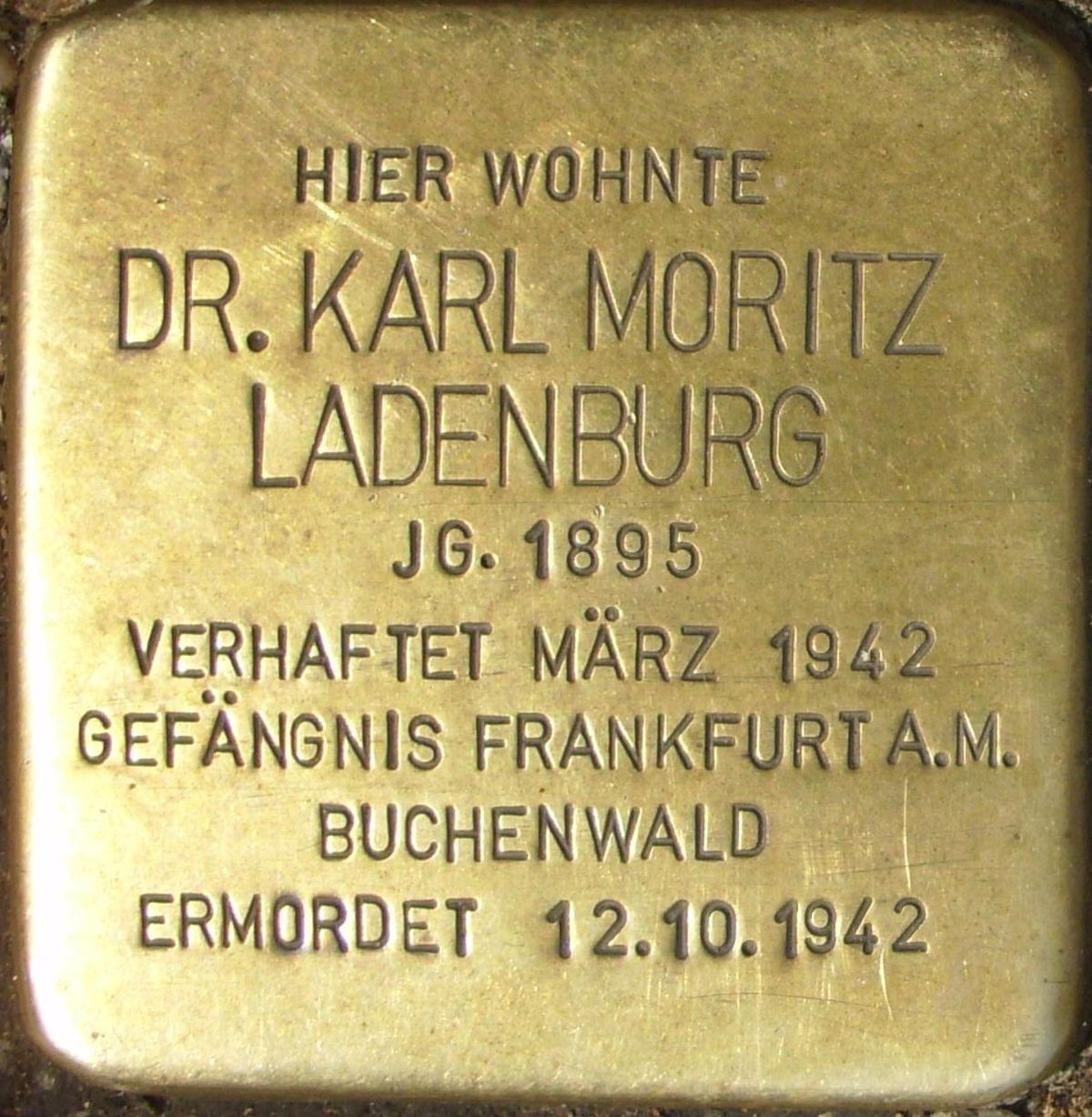
Plan and listen to Stolperstein Dedicated To Dr. Karl Moritz Ladenburg with Audiala.
Audio guide in your pocket, itinerary in your browser. Built for the way you actually visit.
Introduction
The Stolperstein dedicated to Dr. Karl Moritz Ladenburg in Mainz stands as a solemn tribute to the lives lost during the Holocaust and serves as a poignant marker of the city’s Jewish heritage. Stolpersteine—small, brass-plated cobblestones embedded in sidewalks—are part of an expansive memorial project initiated by artist Gunter Demnig in 1992. Today, there are over 100,000 Stolpersteine in more than 1,800 cities across Europe, making this the world’s largest decentralized remembrance initiative (Stolpersteine.eu).
Dr. Ladenburg’s memorial is located at his last freely chosen residence on Kaiserstraße 11, Mainz. This guide offers comprehensive visitor information—including practical tips, historical context, accessibility, and suggestions for deeper engagement—helping you honor his memory and better understand the wider significance of the Stolpersteine project.

Historical Context and Cultural Significance
Stolpersteine Project in Germany
Conceived by Gunter Demnig, the Stolpersteine project commemorates individuals persecuted or murdered by the Nazi regime—Jews, Roma, Sinti, political dissidents, LGBTQ+ people, and others. Each Stolperstein is engraved with the victim’s name, birthdate, fate, and, if known, the date and place of death. In Mainz, the project began in 2005, and as of 2025, over 350 Stolpersteine have been installed (Mainz.de).
Dr. Karl Moritz Ladenburg: Life and Tragedy
Born in 1882, Dr. Karl Moritz Ladenburg was a respected Jewish physician and community leader in Mainz. After the Nazis came to power, he faced escalating discrimination, lost his medical license under the Nuremberg Laws, and was eventually deported to Theresienstadt, where he perished in 1943. His Stolperstein, at Kaiserstraße 11, personalizes the vast tragedy of the Holocaust and anchors the memory of Mainz’s once-vibrant Jewish community (Stolpersteine Mainz).
Symbolism and Memorial Function
Unlike large, centralized monuments, Stolpersteine are located at street level in front of victims’ former homes. This approach personalizes remembrance, prompting daily engagement from passersby and integrating memory into everyday urban life (Deutsche Welle). The act of bowing one’s head to read an inscription is both intimate and public, reinforcing a culture of active remembrance.
Community Engagement and Educational Impact
Local initiatives, often involving schools, historians, and family descendants, drive the Stolpersteine installations in Mainz. The project fosters intergenerational dialogue and is supported by educational programs, such as those run by the Haus des Erinnerns – Für Demokratie und Akzeptanz (Haus des Erinnerns). Ceremonial cleaning, laying flowers or stones, and guided memorial walks are customary acts of remembrance.
Visitor Information
Location and How to Get There
- Address: Kaiserstraße 11, 55116 Mainz, Germany
- Nearest Transport: Mainz Hauptbahnhof (main station) is a 10-minute walk. The area is served by multiple trams and buses.
- Accessibility: The Stolperstein is on a public sidewalk and is wheelchair accessible.
Visiting Hours and Tickets
- Stolpersteine are public memorials and can be visited 24/7, free of charge.
- No tickets or reservations are required.
- For optimal visibility, visit during daylight hours.
Best Times and Etiquette
- Early morning or late afternoon offers a quieter, more contemplative experience.
- Pause to read the inscription; leaving a small stone or flower is encouraged, reflecting Jewish mourning traditions.
- Photography is permitted—please be discreet and respectful of local residents.
Accessibility
- The Stolperstein is at ground level and accessible to visitors with mobility challenges.
- Nearby museums and memorial institutions typically offer barrier-free access; check individual websites for details (Mainz.de Barrier-Free Info).
Enhancing Your Visit
Guided Tours and Educational Walks
- Mainz Tours offers guided walking tours covering Stolpersteine and Jewish history. Advance booking recommended for groups.
- The Haus des Erinnerns provides educational programs and exhibitions on Mainz’s Jewish heritage.
Museums and Memorial Institutions
- Haus des Erinnerns – Für Demokratie und Akzeptanz (Flachsmarktstraße 36): Open Tuesday–Sunday, 10:00–18:00, admission free.
- Landesmuseum Mainz: Open Tuesday–Sunday, 10:00–17:00, tickets €7 (adults), reduced €5, children under 18 free.
- Stadthistorisches Museum Mainz: Open Tuesday–Sunday, 10:00–18:00, admission generally free.
Check individual museum websites for updates on hours and exhibitions.
Related Historical Sites
- Mainz Synagogue: Modern architectural landmark, important center of Jewish life.
- Haus des Erinnerns: Key remembrance and educational hub.
- Mainz Cathedral (St. Martin’s): Iconic Romanesque-Gothic building.
- Gutenberg Museum: World-famous museum celebrating printing heritage.
- Judensand Cemetery: The oldest Jewish cemetery in Europe, part of the UNESCO SchUM World Heritage (SchUM Sites).
Frequently Asked Questions (FAQ)
Q: Is there a ticket required to visit the Stolperstein for Dr. Karl Moritz Ladenburg?
A: No, the Stolperstein is a public memorial accessible at all times, free of charge.
Q: What are the opening hours for nearby museums?
A: Most museums are open Tuesday–Sunday, 10:00–17:00 or 18:00. Confirm on their official websites.
Q: Is the site accessible for visitors with disabilities?
A: Yes, the Stolperstein is on public sidewalks and accessible. Nearby institutions also provide barrier-free access.
Q: Are guided tours available?
A: Yes, organizations such as Mainz Tours and the Haus des Erinnerns offer guided walks focusing on Stolpersteine and Jewish heritage.
Q: Can I take photographs?
A: Photography is permitted. Please be discreet and respectful.
Suggested Itinerary
- Start at the Stolperstein for Dr. Karl Moritz Ladenburg at Kaiserstraße 11.
- Use the Stolpersteine Mainz directory or apps to explore other nearby stones.
- Visit the Haus des Erinnerns for exhibitions and educational materials.
- Explore the Landesmuseum Mainz and the Judensand cemetery to further connect with Mainz’s Jewish heritage.
- Join a guided tour for in-depth historical context.
Discover More
The Stolperstein for Dr. Karl Moritz Ladenburg in Mainz is more than a memorial; it is an invitation to remember, reflect, and engage with the city’s layered history. By visiting, participating in guided walks, exploring digital resources, and supporting local remembrance projects, you contribute to an enduring culture of memory and civic responsibility.
Enhance your visit by downloading recommended apps, reviewing educational materials, and connecting with local institutions for special events and programming. Each Stolperstein tells a story—through remembrance, these stories continue to shape our present and future.
Listen to the full story in the app
The whole Stolperstein Dedicated To Dr. Karl Moritz Ladenburg,
told well.
Audio guides for 1,100+ cities across 96 countries. History, stories, and local insight — offline ready.
Verified, and shown.
Researched and written by the Audiala editorial team from historical records, architectural archives, and local expertise.
Researched from Wikidata, Wikipedia & official sources · fact-checked · How we make our guides →