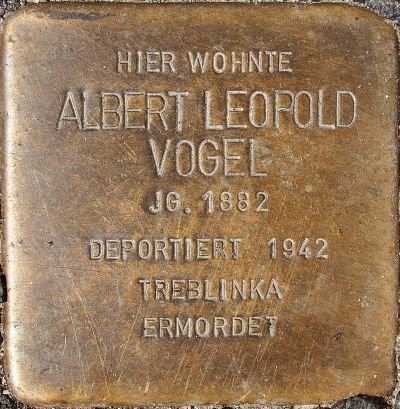
Plan and listen to Stolperstein Dedicated To Albert Leopold Vogel with Audiala.
Audio guide in your pocket, itinerary in your browser. Built for the way you actually visit.
Introduction
The Stolpersteine project, launched by German artist Gunter Demnig in 1992, is the world’s largest decentralized memorial, commemorating victims of the Nazi regime through small brass-plated cobblestones embedded in sidewalks. Each Stolperstein (“stumbling stone”) is placed in front of the last freely chosen residence of a victim, transforming public spaces into sites of personal remembrance. In Mainz—a city with a vibrant yet tragic Jewish history—over 350 Stolpersteine have been installed, including those dedicated to Albert Leopold Vogel and his wife Marie. Their stones, located at Diether-von-Isenburg-Straße 11, were initiated by their daughter, Yael Avner, as a deeply personal act of commemoration (Stolpersteine Mainz; Haus des Erinnerns Mainz; Waymarking: Albert Leopold und Marie Vogel; Stolpersteine.eu).
Visiting the Stolperstein for Albert Leopold Vogel offers a unique way to connect with Mainz’s past, providing an intimate window into the lives disrupted by persecution. The memorials are freely accessible at all hours and are supported by local organizations such as the Verein für Sozialgeschichte Mainz e.V. and Haus des Erinnerns – für Demokratie und Akzeptanz. These groups coordinate research, educational outreach, and commemorative events, ensuring the ongoing relevance and preservation of these important sites.
This guide details everything you need to know for a respectful and meaningful visit to the Albert Leopold Vogel Stolperstein, including practical information, historical context, accessibility tips, and opportunities for deeper engagement with Mainz’s remembrance culture.

Stolpersteine: Memorializing Victims of the Holocaust
What Are Stolpersteine?
Stolpersteine are 10x10 cm brass-plated cobblestones, each inscribed with the name, birth date, fate, and, if known, death place of a victim. They are installed at the victim’s last freely chosen home or workplace, making remembrance part of everyday urban life. The act of bending to read a Stolperstein is itself a gesture of respect.
The Project’s Expansion and Impact
Since the first Stolperstein was laid in Cologne, the project has grown to over 107,000 stones in 31 countries by 2024, commemorating Jews, Sinti and Roma, LGBTQ+ individuals, political dissidents, and others persecuted by the Nazis (Stolpersteine.eu; Wikipedia: Stolperstein). While some cities have debated the appropriateness of memorials on the ground, Stolpersteine remain a powerful, decentralized tool for remembrance.
Stolpersteine in Mainz: Local Context and Community Involvement
Mainz’s Stolpersteine are the result of collaboration between local historians, city authorities, descendants, and remembrance organizations. The Verein für Sozialgeschichte Mainz e.V. and Haus des Erinnerns coordinate research, maintenance, and community outreach. Biographies are carefully researched and verified, often involving family consultations and archival work (Stolpersteine Foundation; Stolpersteine Mainz).
Educational programs for schools, public installation ceremonies, and annual remembrance events—often on Holocaust Remembrance Day—keep the project vibrant. Volunteers and school groups help maintain the stones, and guided walking tours deepen public engagement (Mainz Stadtführungen).
The Stolperstein for Albert Leopold and Marie Vogel: Historical Significance
Albert Leopold Vogel (b. 1882) and Marie Vogel (née Eisenmann, b. 1895) were deported from Mainz to Treblinka in 1942, where they were murdered. Their Stolpersteine, installed on September 11, 2010, were requested by their daughter, Yael Avner (Waymarking: Albert Leopold und Marie Vogel). These stones stand as both a personal and collective memorial, rooted in the heart of Mainz’s historical landscape.
Visitor Information
Location and Getting There
- Address: Diether-von-Isenburg-Straße 11, Mainz, Germany
- Access: The Stolperstein is a short walk from Mainz Hauptbahnhof (Central Station) and conveniently located within the city center, making it easy to include in a walking tour of Mainz’s Jewish heritage sites.
Visiting Hours and Tickets
- Hours: Open 24/7 as part of the public sidewalk
- Tickets: No admission fee; free for all visitors
Accessibility
- The Stolperstein is embedded in the pavement. Most are accessible to wheelchair users, though some streets in the old town are uneven or cobblestoned. Visitors with mobility challenges should consult maps or tour organizers for accessible routes.
Etiquette and Visitor Tips
- Reflect and Pause: Spend a quiet moment at the stone, reading the inscription and reflecting on the individual’s story.
- Do Not Stand on Stones: Avoid stepping directly on the Stolperstein.
- Leave a Token: Placing a small stone or flower is a traditional sign of respect.
- Photography: Permitted, but should be discreet and respectful.
- Clean the Stone: Gently polishing the stone with a soft cloth is a way to honor the memory, especially on remembrance days (pragueviews.com).
- Respect Residents: Be mindful of those living nearby and avoid loud conversation or disruptive behavior.
Guided Tours and Community Remembrance
Local organizations, such as Gästeführerverband Mainz e.V., offer guided tours that include multiple Stolpersteine and related Jewish heritage sites. These tours provide valuable historical context and can be booked in advance (Mainz Stadtführungen).
Annual ceremonies mark new installations and commemorative dates, often featuring readings, music, and moments of silence. Public participation is encouraged and deepens the connection to the city’s history.
Nearby Attractions and Suggested Itinerary
While visiting the Stolperstein for Albert Leopold Vogel, consider exploring:
- Mainz Cathedral (Mainzer Dom)
- Gutenberg Museum
- Jewish Museum of Mainz
- Other Stolpersteine within walking distance
Combining these sites can provide a comprehensive understanding of Mainz’s historical and cultural landscape.
Frequently Asked Questions (FAQ)
Where can I find more Stolpersteine in Mainz?
Maps and online databases list all Stolpersteine in Mainz, including addresses and biographical information (Stolpersteine Mainz database).
Are Stolpersteine accessible at night?
Yes, but daytime visits are recommended for safety and visibility.
Are guided tours available in English?
Some tours are offered in English; check with local organizations or the tourist office.
Is the site wheelchair accessible?
Most Stolpersteine are on public sidewalks, but some streets have cobblestones. Plan routes accordingly.
Can I take photos?
Yes, but do so respectfully and avoid photographing residents without consent.
Listen to the full story in the app
The whole Stolperstein Dedicated To Albert Leopold Vogel,
told well.
Audio guides for 1,100+ cities across 96 countries. History, stories, and local insight — offline ready.
Verified, and shown.
Researched and written by the Audiala editorial team from historical records, architectural archives, and local expertise.
Researched from Wikidata, Wikipedia & official sources · fact-checked · How we make our guides →