Plan and listen to Stolperstein Dedicated To Albert Gerson with Audiala.
Audio guide in your pocket, itinerary in your browser. Built for the way you actually visit.
Introduction
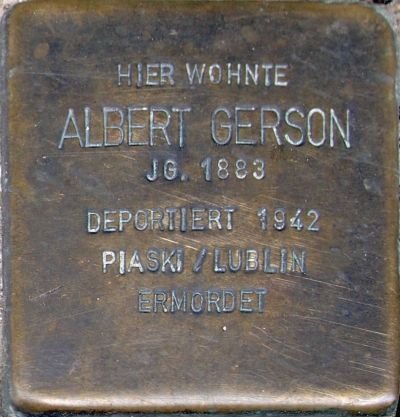
Mainz, Germany, is renowned for its deep Jewish heritage and commitment to Holocaust remembrance. Among its many poignant memorials, the Stolperstein dedicated to Albert Gerson stands out as a significant site of memory. Stolpersteine—“stumbling stones”—are small brass plaques set into sidewalks across Europe, each remembering an individual victim of Nazi persecution at their last freely chosen residence. Initiated by artist Gunter Demnig in 1992, this decentralized memorial project is now the world’s largest, weaving personal stories into the urban landscape and inviting passersby to pause, reflect, and remember (Folklife Magazine, Leo Baeck Institute).
This guide provides detailed information for visiting the Albert Gerson Stolperstein in Mainz, including historical context, practical visitor details, cultural significance, and connections to other Jewish heritage sites throughout the city.

Origins and Purpose of the Stolpersteine Project
The Stolpersteine project began in 1992 when Gunter Demnig installed the first plaque in Cologne to memorialize Sinti and Roma victims of the Nazis. In 1993, Demnig expanded the concept by placing brass plaques at the last known residences of Holocaust victims, personalizing remembrance and rooting it in everyday spaces (Folklife Magazine, Leo Baeck Institute).
Today, Stolpersteine honor Jews, Sinti and Roma, Black Germans, Jehovah’s Witnesses, LGBTQ+ individuals, people with disabilities, and others persecuted under National Socialism (Folklife Magazine). The project’s decentralized philosophy ensures that memory is not confined to a single monument but is encountered throughout daily life.
Design, Installation, and Symbolism
Each Stolperstein is a hand-crafted, 10x10 cm brass plaque inscribed with the victim’s name, date of birth, fate, and, if known, date and place of death. The stones are installed at ground level, requiring visitors to pause and engage closely with each story (Folklife Magazine). As the project has expanded, artists in Berlin now produce hundreds of stones monthly, with over 70,000 installed in more than two dozen countries by 2024 (Leo Baeck Institute).
The project's name—“stumbling stones”—is metaphorical, meant to prompt reflection rather than physical tripping.
Stolpersteine in Mainz: Local Context and Visitor Guidance
Mainz’s sidewalks are dotted with Stolpersteine, each marking the last address of a persecuted resident. The Albert Gerson Stolperstein is located at Ludwig-Nauth-Straße B, in the Hartenberg-Münchfeld district (Mapcarta). Other notable stones in the city commemorate figures such as Betty Gerson and Selma Zacharias.
For a full directory and biographies, consult the Stolpersteine Mainz website.
Visiting Hours and Accessibility
Stolpersteine are in public spaces and accessible 24/7, free of charge. No ticket is required. The sidewalks are generally suitable for visitors with mobility aids, but standard urban conditions apply.
Guided and Self-Guided Tours
Organizations in Mainz offer guided Stolpersteine tours, providing historical context and personal stories. For independent exploration, the Stolpersteine Guide app offers maps, biographies, and audio guides.
Combine your visit with other city sites, such as the Mainz Cathedral or the Gutenberg Museum, for a deeper cultural experience.
Visiting Etiquette
- Approach the site with respect and quiet reflection.
- Do not step directly on the plaques if possible.
- Photography is allowed but should be discreet.
- Placing small stones or flowers is a traditional gesture of remembrance.
Historical Background: Albert Gerson and the Jewish Community of Mainz
Albert Gerson was a Jewish butcher who lived in Mainz before the Holocaust. Married to Betty, niece of Jakob Lorch, he was part of a vibrant Jewish community until the rise of National Socialism. The Gerson-Lorch family ran a butcher shop and contributed to Mainz’s social and economic life. Under Nazi rule, they, like many Jewish families, faced discrimination, forced business closures, and eventual deportation (stolpersteine-mainz.de).
Mainz’s Jewish history extends back to the 10th century, with the city forming part of the SchUM cities—an intellectual and spiritual hub of Ashkenazi Judaism (rheinhessen.de). The community thrived and endured cycles of prosperity and persecution until the devastation of the Holocaust (mainz-tourismus.com, stripes.com).
Related Jewish Heritage Sites in Mainz
- Jewish Museum Mainz: Exhibits on Jewish life and Holocaust remembrance.
- Judensand Cemetery: One of Europe’s oldest Jewish cemeteries, with tombstones dating from the 11th century.
- Heunen Column and Jewish Quarter: Historic monuments and commemorative sites.
- Albert Gerson Memorial in Mainz-Bretzenheim: Honors the broader Gerson-Lorch family and their role in Mainz’s history.
Most sites are accessible, with the Jewish Museum open Tuesday to Sunday, 10:00 AM–5:00 PM (adults: €5; discounts for students/seniors). Judensand Cemetery is open daily, dawn to dusk, and free (mainz.de).
Community Involvement and Remembrance Rituals
Each Stolperstein is sponsored, often by local residents, organizations, or descendants, at a cost of about €120. Community members and volunteers participate in historical research and the ritual cleaning of stones on remembrance days such as January 27 (International Holocaust Remembrance Day) and November 9 (Kristallnacht anniversary) (Folklife Magazine). This fosters a living connection between past and present.
Controversies and Discussions
Some critics argue that placing memorials in sidewalks can be disrespectful, as the plaques may be stepped on or become dirty. Munich, for example, has banned Stolpersteine on public streets, opting for wall plaques instead (Leo Baeck Institute). Supporters maintain that encountering these stones in daily life is a powerful act of remembrance.
Practical Visitor Tips and Nearby Attractions
- Comfortable Shoes: Urban terrain may be uneven, especially near the Judensand Cemetery.
- Accessibility: Most sites, including the Albert Gerson Stolperstein, are wheelchair accessible.
- Public Transport: Mainz is well-connected, with bus and tram stops near major heritage sites.
- Nearby Attractions: Mainz Cathedral, Rhine River promenade, and the Gutenberg Museum are all within walking distance.
Frequently Asked Questions (FAQ)
What are Stolpersteine?
Small brass plaques commemorating individuals persecuted by the Nazis, installed at their last chosen residence.
Where can I find Stolpersteine in Mainz?
They are located throughout the city. A searchable map is available via the Stolpersteine Mainz directory.
Are guided tours available?
Yes. Book through local organizations or use the Stolpersteine Guide app for self-guided options.
Is there a fee to visit Stolpersteine?
No. They are in public spaces and accessible at all times.
How can I support the project?
Sponsor a stone, volunteer for research, or participate in remembrance events. More information is available on the Stolpersteine Mainz website.
Listen to the full story in the app
The whole Stolperstein Dedicated To Albert Gerson,
told well.
Audio guides for 1,100+ cities across 96 countries. History, stories, and local insight — offline ready.
Verified, and shown.
Researched and written by the Audiala editorial team from historical records, architectural archives, and local expertise.
Researched from Wikidata, Wikipedia & official sources · fact-checked · How we make our guides →