Plan and listen to Stolperstein Dedicated To Elsa Berta Müller with Audiala.
Audio guide in your pocket, itinerary in your browser. Built for the way you actually visit.
Introduction: Remembering Elsa Berta Müller in Freiburg
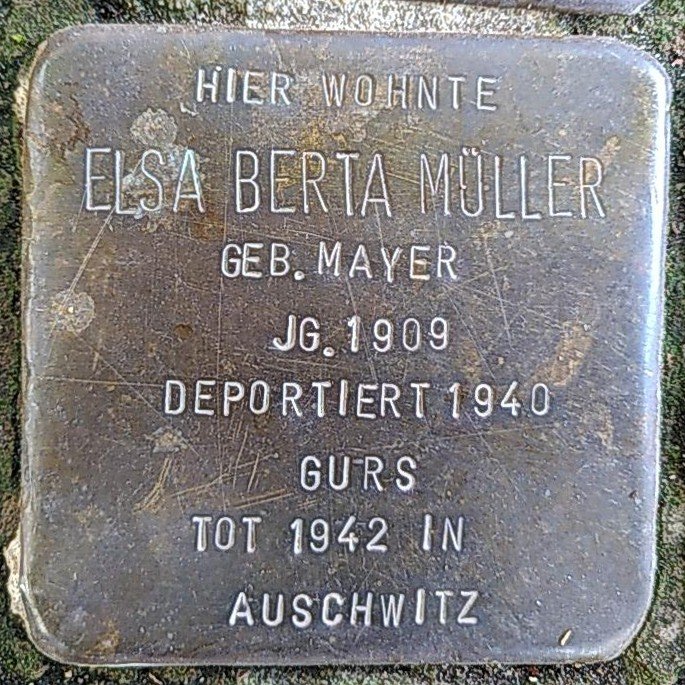
In the heart of Freiburg im Breisgau, Germany, the Stolperstein dedicated to Elsa Berta Müller stands as a poignant reminder of the city’s vibrant yet disrupted Jewish community. This brass-plated “stumbling stone,” part of Gunter Demnig’s internationally renowned Stolpersteine project, marks the last freely chosen residence of Elsa Berta Müller—restoring her name and story to the public sphere. As one of over 100,000 memorial stones across Europe, Elsa’s Stolperstein is both a personal tribute and a call to collective remembrance, inviting visitors to reflect upon the Holocaust’s enduring impact on Freiburg and beyond.
This comprehensive guide provides historical context, practical visiting information, and insights into the broader significance of the Stolperstein project in Freiburg. It also highlights nearby heritage sites and offers tips for meaningful engagement, ensuring your visit is both informative and respectful (Stolpersteine in Freiburg, Germany.info, Denkmalprojekt: Deportation 1940).

Historical Background: The Stolpersteine Project
Initiated in 1992 by German artist Gunter Demnig, the Stolpersteine (“stumbling stones”) project is the world’s largest decentralized memorial to victims of Nazi persecution. Each 10x10 cm stone, topped with a brass plate, is inscribed with a victim’s name, birth date, fate, and, when known, their place and date of death. The stones are embedded in sidewalks outside the last freely chosen residences of those persecuted—Jews, Sinti and Roma, political dissidents, LGBTQ+ individuals, and others—making memory a visible part of daily life (Folklife Magazine, Germany.info, Wikipedia).
In Freiburg, the project began in 2002, led by local activist Marlis Meckel. As of 2025, over 480 Stolpersteine have been installed throughout the city, each honoring an individual story and fostering ongoing dialogue about history and memory (Stolpersteine in Freiburg).
Elsa Berta Müller: Life and Family
Elsa Berta Müller, née Mayer, was a Jewish resident of Freiburg. She lived with her family—including Arthur and Blandine Müller, who are also commemorated with Stolpersteine nearby—at Elsässerstraße 35a in the Stühlinger district (Mapcarta: Jüdischer Friedhof, Wikimedia Commons: Stolpersteine for the Müller Family). While detailed early biographical data is scarce, the Stolperstein ensures that Elsa’s name and memory endure in the public consciousness.
The Wagner-Bürckel Aktion: Deportation and Persecution
On October 22, 1940, as part of the Wagner-Bürckel Aktion, Elsa Berta Müller and her family, along with over 6,500 Jews from Baden, Saarland, and the Palatinate, were deported by the Nazi regime. Among them were 375 Jews from Freiburg. They were sent to the Gurs internment camp in southern France, where harsh conditions awaited (Denkmalprojekt: Deportation 1940). The Stolperstein for Elsa Berta Müller marks her last freely chosen home, preserving her story and the tragedy faced by Freiburg’s Jewish community.
Location and Visiting Information
Address
Elsässerstraße 35a, 79110 Freiburg im Breisgau, Germany
Located in the Stühlinger district, near Freiburg’s Jewish Cemetery and easily accessible from the city center (Stolpersteine in Freiburg).
Visiting Hours and Admission
- Publicly accessible 24/7; no admission fee or ticket required.
- Stolpersteine are embedded in the sidewalk; visitors can pay their respects at any time.
How to Get There
- Public Transport: Freiburg’s tram and bus network provides easy access; the nearest tram stop is a short walk away.
- On Foot: A 15–20 minute walk from the city center.
- Maps & Guidance: Use official resources or GPS-enabled apps for directions.
Accessibility
- The sidewalk at Elsässerstraße 35a is generally accessible, though some uneven pavement may exist.
- The Jewish Cemetery nearby is open daily from 8:00 AM to 6:00 PM (free entry).
Cultural Significance and Community Involvement
Personal and Collective Remembrance
Stolpersteine personalize Holocaust memory by marking the places where victims lived, turning abstract statistics into individual stories. The inscription typically reads:
“Hier wohnte Elsa Berta Müller, geb. Mayer …”
(“Here lived Elsa Berta Müller, née Mayer …”)
Educational and Social Impact
In Freiburg, local residents, schools, and organizations sponsor and maintain Stolpersteine, ensuring the stones remain visible and their stories alive. Public ceremonies, especially on Holocaust Remembrance Day (January 27) and Kristallnacht (November 9), further reinforce the collective commitment to remembrance (Folklife Magazine).
Controversy and Dialogue
While Stolpersteine are widely embraced, some debate surrounds their placement “underfoot.” Critics worry this may be disrespectful, but many see it as a powerful integration of memory into everyday life (Leo Baeck Institute). In Freiburg, the project enjoys strong community support.
Practical Visitor Tips
- Pause and Reflect: Take a moment to read the inscription and reflect on Elsa Berta Müller’s life.
- Do Not Stand Directly on the Stone: Out of respect, avoid stepping directly on the Stolperstein.
- Photography: Allowed and encouraged if done respectfully.
- Attend a Guided Tour: Local organizations and the Tourist Information office offer guided and self-guided tours focusing on Jewish heritage and Stolpersteine (Freiburg Tourist Information).
- Participate in Community Events: Cleaning and remembrance events are held annually.
Frequently Asked Questions (FAQ)
Q: Where is Elsa Berta Müller’s Stolperstein?
A: Elsässerstraße 35a, 79110 Freiburg im Breisgau, in the sidewalk outside her former residence.
Q: Are there visiting hours or fees?
A: No; Stolpersteine are accessible at all times, free of charge.
Q: Is the site wheelchair accessible?
A: Generally yes, though some sidewalk unevenness may exist.
Q: Can I take photographs?
A: Yes, respectful photography is permitted.
Q: Are guided tours available?
A: Yes, through local organizations and the Tourist Information office.
Listen to the full story in the app
The whole Stolperstein Dedicated To Elsa Berta Müller,
told well.
Audio guides for 1,100+ cities across 96 countries. History, stories, and local insight — offline ready.
Verified, and shown.
Researched and written by the Audiala editorial team from historical records, architectural archives, and local expertise.
Researched from Wikidata, Wikipedia & official sources · fact-checked · How we make our guides →