
Garmisch-Partenkirchen
District of Garmisch-PartenkirchenGermany 47° N · 11° E Updated May 2026
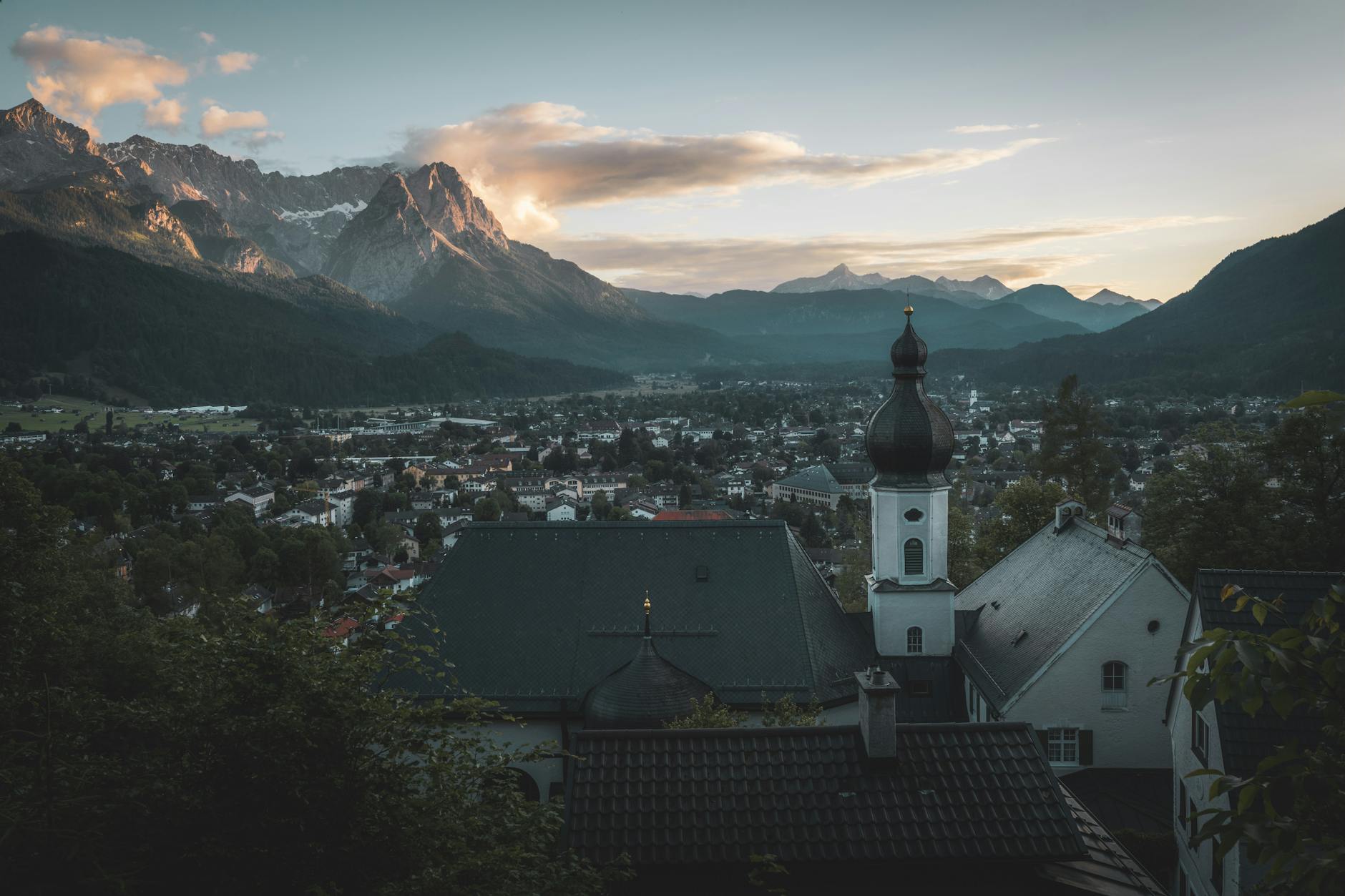
Two Bavarian towns were forced into one in 1935; today Garmisch-Partenkirchen feels split, with a Roman road on one side and Olympic ghosts on the other.
 Photo: Milei.vencel · CC BY-SA 4.0
- Time needed
- Half day
- Entry
- Free to wander town; attractions priced separately
Why does one Alpine resort still argue with itself nearly a century after it was welded together on paper? Garmisch-Partenkirchen, in the district of Garmisch-Partenkirchen, Germany, rewards a visit because the pretty facades, onion domes, and mountain light hide a harder story about Roman roads, witch fires, and a town the Nazis forced into existence. Today you walk from frescoed houses along Ludwigstrasse to the rush of the Partnach, with church bells bouncing off the limestone walls of the Wetterstein and the smell of wood smoke hanging in cold air.
What most visitors see first is postcard Bavaria done almost suspiciously well: painted shutters, deep eaves, cafe tables, peaks that look close enough to touch. But the place feels better when you stop treating it as a ski resort with extra history and start reading it as two stubborn towns, each still keeping score.
Partenkirchen grew along a Roman trade route, and Ludwigstrasse still follows that old line through the valley like a memory that refused to move. Garmisch developed differently, more agrarian, more local, and that split still shapes festivals, dialect, and pride in ways outsiders usually miss.
Come for the mountain air if you want. Stay for the friction. Few Alpine towns let you see so plainly how beauty, fear, faith, and political coercion can all leave marks on the same street.
What to see
-
Ludwigstrasse and the Painted Face of Partenkirchen
Partenkirchen keeps its best trick in plain sight: Ludwigstrasse still follows the Roman road of Partanum, and the houses along it behave like a fresco gallery that forgot to charge admission. Cobblestones click under your shoes, painted saints lean from facades, and trompe-l'oeil columns fake a grandeur that turns sly when you stand close enough to catch the brushwork; once you start reading the Lüftlmalerei as messages about trade, faith, and family pride, the street stops being pretty and starts talking. -
Partnach Gorge
Partnachklamm feels less like a walk than an argument with water. The gorge runs about 700 meters and drops to 80 meters deep, roughly the height of a 25-storey building, while the river hammers the rock at a volume said to reach 100 decibels, loud as standing beside a club speaker; your sleeves catch the spray, the tunnel walls sweat cold against your hand, and the glacial water flashes turquoise below the iron railings. Go early or late. Gold light slips into the fissure then, and if you climb to the Eiserne Brücke above, you get the view most visitors miss: the whole crack in the mountain opening beneath your feet. -
Museum Werdenfels to Marienplatz
Start at Museum Werdenfels on Ludwigstrasse 47, because the town hides one of its best shocks indoors: the original Zugspitze summit cross, 150 kilograms of painted iron, waits here in a gallery instead of on the mountain everyone photographs. The museum's 2019 extension by Atelier Lüps creaks underfoot by design, blue-grey light cools the staircase like metal, and the bridge to the oriel frames the Zugspitze with almost theatrical nerve; then walk on to Marienplatz, where the baroque Neue Kirche, completed in 1752 with stone taken from ruined Werdenfels Castle, turns the region's harder history into masonry you can still see.
Plan your visit
- Getting There
- Munich Hbf is the cleanest approach: hourly regional trains reach Garmisch-Partenkirchen in about 1 hour 20 minutes, and the Zugspitzbahnhof for the cogwheel train sits roughly 200 meters west of the main station, about the length of two train carriages. By road, take the A95 south to its end and continue on the B2 via St.-Martin-Straße; for Zugspitze and Eibsee, arrive before 10:00 on sunny days because the single access road clogs fast.
- Opening Hours
- As of 2026, Garmisch-Partenkirchen itself is always open, but the places people actually come for keep mountain hours: Partnach Gorge runs 08:00-20:00 from June to September and 08:00-18:00 from October to May, with last entry 30 minutes before closing. The Zugspitze cable car from Eibsee runs 08:30-16:45, usually at least every 30 minutes, and weather can shut both gorge and mountain operations without much romance.
- Time Needed
- Give the town itself half a day if you want Ludwigstraße, Mohrenplatz, and the Olympic area without sprinting past the good bits. Partnach Gorge needs 1.5 to 2 hours, while Zugspitze works best with 4 to 6 hours; if you want summit, gorge, and a proper old-town wander, 2 to 3 days feels right.
- Accessibility
- As of 2026, Bayerische Zugspitzbahn parking areas include marked accessible spaces, and parking fees are waived for holders of a German disabled parking permit who also buy a mountain-railway ticket. Partnach Gorge is the problem child: the path is narrow, wet, uneven, and cut through rock tunnels, so wheelchair access is not realistic and closures after rain, ice, or rockfall happen.
- Cost And Tickets
- As of 2026, a round-trip Zugspitze ticket costs 78 euros for adults in summer and 69 euros in winter; the 2-Peak Pass covering Zugspitze plus Garmisch-Classic or Wank costs 93.50 euros in summer. Children under 6 ride free with a parent, dogs cost 7 euros, and some Deutsche Bahn tickets earn a counter discount, while the Deutschland-Ticket only covers the valley section of the cog railway between Garmisch-Partenkirchen and Grainau.
Photo Gallery


History
Two Towns, One Signature, and a Much Older Shadow
Garmisch-Partenkirchen looks unified now, but that neat hyphen covers layers that do not sit quietly together. Scholars trace Partenkirchen to the Roman route over the Alps, while records from the early medieval period name Garmisch as a separate settlement with its own character and economy.
The valley also carries darker sediment. Documented records show that between 1589 and 1596, authorities in the County of Werdenfels executed 63 people in witch trials, and local memory still circles that wound; then, on 1 January 1935, Nazi power erased the legal border between the two market towns for Olympic theater, though the social border never really left.
The turning point
The Town That Was Forced to Pretend
At first glance, Garmisch-Partenkirchen seems like a single old Alpine town that naturally grew into a winter sports capital. The train arrives, the signs use one name, and the 1936 Winter Olympics appear to confirm the story.
But the dates do not behave. Documented municipal sources show that Garmisch and Partenkirchen were still separate towns until 1 January 1935, when Bavarian interior minister Adolf Wagner pushed through the merger under Hitler's orders; local accounts say Garmisch councilors resisted until Wagner threatened Dachau, so what stood at stake for them was not prestige but their freedom and possibly their lives.
That threat is the turning point. Wagner needed a polished Olympic host for February 1936, the regime needed an image of orderly, peaceful Germany, and the new hyphenated town became propaganda by decree; once you know that, today's dual festivals, dual loyalties, and the irritation some Partenkirchen residents feel when visitors say only "Garmisch" stop seeming quaint and start looking like a long aftershock.
Stones After Fire
Local history holds that people feared the ruins of Werdenfels Castle after the witch trials, because the castle had become a place of imprisonment and execution rather than defense. According to local accounts, workers tore much of it down in the 1750s and reused the stone for the baroque Neue Kirche on Marienplatz, completed in 1752, turning material linked to terror into a church where the valley gathered under painted vaults and candle smoke.
The Roman Street Beneath Your Feet
Partenkirchen did not begin as a resort at all. Scholars connect it to the Roman settlement of Partanum on the Venice to Augsburg route, and Ludwigstrasse still follows that old commercial spine, which means that when you hear suitcase wheels rattle over the pavement today, you are moving along a corridor where traders, animals, tolls, gossip, and Alpine weather shaped life long before skis did.
Tips for visitors
Beat The Queue
Eibsee parking fills early because one road feeds the whole cable-car base. On blue-sky days, aim for the first train out of Munich or get there before 10:00; after that, the mountain starts with brake lights.Drone Reality
Street photography on Ludwigstraße is fine, but keep your lens out of people's windows; those painted facades are homes, not stage sets. Drones are heavily restricted around Zugspitze and much of the surrounding protected mountain terrain, so leave the flying camera in your bag unless you have checked the exact airspace rules.Church Manners
St. Martin and St. Anton still function as churches, not museum shells. Cover your shoulders, take off your hat, silence your phone, and do not wander the nave during Mass unless you enjoy the full weight of Bavarian disapproval.Eat Off Axis
Skip the weakest tourist menus around Marienplatz and Am Kurpark. For better value, aim for Gasthof Fraundorfer on Ludwigstraße for mid-range Bavarian standards, Zum Wildschütz for game dishes, or Metzgerei Magnus Müller for a budget butcher-counter lunch that locals actually buy.Buy Direct
Third-party Zugspitze sellers love dressing up ordinary tickets as special access and charging extra for the privilege. Buy from the official Bayerische Zugspitzbahn shop or counter, and if you are traveling with a Deutsche Bahn ticket, ask for the rail-linked discount before you pay.See Both Halves
Most visitors treat GaPa as one postcard, which misses the point. Walk Ludwigstraße on the Partenkirchen side for the older bones of the place, then cross toward Garmisch for the resort-town rhythm; the tension between the two is the town's real plot.
Watch & Explore Garmisch-Partenkirchen.


Frequently asked
Is Garmisch-Partenkirchen worth visiting?
Yes, especially if you want a place where a painted old street, a loud glacial gorge, and Germany's highest peak all sit within the same valley. Most Alpine resorts sell scenery; GaPa also gives you Ludwigstraße's frescoed houses, the Partnach's cold spray and tunnel echoes, and a town still split between Garmisch and Partenkirchen after the forced 1935 merger. That tension gives the place a pulse.
How long do you need at Garmisch-Partenkirchen?
Two to three days is the sweet spot. Give Zugspitze 4 to 6 hours, Partnach Gorge about 1.5 to 2 hours, and half a day for Ludwigstraße, the Olympic area, and the quieter corners that make the town feel lived-in rather than staged. One day works, but you'll spend it choosing what to cut.
How do I get to Garmisch-Partenkirchen from Munich?
The easiest way is the direct regional train from Munich Hauptbahnhof, which takes about 1 hour 20 minutes with no transfer. The station sits right in town, and the Zugspitzbahnhof for the cog railway is about 200 meters west, roughly the length of two train carriages placed end to end. Driving works too, but Eibsee parking fills fast on sunny days, often before 10:00.
What is the best time to visit Garmisch-Partenkirchen?
September is the best all-round month. Summer gives you long light on the mountains and full access to gorges, lakes, and lifts, while winter brings ski season and ice-hung rock walls in the Partnach; November and late April can feel half-shut and in between. Early morning or late evening pays off in the gorge, when the light turns the water and wet stone gold.
Can you visit Garmisch-Partenkirchen for free?
Yes, parts of it cost nothing, but the big mountain infrastructure does not. Ludwigstraße, the Olympia-Skistadion area, and a walk through town are free, while Zugspitze tickets run from 78.00 euros for an adult summer round trip and Garmisch-Classic from 39 euros; children under 6 ride free with a parent. Partnach Gorge charges admission, so free GaPa means choosing street life over summit machinery.
What should I not miss at Garmisch-Partenkirchen?
Don't miss Ludwigstraße, Partnach Gorge, and one high viewpoint, whether that's Zugspitze or AlpspiX. Ludwigstraße reads like an outdoor picture book if you slow down enough to notice the painted saints and trompe-l'oeil facades, while the gorge hits with water noise that can reach 100 decibels, about as loud as a nightclub speaker from a meter away. And if you like secrets, Museum Werdenfels keeps the original 150-kilogram Zugspitze summit cross in town, not on the mountain.
Sources & attribution 10
- Garmisch-Partenkirchen Tourism — Used for train access from Munich, station location, airport distances, and general arrival logistics.
- Bayerische Zugspitzbahn Parking and Mobility — Used for Eibsee parking warning, live parking context, Deutsche Bahn discount notes, and seasonal visitor logistics.
- Zugspitze Ticket Rates — Used for adult summer round-trip fare to Zugspitze, child fare rules, and seasonal pricing context.
- Garmisch-Classic Ticket Rates — Used for Garmisch-Classic return ticket pricing.
- Partnach Gorge Hours and Fees — Used for Partnach Gorge opening pattern and confirmation that the gorge is a paid attraction.
- TripHobo Zugspitze Guide — Used for the practical time estimate for a Zugspitze outing.
- Lueftlmalerei Ludwigstrasse Guide — Used for Ludwigstraße's painted-house character and why the street matters beyond a quick photo stop.
- Erlebe Bayern: Sehenswürdigkeiten in Garmisch-Partenkirchen — Used for Partnach Gorge sensory detail, including the 100 dB sound comparison, and for the broader list of standout sights.
- Museum Werdenfels — Used for Museum Werdenfels as a key cultural stop and for the presence of the original Zugspitze summit cross.
- Wikipedia: Garmisch-Partenkirchen — Used for the town's dual identity and the 1935 forced merger as essential background to why the place feels unlike a purpose-built resort.
Built from cited sources · see the method · How we make our guides →
Pick up where you left off
Saved and recently read places — kept on this device only.
Photo credits (12)
- Elisa Photography — Unsplash License (https://unsplash.com/license) — Source: https://images.unsplash.com/photo-1668207225450-bf10e362fd1c
- Partnachklamm — Randusr836 — CC BY-SA 4.0 (https://creativecommons.org/licenses/by-sa/4.0/) — Source: https://commons.wikimedia.org/wiki/File:Partnachklamm.png
- Garmisch-Partenkirchen, Ludwigstraße — Dguendel — CC BY 4.0 (https://creativecommons.org/licenses/by/4.0/) — Source: https://commons.wikimedia.org/wiki/File:Garmisch-Partenkirchen,_Ludwigstraße.JPG
- 20230608 Olympiaschanze Garmisch-Partenkirchen — Flocci Nivis — CC BY 4.0 (https://creativecommons.org/licenses/by/4.0/) — Source: https://commons.wikimedia.org/wiki/File:20230608_Olympiaschanze_Garmisch-Partenkirchen.jpg
- Lake Eibsee and Zugspitze — Sameed Tehami — CC BY-SA 4.0 (https://creativecommons.org/licenses/by-sa/4.0/) — Source: https://commons.wikimedia.org/wiki/File:Lake_Eibsee_and_Zugspitze.jpg
- Garmisch-Partenkirchen, das Werdenfels Museum — Dguendel — CC BY 3.0 (https://creativecommons.org/licenses/by/3.0/) — Source: https://commons.wikimedia.org/wiki/File:Garmisch-Partenkirchen,_das_Werdenfels_Museum.JPG
- Aleksandar Langer — Unsplash License (https://unsplash.com/license) — Source: https://images.unsplash.com/photo-1754338484098-7298a14de9e2
- Garmisch P — Milei.vencel — CC BY-SA 4.0 (https://creativecommons.org/licenses/by-sa/4.0/) — Source: https://commons.wikimedia.org/wiki/File:Garmisch_P.jpg
- op23 — Pexels License (https://www.pexels.com/license/) — Source: https://www.pexels.com/photo/12568189/
- Wolfgang Weiser — Pexels License (https://www.pexels.com/license/) — Source: https://www.pexels.com/photo/33395388/
- Wolfgang Weiser — Pexels License (https://www.pexels.com/license/) — Source: https://www.pexels.com/photo/33395389/
- op23 — Pexels License (https://www.pexels.com/license/) — Source: https://www.pexels.com/photo/12518946/
Photos may have been resized or cropped.