Reichstag
Bezirk MitteGermany 52° N · 13° E Updated May 2026
The Reichstag's famous dome is free, but the real surprise sits below it: a working parliament where Berlin stages democracy in glass, steel, and queues.
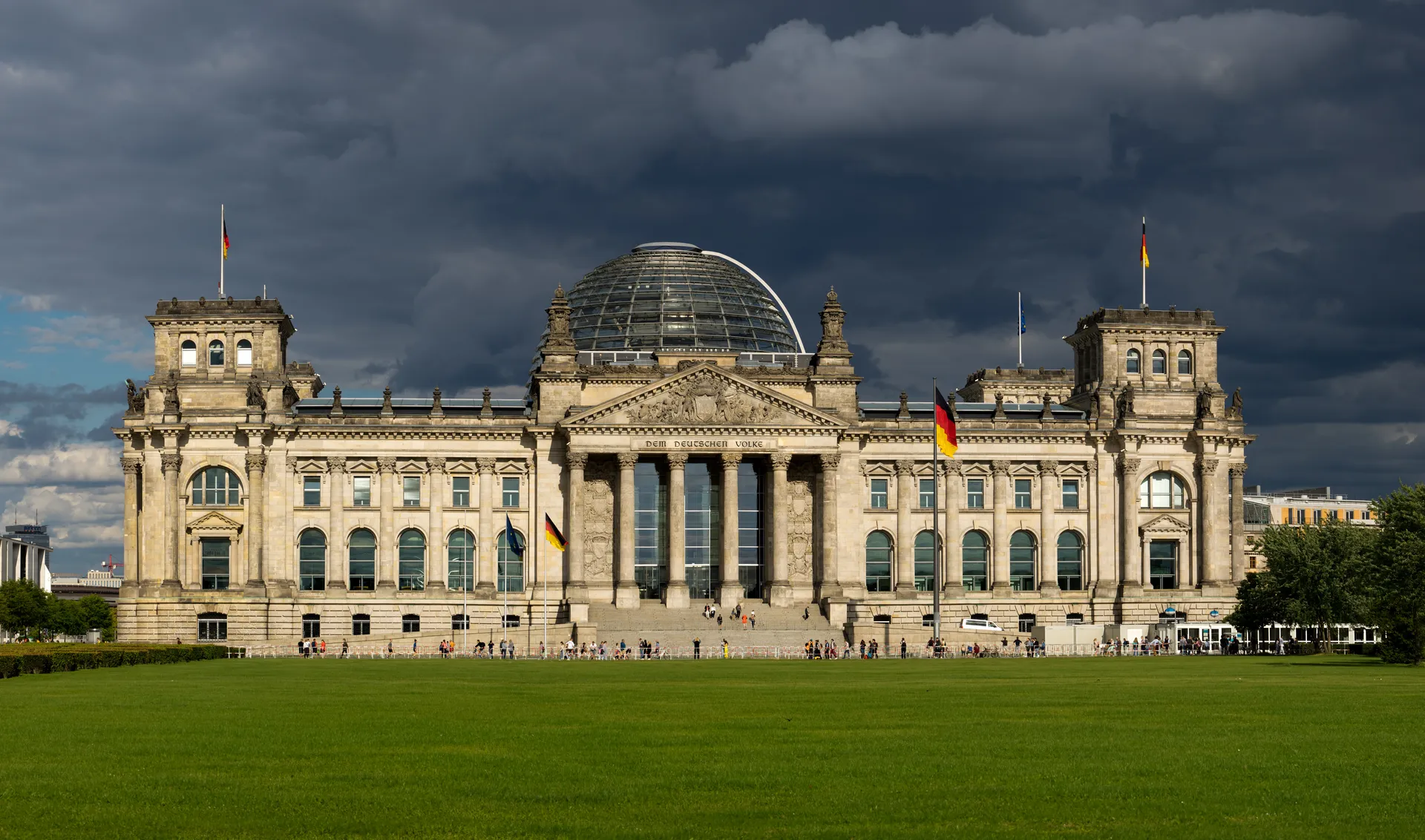 Photo: Jörg Braukmann · CC BY-SA 4.0
- Entry
- Free
How does a building that helped democracy collapse become one of the few places in Europe where citizens literally look down on their parliament? The Reichstag in Bezirk Mitte, Germany, answers that question in glass, stone, and old scars, and that's why you should visit. Today you arrive at Platz der Republik and see Norman Foster's dome rising above Paul Wallot's heavy 1894 shell, while visitors spiral upward in daylight and the debating chamber sits below like a stage set for accountability.
Most people come for the dome. Fair enough. The mirrored cone throws daylight into the chamber, the ramps curl upward like a double helix, and Berlin opens around you in a flat, wind-bright panorama that makes the city's history feel readable block by block.
But the real charge lies lower down. Records show this building has served the same basic function across empire, republic, dictatorship, division, and reunification: Germans keep returning here to argue about power in public, even after fire, shelling, and political sabotage tried to turn that argument into rubble.
Look closely and the place stops behaving like a postcard symbol. The inscription "Dem Deutschen Volke," added in 1916 over Kaiser Wilhelm II's objections, sits above walls still marked by war, and that tension between grandeur and damage is exactly what makes the Reichstag worth your time.
What to see
-
The West Facade and "Dem Deutschen Volke"
The first surprise is how unfortified Germany's parliament feels: you cross the broad lawn of Platz der Republik, hear bicycle wheels hiss past on wet pavement, and then the sandstone front rises up with four corner towers and a pediment inscription added in 1916 against Kaiser Wilhelm II's wishes. Paul Wallot's building took ten years to finish, from 1884 to 1894, with more than 32 million bricks and 30,000 cubic meters of sandstone, a mass so large it reads less like a palace than a cliff cut into columns; stand here near sunset, when the bronze letters darken and the stone catches honey-colored light, and the Reichstag stops being a postcard and starts feeling like an argument about who power belongs to. -
The Glass Dome and the Wounds Left Inside
Most people come for the dome, then realize the real drama is the collision beneath it: heavy masonry, preserved Soviet graffiti from 1945, and Foster's steel-and-glass structure curling upward in two ramps over a 230-meter walk, roughly the length of two football fields laid end to end. Go slowly. The mirrored cone throws daylight down toward the chamber below while footsteps ring lightly on the ramps, and when you look across Berlin from the top, then back down at the parliament floor, the building makes its point without a speech: citizens stand above their representatives, and history is kept in view rather than scrubbed away. -
A Better Reichstag Visit: Roof Terrace, Richter, Then the Dome
Skip the rushed dash upstairs and do the building in the right order: enter through the west side, look for Gerhard Richter's 21-meter "Schwarz Rot Gold" in the entrance hall, then head to the roof terrace before climbing the dome when the light softens. That sequence changes everything, because the Reichstag stops feeling like a famous viewpoint and starts reading as a carefully staged lesson in German democracy, with cold air on the terrace, the city spread around Tiergarten and the Brandenburg Gate, and one sly detail many visitors miss: from the right spot, the real flag outside folds into Richter's glass work.
Plan your visit
- Getting There
- Berlin Hauptbahnhof is the low-stress approach: walk about 10 minutes via Gustav-Heinemann-Brücke and Spreebogenpark to Platz der Republik 1. Transit is also easy on U5 to Bundestag, S+U Brandenburger Tor, or buses 100 and M41 to the Reichstag/Bundestag stop; from Brandenburg Gate, the south approach takes about 5 to 10 minutes on foot. Visitors arriving by car should know the Bundestag has no regular visitor parking, though accessible spaces are marked on Paul-Löbe-Allee.
- Opening Hours
- As of 2026, the roof terrace and glass dome are open daily, with entry slots every 15 minutes and officially confirmed last admission at 21:45; current public listings place the first slots around 08:00. The dome closes for maintenance on 15 to 19 June, 29 June to 3 July, 14 to 18 September, 28 September to 2 October, and 19 to 30 October 2026, while the roof terrace stays open. The whole site closes on 24 December 2026, and on 31 December 2026 it shuts from 16:00 with last admission at 14:30.
- Time Needed
- Give it 45 to 60 minutes if you want the essentials: security, elevator up, the dome ramp, a few photos, done. Most visitors need 60 to 90 minutes, which fits the 20-minute audio guide and enough time to stand at the top while Berlin spreads out like a model city under glass. Stretch it to 2 to 3 hours if you book the Dachgarten restaurant or like to linger over the view.
- Accessibility
- The Reichstag is one of the easier big-view visits in Berlin for wheelchair users: use accessible entrance West C on Platz der Republik, then elevators take you up and the dome itself rises on a gradual spiral ramp about 230 meters long. Accessible toilets sit on every floor, emergency wheelchairs are available on the visitor level, and the Bundestag also provides support for blind, low-vision, deaf, and hard-of-hearing visitors, including induction loops and tactile orientation aids.
- Cost and Tickets
- As of 2026, standard access to the roof terrace and dome is free, but your name must be registered in advance through the Bundestag's official booking system. Telephone booking is not offered, and third-party sellers are usually charging for a guide service, not for entry itself. If online slots are gone, the official service center about 150 meters north of the Reichstag on Scheidemannstraße sometimes issues same-day passes at least two hours before the visit if space remains.
History
One House, Repeatedly Claimed Back
The Reichstag's deepest continuity is almost stubborn: Germany keeps using this building, or this exact site, to stage public political life. Records show parliament needed a permanent home after unification in 1871, and after every rupture that followed, leaders and citizens kept dragging the idea of open debate back to this address at Platz der Republik 1.
That continuity never looked tidy. The chamber burned in 1933, Soviet shells tore into the fabric in 1945, West Berlin stripped off the old dome in the 1950s, and Foster rebuilt the top in the 1990s. Yet the core function endured: speeches, votes, memorial sessions, school visits, presidential elections, and citizens watching lawmakers at work from above.
The turning point
The Motto the Kaiser Didn't Want
At first glance, the Reichstag's pediment seems to tell a simple story. "Dem Deutschen Volke" looks like the kind of inscription that must have arrived with the building in 1894, as if empire and democracy had always marched in step across the same facade.
But the dates don't behave. Records show Paul Wallot finished the building in 1894, while the bronze letters went up only in 1916, twenty-two years later, and Kaiser Wilhelm II had tried to block them because the phrase gave symbolic ownership to the people rather than the crown.
That delay mattered personally to Wilhelm II. He already loathed the building, reportedly calling it the "Reichsaffenhaus," and he feared a parliament that could claim moral authority in stone; then war changed the calculation, and the inscription was added to shore up national feeling during a crisis the monarchy could no longer fully control.
Once you know that, the pediment stops reading as decoration. You look up and see an argument frozen in metal: a monarch resisted those words, the state installed them anyway, and every visitor walking beneath them now passes under a promise Germany has spent more than a century trying, failing, and trying again to keep.
What Changed
What Endured
Tips for visitors
ID and Screening
Bring original photo ID if you are 16 or older; ages 14 to 15 should also carry an ID with name and photo. Security works like a small airport, with X-ray screening and metal detectors, and staff will match names to the booking.Photo Rules
Personal handheld photos in the dome and on the roof terrace are generally fine, and the late light on the glass cone is worth waiting for. Drones are effectively off the table around the Reichstag because the government district sits inside a permanent flight-restricted zone, and bulky camera gear may draw security attention.Skip Fake Tickets
Don't pay random websites for a basic Reichstag entry slot. The official Bundestag visit is free in 2026, so paid offers are usually selling a guide or convenience layer, not a ticket you actually need.Eat Nearby
For a budget-to-low-mid stop, Zimt & Zucker at Am Schiffbauerdamm 12 does coffee, cakes, and light lunches by the Spree. Mid-range works best at Zollpackhof, Elisabeth-Abegg-Straße 1, especially if you want beer-garden calm after the security lines; splurge on Käfer Dachgarten-Restaurant inside the complex if the idea of dining above parliament beats your need for local atmosphere.Best Visit Window
Aim for the first morning slots or the last light before sunset, when the dome feels less like a queue machine and more like Norman Foster's argument in glass and air. Winter can bring short-notice weather closures on the roof, and the wind up there has teeth, so pack a layer even when Berlin streets feel mild.Pair It Well
The Reichstag makes most sense as part of a political Berlin walk: start at Hauptbahnhof, cross through Spreebogenpark, visit the dome, then continue to Brandenburg Gate and the Memorial to the Murdered Jews of Europe. Skip lingering too long on the forecourt itself unless you enjoy windswept lawns and security barriers, because the real reward is how the building changes once you see the chamber below from the ramp above.
Frequently asked
Is Reichstag worth visiting?
Yes, especially if you want one place that explains modern Germany in stone, glass, and scar tissue. Paul Wallot finished it in 1894, Norman Foster reopened it with the new dome in 1999, and the climb puts you above the debating chamber instead of below it. That twist matters; the public rises on a 230-meter spiral while Berlin opens around you and parliament stays in sight beneath your feet.
How long do you need at Reichstag?
Give it 60 to 90 minutes for a visit that doesn't feel rushed. The official audio guide runs about 20 minutes, and you still need time for security, the elevator, the roof terrace, and the slow spiral around the dome. If you linger for photos or book the rooftop restaurant, 2 hours is safer.
How do I get to Reichstag from Berlin Hauptbahnhof?
Walk if the weather behaves; it takes about 10 minutes and saves you the fuss of extra transfers. The usual route crosses Gustav-Heinemann-Brücke and cuts through Spreebogenpark to Platz der Republik 1, with the dome ahead like a glass lantern over the sandstone bulk. Public transport also works well: U5 stops at Bundestag, and nearby connections include Brandenburger Tor plus buses 100 and M41.
What is the best time to visit Reichstag?
Late afternoon into evening is the sweet spot, when low light warms the west facade and the dome starts glowing over Berlin. Summer gives you longer views and a sociable lawn on Platz der Republik, but the quieter months feel sharper and more atmospheric, with the wind on the roof and the mirrored cone catching colder light. Avoid dates when the dome closes for maintenance, because the terrace may stay open while the main experience does not.
Can you visit Reichstag for free?
Yes, the roof terrace and glass dome are free to visit, but you usually need advance registration. That catches people out. The Bundestag checks names against photo ID, screens visitors airport-style, and does not treat this as a casual drop-in viewpoint even though the ticket price is zero.
What should I not miss at Reichstag?
Do not rush straight to the skyline and miss the building's wounds. The preserved Soviet graffiti in the corridors, the mirrored cone with its 360 mirrors, and the view down into the plenary chamber tell the real story: this parliament does not hide the damage that shaped it. Also look for the bronze words "Dem Deutschen Volke" on the facade and the small history exhibition in the dome, which many people walk past at full speed.
Sources & attribution 10
- German Bundestag: Dome Visit Registration — Official visitor rules, free admission, advance registration, ID checks, audio guide length, dome walk distance, and current access details for the roof terrace and glass dome.
- German Bundestag: Roof Terrace, Dome and Rooftop Restaurant — Official opening structure, roof terrace access, dome closures, and restaurant-related visitor logistics.
- German Bundestag: Getting There — Official directions to the Reichstag complex, including nearby stations and bus connections.
- BVG Station Overview: U Bundestag — Current public transport confirmation for the U Bundestag station.
- BVG Route Overview: U5 — Line information confirming U5 as the relevant U-Bahn route for Bundestag access.
- visitBerlin: Reichstag in Berlin — Visitor-facing overview used for approach, atmosphere, surrounding area, and walking context from central Berlin.
- German Bundestag: Architecture of the Reichstag — Official architectural details on the dome, mirrored cone, preserved historic fabric, and the relationship between visitor route and plenary chamber.
- Foster + Partners: Reichstag, New German Parliament — Architectural intent behind the 1999 dome, the symbolic public ascent, lighting system, and the contrast between old masonry and new glass and steel.
- German Bundestag: History of the Reichstag — Official historical timeline for the building, including construction, political symbolism, and postwar rebuilding.
- German Bundestag: From the Reichstag to the Bundestag Exhibition — Official information on the history exhibition installed in the dome, used for the 'what not to miss' answer.
Built from cited sources · see the method · How we make our guides →
Pick up where you left off
Saved and recently read places — kept on this device only.
Photo credits (4)
- Ben Kupke — Unsplash License (https://unsplash.com/license) — Source: https://images.unsplash.com/photo-1749976610047-d62f37668b2f
- Dima — Unsplash License (https://unsplash.com/license) — Source: https://images.unsplash.com/photo-1757860090557-2196e39d3bfb
- Yoav Aziz — Unsplash License (https://unsplash.com/license) — Source: https://images.unsplash.com/photo-1747196959942-d822620076b0
- Reichstagsgebäude von Westen — Jörg Braukmann — CC BY-SA 4.0 (https://creativecommons.org/licenses/by-sa/4.0/) — Source: https://commons.wikimedia.org/wiki/File:Reichstagsgebäude_von_Westen.jpg
Photos may have been resized or cropped.