An introduction.
Researched by the Audiala editorial team from historical records, architectural archives, and local expertise.
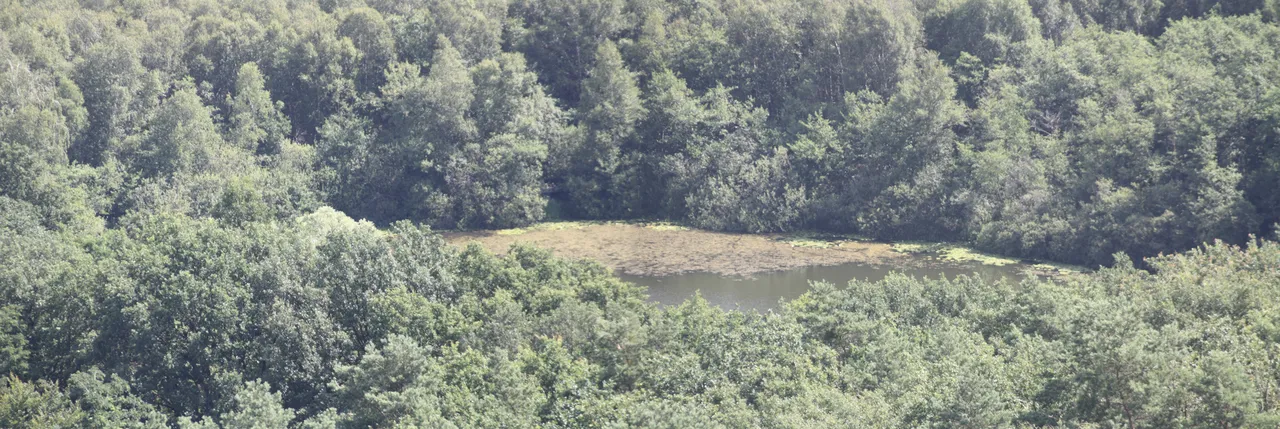
EEight thousand tons of post-war rubble, slag, and tar sat rotting in this bog until 2003, unseen beneath the sundew and cotton grass. Teufelsseemoor Köpenick, in southeast Berlin, is Germany's capital at its wildest — a Weichselian dead-ice kettle never drained, with peat reaching roughly thirteen metres down in its deeper eastern basin. Come for the larch boardwalk. Stay for a place cursed by legend, quarried for sand, shelled by Prussian cannon, poisoned by post-war tips, and still breathing.
The bog sits between the Müggelsee and the Langer See, on the northern slope of the Müggelberge hills inside Treptow-Köpenick. Bus 169 drops you at the Rübezahl stop; the boardwalk is a six-minute walk through pines. From Alexanderplatz, allow roughly an hour door-to-moor.
What the 300-metre larch boardwalk shows you is 6.45 hectares of open moorland hanging on by its fingernails. Pines and birches push in as groundwater falls. Berliner Forsten cuts them back by hand every few winters so the sundew still gets light — a small, ugly, necessary job done in the cold months when visitors aren't watching.
If you've already done Berlin's wall and Grunewald tower, this is the other Berlin: a wetland that outlived Prussian artillery, Nazi dynamite, DDR negligence, and reunification-era bureaucracy, and now lives as a Natura 2000 site nobody outside Köpenick talks about.
01 What to see.
The 300-Metre Larch Boardwalk
The boardwalk opened in December 2015, and the engineering is hidden where you can't see it — 240 larch pilings driven up to 8 metres into the peat, roughly the depth of a three-storey building sunk out of sight beneath your feet. Walk slowly. The boards flex and creak in a way that feels structural rather than worrying, a quiet reminder that everything below is water, moss, and thirteen metres of compressed organic time.
Look left, then right. One side holds still dark water dotted with lilies; the other shows dead birches standing upright in the peat, silver-barked and skeletal, refusing to fall. The contrast is abrupt enough to feel composed, as if someone staged it.
Crouch at the mid-point and peer through the gaps between planks. The peat below is the colour of strong tea, layered and glistening, and there's no interpretive sign because none is needed.
Sundew, Sphagnum and the Frog Concert
Most people walk the boardwalk in ten minutes and miss the thing worth coming for. Crouch next to the moss and find the sundew — red tentacles tipped with what looks like dew but is actually digestive fluid, an insect trap running in full daylight at ankle height. The red-on-green at macro scale is startling once you see it.
The sphagnum itself isn't one colour. Greens shade into deep burgundy and yellow-ochre across a single square metre, and the surface springs back when pressed because each cell holds 15 to 30 times its dry weight in water. May through June brings the Froschkonzert, six amphibian species overlapping at dawn and dusk, with male moorland frogs turning a startling cobalt blue during breeding season.
Arrive at 7am on a May weekday and you'll hear something most Berliners never have.
Lehrkabinett Teufelssee — The Root Hut and the Fox Burrow
Plan and listen to Teufelsseemoor Köpenick with Audiala.
Audio guide in your pocket, itinerary in your browser. Built for the way you actually visit.
03 Visitor logistics.
The practical scaffolding for a good visit — kept short.
Getting There
Take S-Bahn S3 to Köpenick, then Bus 169 toward Alt-Müggelheim and get off at Rübezahl (21 min, 16 stops). From the stop, a 10-minute walk on the flat Breite Promenade through pine forest drops you at the trailhead. By car: free informal lot at Rübezahl, Müggelheimer Damm 143–144.
Opening Hours
The reserve itself is open 24/7 year-round — no gates, no tickets. The on-site Lehrkabinett Teufelssee (forest info cabin) runs roughly Wed–Sun 10:00–16:00 in 2026, mostly May–September; hours shift, so call (030) 654 13 71 before making a special trip.
Time Needed
Boardwalk-only peek: 45 minutes. Full 3 km Naturlehrpfad loop around the lake: 1–1.5 hours. Add the Lehrkabinett and you're at 2.5 hours. Stretch it into the 9.5 km SO08 route over the Müggelberg and down to the Müggelsee for a half-day, roughly 2.5 hours walking plus stops.
Accessibility
The Breite Promenade from Rübezahl is wide, flat, and manageable with strollers or mobility scooters. The 300 m larch boardwalk over the moor is narrow, uneven, and slick when wet — not reliably wheelchair-friendly. No toilets on trail; the Lehrkabinett has limited facilities.
Cost
Free. Trail, boardwalk, Lehrkabinett — all zero euros in 2026. Only costs are the BVG AB ticket (~€3.80 single) and whatever you spend at Rübezahl. No booking, no skip-the-line — it doesn't exist here.
04 Tips for visitors.
Small things that change the day.
Wrong Teufelssee
Berlin has two Teufelsseen. The Grunewald one allows swimming; this Köpenick moor does not — it's a Natura 2000 reserve with protected sphagnum and sundew. Bring swim gear to the Müggelsee instead, 750 m north.
Stay On Boards
Leaving the boardwalk damages peat that took millennia to form and carries real fines under Naturschutzgesetz. Dogs must be on a short lead the entire time — enforced, especially during amphibian breeding season in spring.
When To Go
September–October for fewer walkers and autumn color on the birches, or June for cotton grass and long evenings. Skip July–August weekends. Avoid dusk — no trail lighting, and the boardwalk gets genuinely slippery after rain or frost.
Eat At Rübezahl
Rübezahl am Müggelsee (Müggelheimer Damm 143), running since 1876, sits right at the trailhead. Budget Currywurst, fresh-tapped beer, fish sandwiches, Biergarten with lake view — €3.50–8. Full daily service May–October; weekends only November–April.
No Drones
Natura 2000 plus Berlin airspace rules mean drones need a LUBB permit before you take off — penalties for flying without one are steep. Flash photography is legal but disturbs amphibians; skip it on the boardwalk.
Pack For Bog
Waterproof boots, not trainers — planks are slick, surrounding ground spongy. Bring insect repellent May–September; this is a wetland and mosquitoes know it. Offline Komoot map helps if you extend onto the SO08 route over the Müggelberg.
Combine With Müggelturm
The 30 m Müggelturm sits a short uphill walk south — €4 entry, 126 steps, panoramic view over lake, moor, and Brandenburg forest. Pair it with the 3 km lake loop for a ~4-hour half-day that ends with a beer back at Rübezahl.
Check Trail Status
The Lehrpfad got its first full overhaul since 1970/71 during 2024–25 with new boards and signage. Most sections reopened by summer 2025, but short closures can still pop up — check berlin.de/forsten before a long detour.
Where to Eat
Don't Leave Without Trying
Restaurant Asteria Köpenick
local favoriteOrder: The moussaka is creamy and rich, with portions that feel authentic—exactly like your grandma made back in Athens. The calamari are equally tender and savory. Finish with the traditional galaktoboureko (Greek milk pie), a rarity in Berlin.
Canalside terrace with painted murals and impeccable service—this is where Köpenick locals go for real Greek food. Reviewers who've dined in Greece consistently rank it as better than the originals.
Wieduwilt und Krause
fine diningOrder: The Schweinebraten (roasted pork) and ribs are perfectly balanced—slow carbs, vegetables, protein, never oversalted. Every dish reflects seasonal precision and thoughtful composition.
Elegant Alpine cooking that earns a devoted following. Locals discover it by the aroma alone and become regulars for life. The catering service handles everything from family dinners to weddings with the same meticulous care.
Zum Gletscher
local favoriteOrder: Some of Berlin's best pizzas at genuinely affordable prices. The tiramisu is equally legendary—skip it at your peril. Locals order takeout twice weekly and still insist it's criminally underrated.
Waterside terrace overlooking the lake, with the kind of genuine warmth that makes you feel like a regular from your first visit. This is authentic neighborhood dining—no performance, just good food and a place that respects its regulars.
Café Antoní Berlin
cafeOrder: The waffles—crunchy, substantial, savory—are a Berlin take on the classic. Bacon and egg on top, with an interesting spicy dressing that makes them unforgettable. Strong coffee and a sidewalk seat complete the experience.
Bare-brick charm in the heart of the Altstadt, with sidewalk seating that captures the neighborhood's rhythm. Excellent breakfasts and waffles draw a lively, loyal crowd. Book ahead on weekends or arrive early.
Dining Tips
- check Carry cash. Berlin remains more cash-heavy than most European cities—many cafes, bakeries, and Kneipen are cash-only. Have €20–40 on hand.
- check Tipping: 5–10% at casual spots, 10–15% at sit-down restaurants. Tell the server your total when paying, rather than leaving coins on the table.
- check Reservations recommended for Friday and Saturday evenings at popular spots, especially for groups of 4+.
- check Many restaurants observe a Ruhetag (closing day), typically Monday or Tuesday. Always verify hours before visiting.
- check Dinner rush peaks at 6:30–9:00 PM. Kitchens typically close 22:00–23:00; late-night kebab shops stay open much later.
- check Local markets: Wochenmarkt Schlossplatz (Tuesday & Thursday, 8:30–17:00) and Wochenmarkt am S-Bahnhof Köpenick (Mon-Fri 9:00–18:00, Sat 9:00–16:00). Fresh produce, bread, cheese, fish.
Restaurant data powered by Google
05 Cursed, Quarried, Shelled, Poisoned
The name comes from fear. For centuries, villagers south of the Müggelberge told of a devil causing mischief in the bog, of a princess cursed into its waters, of an altar hidden somewhere in the reeds. Impassable, gloomy, undrainable — the moor stayed wilderness while the forest around it was cleared, and the fear wrote itself into the maps.
Protection came late, and from the East. Records show the first Landschaftsschutzgebiet ordinance covering the Müggelberge was issued in July 1954 by the East Berlin Magistrat, a decade before West Berlin's equivalent. The Lehrpfad (nature trail) opened in 1965 as DDR environmental pedagogy. Natura 2000 and formal Naturschutzgebiet status arrived on September 12, 2016 — a quarter-century after reunification.
The Architect Who Cut the Wires
Walter Wichelhaus bought the wooden Müggelturm — the observation tower on the ridge above Teufelssee — in 1924. He was an architect, and he spent the next twenty-one years of his life rebuilding it into a landmark. In 1926 he opened a prehistoric exhibition inside, displaying the Stone, Bronze, and Iron Age finds unearthed during construction. In 1928 he built, by hand, a 111-step staircase climbing from the Teufelssee shore up to the Kleiner Müggelberg summit — stitching the lake physically to the tower.
In late April 1945, as Soviet forces took Müggelheim a kilometre south and closed on Köpenick, Volkssturm troops packed two Zentner — roughly 200 kilograms — of dynamite into the tower's lower chamber. The plan was to blow the Müggelturm and the neighbouring Bismarckwarte so the Red Army couldn't use them as observation posts. Wichelhaus walked in and cut the electrical wires to the charges. Twenty-one years of his own labour against a demolition order, and he chose the labour.
The tower survived the war because of him. Then, on May 19, 1958, during an East German renovation, welding sparks from contractors who had just gone home for the day ignited the dry wood. Eyewitnesses said it burned 'like a blazing torch,' gone in under an hour. The structure Wichelhaus saved from Nazi dynamite did not survive a DDR plumber.
Eight Thousand Tons Below the Boardwalk
The Valley That Was a Quarry, Then a Gun Range
Listen to the full story in the app
The whole Teufelsseemoor Köpenick,
told well.
Audio guides for 1,100+ cities across 96 countries. History, stories, and local insight — offline ready.
06 Frequently asked.
The questions travellers send us most about Teufelsseemoor Köpenick.
Is Teufelsseemoor Köpenick worth visiting?
Yes, if you want a genuinely quiet corner of Berlin most tourists never reach. A 300m larch boardwalk over a 12,000-year-old kettle bog, carnivorous sundew plants, and a frog chorus between April and June — all free, 45 minutes from Alexanderplatz. Skip it if you expect swimming or dramatic views; this is a contemplative walk, not a beach.
How long do you need at Teufelsseemoor Köpenick?
Plan 1 to 1.5 hours for the 3km lake circuit, which is the core visit. Add another hour for the Lehrkabinett forest cabin (Wed–Sun 10:00–16:00, free), or stretch to 4–5 hours if you walk up to the Müggelturm tower for the panoramic view.
How do I get to Teufelsseemoor Köpenick from central Berlin?
Take S-Bahn S3 to Köpenick station, then Bus 169 toward Müggelheim and get off at Rübezahl — about 45 minutes total from Alexanderplatz. From the Rübezahl stop it's a 6–10 minute walk through the forest. A BVG AB single ticket (~€3.50) covers the whole trip.
Can you swim in Teufelssee Köpenick?
No. This Teufelssee sits inside a Natura 2000 protected reserve and swimming is prohibited to protect the sphagnum and amphibian habitat. Visitors often confuse it with the other Berlin Teufelssee in Grunewald, where swimming is allowed — these are two completely different lakes on opposite sides of the city.
What is the best time to visit Teufelsseemoor Köpenick?
October on a weekday morning. The beech forest glows yellow around the moor, mosquitoes have dropped off, and the light is clear and low. April–June brings the frog chorus and cotton grass; July–August means serious mosquitoes and peak crowds.
Is Teufelsseemoor Köpenick free to visit?
Yes, entirely free — no tickets, no gates, open 24/7. The adjacent Lehrkabinett Teufelssee forest cabin is also free during its Wed–Sun 10:00–16:00 opening hours. Parking at the Rübezahl lot costs nothing either.
What should I not miss at Teufelsseemoor Köpenick?
Crouch on the boardwalk to see the sundew — red carnivorous tentacles glistening with digestive fluid, easy to walk past. Also look through the gaps between the larch planks to see the dark peat layers below, and stop at the Lehrkabinett's Wurzelhütte, which lets you view a beech tree's full root system from underneath.
Can you bring a dog to Teufelsseemoor Köpenick?
Yes, on a short lead at all times — this is a strict Naturschutzgebiet with breeding amphibians and ground-nesting birds. Leaving the marked paths or boardwalks is prohibited for both dogs and humans, and enforcement is real.
Verified, and shown.
Researched and written by the Audiala editorial team from historical records, architectural archives, and local expertise.
Official Natura 2000 protection status, 2016 designation, ecological data
Peat depth, boardwalk construction 2015, 8,000-ton contamination removal 2003
Lake dimensions, folklore, kettle-bog geological formation
Local history, legends, Prinzessinnenstein fate
Forest cabin hours, Wurzelhütte exhibits, 1972 DDR founding
1981 building history, DDR-era origins, pedagogy
Forest school programs, seasonal opening hours
3km nature trail, 2024–25 renovation status
9.5km hiking route specs and access
Extended loop via Kanonenberge
Scientific peat depth data, two-basin structure, climate research
Walter Wichelhaus biography, 1928 staircase, 1945 detonation-wire story
Tower history, 1958 fire, reconstruction
WWII military use, 1961 concrete replacement
Eyewitness accounts of the 1958 fire
April 1945 Soviet advance through Müggelheim
1884–1902 sand quarrying, 1911 artillery range history
Military use and permit dates
Artillery testing background
Prinzessinnenstein destruction detail
1954 DDR Magistrat protection history
Müggelberge hills geography and history
Name etymology, Slavic/Wendish roots
Trailhead restaurant, local history
Route description from Rübezahl trailhead
Practical visit information
Family visit notes, Lehrkabinett exhibits
15km self-guided trail, 30+ interpretation stations
Guided walks programme
Full legend text, St. John's Night redemption
Devil's altar folklore
Witch legend literary text
Haunting folklore text
Sensory description of the moor, flora, atmosphere
Official Berlin tourism overview
Guided amphibian tour dates with Griesbaum/Pacher
Family walk notes and sensory detail
Family-focused trail description
Playground near Rübezahl trailhead
Bus 169 schedule, Rübezahl stop, S Köpenick connection
Researched from Wikidata, Wikipedia & official sources · fact-checked · How we make our guides →