Type 2+ letters to search all countries, cities, and places
/Ctrl KEsc
travel_explore
Type 2+ letters to search all countries, cities, and places
Press Enter to open the top result
Siegessäule
Berlin·Germany·52° N · 13° E·Updated Jul 2026
Berlin's Victory Column began as one war memorial, then grew into a monument to empire, protest, Pride, and one of the city's sharpest views from above.
Not wheelchair accessible; access is via 285 spiral stairs
How does a monument built to celebrate Prussian victories end up as one of Berlin's queer landmarks and most revealing viewpoints? The Siegessäule in Berlin, Germany, stands in the middle of the Tiergarten like a piece of imperial theater that the city refused to leave alone, and that's exactly why you should visit: 285 steps take you into a story about war, propaganda, survival, reinvention, and the odd tenderness with which Berliners now call its gilded goddess Goldelse.
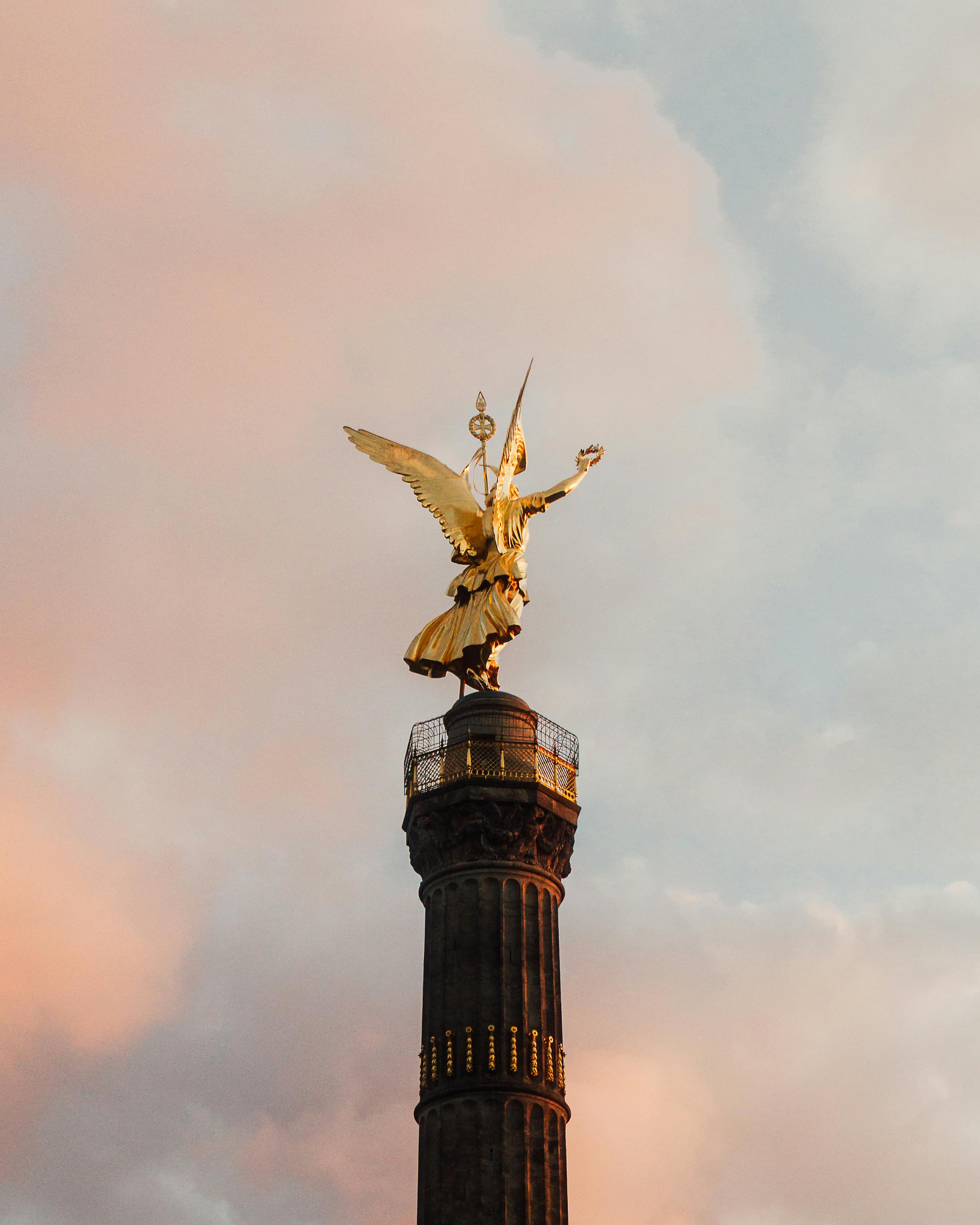
From the traffic island at Großer Stern, the column looks almost absurdly self-assured: sandstone rising in fluted drums, bronze cannon barrels glinting in gold, Victoria balancing high above the treetops with her laurel wreath and staff. Cars circle below. Wind moves through the chestnut leaves. Inside, the staircase tightens, the air cools, and every footstep starts to echo.
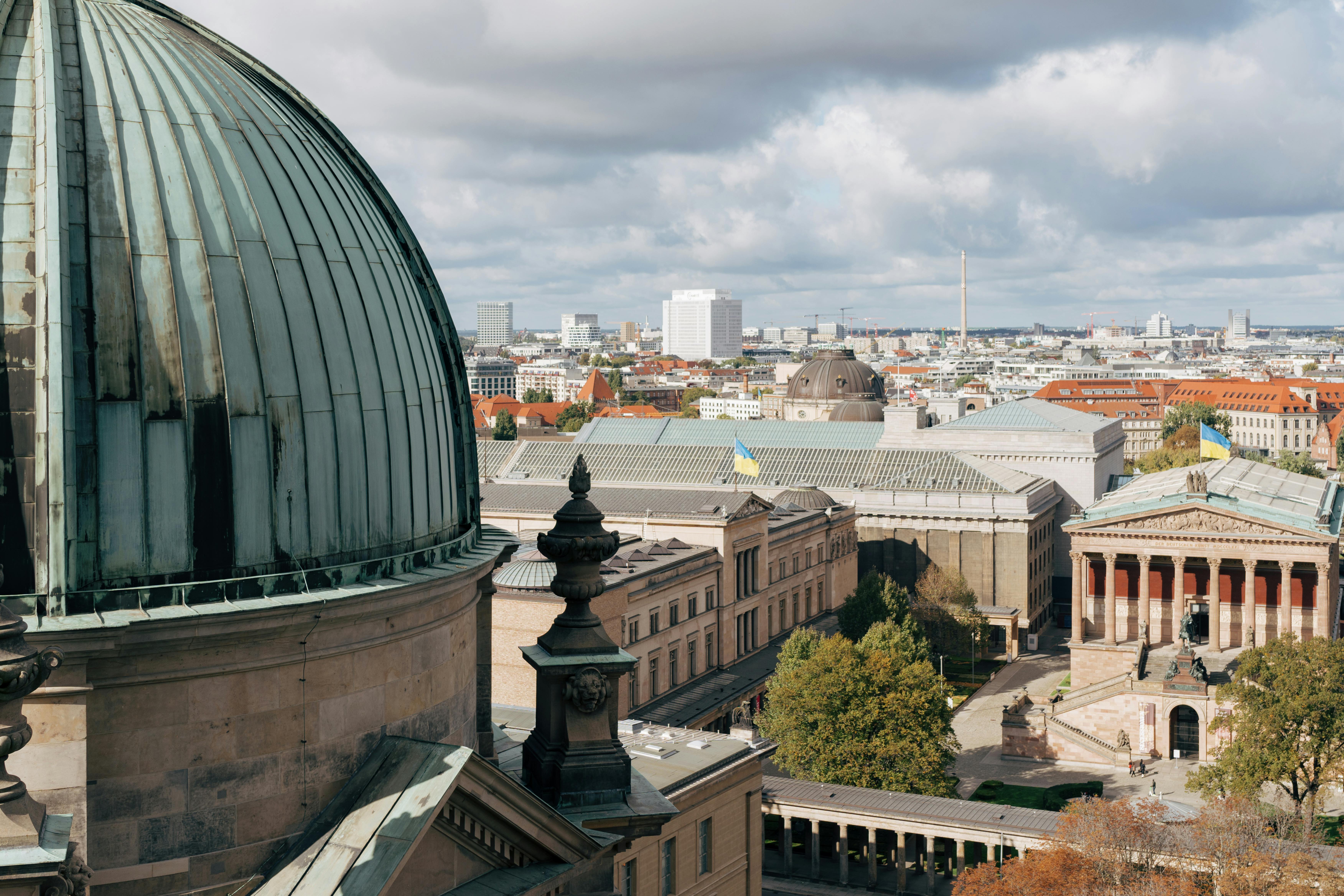
Most visitors come for the view along Straße des 17. Juni toward the Brandenburg Gate and across the green spread of the Tiergarten toward the dome of Berlin Cathedral. Fair enough. But the real reason to come is stranger: this is a monument whose meaning never held still, and Berlin has spent 150 years arguing with it in public.
That argument is visible everywhere. The reliefs still speak the language of conquest, yet Pride marches flow around the base, protest crowds gather here, and the city uses the column less as a shrine to victory than as a stage on which each generation declares what victory ought to mean.
Researched by the Audiala editorial team from historical records, architectural archives, and local expertise.
What to see
Climb to Goldelse
Siegessäule looks almost frivolous from a distance, a gold figure floating above the Tiergarten trees, but up close it feels heavier, stranger, and far more political. Climb the 285-step spiral stair to the platform 51 meters up, about the height of a 16-storey apartment block, and Berlin suddenly arranges itself into geometry: the starburst of Großer Stern below, the green spread of the park, and clear sightlines toward Brandenburg Gate and the government quarter, all with wind in your hair and traffic still growling faintly underneath.
The Mosaic Hall and War Reliefs
Most visitors treat the column as a staircase with a view and miss the best room entirely: the circular colonnaded hall, where 16 granite columns hold a quieter world of filtered light, cool stone, and a glass mosaic frieze that glints after the dark climb. Slow down at the bronze reliefs on the base too; records show builders conceived the monument after the 1864 war against Denmark, then turned it into a louder imperial statement after victories over Austria and France, and the scars left by removed inscriptions still tell you that monuments remember more than cities admit.
Read the Monument Through Its Approach
The smartest way to see Siegessäule starts underground, not on the viewing platform. Enter through the pedestrian tunnels at Großer Stern, notice the original 1939 Villeroy & Boch tiles from the Nazi relocation project, read the plaques by the entrances, then come back into daylight and walk west into the Tiergarten; what first looked like a simple triumph column becomes a Berlin story about empire, propaganda, damage, repair, queer reinvention, and a city that keeps arguing with its own symbols.
Plan your visit
Getting There
Großer Stern 1 sits in the middle of the Tiergarten roundabout, so the easy move is bus 100, 106, 187, or night bus N26 to Großer Stern. From Brandenburg Gate, walk west along Straße des 17. Juni for about 20 minutes; from S Bellevue, S Tiergarten, or U9 Hansaplatz, expect a 10 to 20 minute walk through the park and use the pedestrian underpasses rather than trying to cross the traffic circle above ground.
Opening Hours
As of 2026, the viewing platform opens at 9:30 daily. The most current city tourism listing gives Monday to Friday 9:30 to 18:30 and Saturday to Sunday 9:30 to 19:00; Berlin.de also lists a winter closing time of 17:30 and says December 24 is closed, so check the day’s listing if you visit in colder months or around holidays.
Time Needed
Give it 15 to 25 minutes if you want the quick version: ticket, climb, panorama, down again. A better visit takes 30 to 45 minutes, and 60 to 90 minutes makes sense if you pair the column with a Tiergarten walk, Schloss Bellevue, or a stop at Café am Neuen See.
Accessibility
The hard truth: Siegessäule is not barrier-free. As of 2026, the platform requires climbing 285 steps on a spiral staircase that narrows toward the top, there is no lift, and there is no toilet inside; the surrounding Tiergarten paths are mostly broad and flat, and U Hansaplatz has elevator access, but the monument itself shuts the door on wheelchair users and many visitors with limited mobility.
Cost And Tickets
As of 2026, admission is €4.50 for adults and €3.50 reduced, and both official city listings say cash only. No official online booking, timed entry, skip-the-line option, or free-entry day turned up in current research, so bring coins or notes and expect to buy on site.
Tickets & tours.
These are guided options from our partners — same price as booking direct.
Prices are indicative — final pricing and availability are confirmed at checkout. Audiala may earn a commission from bookings made through these links.
Photo Gallery
A view of Siegessäule, Berlin, Germany. · Willy PragherA view of Siegessäule, Berlin, Germany. · Willy PragherA view of Siegessäule, Berlin, Germany. · Willy PragherA view of Siegessäule, Berlin, Germany. · Willy PragherA view of Siegessäule, Berlin, Germany. · Anil ÖztasA view of Siegessäule, Berlin, Germany. · Anil ÖztasA view of Siegessäule, Berlin, Germany. · Mabit1
History
A Column That Keeps Getting Reused
Records show that the Siegessäule has changed location, height, and political meaning, yet one function has held steady since its inauguration on 2 September 1873: Berlin keeps using it as a public machine for looking, gathering, and declaring power. Kaiser Wilhelm I used it to frame imperial triumph. Albert Speer used it to anchor a Nazi axis. Berliners now use the same monument for viewpoints, marches, concerts, and argument.
That continuity matters more than the bronze and sandstone alone. The column has never been a quiet object. It keeps pulling bodies into its orbit, whether they come to climb the stairs, wave a flag, dance in the road, or reclaim a symbol that earlier regimes tried to freeze in one meaning.
The turning point
The Monument That Was Never Where You Think It Was
At first glance, the story seems simple: the Siegessäule looks like a fixed monument to German unification, planted exactly where history meant it to stand. Many tourists accept that version because Großer Stern feels so theatrically right, with the column commanding the long axis toward the Brandenburg Gate.
But the dates don't quite behave. Records show that Johann Heinrich Strack designed the column after Prussia's 1864 victory over Denmark, not after unification, and he placed it at Königsplatz, today's Platz der Republik near the Reichstag, not here in the Tiergarten. Then another contradiction appears: the column you see now is taller than Strack's original by one full drum, roughly 16 meters, about the height of a five-storey Berlin apartment block.
The turning point came in 1938, when Albert Speer needed old monuments to serve Adolf Hitler's planned Germania. Speer had the entire structure moved about 1.5 kilometers west to Großer Stern and enlarged in 1938-39, because a victory monument near the Reichstag was less useful to him than one staged on a grand ceremonial avenue. What was at stake for Speer was personal as well as political: this relocation helped prove that he could turn ideology into stone, scale, and sightline.
Once you know that, the column stops looking eternal and starts looking edited. You see an imperial monument rewritten by Nazis, spared by war, later reclaimed by a democratic and queer Berlin; even the view from the top changes, because you are not standing inside a pure 1873 artifact but inside a monument that multiple regimes tried, and failed, to own completely.
What Changed
Almost everything visible has shifted. Records show that the column began as a monument to the Second Schleswig War, then absorbed the victories of 1866 and 1870-71 while workers were still building it. Nazis moved it, widened the base, and added the fourth drum. Later generations stripped away much of the old solemnity by turning the area into a gathering ground for the Love Parade, mass rallies, and Christopher Street Day, so the column's message now depends as much on the crowd below as on the bronze above.
What Endured
One practice has survived every rewrite: people come here to look out over Berlin and to be seen in Berlin. The staircase still funnels visitors upward through cool, enclosed stone before releasing them into light and wind above the trees. Also enduring is the monument's role as a public signal. In the 19th century it announced empire; now it still announces something larger than any one visitor, only the claim comes from a city that answers old triumphal symbols with noise, plurality, and reuse.
Tips for visitors
Go Late Day
Late afternoon usually gives the best light, when Tiergarten turns into a sheet of green and Berlin’s pale stone picks up a warmer edge. Weekend hours run to 19:00 as of 2026, which gives you a little more breathing room than weekdays.
Bring Small Gear
Handheld personal photography appears to be fine, but this is a narrow spiral climb, not a place for bulky camera kits. For commercial shoots, tripods, lights, or staged filming on public ground in Mitte, permits apply; drones are a bad idea here because the monument sits inside the restricted government-district flight zone.
Use Underpasses
The least romantic hazard here is traffic. Großer Stern is a serious rotary with fast-moving lanes, so use the pedestrian tunnels, keep bags close on crowded buses, and treat anyone claiming to be plainclothes police with suspicion unless they show proper identification.
Eat In Park
Skip the idea of a quick cafe right at the base; the column stands in a traffic circle, not a neighborhood square. Café am Neuen See is the classic mid-range Tiergarten stop about 10 minutes away, Tiergartenquelle near S Tiergarten does old-school Berlin food at budget to mid-range prices, and Konditorei Buchwald in Hansaviertel is the detour for Baumkuchen and coffee without any trend-chasing.
Pair It Well
Siegessäule works better as one chapter in a longer walk than as a stand-alone mission. Link it with Brandenburg Gate, a Tiergarten loop, or Hansaviertel’s postwar modernist streets; the monument starts to make more sense once you see how Berlin planted imperial pomp inside parkland, traffic, and everyday city life.
Bring Cash Only
This is one of those Berlin details that still catches people out. As of 2026, official listings say cash only, and with no toilet, no cloakroom, and no online tickets, you’ll want to sort payment and bulky luggage before you descend into the underpass.
Where to Eat
local_dining
Don't Leave Without Trying
CurrywurstDöner kebabPfannkuchenBulettenEisbein
Shakko Makko (Brunch-Restaurant&kaffe)
cafe
Levantine-leaning brunch cafe with house-baked brioche, egg dishes, and specialty coffee€€star4.9(728)
Order: Go for the homemade brioche toast or French toast, and add a matcha pistachio latte if you want the full picture.
This is the kind of brunch place people actually bother to return to: generous plates, sharp presentation, and staff who seem to enjoy rescuing a no-reservation lunch. Reviews keep circling back to the details, from perfectly ripe avocado to coffee that holds up.
Late-opening Turkish and international comfort food with cocktails, burgers, lentil soup, and shisha€€star4.7(1863)
Order: Order the lentil soup if you want the house favorite, or the burger if you need something substantial after a long walk through Tiergarten.
Berlin food culture makes more sense once you eat somewhere like this: relaxed, mixed, social, and not trying too hard. The terrace, heaters in winter, and late hours make it useful when the area around Siegessäule starts to feel quiet.
Fresh Berlin bistro for pastries, sandwiches, salads, pancakes, pasta, and strong coffee€€star4.7(1417)
Order: The pancakes and rice pudding get singled out in reviews, though the sandwiches and pastry breakfast are the safer everyday move.
This one reads like a real local habit rather than a polished concept: office workers, repeat breakfast visits, quick service, and shelves full of food that actually looks tempting. It works when you want something easy without settling for dull.
All-day cafe for breakfast plates, composed salads, hummus, tzatziki, cake, and coffee€€star4.7(2945)
Order: Get the mixed salad plate with hummus and tzatziki if you want lunch, or come early for one of the beautifully presented breakfasts and finish with orange cake.
Nearly 3,000 reviews usually mean compromise. Here they mostly mean consistency. People mention the warmth of the owner, the fresh food, and a breakfast that feels cared for rather than assembled.
checkSiegessäule sits in Tiergarten, so you usually eat in the surrounding districts rather than right at the monument.
checkMonday is often treated as a restaurant closing day in Berlin, but not reliably. Check each place individually.
checkBerlin's food identity is not only German. Turkish, Middle Eastern, and other international street food are part of everyday local eating.
checkWinterfeldtplatz market in Schöneberg runs on Wednesdays and Saturdays.
checkThe Ökomarkt im Hansaviertel takes place on Fridays and is one of the closest market options to Tiergarten.
checkKarl-August-Platz weekly market in Charlottenburg runs Wednesday and Saturday from 8:00 AM to 1:30 PM.
checkMaybachufer market in Neukölln runs on Tuesday and Friday.
checkMarkthalle Neun is useful for a market-hall detour: hall hours are Mon-Wed 12:00-6:00 PM, Thu 12:00-10:00 PM, Fri 12:00-6:00 PM, Sat 10:00 AM-6:00 PM, with Street Food Thursday nearly every Thursday from 5:00 PM to 10:00 PM.
Yes, if you want one of Berlin's sharpest views wrapped inside one of its most complicated monuments. The surprise is that this 19th-century war column now feels less like Prussian chest-thumping and more like a Berlin palimpsest: Nazi relocation, postwar survival, Pride landmark, and lookout above Tiergarten's green canopy. Climb the 285 steps and the city opens in spokes beneath you, like a wheel laid across the park.
How long do you need at Siegessäule?
Give it 30 to 45 minutes for a normal visit. That covers the cash ticket, the 285-step spiral climb, a pause in the mosaic ring, and time on the platform under Goldelse, about 51 meters up, roughly the height of a 16-storey building. Pair it with Tiergarten and you can easily stretch the stop to 60 to 90 minutes.
How do I get to Siegessäule from Berlin?
The easiest route is public transport to Großer Stern, then the pedestrian underpass into the roundabout. Bus 100 stops directly there, while buses 106, 187, and night bus N26 also serve the monument; rail options include U Hansaplatz on U9 and the S-Bahn stations Bellevue and Tiergarten, followed by a 10 to 20 minute walk. From Brandenburg Gate, you can also walk west along Strasse des 17. Juni in about 20 minutes.
What is the best time to visit Siegessäule?
Late afternoon in autumn is the sweet spot. Berlin's official city pages single out the gold figure against Tiergarten's orange and rust canopy, and the light up there has a dry, windy clarity that makes the road geometry below snap into focus. Weekdays are also calmer, which matters in a monument where every footstep echoes in the narrowing stair.
Can you visit Siegessäule for free?
No, the viewing platform is not free. Official prices are 4.50 euros for adults and 3.50 euros for reduced admission, and you should bring cash because the site lists cash-only payment. No current official free-entry day appears in the sources.
What should I not miss at Siegessäule?
Don't rush straight to the top and miss the parts that explain why the monument still unsettles people. The best overlooked details are the circular mosaic hall, the 1939 Villeroy and Boch tiles in the approach tunnels, and the north-side traces where a removed dedication once sat. Then climb for the platform, where Großer Stern spreads below you like a starburst carved into the trees.
Sources & attribution10
Researched and written by the Audiala editorial team from historical records, architectural archives, and local expertise. Last updated July 2026.
visitBerlin — Official visitor information for opening hours, ticket prices, cash-only entry, 285 steps, walking time from Brandenburg Gate, and the monument's historical overview.
Berlin.de Attractions and Sights — City overview used for seasonal atmosphere, platform experience, visitor access details, and the monument's role as a Berlin landmark.
Berlin Monument Database — Heritage authority source used for protected-monument status, original and current locations, and the monument's political history including the 1938-39 relocation.
Berlin.de Siegessaeule — German city listing used to confirm ticket prices, practical visitor details, and seasonal opening-hour context.
Berlin Commemorative Plaques PDF — Historical interpretation source used for the preserved 1939 Villeroy and Boch tunnel tiles and the context of the Nazi-era relocation.
Gedenktafeln in Berlin — Source used for the physical traces of removed inscriptions and the monument's postwar restoration details.
Berlin- Großer Stern; Siegessäule; Vordergrund Laterne und Treppenhaussäule - LABW - Staatsarchiv Freiburg W 134 Nr. 015633a — Willy Pragher — CC BY 4.0 (https://creativecommons.org/licenses/by/4.0/) — Source: https://commons.wikimedia.org/wiki/File:Berlin-_Großer_Stern;_Siegessäule;_Vordergrund_Laterne_und_Treppenhaussäule_-_LABW_-_Staatsarchiv_Freiburg_W_134_Nr._015633a.jpeg
Berlin- Großer Stern; Siegessäule; Vordergrund Laterne und Treppenhaussäule - LABW - Staatsarchiv Freiburg W 134 Nr. 015633b — Willy Pragher — CC BY 4.0 (https://creativecommons.org/licenses/by/4.0/) — Source: https://commons.wikimedia.org/wiki/File:Berlin-_Großer_Stern;_Siegessäule;_Vordergrund_Laterne_und_Treppenhaussäule_-_LABW_-_Staatsarchiv_Freiburg_W_134_Nr._015633b.jpeg
Berlin- Großer Stern; Siegessäule im Gerüst (Aufbau) - LABW - Staatsarchiv Freiburg W 134 Nr. 015622 — Willy Pragher — CC BY 4.0 (https://creativecommons.org/licenses/by/4.0/) — Source: https://commons.wikimedia.org/wiki/File:Berlin-_Großer_Stern;_Siegessäule_im_Gerüst_(Aufbau)_-_LABW_-_Staatsarchiv_Freiburg_W_134_Nr._015622.jpeg
Berlin- Großer Stern; Siegessäule von der neuen Unterführung aus - LABW - Staatsarchiv Freiburg W 134 Nr. 015632 — Willy Pragher — CC BY 4.0 (https://creativecommons.org/licenses/by/4.0/) — Source: https://commons.wikimedia.org/wiki/File:Berlin-_Großer_Stern;_Siegessäule_von_der_neuen_Unterführung_aus_-_LABW_-_Staatsarchiv_Freiburg_W_134_Nr._015632.jpeg
Berlin (DE), Hofjägerallee -- 2021 -- 8664 — Anil Öztas — CC BY-SA 4.0 (https://creativecommons.org/licenses/by-sa/4.0/) — Source: https://commons.wikimedia.org/wiki/File:Berlin_(DE),_Hofjägerallee_--_2021_--_8664.jpg
Berlin (DE), Siegessäule -- 2021 -- 8666 — Anil Öztas — CC BY-SA 4.0 (https://creativecommons.org/licenses/by-sa/4.0/) — Source: https://commons.wikimedia.org/wiki/File:Berlin_(DE),_Siegessäule_--_2021_--_8666.jpg
Berlin Siegessaeule Gelaender — Mabit1 — CC BY-SA 4.0 (https://creativecommons.org/licenses/by-sa/4.0/) — Source: https://commons.wikimedia.org/wiki/File:Berlin_Siegessaeule_Gelaender.jpg
Strictly necessary cookies keep the site working. Analytics (PostHog, Google Analytics) measures how each visitor uses our pages. Marketing loads YouTube videos and walking-route maps without a tap and lets Google Analytics set advertising cookies. We never sell your data. You can change this any time from the footer.
Analytics and marketing cookies are optional and only load if you agree. Details under Customize.
Privacy
Cookie preferences
Pick what you're okay with. You can change this any time from the footer.
Strictly necessary
Always on
Sign-in, language, navigation. Always on.
Product analytics
PostHog (EU) and Google Analytics record which pages you view and how you use them, under a random identifier stored in your browser. Helps us see which pages work and which need fixing. Google's ad personalisation stays off. No selling.
Marketing
Loads YouTube videos and the walking-route maps (OpenFreeMap) without a tap; without it, they load only when you tap them. If analytics is also on, Google Analytics may set advertising cookies. Ad personalisation stays off.