An introduction.
Researched by the Audiala editorial team from historical records, architectural archives, and local expertise.
FFour days separated a ribbon cutting from a funeral on this patch of Berlin riverbank. The industrialist who gambled his fortune on the marshland behind Mentzelpark — a 1.5-hectare public garden on the Dahme-Spree confluence in Berlin-Spindlersfeld, Germany — died before he saw his steam laundry fully running. Today the park is free, open 24/7, and most visitors have no idea they're walking through the ghost of the first industrial worker village in Berlin.
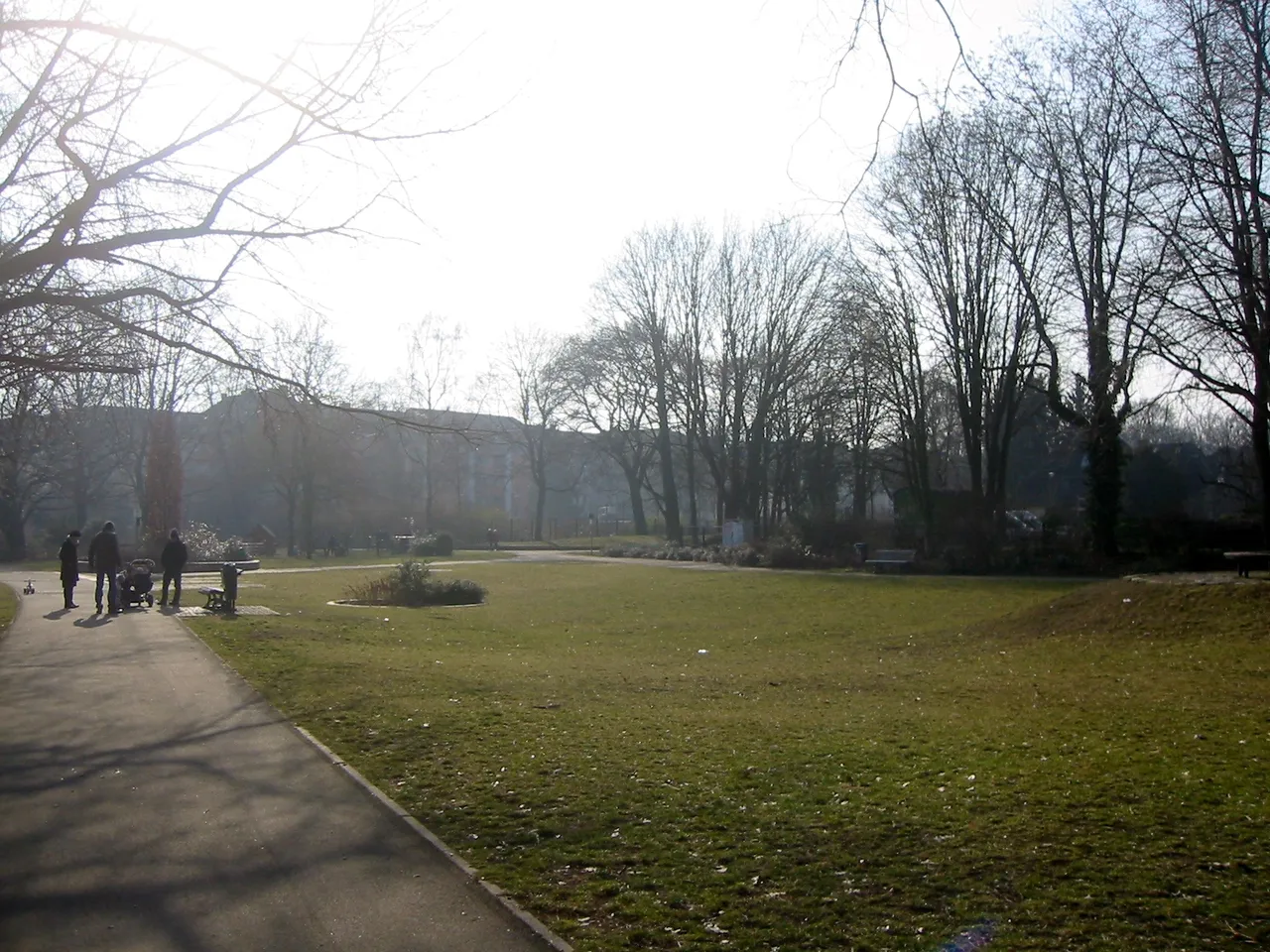
Mentzelpark sits at the eastern end of the S47 line, a seven-minute walk from Schloss Köpenick. The Spree slides past on one side. A covered pergola runs through the middle, its vines turning the path into a green tunnel by July.
Come for the waterfront promenade and the observation platform where barges still pass. Stay for what the quiet hides: red-brick tenements from 1873, a rubble hill recycled from WWII debris, and a name that commemorates a landowner whose villa nobody can quite locate anymore.
If you're already in Köpenick for the Altstadt or Luisenhain, this park rewards a detour. It's less manicured than the central Berlin parks, and that's the point.
01 What to see.
The Laubengang — a Green Tunnel from the Flemmingpark Era
Walk in from Flemmingstraße and the pergola swallows you. Climbing vines knit across timber ribs overhead, and in July the whole thing becomes a dappled green corridor, the kind of shaded tunnel where light moves like water on the path.
Here's the detail nobody points out: two generations of pergola stand end-to-end. The older section survives from the estate's Flemmingpark days, the newer one grafted on later, and if you walk the full length you can feel the material shift under your fingers — weathered joints giving way to crisper, squarer timber.
Winter strips it back to architecture. Skeletal, exposed, the bones legible. Benches sit along the length; locals treat it like an outdoor reading room.
The Rodelhügel and the Lost Viewpoint
The hill shouldn't be here. It's a rubble mound — WWII debris piled up, grassed over, now a sledding slope for families during Berlin's rare snow weeks. A literal palimpsest: destruction flattened into a park feature.
Climb the worn stairs to the plateau and you'll notice the strange thing. This was designed as a scenic overlook, but the trees planted around it have grown into a wall. The view the architects intended is gone, absorbed by the same greenery they planted. Standing there is standing at a viewpoint that no longer works — and the absence is the point.
Glimpses of the Spree still break through in winter when the canopy thins. In summer, just shade and birdsong.
Spree Promenade and the Wilhelm-Spindler-Brücke
The metal-railed observation platform juts toward the river like a small pier, angled to catch Spree traffic — excursion boats in summer, working barges year-round, diesel engines audible from the far bank. Panoramic north. Reflections of the 2002 Wilhelm-Spindler-Brücke drop into the water: a three-span prestressed concrete arch clad in light-gray Oberlausitzer granite, cool and rough-dressed when you touch it.
This is also where the fishermen are, quietly. Easy to miss. They're a continuation of the working-class recreational culture that shaped this whole bend of the river, back when W. Spindler's laundry empire employed the neighborhood. Stand on the platform long enough and the industrial logic of Spindlersfeld — water, transport, labor — rearranges itself into something you can read.
Step Outside: the Werkssiedlung Spindler
Don't leave without walking one block onto Mentzelstraße or Färberstraße. The brick terraces you'll see — 1873, 1875, and 1887 — are the first industrial worker settlement in Berlin built by a private company, housing up to 50 Spindler laundry families at its peak. All monument-protected today.
The park and the settlement are one story. Albert Mentzel, brother-in-law of Carl Spindler, owned the estate that became this green space; the houses around the corner housed the workers who dyed and cleaned Berlin's linens from 1854 onward, when W. Spindler pioneered chemical cleaning in Germany. Pair the walk with a swing south to Luisenhain, 600 metres along the Spree toward Schloss Köpenick, and you've traced the full arc from industrial labor to royal leisure in under an hour.
Plan and listen to Q15867295 with Audiala.
Audio guide in your pocket, itinerary in your browser. Built for the way you actually visit.
03 Visitor logistics.
The practical scaffolding for a good visit — kept short.
Getting There
Take S-Bahn S47 to its eastern terminus, S Spindlersfeld — roughly 30 minutes from Alexanderplatz. From the station, it's a 400m walk south along Oberspreestraße to the park entrance. Buses 162, 164, 165 and Tram 63 also serve the area; the N63/N64/N65 cover night hours.
Opening Hours
As of 2026, Mentzelpark is open 24/7, year-round, with no gates or closing times. The children's playground is fenced but not locked. Winter sledding on the Rodelhügel runs roughly December through February when snow holds.
Time Needed
30–45 minutes to walk the promenade, pergola, and observation platform. Allow 2–3 hours if you're combining with the 590m stroll to Schloss Köpenick. A full Sunday plan — park, Alt-Köpenick, onward to Müggelsee — runs 10–15 km and 4–6 hours.
Cost
Free. No tickets, no gates, no on-site café or kiosk. Bring your own water and snacks — nearest shops sit near the S-Bahn station, not inside the park.
Accessibility
Mostly flat paved paths along the Spree promenade and pergola, suitable for wheelchairs and strollers. The Rodelhügel (rubble mound) has stairs to the plateau and no ramp. Slope embankments were renovated in 2011, but expect some gravel and tree-root patches away from the main promenade.
04 Tips for visitors.
Small things that change the day.
Sunny Sunday Only
Locals are blunt: don't bother on a cold grey weekday. The park comes alive on sunny weekends when barges pass, the pergola vines shade the benches, and Spindlersfeld families fill the playground.
Eat In Alt-Köpenick
No food on-site. Walk 15 minutes east to Waschhaus Alt-Köpenick (mid-range beer garden with boat pier) or Ratskeller Köpenick (mid-range German cellar, 4.7★). Altstadtcafé Cöpenick handles budget waterfront coffee.
Drone Rules
Drones over 250g need LBA registration and €750,000 liability insurance, 120m altitude cap, no overflight of people. Check Berlin's UAS geozone map before flying — the adjacent Wasserstadt construction zone and residential blocks make low-altitude flight awkward.
Start A Longer Walk
Mentzelpark is the standard trailhead for Spindlersfeld → Dahme-Spree confluence → Alt-Köpenick → Müggelsee, a 10–15 km flat walk along Grüner Hauptweg 1 (Spreeweg). Well-marked, low-traffic, and shared with EuroVelo R1 cyclists.
Read The Worker Houses
Before entering the park, detour two minutes up Mentzelstraße (1873, 1875) and Färberstraße (1887) — Berlin's first company-built industrial worker settlement, housing up to 50 Spindler laundry families. All protected monuments. No interpretive signage on site, so knowing the story matters.
Buy Spindlersfelder Honig
Sozialstiftung Köpenick runs four organic honeybee colonies in the park — 30–40 kg per colony every 3–4 weeks, cold-extracted. If you spot the branded jars at local community events or the foundation shop, buy one: it's the park's only genuine souvenir.
Low-Risk Area
Spindlersfeld has no tourist scams — it's a quiet residential outer borough, 4,103 residents, almost no foreign footfall. Standard Berlin pickpocket caution still applies on the S47 to and from central stations.
Pair With Schloss Köpenick
The baroque island palace sits 590m southeast, 7 minutes on foot. Combining both gives you the full Köpenick arc: Spindler industrial heritage at the park, then Hohenzollern court life across the water.
Where to Eat
Don't Leave Without Trying
Restaurant Facil
fine diningOrder: The seasonal tasting menu—each course is masterfully presented with bold, refined flavors and impeccable technique.
Berlin's finest dining experience with an exceptional sommelier, attentive service, and minimalist elegance. Worth the splurge for a special evening.
A Mano
local favoriteOrder: Modern Italian pasta and fresh fish plates with creative twists—reviewers rave about the bold, refined flavors and careful plating.
A genuine Italian gem where every dish is thoughtfully prepared. The stylish atmosphere and warm service make it a locals' favorite for special occasions.
Luardi Cucina della mamma
local favoriteOrder: The truffle pasta is divine—locals return specifically for it. Don't skip the fresh bread with homemade Italian olive oil.
Berlin's busiest Italian restaurant for good reason: authentic home-style cooking with an owner who's genuinely invested in every table. Reserve ahead, especially weekends.
Alchemist Café
cafeOrder: Homemade cheesecake and tiramisu—everything is house-made. The hot chocolate arrives with beautiful latte art.
A cozy neighborhood sanctuary with excellent coffee and pastries. Perfect for a quiet break, with friendly staff and good space for work.
Dining Tips
- check Tipping is expected (5–10% standard). Tell the server your total including tip—don't leave cash on the table.
- check Cash is still dominant, especially at small restaurants and cafés. Carry €20–50.
- check Fine dining requires 1–2 weeks advance reservation; popular spots may need 4+ weeks.
- check Lunch typically runs 12:00–14:00; dinner 18:00–21:00. Many kitchens stop taking orders by 21:30–22:00.
- check Weekend brunch is hugely popular—book 2–5 days ahead at trendy spots.
- check Card payment is increasingly accepted, but call ahead if paying by Amex.
Restaurant data powered by Google
05 The Four-Day Empire
Before 1871, this stretch of the Köpenick shoreline was marshland. Records show that Wilhelm Spindler, a Berlin silk dyer who had brought benzene dry-cleaning back from Paris in 1854 — the first such process in Germany — bought roughly 50 hectares here at age 61. He intended to build the largest modern laundry in Europe.
What he built instead was a village. The factory needed workers, the workers needed houses, and Köpenick was too far from Berlin to commute. By December 29, 1873, the Brandenburg provincial government had officially named the new settlement Spindlersfeld. Albert Mentzel, Spindler's brother-in-law, owned the estate that became this park.
Ribbon, Stroke, Funeral: April 1873
On April 24, 1873, Wilhelm Spindler stood in formal dress at the inauguration of the first wing of his steam-powered chemical laundry. Records show steam vats the size of rooms, a private rail spur to the Spree for freight, and hundreds of workers already moving into finished red-brick tenements on what is now Mentzelstraße. He was 63. He had staked every mark he had on this marshland.
Four days later, on April 28, 1873, he was dead of a stroke. His sons Carl and William inherited a half-built factory, a payroll of more than two thousand workers, and creditors who had not expected to deal with grieving twenty-somethings. The turning point wasn't the ribbon — it was what happened after. The sons finished the complex, scaled it to 1,886 workers by 1896, and made Spindlersfeld synonymous with industrial laundry across the German Empire.
Wilhelm never saw any of it operational. The park you're walking through carries his brother-in-law's name because the Spindler name went to the factory, the village, the railway station, and the brand. Mentzel got the garden.
The Worker Village That Came First
From Private Estate to Public Green
Listen to the full story in the app
The whole Q15867295,
told well.
Audio guides for 1,100+ cities across 96 countries. History, stories, and local insight — offline ready.
06 Frequently asked.
The questions travellers send us most about Q15867295.
Is Mentzelpark worth visiting?
Yes, if you want a quiet Spree-side park with real industrial history and zero tourists. Skip it on a cold grey weekday — it's a neighborhood park, not a destination. On a sunny Sunday, pair it with Alt-Köpenick and the Schloss for a half-day in Berlin's southeast.
How do I get to Mentzelpark from central Berlin?
Take S-Bahn S47 to its eastern terminus, Spindlersfeld — roughly 30 minutes from Mitte. The park is a 5-minute walk from the station via Oberspreestraße. Buses 162, 164, 165 and Tram 63 also serve the area.
How long do you need at Mentzelpark?
Thirty to forty-five minutes for the park itself — it's only about 1.5 hectares. Add an hour if you walk the adjacent Spindler worker-housing streets (Mentzelstraße 1873, Färberstraße 1887) and cross the Wilhelm-Spindler-Brücke. Most visitors combine it with the 10–15 km walk to Müggelsee via Alt-Köpenick.
Can you visit Mentzelpark for free?
Yes. The park is public, open 24/7, year-round, no admission. There's no café, no ticket booth, no gate — just benches, a playground, a pergola and the riverbank.
What should I not miss at Mentzelpark?
The Laubengang pergola in summer, when climbing vines turn it into a green tunnel, and the riverside observation platform for watching Spree barges. Climb the Rodelhügel — a post-WWII rubble mound now used for sledding — and step one block inland to see the 1873 Spindler worker housing, Berlin's first company-built industrial settlement. The beekeepers of "Das Große Summen" keep four colonies here producing Spindlersfelder Honig.
What is the best time to visit Mentzelpark?
Late spring through early autumn, when the pergola is overgrown and the Spree is busy with excursion boats. Winter works too if snow falls — the Rodelhügel becomes a functioning sledding hill for local families. Sunday mornings are quietest; weekday mornings bring parents with toddlers to the fenced playground.
Is Mentzelpark safe?
Yes, very. Spindlersfeld is a low-traffic residential enclave with no documented scams or tourist-targeted crime. Standard S-Bahn pickpocket caution applies on the ride in from central Berlin, not in the park itself.
What is the history behind Mentzelpark?
The park sits on the former estate of Albert Mentzel (1839–1922), brother-in-law of laundry magnate Carl Spindler, and became public green space when Berlin bought it in 1925. The surrounding Spindlersfeld neighborhood grew from Wilhelm Spindler's 1871 purchase of 50 hectares of Köpenick marshland for what became Germany's first dry-cleaning factory — Spindler himself died on 28 April 1873, four days after inaugurating it. The adjacent 1873–1887 worker houses on Mentzelstraße and Färberstraße are protected monuments and the first industrial company housing built in Berlin.
Verified, and shown.
Researched and written by the Audiala editorial team from historical records, architectural archives, and local expertise.
Core facts on park history, features, Rodelhügel rubble mound, 1925 city acquisition.
Neighborhood history, Spindler worker housing monument listings, 1873 village naming.
Biography of Wilhelm Spindler, 1854 dry cleaning pioneer, death April 28 1873.
Local historical society notes on Wilhelm Spindler's life and legacy.
Detailed industrial saga of Spindler factory, worker settlement, Schering sale, VEB Rewatex era.
Post-reunification Treuhand sale to Larosé and 1995 closure.
Transport and infrastructure context for Spindlersfeld neighborhood.
Local food options near the park.
East German industrial operation at Spindlersfeld; 1989 production figures.
Local crowdsourced description of Mentzelpark as a favorite place.
Adjacent Spree corner entry, local attachment.
Visitor-facing description of the Laubengang and park features.
Playground details, age range, equipment.
Walking/cycling waypoint, waterfront promenade notes.
Street register entry for Mentzelpark location.
2002 bridge, Oberlausitzer granite cladding, three-span prestressed concrete arch.
Photographic documentation of the neighborhood.
Popular 10–15 km walking route using Mentzelpark as starting point.
Citizens' initiative against Wasserstadt luxury development.
Local petition to preserve green space against development.
Community beekeeping project, Netzwerk Leben im Kiez.
Four bee colonies, harvest figures, organic honey branding.
Local press on honey harvest at the park.
Official district profile, 2024 population 4,103.
Reporting on stalled Wasserstadt luxury development.
Coverage of planned luxury riverfront housing.
Public consultation on the zoning plan.
Political demand to halt construction pollution.
Official green corridor route passing through the park.
Nearby restaurant and beer garden recommendation.
Classic Altstadt cellar restaurant near the park.
German federal drone rules, LBA registration, 120m altitude cap.
General S-Bahn pickpocket safety guidance.
Researched from Wikidata, Wikipedia & official sources · fact-checked · How we make our guides →