Introduction
Why does a building that survived five years of Allied bombs finally burn down on 8 May 1945 — the day after Germany surrenders? The Altes Museum on Berlin's Museum Island holds that answer, and a stranger one: it was the first public museum in Prussia, opened in 1830 as a radical act of giving royal art to the people. Today its 18 Ionic columns still face the Lustgarten lawn, and if you look closely at them, you can see shrapnel scars the restorers chose not to polish away.
Stand on the Lustgarten side at opening time, before the tour groups arrive. The portico stretches 87 metres across, flat and calm, hiding a 23-metre rotunda behind it like a secret. Karl Friedrich Schinkel called that rotunda the Pantheon in his drawings — a direct quote of Rome's temple to all the gods, repurposed as a temple to Bildung, the German idea that any citizen can cultivate themselves through culture.
Inside lives the Antikensammlung, Berlin's collection of Greek, Roman, and Etruscan antiquities — the Praying Boy bronze, Apulian vases, Roman portraits of emperors whose names you half-remember from school. But the building itself is the main exhibit. Come for the Greeks; stay for what Schinkel built, what the war broke, and what East German restorers deliberately left undone.
What to See
The Rotunda
Schinkel labeled this room "Pantheon" on his own drawings, and he meant it. A circular hall rises 22 metres under a coffered dome studded with winged genii and zodiac signs most visitors never spot, because they never look up. Sixteen Greek deities stand at arm's reach on the floor — Nike with her laurels, Asclepius with his serpent staff, Apollo mid-cithara — arranged in facing pairs across the central axis, a choreography Schinkel worked out himself.
The light does the rest. A glazed oculus sends a shaft of daylight down through the dome, warmed red-gold by the cassettes, and it moves across the marble as the sun shifts. Mornings are theatrical; overcast afternoons turn everything silver and hushed.
One caveat worth knowing. The rotunda burned out completely under Allied bombing and Soviet shelling in 1945, and what you're standing in is a 1958–1966 reconstruction, with the statues restored only in 1999–2000. German restorers rebuilt Schinkel's vision cassette by cassette from surviving fragments and drawings. Sit on the bench for twenty minutes. The acoustic hum of the dome is part of the exhibit.
The Portico and the Granitschale
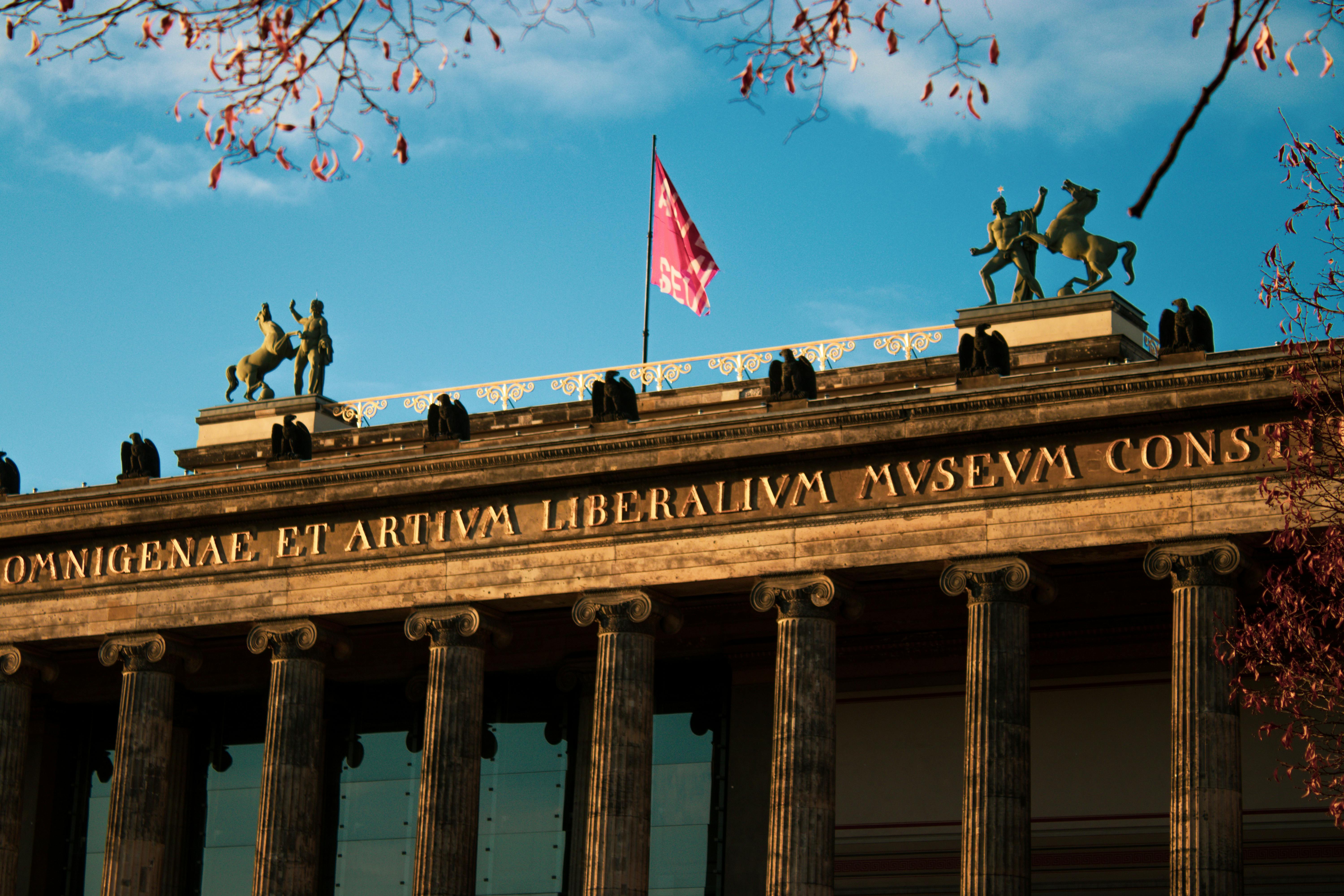
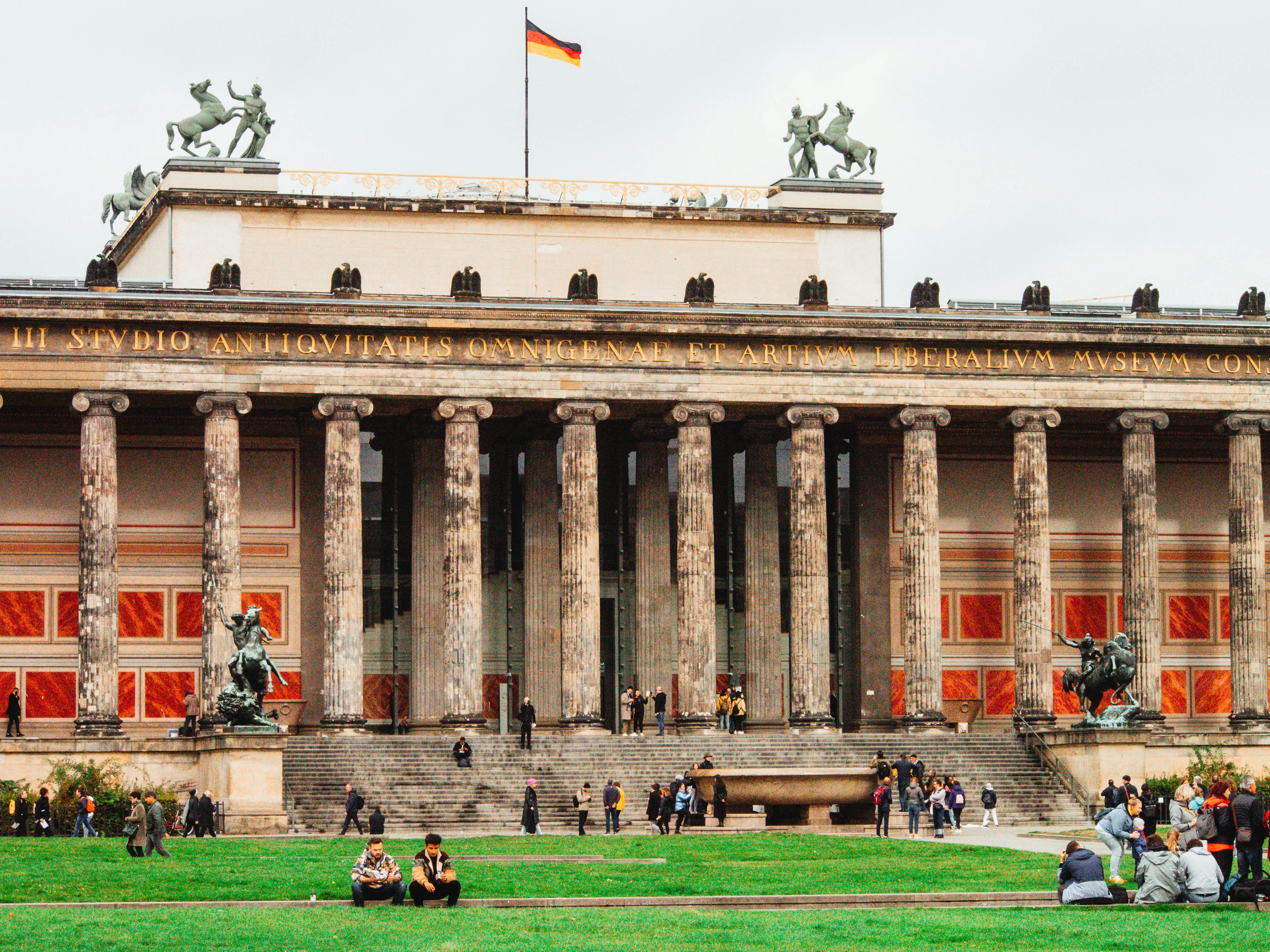
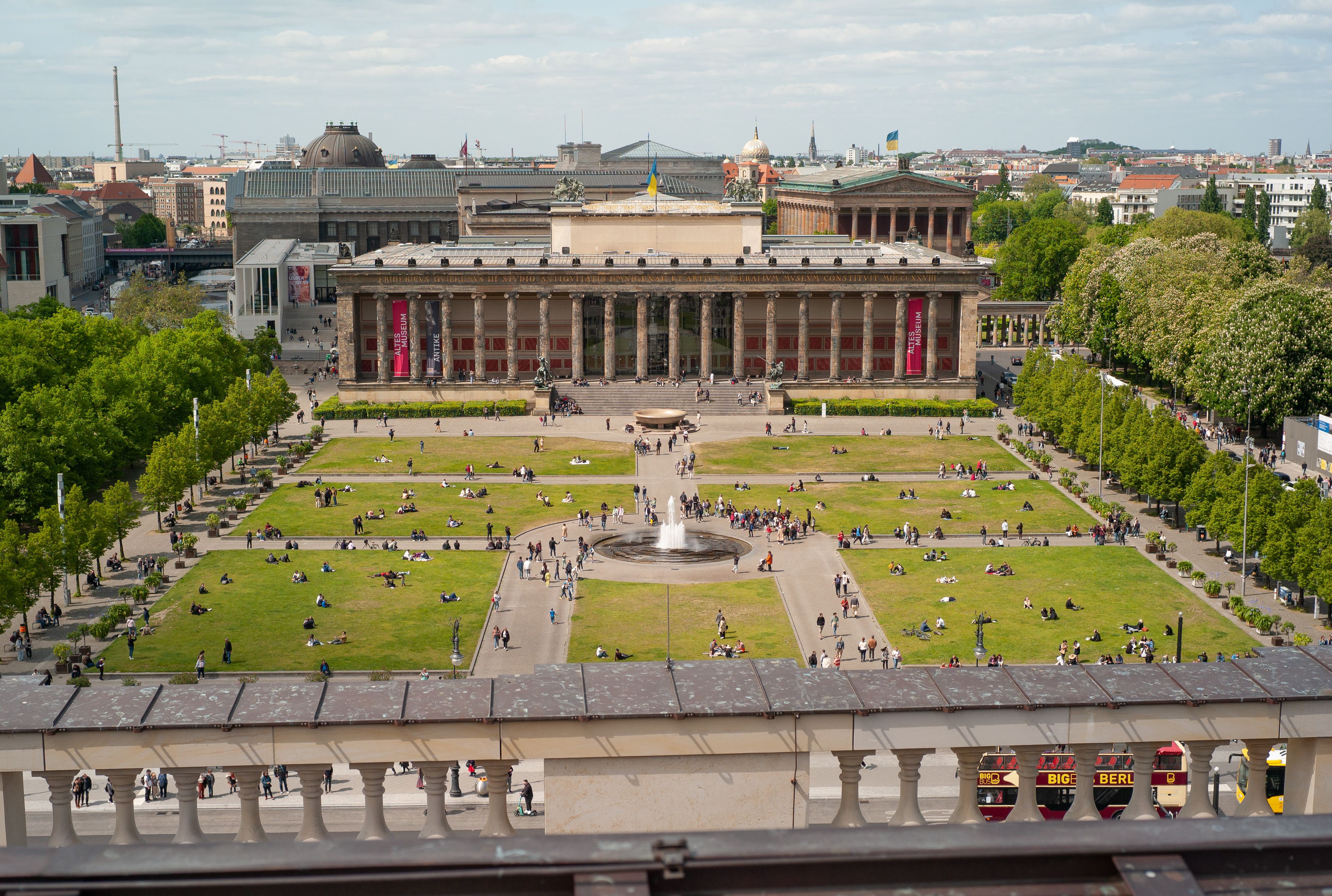
Eighteen Ionic columns march the full 87-metre width of the facade without a single break — no projections, no pediment interrupting the line, just a horizontal wall of pale Silesian sandstone quarried and hauled by Prussian stoneworkers between 1825 and 1830. Schinkel wanted grandeur previously reserved for kings handed to ordinary Berliners climbing the open stair from the Lustgarten. Read the Latin frieze from down on the square, not from under it. Up close you're standing inside the inscription, not reading it.
In front of the museum squats the Granitschale, a polished bowl 6.91 metres across and weighing roughly 75 tonnes — the largest vessel ever carved from a single stone. Stonecutters finished it from a glacial erratic near Fürstenwalde, then discovered it was too wide for the rotunda doors. So it stayed outside. Run a hand along the rim and you'll feel the transition from rough pedestal to mirror-polished interior, and if you look carefully you'll find the reddish granite patch crossing a WWII bomb crack — a repair left deliberately visible, like the pockmarks on the entrance columns.
Upper Floor — the Quiet One
Most visitors stop at the rotunda and the Greek ground floor, which means the upper level stays blissfully empty. Go up. You'll find the largest Etruscan collection outside Italy — bucchero ware so glossy-black it looks lacquered, a house-shaped urn from Chiusi that preserves the roofline of a 7th-century BC Etruscan home, and the Silver Treasure of Hildesheim, a Roman silver hoard dug up in Lower Saxony in 1868. Downstairs the Berliner Göttin (580–560 BC) still carries faint red pigment on her marble garment — proof that every "white" antiquity you've ever seen was once loudly painted. Bring time, not a checklist.
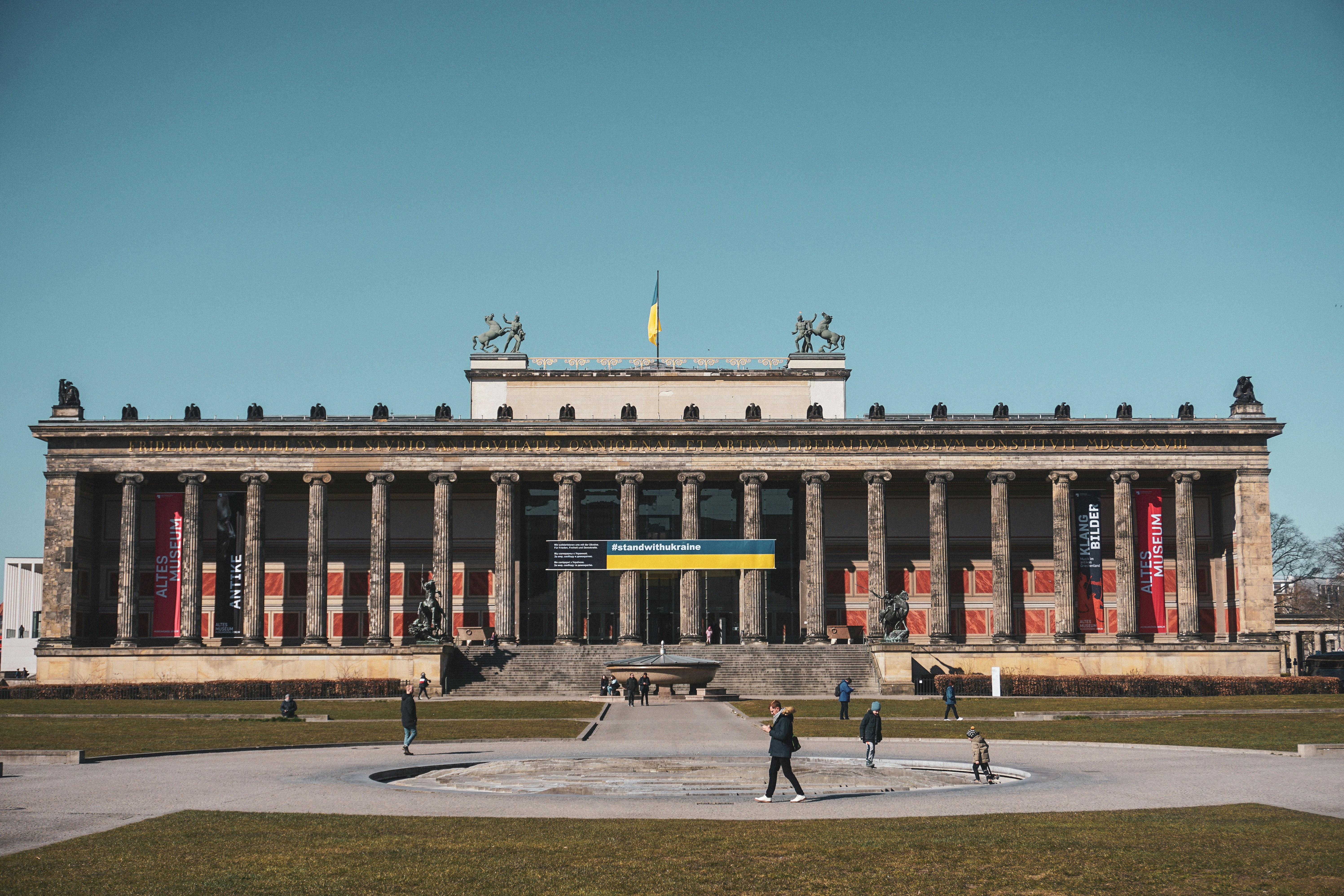
Photo Gallery
Explore Q156722 in Pictures

Visitors gather on the lawn and around the fountain in front of Q156722 in Berlin. The long colonnaded facade stands out under heavy, shifting clouds.
Tanapatjms · cc by-sa 4.0

Soft daylight washes across the grand interior of Q156722 in Berlin, revealing a formal staircase, coffered ceiling, and restrained classical detailing. A single figure by the open door gives scale to the quiet space.
Gunnar Klack · cc by-sa 4.0

Q156722 rises above a long flight of steps with a commanding row of weathered stone columns. Bright daylight sharpens the geometry and scale of this neoclassical Berlin landmark.
Gunnar Klack · cc by-sa 4.0

The grand neoclassical facade of Q156722 stands out in Berlin at dusk, its tall columns framing a vivid red neon installation. Statues flank the staircase, where a few visitors sit beneath the evening light.
Galleria fumagalli · cc by-sa 4.0

The grand neoclassical facade of Q156722 stretches across a broad lawn in central Berlin. Small groups of visitors and bright daylight emphasize the scale of its long colonnade.
Gunnar Klack · cc by-sa 4.0

A painted interior detail at Q156722 in Berlin shows ancient Egyptian figures, offerings, and hieroglyphic bands across a pale stone wall. The scene is photographed in soft indoor light, with muted colors and visible age in the surface.
Hienafant · cc by-sa 4.0

Q156722 stands across a broad green lawn in Berlin, its long colonnaded facade lit by clear midday sun. A central path, fountain, and a few visitors give the grand neoclassical building scale.
Rəcəb Yaxşı · cc by 4.0

The neoclassical frontage of Q156722 rises behind a bronze equestrian statue in central Berlin. Bright daylight picks out the columns, Latin inscription, and rooftop eagle sculptures.
Rəcəb Yaxşı · cc by 4.0

The image shows the monumental neoclassical facade of Q156722 in Berlin, with fluted columns, a Latin inscription, and sculpted figures along the roofline. Clear daylight and an empty foreground keep the focus on the building's scale and symmetry.
Rəcəb Yaxşı · cc by 4.0

The image shows Q156722 in Berlin, Germany, with tall stone columns, a bronze equestrian sculpture, and strong midday light against a clear blue sky. A lone visitor near the entrance gives scale to the monumental facade.
Rəcəb Yaxşı · cc by 4.0

The image shows the grand neoclassical facade of Q156722 in Berlin, framed by towering columns and a dramatic bronze statue in bright daylight. Clear blue skies and strong sunlight sharpen the building's monumental presence.
Rəcəb Yaxşı · cc by 4.0

Q156722 stands prominently in Berlin with its long neoclassical colonnade, broad steps, and open lawn in front. Soft daylight and scattered visitors give the scene a calm, monumental feel.
Jonaseckerbom · cc by-sa 4.0
Step up close to the 18 Ionic entrance columns and examine the stone surface: repair patches from Allied bombing and Soviet artillery (1945) are deliberately left unretouched and visible — a quiet memorial most visitors walk past without noticing.
Visitor Logistics
Getting There
U5 Museumsinsel station (opened 2021) drops you at the Schlossbrücke exit, under two minutes on foot to the portico. Tram M1 or M12 to Am Kupfergraben stops directly beside the museum, and S-Bahn lines 3/5/7/9 to Hackescher Markt mean a 10-minute walk across the Spree. Skip driving — no parking on the island; nearest garages are Dom Aquarée and Tiefgarage Bebelplatz, roughly 200m away.
Opening Hours
As of 2026: closed Mondays, open Tuesday–Friday 10:00–17:00, Saturday–Sunday 10:00–18:00. Last entry 30 minutes before closing. Closed December 24 and 31; January 1 opens at 12:00.
Time Needed
Rotunda plus headline pieces (Praying Boy, Berlin Goddess, Caesar busts): 45–60 minutes. A comfortable wander through the Greek, Etruscan and Roman floors runs 1.5–2 hours. Give it three hours if you want to read the labels and sit with Schinkel's architecture.
Tickets & Passes
Adult €14, concession €7, under-18s free. The Museumsinsel Day Pass at €24 covers all five island museums and pays off after two; the 3-day Berlin Museum Pass at €32 hits 30+ venues. Book online via smb.museum to scan past the queue.
Accessibility
Step-free entry is via the east-side service door, with elevators to every floor and accessible restrooms. Audio guides and large-print material are stocked at the info desk. Message the museum ahead if you need wheelchair assistance on arrival.
Tips for Visitors
Beat The Buses
Tuesday or Wednesday at 10:00 opening, or after 16:00 once school groups clear out, are the genuinely quiet windows. Saturday afternoons on the island are a scrum — locals avoid them on principle.
Photography Rules
Handheld shooting is fine, but flash, tripods, monopods and selfie sticks are banned, and special exhibitions often forbid cameras entirely. For the Rotunda, bump your ISO and use the natural window light — it's softer than anything a flash would give you.
Pickpocket Hotspot
Berlin police flag Museumsinsel as one of the city's top pickpocket zones — bump-and-grab in queues, ketchup-spill distraction tricks. Wear your bag on your front, keep nothing valuable in outer backpack pockets, and buy tickets only from smb.museum or the official desk.
Eat Off The Island
Island cafés charge island prices. Walk five minutes to Curry61 at Hackescher Markt for a proper Berlin currywurst (budget, €5–8), or Kebap with Attitude in Mitte for free-range döner; Zimt & Zucker on the Spree is the mid-range sit-down locals actually rate.
Money-Saving Moves
Under-18s walk in free, students get 50% with ID. If you're staying more than two days, the €40 annual pass for all Berlin state museums beats any combo ticket — it's what Berliners themselves buy.
Don't Miss Lustgarten
Before you go in, look at the 8.5m granite bowl on the square — 70+ tons of polished stone that locals call the Suppenschüssel, the soup bowl. And check the portico columns: the patched shrapnel scars from 1945 are deliberately left visible.
Name Confusion
Altes Museum and Alte Nationalgalerie are different buildings with different collections — guidebooks mix them up constantly. Schinkel's 18-column portico facing the Lustgarten is the one you want; the Nationalgalerie sits behind, looking like a Corinthian temple on a plinth.
Bag Check Rules
Anything larger than roughly 30×20×10 cm has to go in the cloakroom — lockers take a €1–2 coin, returned on release. Small camera bags pass if you carry them in front of you.
Where to Eat
Don't Leave Without Trying
Ephraims
fine diningOrder: Traditional German dishes — schnitzel or eisbein executed perfectly; never too salty, never too heavy.
Historic mansion right on the Spree with river terrace. Elegant interior, warm service. Locals and visitors both come here for authentic German food done right, not tourist shortcuts.
Luardi Cucina della mamma
local favoriteOrder: Truffle pasta — reviewers call it 'absolutely divine.' Homemade olive oil from Italy, fresh ingredients that taste alive.
Berlin's most beloved Italian restaurant with 8,500+ reviews. Saturdays book weeks out. The owner works the room; service feels familial, not transactional.
Flamingo Fresh Food Bar
quick biteOrder: Omelette — superb, tasty, perfectly portioned. Pancakes and rice pudding also reliable. Excellent coffee.
Bright, airy space near Friedrichstraße filled with locals, not tour groups. Clean execution on simple, honest food. Staff genuinely welcoming.
YADA YADA "breakfast club"
cafeOrder: Scrambled eggs cooked with rich flavor and perfect texture. Pastries impossibly soft — cinnamon sugar variety is a standout.
Hip coffeehouse with warm, inviting vibes. Regulars describe it like visiting mom's house. Coffee is excellent (not aggressive), every ingredient tastes fresh.
Dining Tips
- check Breakfast strong 7:00–10:00 AM; weekend brunch extends to 14:00 in cafes
- check Lunch traditional main meal 12:00–14:00; many restaurants offer Mittagstisch specials
- check Dinner 18:00–21:00; kitchens often open until 22:00–23:00+ in trendy spots
- check Cash essential — many restaurants, street stalls, pubs are cash-only
- check Tipping not mandatory; 5–10% standard at casual places, up to 15% at upscale venues
- check Tell server total you want to pay when handing over cash (e.g., bill €15.90 → hand €20, say 'achtzehn bitte')
- check Book 1–2 weeks ahead for popular/fine-dining; casual spots need 1–2 days notice
- check Germans expect reservations for groups even at casual venues; use OpenTable or Quandoo
Restaurant data powered by Google
Historical Context
A Temple for the People, Burned in Peacetime
In 1810, philosopher Wilhelm von Humboldt and architect Karl Friedrich Schinkel began lobbying King Frederick William III to build something Prussia had never had: a museum open to everyone, not just the court. It took thirteen years to get royal approval. The cornerstone was laid on 9 July 1825, and on 3 August 1830 the doors opened — the first public museum in Berlin, then called simply the Königliches Museum. It picked up its current name, the Altes Museum, in 1845, when the Neues Museum opened next door.
Records show Schinkel worked around an awkward triangular plot by hiding a perfect rotunda behind a perfectly rectangular facade — architectural sleight of hand. The 18 Ionic columns weren't just decoration. They were a statement: this is a temple, and the gods here are knowledge and art, and you are invited in.
Wilhelm von Humboldt's Last, Costly Gift
The official story says the Altes Museum is Schinkel's masterpiece — a neoclassical jewel, product of Prussian ambition and royal patronage. Tourists read the 1828 dedication inscription above the portico and move on to the Greek bronzes inside.
But something doesn't fit. Why, in 1829 — one year before the museum opened — did King Frederick William III put a 62-year-old philosopher in declining health in charge of deciding what Prussia would publicly display? Wilhelm von Humboldt wasn't a curator. He was an education reformer whose wife Caroline had just died, whose hands were beginning to tremble with what we'd now recognise as early Parkinson's.
The answer, according to Humboldt's own writings, is that the museum was never really about the art. It was the material form of his philosophy of Bildung — the idea that a state's duty is to give every citizen the means of self-cultivation. He took the selection committee appointment the year his personal life collapsed because this was the last chance to build it in stone. He was ageing rapidly, grieving, and working anyway. He died in 1835, five years after the opening.
Knowing this changes the portico. Those 18 Ionic columns aren't quoting Athens for decoration. They're Humboldt's argument — that a Prussian farmer or shopkeeper deserves the same access to Phidias and Praxiteles as a Hohenzollern prince — translated into stone by a friend who understood exactly what was at stake.
The Fire After the War Ended
The building survived five years of Allied bombing largely intact. Then, on 8 May 1945 — the day after Germany's unconditional surrender — a fuel truck exploded directly in front of the portico. The interior gutted. The fire destroyed Peter Cornelius's monumental fresco cycle across the portico and stairwell, painted 1841 onwards to Schinkel's designs, which scholars describe as among the most important frescoes of the 19th century. Only two of Schinkel's original sketches survived, now in the Kupferstichkabinett. Restoration ran from 1951 to 1966 under Hans Erich Bogatzky and Theodor Voissen, who made a deliberate choice: restore the spirit, don't fake the details. The ornate ground-floor ceiling systems were not rebuilt. The paired columns under the girders were not rebuilt. The passage Stüler built in 1844 to the Neues Museum was removed entirely.
From Public Garden to Parade Ground and Back
The Lustgarten in front of the museum has been a political mirror of Germany for two centuries. Lenné laid it out as a public park in 1826, framing Schinkel's new temple of learning with lawns and fountains. In 1921–1922, up to half a million Berliners gathered here to protest the assassination of foreign minister Walther Rathenau — one of Weimar's largest democratic assemblies. Then the Nazis paved it over as a rally ground, removing every plant. After reunification, landscape architect Hans Loidl restored it in Lenné's 1826 spirit, finished in 1998. Sit on the grass today and you're sitting on a compressed biography of modern Germany: royal garden, democratic square, fascist parade ground, civic lawn.
More than a million artworks seized from Berlin museums by Soviet Trophy Brigades in 1945 remain in Moscow and St. Petersburg, their full inventory still unknown; provenance scholars are actively tracing specific Altes Museum pieces, and a complete accounting of what Cornelius actually painted on the lost fresco cycle may never be recoverable.
If you were standing on this exact spot on 8 May 1945, you would smell petrol before you saw the flames. Germany surrendered yesterday; Soviet soldiers are already drinking in the Lustgarten rubble. A fuel truck goes up in front of the portico with a concussion you feel in your ribs, and fire climbs the columns into the rotunda, devouring Cornelius's frescoes while nobody runs to save them — the war is over, and the museum burns anyway.
Listen to the full story in the app
Your Personal Curator, in Your Pocket.
Audio guides for 1,100+ cities across 96 countries. History, stories, and local insight — offline ready.
Audiala App
Available on iOS & Android
Join 50k+ Curators
Frequently Asked
Is the Altes Museum worth visiting? add
Yes, especially if Pergamon's closure through 2027 has redirected you here. Schinkel's 1830 rotunda rivals any single room on Museum Island for architectural power, and the building sees a fraction of the crowds its neighbors do. Come for the space itself, not just the Greek bronzes.
How long do you need at the Altes Museum? add
Plan 1.5 to 2 hours for a comfortable visit. Highlights only (rotunda, Praying Boy, Berlin Goddess, Caesar bust) fit into 45-60 minutes. Give it 2-3 hours if you want the upper Etruscan floor, which most visitors skip entirely.
How do I get to the Altes Museum from Alexanderplatz? add
Walk. It's about 10 minutes west via Spandauer Straße, crossing onto Museum Island at the Lustgarten. If you'd rather ride, take the U5 one stop to Museumsinsel (opened 2021) and exit toward Schlossbrücke — under 2 minutes on foot from there.
What is the best time to visit the Altes Museum? add
Tuesday or Wednesday right at the 10:00 opening, or after 16:00 when tour buses leave. Thursday evenings run until 20:00 and thin out after 18:00. Avoid Saturday afternoons — locals do.
Can you visit the Altes Museum for free? add
Under-18s are always free, and the first Sunday of every month is free for all visitors across the Berlin State Museums (reservations required). School groups also enter free. Otherwise adult entry is €14, concession €7.
What should I not miss at the Altes Museum? add
The rotunda — stand in the center, then look up at the zodiac signs and winged genii in the coffered dome. On the ground floor, find the Praying Boy bronze (c. 300 BCE) and the Berlin Goddess with her traces of original red pigment. Outside, touch the Granitschale in the Lustgarten — the 75-tonne granite bowl locals call the "Suppenschüssel" (soup bowl).
What is inside the Altes Museum? add
The Antikensammlung — Greek, Etruscan, and Roman antiquities, plus the Münzkabinett coin collection. Ground floor holds Greek sculpture including the Praying Boy and portrait busts of Caesar and Cleopatra. Upper floor holds the largest Etruscan collection outside Italy and the Roman Silver Treasure of Hildesheim.
Is the Altes Museum the same as the Alte Nationalgalerie? add
No — different buildings, different collections, and guidebooks confuse them constantly. The Altes Museum (Schinkel, 1830) holds classical antiquities and faces the Lustgarten. The Alte Nationalgalerie (Stüler, 1876) holds 19th-century painting and sits behind it on the same island.
Sources
-
verified
Staatliche Museen zu Berlin — Altes Museum Profile
Official museum profile, history, Schinkel intent quotes
-
verified
SMB — Opening Hours
2026 hours including Tuesday reopening and holiday closures
-
verified
SMB — Prices & Tickets
Adult €14, concession €7, under-18 free, day pass details
-
verified
SMB — Museum Regulations (Antikensammlung)
Photography rules, accessibility, bag policy
-
verified
SMB — Concessions & Free Admission
First-Sunday free entry, annual pass pricing
-
verified
SMB — Current Exhibitions (Altes Museum)
Founded on Antiquity anniversary exhibition dates
-
verified
SMB — Altes Museum Events
Guided tour program including Ancient Highlights tour
-
verified
SMB — The Lost Museum exhibition
WWII losses and Soviet trophy art context
-
verified
SMB — Long Night of Museums announcement
Lange Nacht der Museen participation
-
verified
SMB — Kolonnaden Bar 2024
Summer bar reviving 1890s leisure tradition
-
verified
SMB — HERE WE ARE! youth outreach project
Youth committee governance of museum interpretation
-
verified
SMB — Haus Bastian political education
Achtet AlisMB model project background
-
verified
SMB — Apulian Vase Restitution to Italy
2024 repatriation of 25 objects and reciprocal loan
-
verified
SMB — Provenance Research
Antikensammlung provenance research position paper
-
verified
SMB — Antikensammlung Acquisition Logs
Public transparency on accessions
-
verified
SMB — Altes Museum Home
General visitor info and etiquette
-
verified
Google Arts & Culture — Rotunda
Rotunda iconography, Schinkel Pantheon label, 1980s restoration
-
verified
ArchEyes — Altes Museum architectural analysis
Schinkel design analysis, democratic intent, facade
-
verified
e-architect — Altes Museum Building
Visible WWII repair patches on columns
-
verified
Wikipedia — Altes Museum
Core history, dates, Cold War GDR repurposing
-
verified
Wikipedia — Granitschale im Lustgarten
75-tonne granite bowl dimensions and story
-
verified
Wikipedia — Lustgarten
Lustgarten trajectory from royal garden to civic lawn
-
verified
Britannica — Karl Friedrich Schinkel
Schinkel biography, 1840 stroke, 1841 death
-
verified
Explore PSL — Humboldt Brothers
Wilhelm von Humboldt 1829 selection committee role
-
verified
berlin.de — Wilhelm and Alexander von Humboldt
Humboldt biography and museum role
-
verified
Traces of War — Altes Museum
May 8 1945 fuel truck fire detail
-
verified
Berlin Luft Terror — Das Alte Museum
WWII bombing damage and 1951-1966 restoration
-
verified
Entwicklungsstadt — Altes Museum renovation
Bogatzky/Voissen postwar reconstruction choices
-
verified
Entwicklungsstadt — Lustgarten history
Lustgarten political biography
-
verified
Medium — Revisiting the Lost Museum
Soviet trophy art numbers
-
verified
Apollo Magazine — Red Army Trophy Art
Objects still held in Moscow and St. Petersburg
-
verified
UNESCO Deutsche Kommission — Museumsinsel
1999 World Heritage designation
-
verified
Museumsinsel Masterplan
Masterplan timeline and visitor figures
-
verified
Preussischer Kulturbesitz — Masterplan
Pergamon closure through 2027, construction phasing
-
verified
Preussischer Kulturbesitz — 200 Jahre jubilee
2025-2029 anniversary cycle
-
verified
mi200.de — 200 Years Museum Island
Inselfest program and anniversary events
-
verified
Deeds News — Founded on Antiquity exhibition
Anniversary exhibition July 2025-May 2026
-
verified
Lange Nacht der Museen Berlin
Annual Long Night of Museums event
-
verified
visitBerlin — Lustgarten
Lustgarten contemporary civic use
-
verified
visitBerlin — Museum Island
Museum Island overview
-
verified
About visitBerlin — Kolonnaden Bar
Kolonnaden Bar 1890s tradition revival
-
verified
berlin.de Landesdenkmalamt — Altes Museum
Heritage listing
-
verified
berlin.de — Am Lustgarten venue
Lustgarten as official event venue
-
verified
Berlin Police — Theft Prevention
Museum Island pickpocket warning
-
verified
Museumsportal Berlin — Altes Museum
Tour schedule and program info
-
verified
Museum Island Berlin — Cafes & Restaurants
On-island dining options
-
verified
Wonderful Museums — Best Restaurants Near Museum Island
Nearby restaurant recommendations
-
verified
Wonderful Museums — Altes Museum
Museum overview
-
verified
The Touristin — Altes Museum Berlin
Visitor experience notes
-
verified
TripAdvisor — Altes Museum
Visitor opinions and crowding patterns
-
verified
Sehenswürdigkeiten Berlin — Altes Museum
Historical background
-
verified
Berlin Tickets — Altes Museum
Ticket and audio guide info
-
verified
Toorists — Altes Museum Berlin
Photography rules summary
-
verified
Welcome to Berlin — Berliner nicknames
Local nicknames including Suppenschüssel
-
verified
Travellers Archive — Berlin Insider Tips
Local timing advice
-
verified
Original Berlin Tours — Mitte safety
Mitte neighborhood safety context
-
verified
Cuddlynest — Mitte area guide
Neighborhood orientation
-
verified
Curry 61
Nearby currywurst stand
-
verified
Kebap with Attitude
Nearby döner kebab restaurant
-
verified
Cultural Property News — Apulian Vase return
2024 restitution to Italy details
-
verified
Kulturprojekte Berlin — Museumsdienst
30+ year outreach program context
Last reviewed: