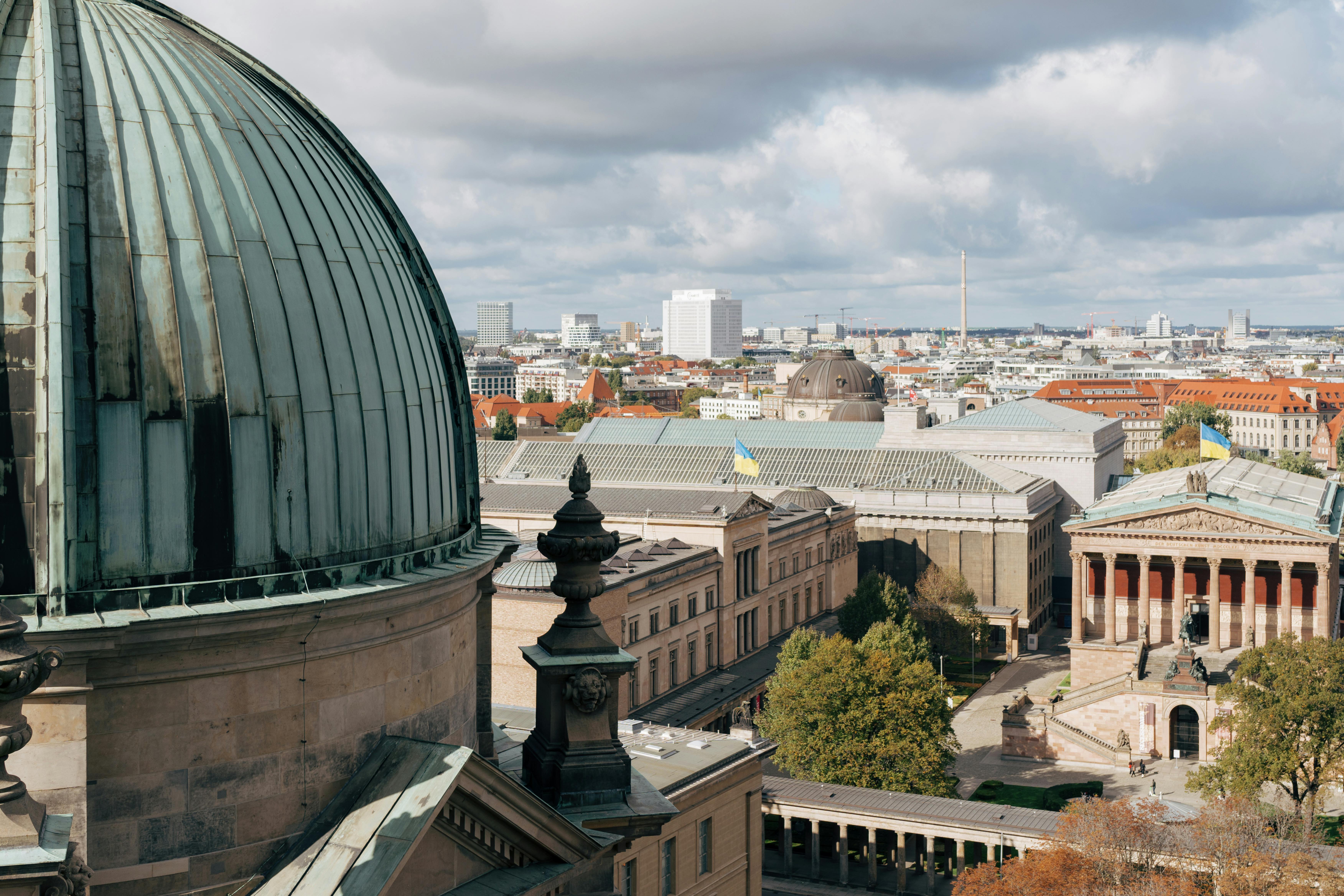
Why does Berlin's grandest museum of antiquity make its strongest point when you can't even enter it? The Pergamon Museum in Berlin, Germany, earns a visit because its closed doors, scaffolding, and nearby panorama expose the real drama of the place: not a tidy vault of ancient masterpieces, but a century-long argument about empire, reconstruction, war, and what a museum is allowed to fake in order to make you believe. Today, on Museum Island, you face a long neoclassical mass of pale stone and silence, while nearby at Pergamonmuseum. Das Panorama the light shifts across rebuilt ruins and the whole story feels oddly unfinished.
Most visitors come expecting the Pergamon Altar, the Ishtar Gate, and the Market Gate of Miletus. Fair enough. But the stranger truth is that the building itself is one of Berlin's great exhibits: damaged in war, reworked in peace, and still under a renovation so large that the first restored section is scheduled to reopen only on 4 June 2027, according to the museum.
That changes the mood completely. Instead of rushing from masterpiece to masterpiece, you start noticing the weight of the architecture, the hush over the island, the sense that this museum has spent much of its life being repaired, argued over, or reimagined.
Come here for the ancient monuments, yes. Stay for the colder, more interesting revelation: Pergamon is also a portrait of Berlin itself, a city that keeps rebuilding the same dream and never quite finishes it.
Researched by the Audiala editorial team from historical records, architectural archives, and local expertise.
What to see
The 360° Panorama Rotunda
The surprise in 2026 is that the famous museum itself is shut behind scaffolding, while the real drama happens across the way inside Pergamonmuseum. Das Panorama at Am Kupfergraben 2. Walk through the dim object galleries and the room suddenly opens into a rotunda more than 30 meters high, about the height of a 10-storey Berlin apartment block, where Yadegar Asisi wraps ancient Pergamon around you in a 104-meter circle; light slides from dawn to night, a low carpet of sound rises and falls, and from the top platform you stop reading archaeology as dead stone and start seeing a city with smoke, theater crowds, workshops, and a festival day in 129 AD.
The Telephos Frieze and the Small Things People Rush Past
Most visitors aim straight for the tower, which is a mistake. The sharper experience begins in the darker galleries, where the Telephos Frieze catches changing light across its carved surfaces and the smaller works fight back against the big spectacle: a parrot mosaic flickers against a deep red wall, robed statues gather their shadows, and the Prometheus group stands before an abstract gold Caucasus that sounds odd on paper and looks quietly brilliant in person; suddenly the museum stops being a monument to empire and becomes a lesson in how curators stage feeling.
Museum Island Detour While the Main Building Sleeps
Treat the closure as part of the story and circle the outside before or after your visit. From the Spree edge opposite the Bode Museum, the sealed Pergamonmuseum reads as a wounded giant by Alfred Messel and Ludwig Hoffmann, opened in 1930 after an earlier museum on the same site had already failed because the ground beneath it gave way; then step back toward the temporary panorama building, whose industrial cylinder and 108-meter exhibition wing feel almost cheeky beside Berlin's stone classicism, and you understand that this place has always been less about tidy display than about rebuilding antiquity at absurd scale, then rebuilding the museum itself when that ambition cracks.
Plan your visit
Getting There
As of 2026, you are not heading into the closed main Pergamon Museum building but to Pergamonmuseum. Das Panorama at Am Kupfergraben 2, 10117 Berlin. Take U5 to Museumsinsel, or S-Bahn to Friedrichstraße for a 5-6 minute walk across the canal; Hackescher Markt is about 0.6 km away, roughly 8-10 minutes on foot, and drivers should expect to use public garages near Unter den Linden or Dorotheenstraße because the museum has no dedicated parking.
Opening Hours
As of 2026, Pergamonmuseum. Das Panorama is open Tuesday-Sunday from 10:00 to 18:00 and closed on Mondays, with no separate summer or winter timetable posted. The main Pergamonmuseum remains closed for renovation through 2026, with a partial reopening scheduled for 4 June 2027; holiday exceptions already listed for late 2026 include closure on 24 and 31 December and Sunday hours on 3, 25, and 26 October/December dates where applicable.
Time Needed
Give it 45-60 minutes if you want the core experience: the giant panorama, the shifting light, and a quick pass through the displays. Allow 75-120 minutes if you use the included audio guide, linger on the viewing platforms, and fold in the cafe; on its own, this is not a half-day museum but a smart stop inside a Museum Island day.
Accessibility
As of 2026, the Panorama venue is officially fully wheelchair accessible, with an accessible entrance, accessible toilet, cloakroom, lockers, and indoor circulation designed for mobility aids rather than heroic effort over cobbles. Audio guides in multiple languages, children's versions, simplified language, and audio description are included, and SMB's info line at +49 30 266424242 can confirm wheelchair availability before you go.
Cost & Tickets
As of 2026, the current working price is €14 regular and €7 reduced for Pergamonmuseum. Das Panorama, despite one stale English page still showing the older rate. Children and teens under 18 enter free, the Museumsinsel + Panorama combined ticket costs €24 regular or €12 reduced, and the best money move is to book online up to 4 weeks ahead or aim for Museum Sunday, the first Sunday of each month, after checking that month's participation.
History
A Museum Built Twice, Believed Once
The clean version says Berlin built a museum for spectacular finds from the ancient city of Pergamon and opened it in 1930. Records show the reality is rougher, and better: this is the second museum on the site, because the first one opened in triumph on 18 December 1901 and then had to be demolished in 1909 when the ground beneath it failed.
That pattern never really stopped. Alfred Messel shaped the project in the first decade of the 20th century, Ludwig Hoffmann carried it on after Messel's death in 1909, war tore into the building in 1945, Soviet trophy removals emptied out its star objects, and the present restoration has driven more than 700 micropiles into the earth below like medical pins in a broken bone.
The turning point
The Altar You Think You Know
At first glance, the Pergamon Museum seems to tell a simple story: Berlin rescued a complete Hellenistic masterpiece and built a palace around it. Tourists looked up at the altar's broad stair and colonnaded front as if antiquity had arrived here more or less intact, only needing a good roof and German efficiency.
Then the details start misbehaving. Records show engineer and archaeologist Carl Humann noticed sculpted marble fragments at Pergamon in the 1870s while pieces were being burned in lime kilns, which means the monument was already shattered and reused long before Berlin claimed it. And the version visitors later admired in Berlin was never a complete ancient survival anyway: official museum research states that well over 80% of the reconstructed west facade is modern supplement rather than ancient stone.
The turning point came when Humann understood what was at stake, personally and professionally. If he misread those fragments, he was just another excavator chasing rubble; if he was right, he had found the object that could lift German archaeology into the same prestige contest as the Louvre and the British Museum. He was right. But the museum that grew from that discovery also created a powerful illusion, because Berlin did not simply display the altar: it rebuilt an idea of it.
Once you know that, your gaze changes. The staircase stops looking like pure antiquity and starts reading as a collaboration across centuries, with Hellenistic sculpture, Byzantine reuse, imperial ambition, and Berlin plaster all standing in the same frame.
The Mud Under the Masterpiece
The first Pergamon Museum failed for a brutally physical reason. Records show the predecessor building suffered structural damage from subsoil problems and had to be torn down in 1909, which gives the site an almost comic honesty: this museum literally sank under the weight of what it wanted to show. The present closure feels less like bad luck once you know that instability has haunted the address from the beginning.
War, Absence, Return
In 1945, bombing and artillery left the museum badly damaged, with shattered roofs and scarred masonry. Then came the quieter wound: major works, including parts of the Pergamon Altar, were taken to the Soviet Union and only returned in 1958 and 1959. What reopened in East Berlin was not the same museum that had closed; it was a survivor, patched together after defeat and political division.
Tips for visitors
Photo Rules
Personal photography is generally allowed, which helps because the panorama's artificial dusk light does strange, theatrical things to stone and shadow. Flash, selfie sticks, and tripods are not allowed, and any commercial shoot needs written permission from SMB.
Queue Scams
Museum Island is safe, but pickpockets work the soft edges: S-Bahn platforms at Hackescher Markt and Friedrichstraße, ticket lines, and the space near Humboldt Forum. Ignore clipboard petitions and anyone selling unofficial fast-track entry; use the SMB shop only.
Eat Elsewhere
Skip the generic museum-snack mood unless you need speed. For a budget bite, Bandy's Currywurst near Karl-Liebknecht-Straße does the Berlin classic for about €5-€10; for mid-range, Bistro Lebenswelten in the Humboldt Forum lands around €12-€18, while Restaurant Baret is the splurge pick at roughly €40-€70 with the kind of rooftop view that makes the construction cranes look almost intentional.
Pair It Well
This works best as one chapter of a larger Museum Island circuit, not the whole book. Combine it with the museums around the island, then walk south toward Alexanderplatz if you want Berlin to shift from marble calm to tram-bell noise in under fifteen minutes.
Bag Limits
Small bags are fine, but anything larger than 30 x 20 x 10 cm has to be checked, and storage for real luggage is limited enough to spoil your timing. Heavy coats, wet jackets, and bulky backpacks belong in the cloakroom if you want to move through the galleries without feeling like a pack mule.
Best Timing
Go soon after opening or in the last 90 minutes before closing, when the crowd thins and the sound inside drops from school-trip murmur to something closer to a low tide of footsteps. Grey Berlin weather actually helps here: the indoor light effects feel richer when you come in from a damp, silver afternoon.
Order: Order the Mountain Cheese Dumplings, then add the sauerbraten and sausage if you're sharing. Reviews keep coming back to those plates for a reason.
This is one of the better ways to eat German food in Mitte without committing to a heavy one-plate dinner. The small-plates format lets you try the classic flavors Berlin visitors actually come looking for, and the room still feels like a place people choose for birthdays, not just somewhere they drift into.
Order: Go for the tasting menu, and if those dishes are on, pay attention to the scallop, halibut, beef, and duck. The tea pairing also gets unusually strong praise.
Dae Mon is the polished night out on this list: moody room, sharp service, and a menu that treats dinner like a sequence rather than a transaction. It feels very Berlin in the best sense, stylish without the dead formalism.
Contemporary international restaurant with strong brunch and cocktails€€star4.7(1564)
Order: For dinner, get a few plates to share and order a spicy margarita or the Orchard alongside. Reviews are consistent on the rich flavors and the cocktail list.
Nomad has the kind of menu locals return to because it covers more than one mood well: brunch, dinner, and drinks all seem to matter here. Service also gets called out, which in Berlin is not trivial.
All-day European brasserie with Italian-leaning comfort food and breakfast€€star4.7(1906)
Order: The vegetarian lasagna has the most emphatic praise in the reviews, and the English breakfast and espresso are strong picks earlier in the day.
Barist is useful in the most practical way: long hours, plenty of seats, breakfast through late-night food, and a room grand enough to feel like you chose it on purpose. Around Museum Island, that flexibility matters.
checkAround Pergamon Museum, think wider than the museum itself: the useful dining zone is Mitte, especially Hackescher Markt and Oranienburger Straße.
checkA very Berlin eating day looks like this: bakery breakfast, street-food lunch, then either hearty German food or casual international dinner.
checkIf you want classic local flavors, start with currywurst, döner, pfannkuchen, buletten, or eisbein.
checkIn Berlin, Pfannkuchen means a jam-filled doughnut, not a pancake.
checkHackescher Markt has a weekly market on Saturday. The supplied research confirms the day, but not the hours.
checkMarkthalle Neun's Street Food Thursday runs on Thursday, with the event day confirmed by multiple sources in the research set.
checkÖkomarkt am Kollwitzplatz runs on Thursday, with that day confirmed by multiple sources in the research set.
checkManifesto Market at Potsdamer Platz is listed in the research as open daily from 11:00 to 22:00, but that timing appears in only one supplied source.
Food districts:Mitte / Museum IslandHackescher MarktOranienburger StraßePotsdamer PlatzKreuzbergPrenzlauer BergNeuköllnCharlottenburg
Restaurant data powered by Google
Watch & Explore Pergamon Museum.
Ishtar Gate and Processional Way of Babylon Pergamon museum Berlin
Visit Places1 min8K
【4K】Get Inside Pergamon Museum in Berlin - Full Museum Tour
Walker's Story28 min6K
The Magical Art of Ancient Civilizations | The Pergamon Museum, Berlin, Germany, 2023 4K
Durar Bacri Art Studio15 min13K
Frequently asked
Is Pergamon Museum worth visiting?
Yes, but in 2026 you are visiting the idea of Pergamon rather than the famous halls themselves. The main Pergamon Museum is closed for renovation as of July 24, 2026, so the real visit is Pergamonmuseum. Das Panorama on Am Kupfergraben 2, where a 30-meter-high rotunda wraps ancient Pergamon around you like a painted drum taller than a 10-story building. Go if you want atmosphere, the Telephos frieze in changing light, and a smart stop on Museum Island; skip it if your heart is set on the original altar hall or the Ishtar Gate.
How long do you need at Pergamon Museum?
Plan on 45 to 90 minutes for Pergamonmuseum. Das Panorama. A quick pass takes about 45 to 60 minutes, while the audio guide, three viewing platforms, and the slow shift from daylight to dusk inside the rotunda can stretch the visit closer to 90 minutes. It works best as one chapter in a wider Museum Island day, not as a half-day anchor.
How do I get to Pergamon Museum from Berlin?
The current Pergamon visit is easy to reach by public transport because the open venue sits on Museum Island at Am Kupfergraben 2, 10117 Berlin. The closest U-Bahn stop is Museumsinsel on U5; Friedrichstraße and Hackescher Markt are the handiest S-Bahn stations, each an easy walk of roughly 0.4 to 0.6 kilometers, about the length of four to six city blocks. From central Berlin, walking often beats a taxi.
What is the best time to visit Pergamon Museum?
The best time is a weekday morning soon after opening, when the galleries feel calmer and the rotunda lands with more force. Pergamonmuseum. Das Panorama is open Tuesday to Sunday from 10:00 to 18:00 and closed on Mondays, so arriving early gives you more room to notice the soundscape, the changing light, and tiny scenes in the city panorama instead of shuffling behind a crowd. Winter or summer matters less here because the drama happens indoors.
Can you visit Pergamon Museum for free?
Yes, sometimes, but not as a general rule. Children and teens under 18 enter free, and the venue also joins Berlin's Museum Sunday on the first Sunday of the month, when free tickets are usually released online; otherwise the current standard ticket for Pergamonmuseum. Das Panorama is generally €14, with €7 reduced admission. Check the museum's official booking pages before you promise yourself a free slot.
What should I not miss at Pergamon Museum?
Do not miss the top viewing platform inside the panorama rotunda. From up there, ancient Pergamon opens in layers: a steep theater cut into the slope, festival crowds, workshops, and shifting light that makes the city breathe rather than sit still. Also slow down for the Telephos frieze and the small Parrot Mosaic, because the little things often stay with you longer than the big spectacle.
Sources & attribution15
Researched and written by the Audiala editorial team from historical records, architectural archives, and local expertise. Last updated July 2026.
Berlin.de - Museum Sunday — Used to support that Pergamonmuseum. Das Panorama participates in Berlin's free Museum Sunday listings.
Pergamonmuseum. Das Panorama Floor Plan PDF — Used for the layout, viewing platforms, included audio guide, and the physical dimensions of the rotunda and exhibition spaces.
VisitBerlin - Pergamon Museum — Used to confirm the phased reopening and that landmark displays such as the Ishtar Gate will return later than the first 2027 reopening stage.
The Aleppo Room panorama — Photograph by Mike Peel (www.mikepeel.net). — CC BY-SA 4.0 (https://creativecommons.org/licenses/by-sa/4.0/) — Source: https://commons.wikimedia.org/wiki/File:The_Aleppo_Room_panorama.jpg
(20260607) Berlin Museum Island 132148 — Roy Zuo — CC BY-SA 4.0 (https://creativecommons.org/licenses/by-sa/4.0/) — Source: https://commons.wikimedia.org/wiki/File:(20260607)_Berlin_Museum_Island_132148.jpg
Pergamonmuseum Front — Raimond Spekking — CC BY-SA 4.0 (https://creativecommons.org/licenses/by-sa/4.0/) — Source: https://commons.wikimedia.org/wiki/File:Pergamonmuseum_Front.jpg
Strictly necessary cookies keep the site working. Analytics (PostHog, Google Analytics) measures how each visitor uses our pages. Marketing loads YouTube videos and walking-route maps without a tap and lets Google Analytics set advertising cookies. We never sell your data. You can change this any time from the footer.
Analytics and marketing cookies are optional and only load if you agree. Details under Customize.
Privacy
Cookie preferences
Pick what you're okay with. You can change this any time from the footer.
Strictly necessary
Always on
Sign-in, language, navigation. Always on.
Product analytics
PostHog (EU) and Google Analytics record which pages you view and how you use them, under a random identifier stored in your browser. Helps us see which pages work and which need fixing. Google's ad personalisation stays off. No selling.
Marketing
Loads YouTube videos and the walking-route maps (OpenFreeMap) without a tap; without it, they load only when you tap them. If analytics is also on, Google Analytics may set advertising cookies. Ad personalisation stays off.