Flat paved promenade with broad river staircases; largely step-free
Best season
Summer (June-August)
The woman this Berlin park has honored for 118 years left behind no photograph, no birth record, no death date — only her name carved into a riverbank promenade in Köpenick. Luisenhain sits on the Dahme in Berlin, Germany, a 1.33-hectare ribbon of yellow stone and bronze named for Luise Asseburg, a private citizen most visitors confuse with Queen Luise of Prussia. Come for the river light on the hawthorns at dusk. Stay because almost everything you assume about this park is wrong.
The park opened in 1908 as Köpenick's first public green space, funded by an 80,000 Reichsmark donation from Luise's brother Karl Otto Asseburg, a merchant who wanted his sister remembered "for all eternity." Records show the deed had exactly one condition: demolish the buildings at Schloßstraße 19 and keep the plaza open forever. What stood there before 1906 — nobody documents.
Today the promenade reads as a quiet riverside stroll between the old town of Köpenick and the Dahme, five S-Bahn stops from central Berlin. Look closer. The yellow stone paving carries bronze inlays nobody has catalogued. The bronze Kugelspielerin you photograph isn't the original — that one vanished around 1950 and has never been found. And the concrete woman rising from her plinth was sculpted by a Jewish communist who survived the Nazis in a Black Forest hideout, then spent four decades refusing East Germany's highest honors.
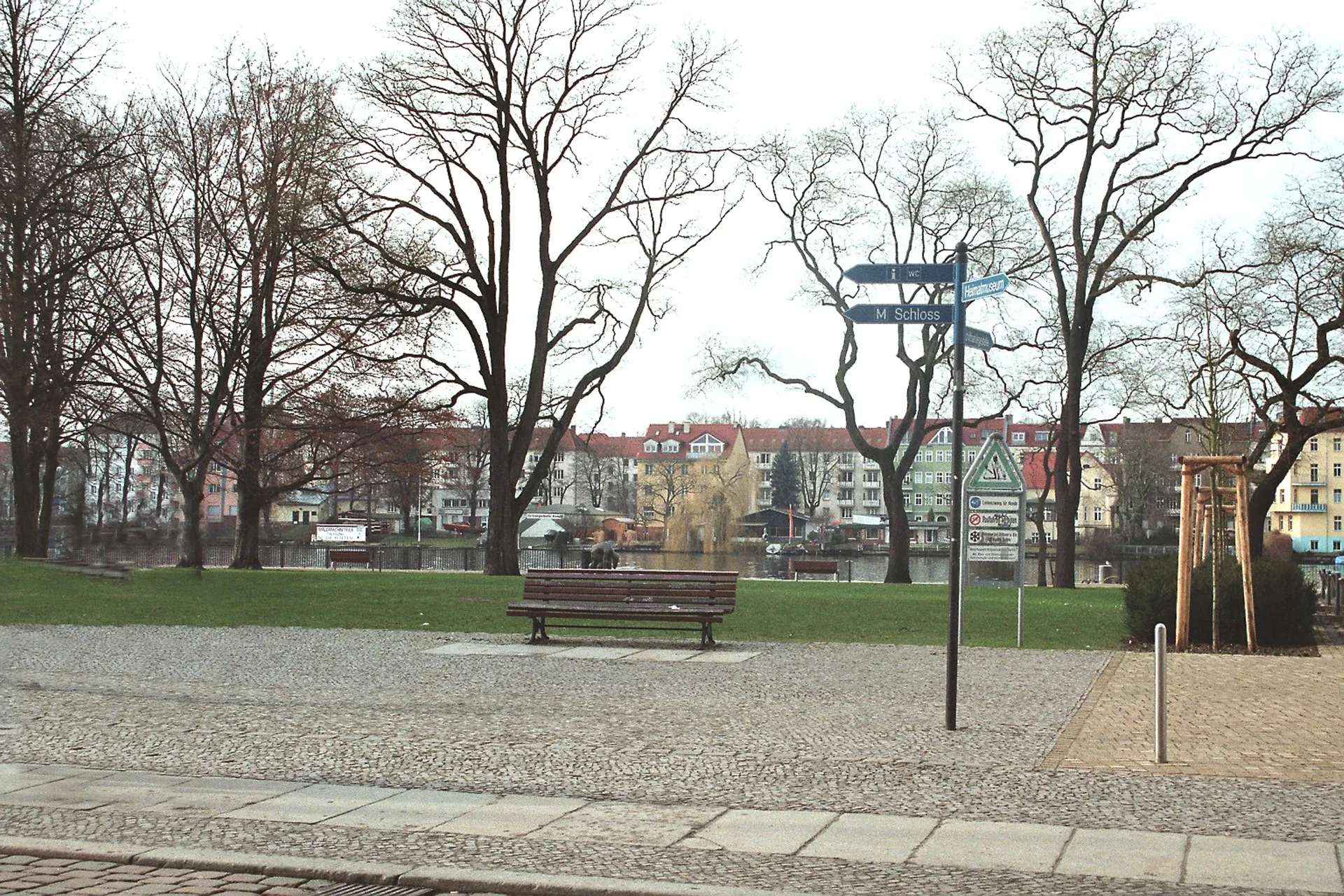
The park runs 13,284 square meters along the water — roughly the footprint of two football pitches laid end to end. Four shallow stone staircases drop to the Dahme. Yew hedges frame the sightlines low enough that the river is always visible. At night, spotlights hit the hawthorns from below and turn the canopies into lanterns. It costs nothing to enter and never closes.
Researched by the Audiala editorial team from historical records, architectural archives, and local expertise.
What to see
The Stadtharfe — a park shaped like a musical instrument
Most Berlin parks grow outward from a lawn. Luisenhain works differently. Landscape firm ST raum a. redesigned the 13,284 m² strip in 2005–2006 for 1.4 million euros, and they built it around a metaphor you can walk on: a harp laid flat between Köpenick's Altstadt and the Dahme river.
The granite pathways are the strings — narrow, deliberately so, echoing the medieval alleys behind you. The yellow natural-stone promenade along the water is the frame. Crouch down on that promenade and you'll notice what most visitors miss: bronze inlays flush with the stone, cool to the touch on a summer afternoon when the yellow pavers have been baking for hours.
Four broad, shallow staircases drop to the water. Take any of them. At river level the air cools two or three degrees, the Dahme laps audibly against the stonework, and the Köpenick Rathaus across the water drops to a waterline perspective you can't get anywhere else. Come back after dark if you can. Spotlights catch the hawthorn crowns from below, and the whole promenade turns theatrical.
Sculptures, a stolen bronze, and a model you're meant to touch
The park's art history reads like a short ledger of loss and repair. In 1950, during Berlin's nonferrous-metal theft wave, Walter Schott's bronze "Die Kugelspielerin" — a woman mid-throw in a game of boccia — vanished. Never recovered. Ingeborg Hunzinger's 1987 concrete figure "Die sich Erhebende" replaced that sense of a human presence, only to be vandalized repeatedly; a 2017 restoration cost over 9,000 euros, and the piece was removed to a depot in 2020. Check before you go — its current whereabouts are a moving target.
What you can count on is Dieter Seiler's bronze relief model of the Altstadt, installed 2009 for Köpenick's 800th anniversary. It sits on a single steel column at 1:1500 scale, showing the old town, Schlossinsel, and the Kietz district. The surface is cast with Braille labels for blind visitors.
Here's the part sighted visitors almost always skip: run your fingers across it. The raised lettering, the ridged streets, the Schloss picked out by touch — you read the town with your hand, then look up and find the actual rooftops above the hedge line. It's the best five minutes in the park.
The half-hour Köpenick waterline walk
Start at the Dammbrücke end and keep the Dahme on your right. The promenade runs only a few hundred metres to the Lange Brücke, but slow down — this is a walk about detail, not distance. Drop to water level at the first staircase. Listen. Come back up. Find the bronze inlays in the yellow pavers (they're easier to spot from a low angle, with the sun behind you).
Past the musical installations scattered in the lawn — usually written off as children's equipment, worth engaging as an adult — you reach the Seiler model. Read it with your fingertips. Then walk the last stretch toward Lange Brücke and look upriver: baroque Schloss Köpenick appears on its island, best in morning light.
Finish at Pier Köpenick (Luisenhain), the river-cruise embarkation stage, and either board a boat or loop back through the Altstadt alleys the granite "strings" were built to echo. For a longer day, pair this with the Spreetunnel Friedrichshagen two S-Bahn stops east — both belong to the same water-facing Berlin most visitors never reach.
Plan your visit
Getting There
S-Bahn S3 or S47 to S Köpenick, then 5–10 min walk through Alt-Köpenick to the riverside (~25 min from Alexanderplatz). Tram 63 stops at Rathaus Köpenick, one minute from the promenade. Driving: nav to Alt-Köpenick 22-32, 12555 Berlin; street parking on Alt-Köpenick or the Kirchstraße 8 lot ~400m away.
Opening Hours
Open 24/7, year-round — no gates, no fences, no closures. As of 2026, Altstadt Köpenick remains a major construction zone until ~2027, with tram detours and pedestrian reroutes on Alt-Köpenick; check BVG before you go. Best months for terraces and river cruises: late May through early October.
Time Needed
30–60 min for a quick promenade, the Hunzinger sculpture, and the tactile Altstadt model. Two to three hours if you add the Lange Brücke crossing, Schloss Köpenick island, and a riverside lunch. Half a day to do Fischerkiez and a Dahme boat trip properly.
Cost
Free, always. No tickets, no booking, no audio guide upsell. The on-site public WC is also free under Berlin's open toilet network.
Accessibility
The Stadtharfe promenade (2004–2006 redesign) is flat yellow stone and granite — easy for wheelchairs and strollers. Barrier-free route runs from the Rathaus Köpenick tram stop. The boat pier and the on-site public WC are not wheelchair-accessible; the tactile 1:1500 bronze model of the Altstadt is designed for visually impaired visitors.
Photo Gallery
A metal information pillar in Luisenhain shows a map model of Köpenick's old town. Trees, grass, and a few visitors give the Berlin park a calm afternoon feel. · LotseA bronze tactile map at Luisenhain presents the layout of the historic riverside quarter in miniature. Warm afternoon light picks out the streets, walls, and clustered buildings. · LotseLuisenhain stretches along the water in Berlin with mature trees, promenades, and striking red-brick church towers rising behind the park. Soft daylight and dramatic clouds give the riverside scene a calm, open feel. · Paul KoreckyLuisenhain stretches along the water in Berlin, framed by historic church towers, bare winter trees, and quiet riverside paths. Soft daylight reflects off the river and gives the skyline a calm, crisp look. · NylkiA bronze scale model stands along the Luisenhain promenade in Berlin, catching the low golden light beside the river. Benches, greenery, and a few distant people frame the quiet waterfront scene. · LotseLuisenhain opens onto a quiet riverside lawn framed by tall bare trees and a cobbled walkway. Across the water, pastel residential buildings give this Berlin scene a calm neighborhood feel. · DguendelA quiet scene at Luisenhain in Berlin shows pedestrians strolling beside the canal under leafless trees. The black-and-white photograph captures the calm waterside atmosphere in soft, muted light. · Horst Sturm
History
The Sister Nobody Remembers
On June 23, 1906, Karl Otto Asseburg — a Köpenick-born merchant then 69 years old — signed over 80,000 Reichsmarks to the municipality with instructions to build a "decorative plaza in honor of my sister Luise Asseburg, who rests in God." Records show the donation specified demolition of the existing structures at Schloßstraße 19 and perpetual preservation of the open space. Workers cleared the site through 1907. The park opened in 1908, the first public park Köpenick ever had.
Asseburg lived to see it. He died in Berlin on January 25, 1915, at 78 — long enough to watch the Linden saplings take hold, not long enough to witness what the twentieth century would do to this riverbank. Every major rupture in modern German history left marks here, some visible, most not.
The turning point
Ingeborg Hunzinger and the Woman Who Rose Two Years Early
In 1987, two years before the Berlin Wall fell, the East German state installed a concrete sculpture in Luisenhain called Die sich Erhebende — "The Rising One." The sculptor was Ingeborg Hunzinger, then 72 years old. Born 1915 to a Jewish mother, she had joined the KPD at 17, been banned from teaching by the Nazis, fled to Italy, and spent the war years hiding in the Schwarzwald. She came back to East Berlin in 1949 and trained under Fritz Cremer.
Here's what's strange. Hunzinger was a committed communist. The GDR should have been her state. But records show she refused both the Order of Merit for the Fatherland and the GDR National Prize — the two highest honors East Germany offered an artist. No surviving source explains why. Her most famous work, Block der Frauen, honoring the wives who publicly protested Jewish deportations at Rosenstraße in 1943, was blocked by GDR censors and couldn't be installed until after 1989. The state that decorated her with a park commission also suppressed her masterpiece.
The turning point came in June 2020. Vandals broke the arm off Die sich Erhebende, and the Treptow-Köpenick district moved the statue to a depot for restoration. Whether it has returned to its plinth — scholars and local reporters haven't documented a reinstallation. Hunzinger died in 2009. Her park sculpture may or may not currently be in the park.
The Bronze Girl Who Disappeared
Walter Schott's Kugelspielerin — a nude young woman caught mid-throw in a game of boccia — stood in Luisenhain from the early 1900s. Around 1950, during Berlin's postwar scrap-metal black market, somebody stole her. No police report survives. No stolen-art registry entry has surfaced. For 69 years the plinth sat empty. Then in 2018, a Köpenick citizen named Werner Wischnewsky organized a recasting from the surviving sister version on Düsseldorf's Königsallee (installed 1902). The new bronze was inaugurated January 19, 2019. Whether the original survives in a private collection, got melted for scrap, or sits in a Soviet-zone warehouse — unknown.
The Week the River Carried Bodies
Between June 21 and 26, 1933, SA stormtroopers ran a systematic terror operation across Köpenick now called the Köpenicker Blutwoche. Up to 500 people were arrested. At least 23 were killed — one source cites 91, scholars disagree. SA men tied the bodies into sacks and threw them into the Dahme and the surrounding lakes. Luisenhain sits directly on the Dahme. No record documents bodies entering the water at this exact stretch, but the disposal sites were minutes away on foot. The Gedenkstätte Köpenicker Blutwoche at Puchanstraße 12, a short walk from the park, occupies the former district court where SA men tortured prisoners. No perpetrator faced prosecution until after 1945.
Tips for visitors
Time it with a festival
Köpenicker Sommer (mid-June), Winzersommer (August) and Herbstspektakel (early October) all stage at Luisenhain. Herbstspektakel includes the Köpenickiade — locals reenact Wilhelm Voigt's 1906 town-hall heist 200m from where you're standing.
Eat at the Ratskeller, not on the terrace
Restaurant Luise has the unbeatable river-confluence terrace but middling food (mid-range). Walk one block to Ratskeller Köpenick on Rosenstraße — Bratwurst around €12.50, fish €13.50, 4.6/5 from 4,700 reviews, closed Mondays.
Skip into Fischerkiez
Most visitors photograph the promenade and leave. Cut into the alleys off Gartenstraße — the oldest single-storey fishermen's houses sit there, and almost no guidebook sends you in.
Catch a boat from the pier
The Luisenhain pier puts you on Dahme and Spree cruises straight from the park. Book ahead in summer; Sunday afternoon sailings sell out on warm weekends.
Hunzinger sculpture may be missing
"Die sich Erhebende" (1987) was removed in June 2020 after repeat vandalism (€9,000+ in repairs). District council voted to reinstall it on the original spot, but execution has dragged — don't be surprised if the plinth is empty.
Shoot at dusk
The 2006 redesign added spotlights aimed up into the hawthorn trees — the promenade glows after sunset and the Dahme reflects everything. Bronze inlays in the yellow stone catch raking late light around 7–8 pm in summer.
Low-risk, but watch festival crowds
Köpenick is off Berlin's pickpocket circuit (Alex, Brandenburger Tor, Ostbahnhof carry the real risk). Standard bag awareness during packed festival evenings; if someone in plain clothes claims to be police and asks for your wallet, demand a Dienstausweis.
Expect dug-up approaches
The Großprojekt Altstadt runs until ~2027 — tram tracks, water pipes, and Alt-Köpenick pavement all under works in phases. The walk in from S Köpenick may detour around hoardings; the park itself stays open.
Where to Eat
local_dining
Don't Leave Without Trying
Currywurst — grilled sausage with spiced tomato-curry sauce, the quintessential Berlin street foodDöner kebab — Berlin claims it was invented here (1972); the city's döner culture is exceptionalEisbein — cured pork knuckle served with sauerkraut and mushy peas; hearty and traditionalKönigsberger Klopse — veal meatballs in creamy caper sauceBerliner Weisse — local wheat beer, traditionally drunk in summer with raspberry or woodruff syrupPfannkuchen — jam-filled doughnuts (called 'Berliner' everywhere else); bakery stapleBauernfrühstück — 'farmer's breakfast': bread, cold cuts, cheese, and spreads
Wieduwilt und Krause | Alpenländische Haute Cuisine | Catering und Lieferservice
local favorite
Alpine Haute Cuisine€€star4.9(344)
Order: The Schweinebraten (pork roast) and ribs are exceptional — diners rave about the balance of slow carbs, vegetables, and protein, with flawless seasoning and meticulous attention to detail.
Locals literally stumbled upon this gem by following the smell of incredible food. Every dish is meticulously prepared with seasonal ingredients; the kitchen's genuine care shows in every bite.
Order: The seasonal menu rotates regularly with locally sourced dishes — regulars praise the unique flavor combinations and careful execution. Coffee and pastries are also excellent.
Over 1000 reviews prove locals keep coming back. Expect a small wait, but the stylish, relaxed vibe and consistently good food make it worth it.
Order: The breakfast is exceptional — described as among the best in Germany. Pair it with tea and soak in the charming, whimsical atmosphere.
Tiny and intimate, with staff that genuinely cares. The cheerful hospitality combined with thoughtful food creates the feeling of being welcomed into a friend's home.
Order: The waffles with bacon and egg — crunchy exterior, fluffy inside, served with a generously dressed salad that brings an unexpectedly spicy, delicious kick.
Bare-brick charm with real soul; the waffles are made with a distinctive technique that sets them apart. Perfect for a leisurely weekend brunch.
checkTipping is not mandatory — servers earn fair wages. Standard: 5–10% in casual spots. Hand cash or card directly to the server and state the total you want to pay (e.g., 'Make it €18' on a €15.90 bill).
checkCash is still widely used in Berlin, though card acceptance is improving. Carry €20–30 as backup for small bakeries and street food stalls.
checkMeal times: Breakfast 7:00–9:00 AM, Lunch 12:00–2:00 PM, Dinner 6:30–9:00 PM. Peak dinner hour is around 8:00 PM.
checkWalk-ins are welcome before 7:30 PM. For popular spots on weekends, book 1–3 days ahead, or arrive at 6:30 PM to avoid waits.
checkDuring toasts, make eye contact and say 'Prost!' — skipping eye contact is considered rude.
checkWait for everyone to receive their food before eating; it's standard dining etiquette.
Food districts:Prenzlauer Berg — Immediately adjacent to Luisenhain. Leafy, bourgeois-bohemian vibe with dense café culture. Thursday Ecomarket at Kollwitzplatz (noon onwards) features 50+ vendors selling organic and local Brandenburg produce.Pankow proper — The neighborhood of Luisenhain itself. Quieter and residential with diverse culinary influences (Russian, Jewish, African, Bavarian) alongside local spots.Kreuzberg — Multicultural, with exceptional döner and Turkish street food. Home to Markthalle Neun and graffiti/street art.Mitte — Central Berlin, tourist-heavy with upscale international and fine dining.Neukölln — Gentrifying neighborhood with young crowds. Turkish market at Maybachufer (Tuesdays and Fridays, 11:00 AM–6:30 PM) is a cultural anchor.
Restaurant data powered by Google
Frequently asked
Is Luisenhain worth visiting?
Yes, if you want Berlin without the tourist crush. It's a riverfront promenade in Köpenick Altstadt with sculptures, water-access staircases, and Town Hall reflections across the Dahme — plus direct walking access to Schloss Köpenick and Fischerkiez. Come for the neighborhood, not just the park.
How long do you need at Luisenhain?
30 to 60 minutes for the promenade and sculptures. Budget 2–3 hours if you add the riverside, Rathaus Köpenick, and a meal at Ratskeller or Luise. A full Altstadt Köpenick day runs 4–6 hours including Schloss Köpenick and Fischerkiez.
How do I get to Luisenhain from central Berlin?
Take S-Bahn S3 or S47 to Köpenick station, about 25 minutes from Alexanderplatz, then walk 5–10 minutes through Alt-Köpenick toward the river. Tram 63 to Rathaus Köpenick puts you one minute from the pier. Major Altstadt construction runs until 2027, so check BVG detours before you go.
Can you visit Luisenhain for free?
Yes. It's a public park with no gates, open 24/7, no tickets or booking needed. The public WC at Schloßplatz is also free via Berlin's free toilet network.
What should I not miss at Luisenhain?
The bronze 1:1500 tactile model of Altstadt Köpenick with Braille labels — run your fingers over it, that's how it's meant to work. Then the four shallow water-access staircases down to the Dahme, the bronze inlays flush in the yellow stone paving, and Hans-Peter Goettsche's 1968 Fischer bronze, the only sculpture that remembers this bank was a working medieval fishing settlement.
What is the best time to visit Luisenhain?
Late May for hawthorn blossom and honey scent, or summer evenings when the water stairs fill with locals and spotlights hit the hawthorn crowns after dark. June brings Köpenicker Sommer across three stages including Luisenhain. April 17–19, 2026 is Winzerfrühling — wine market on the Schlossinsel and promenade.
Who was Luisenhain named after?
Luise Asseburg, a private individual — not Queen Luise of Prussia, as many assume. Her brother Karl Otto Asseburg donated 80,000 Reichsmarks on June 23, 1906 to create a plaza honoring her memory. No biography, death date, or photograph of Luise survives; the park is the only public trace of her existence.
Is the Kugelspielerin statue at Luisenhain the original?
No. Walter Schott's original bronze was stolen around 1950 and never recovered. The statue standing there now was cast in 2018 from the Düsseldorf sister version on Königsallee and inaugurated January 19, 2019 — 69 years after the theft.
Sources & attribution37
Researched and written by the Audiala editorial team from historical records, architectural archives, and local expertise. Last updated April 2026.
Saved and recently read places — kept on this device only.
Photo credits (13)
Berlin-Köpenick, der Park Luisenhain — Dguendel — CC BY 4.0 (https://creativecommons.org/licenses/by/4.0/) — Source: https://commons.wikimedia.org/wiki/File:Berlin-Köpenick,_der_Park_Luisenhain.jpg
Skulptur Luisenhain (Köpe) Panther Heinrich Drake — OTFW, Berlin — CC BY-SA 3.0 (https://creativecommons.org/licenses/by-sa/3.0/) — Source: https://commons.wikimedia.org/wiki/File:Skulptur_Luisenhain_(Köpe)_Panther_Heinrich_Drake.jpg
Strictly necessary cookies keep the site working. Analytics (PostHog, Google Analytics) measures how each visitor uses our pages. Marketing loads YouTube videos and walking-route maps without a tap and lets Google Analytics set advertising cookies. We never sell your data. You can change this any time from the footer.
Privacy
Cookie preferences
Pick what you're okay with. You can change this any time from the footer.
Strictly necessary
Always on
Sign-in, language, navigation. Always on.
Product analytics
PostHog (EU) and Google Analytics record which pages you view and how you use them, under a random identifier stored in your browser. Helps us see which pages work and which need fixing. Google's ad personalisation stays off. No selling.
Marketing
Loads YouTube videos and the walking-route maps (OpenFreeMap) without a tap; without it, they load only when you tap them. If analytics is also on, Google Analytics may set advertising cookies. Ad personalisation stays off.