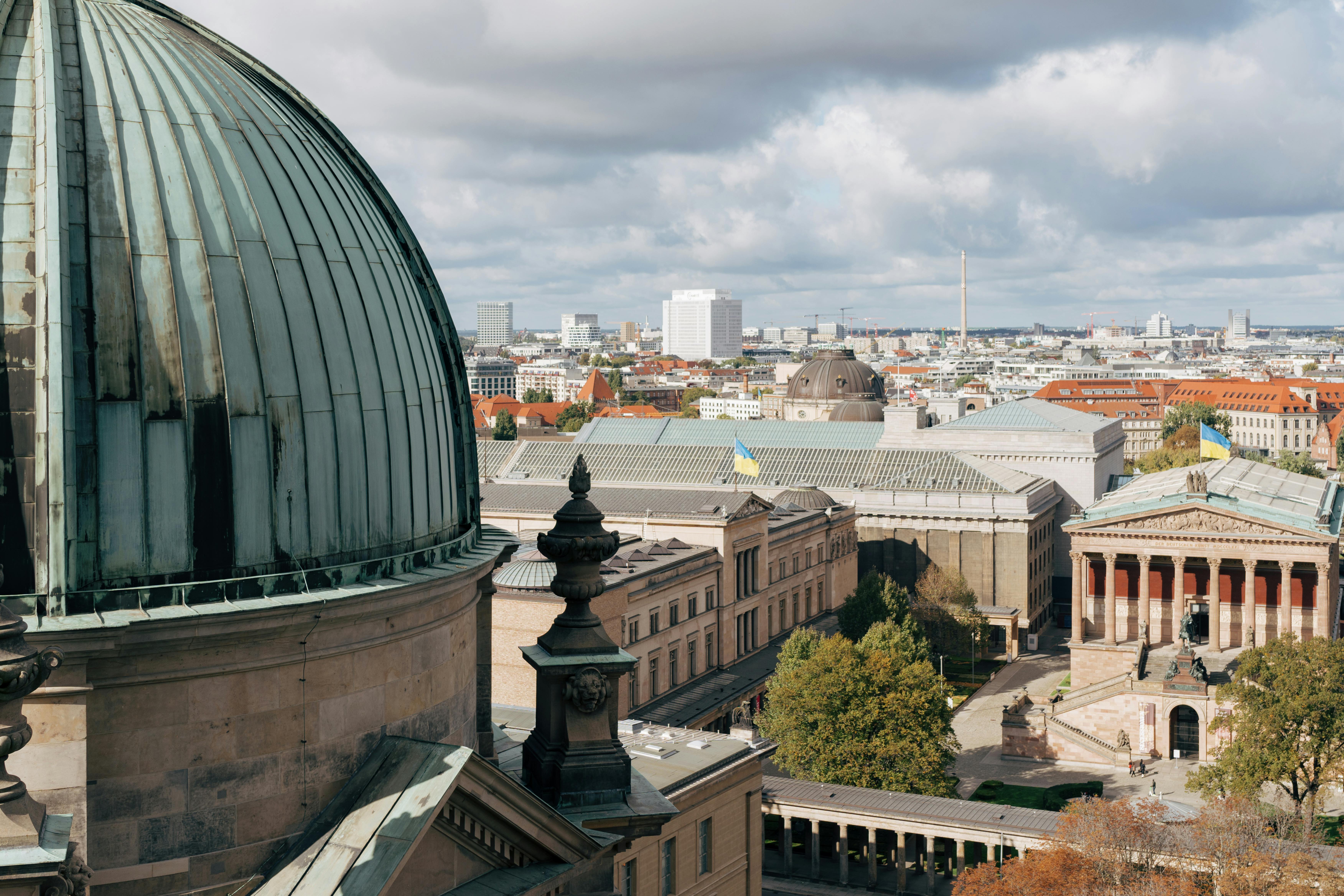
An introduction.
Researched by the Audiala editorial team from historical records, architectural archives, and local expertise.
AA computer built from hand-cut sheet metal on a Kreuzberg dining table now sits a few floors below a wartime cargo plane bolted to the roof. That's the Deutsches Technikmuseum — the German Museum of Technology — on Trebbiner Straße in Berlin, Germany, spread across the bombed-out roundhouses and sidings of the old Anhalter freight yard. Locomotives stand on the rails they were built for, under roofs that Allied bombs opened in 1945. Come for the machines; stay because almost nothing here got here by accident.
Berlin went nearly forty years without a technology museum. The war scattered or destroyed the collections, the city split, and the whole idea sat in limbo until a Friends' Association formed in 1960 to push for a replacement. Official accounts date the founding of the Museum für Verkehr und Technik to 1982; the museum's own history puts the opening in December 1983. Both are right, in the way institutions usually are — paperwork first, doors later.
What opened was a successor to nearly a hundred separate technical collections from prewar Berlin. Most of those objects are gone. A handful of survivors from the Museum für Meereskunde, which opened in 1900, now sit in the shipping halls — and knowing that changes how you look at them, because they're not representatives of a collection so much as the remainder of one.
Two entrances, two moods. Trebbiner Straße 9 gets you the railway halls, the aviation floor and the historic breweries; Möckernstraße 26 opens onto the Science Center Spectrum, where roughly 150 experiments let you push, spin and pump things yourself. Bring children to the second. Bring time to the first.
01 What to see.
The Locomotive Roundhouses
Aviation and the C-47 on the Roof
A Half-Day Route: Sheds, Ships, Park, Sheds Again
02 In pictures.


Plan and listen to German Museum of Technology with Audiala.
Audio guide in your pocket, itinerary in your browser. Built for the way you actually visit.
03 Visitor logistics.
The practical scaffolding for a good visit — kept short.
Getting There
U1/U3/U7 to Möckernbrücke sits closest to the main entrance at Trebbiner Straße 9; U1/U2/U3 to Gleisdreieck or S1/S2/S25 to Anhalter Bahnhof also work, all short walks. Ride the elevated U1 between Möckernbrücke and Gleisdreieck and you pass the roof-mounted C-47 at eye level — best free view in Kreuzberg. Don't drive: the free spaces on Trebbiner Straße become paid parking from 1 September 2026, and the museum itself tells you to take transit.
Opening Hours
As of 2026: closed Mondays, Tue–Fri 09:00–17:30, Sat/Sun/public holidays 10:00–18:00. Last admission is 17:00 every day, no exceptions. From November to April the outdoor Museumspark — windmills, forge, historic brewery — shuts at 16:00, two hours before the halls do, so winter visitors should do the park first.
Time Needed
The museum's own average is 2.5 hours; the site holds 19 permanent exhibitions across roughly 26,000 m² and two separate addresses. Pick three or four halls and accept you'll come back — the German reviews all say the same thing, that your feet die before the exhibits run out. With kids doing Spectrum's 250+ experiments properly, block out the full day.
Tickets
As of 2026, adults pay 15 € online and 17 € at the desk — the 2 € gap is a service fee charged for walking up, so booking on your phone while standing in the queue still saves money. Under-18s go free but still need a booked 0 € ticket per child, and people get caught at the scanner. Card payment at the box office is currently down for technical reasons; carry euro cash or buy online. Everyone enters free from 13:00 on the first Friday of the month, with a free ticket booked in advance.
Accessibility
Buildings are wheelchair-accessible with a few stated exceptions, and accessible toilets sit in every building section. Route via Gleisdreieck or Anhalter Bahnhof — both are step-free, Möckernbrücke is not. Folding wheelchairs and buggies loan from the entrance if you email [email protected] ahead; the free app carries quiz tours in German Sign Language. This is a converted 1874 freight yard, so expect cobbles, outdoor crossings between halls, and long distances.
04 Tips for visitors.
Small things that change the day.
Photos Yes, Tripods No
Private photography and video are allowed throughout, minus tripods, monopods and clip-on flash. German privacy law is strict and enforced here: don't photograph other visitors' faces, especially children.
Two Rooms Demand Silence
The rail hall displays a deportation boxcar as a memorial, and the aviation hall covers the concentration-camp prisoners and forced labourers who built V2 rockets and aircraft, with survivor testimony. Berliners drop their voices there and don't pose for pictures. Tourists who do are noticed.
Lockers, No Cloakroom
There's no staffed cloakroom and large luggage can't be stored at all, so don't plan a stop between train and hotel. Spectrum bans backpacks and large bags outright on safety grounds — use the Ladestraße lockers before you go in.
Audio Guide Is Down
Construction has suspended the audio guide. Download the free museum app instead: three quiz tours for Aviation, Shipping and 'Das Netz', in German, English, Polish and DGS.
Eat At The Brewery
BRLO Brwhouse sits 300 m away in Park am Gleisdreieck, built from 38 shipping containers with 20 taps and a big beer garden — vegetables lead the menu, meat is the side order (mid to splurge). Inside, Café Anhalt does Currywurst and Käsespätzle on a budget, and TorEins has a terrace over the park. You can also bring your own food into the Museumspark.
Weekday Morning, Rain Or Not
716,517 people came in 2023, above pre-pandemic numbers, and this is Berlin's default rainy-day move with children — weekends and school holidays fill up. Arrive Tuesday to Friday at 09:00 and you get two and a half hours before the school groups land.
Walk To The Ruin
Five minutes away stands the surviving portico of Anhalter Bahnhof, the terminus this freight yard once served and a Holocaust deportation site. Topographie des Terrors, the Gropius Bau and the Neue Nationalgalerie all lie within walking distance for a half-day chain.
Check Which Entrance
The site splits into two unconnected halves: Trebbiner Straße 9 for the main halls, Möckernstraße 26 for the Ladestraße road-transport hall and Spectrum. One ticket covers both the same day, and picking the wrong gate costs a confused ten-minute walk.
05 Built on What Was Lost
The museum's oldest ancestor opened in 1906, inside the Hamburger Bahnhof — a station so old it had already stopped handling trains in the 1880s. Called the Königliches Verkehrs- und Baumuseum, it proved popular enough to need two extensions. The 'royal' came off the name after 1918, for reasons the calendar explains.
Then came 1945, and the arithmetic of what survived. Allied raids in February and March flattened much of the Anhalter goods yard and its roundhouses. The collections mostly lived, but they scattered — and the institution that should have gathered them back up no longer existed.
Konrad Zuse Rebuilds His Own Ghost
In 1938, Konrad Zuse finished a programmable mechanical computer in his parents' Kreuzberg apartment on Methfesselstraße — a fifteen-minute walk from where the museum now stands. He called it the Z1. It ran on thin metal plates he cut by hand, a few thousand of them, sliding against each other with the tolerance of a good watch and roughly the reliability of a bad one.
The bombs took all of it. The Z1 and its successor the Z3 were destroyed in the wartime raids on Berlin, along with the drawings. Zuse spent the postwar decades building a real computer company, selling it, and watching the field he helped invent forget where it started.
The turning point came at 76. In 1986 Zuse began rebuilding the Z1 from patents and memory, working three years on a machine nobody but he could fully specify, and handed the finished reconstruction to this museum. He died in 1995. The thing sits there now on the aviation-and-computing floor: 30,000 metal parts, an intricate mechanical brain, still recognisably the work of one man at a table.
The Museum the Cold War Wouldn't Let Reopen
The Yard Itself Is an Exhibit
Listen to the full story in the app
The whole German Museum of Technology,
told well.
Audio guides for 1,100+ cities across 96 countries. History, stories, and local insight — offline ready.

06 Frequently asked.
The questions travellers send us most about German Museum of Technology.
Is the German Museum of Technology worth visiting?
Yes — especially if you like your history physical rather than behind glass. The museum occupies the actual 1874 locomotive depot of the Anhalter Bahnhof, so the rail halls still smell faintly of soot and oil and the locomotives stand on their original turntables. It also refuses to prettify: the aviation hall shows a Ju 87 Stuka as a wreck, names the forced labourers who built V2 rockets, and the rail hall keeps a deportation boxcar as a memorial rather than a technical exhibit.
How long do you need at the German Museum of Technology?
The museum's own figure is 2.5 hours, and that's about half what the place deserves. Nineteen permanent exhibitions spread across two addresses and a 12-hectare park mean most visitors run out of feet before they run out of museum. Pick three or four halls before you arrive — rail, shipping, aviation, Spectrum — and accept you'll come back.
How do I get to the German Museum of Technology from Berlin city centre?
Take the U1, U3 or U7 to Möckernbrücke, the U1/U2/U3 to Gleisdreieck, or the S1/S2/S25 to Anhalter Bahnhof, one stop from Potsdamer Platz. The elevated U1 stretch between Möckernbrücke and Gleisdreieck passes the Douglas C-47 on the museum facade at roughly eye level — the best free view in the city. Wheelchair users should route via Gleisdreieck or Anhalter Bahnhof; Möckernbrücke isn't marked step-free.
What is the best time to visit the German Museum of Technology?
Weekday morning, right at the 09:00 Tuesday-to-Friday opening. Weekends and school holidays fill up, and the museum is the default Berlin rainy-day move for families with children, so grey Saturdays are the worst combination. Come between May and October if you want the museum park too — its windmills, forge and historic brewery shut at 16:00 from November through April.
Can you visit the German Museum of Technology for free?
Yes, on the first Friday of every month from 13:00, though you still have to book a free ticket online. Under-18s are always free, as are older pupils still in regular schooling — but book a €0 ticket per child or you'll be stopped at the scanner. Otherwise book online at €15 rather than €17 at the door: the €2 service fee is charged for buying in person, the reverse of most attractions.
What should I not miss at the German Museum of Technology?
The horse staircase in the old Market and Cold Storage building — a split stair where the outer treads are worn broad and deep by animals hauling loads, and the inner ones barely touched. Then walk under a locomotive in the rail hall for the engineer's view of the undercarriage, and find the Fürstenportal, the princely doorway salvaged from the vanished Anhalter Bahnhof. In shipping, the red JEAN COUSIN propeller reads as backdrop until you stand beside it.
Do you need to book tickets in advance for the German Museum of Technology?
Booking isn't required — a contingent is held back for the box office — but it saves €2 a head and skips the queue in holiday season. There's a catch worth knowing: card payment at the ticket desk is currently down for technical reasons, so walk-up visitors should carry euro cash. Bookings can't be cancelled or rebooked, so pick your date carefully.
Is the German Museum of Technology good for kids?
Very, and the museum is unusually honest about the limits. Under-10s can't roam alone and some children find the halls too big or too loud, so staff advise keeping a first visit short and targeted. Kindergarten-age children go for the aircraft and locomotives; school-age children belong in the Science Center Spectrum next door at Möckernstraße 26, where 150-plus hands-on experiments cover sound, light and motion — one ticket covers both sites the same day, but backpacks are banned inside Spectrum and must go in the Ladestraße lockers.
Verified, and shown.
Researched and written by the Audiala editorial team from historical records, architectural archives, and local expertise.
Opening hours, last admission 17:00, ticket prices, first-Friday free entry, card payment outage, luggage and locker rules, Spectrum bag ban, under-10 supervision rule
Official 2.5-hour average visit time, advice for children of different ages, transport lines and step-free stations, app quiz tours, suspended audio guide
U-Bahn and S-Bahn lines to Möckernbrücke, Gleisdreieck and Anhalter Bahnhof, bike racks, parking changes
Roundhouse setting, ~40 original rail vehicles, the Fürstenportal from Anhalter Bahnhof, walking under a locomotive, smell of soot and oil
1,100+ objects over 6,500 m², the JEAN COUSIN propeller, steam tug KURT HEINZ and the Kaffenkahn barge
Rosinenbomber Douglas C-47 mounted 8 May 1999, Ju 87 wreck display, forced labour in V2 and aircraft production, women's exclusion from aviation
1874 depot site, roundhouses, Schwechten brick architecture, the new glass building, 12-hectare museum park
The horse staircase (Pferdewendeltreppe) with worn outer treads in the old Market and Cold Storage building
Hands-on experiments on sound, light, electricity, motion and perception at the Möckernstraße entrance
Predecessor Verkehrs- und Baumuseum of 1906, the postwar gap, December 1983 opening, successor to ~100 pre-war Berlin collections
Founding chronology, 1996 renaming, exhibition floor area, visitor numbers, 1984 split of collections with Verkehrsmuseum Dresden, new entrance building plans
Independent confirmation of hours and prices, concession categories, Museumspass partnership, nearby museums
Windmills, forge and historic brewery as outdoor park exhibits and their winter closing time
Researched from Wikidata, Wikipedia & official sources · fact-checked · How we make our guides →