An introduction.
Researched by the Audiala editorial team from historical records, architectural archives, and local expertise.
SSoviet gunners hit this concrete cube with 1,000 kilograms of explosives on May 2, 1945, and nothing happened. The Flakturm Humboldthain, wedged into a rubble hill in the Gesundbrunnen district of Berlin, Germany, is what remains of a bomb-proof skyscraper the Third Reich built in six months and the French army failed to demolish three years later. Come here for the rare thing in Berlin: a Nazi-era building that was never softened, never converted, never turned into offices.
The tower sits inside Volkspark Humboldthain, a 29-hectare park a ten-minute S-Bahn ride north of Alexanderplatz. Two of its four corner towers are gone. Two are still here, fused into a hill made from 1.5 million cubic metres of Berlin's own bombed rubble. You climb stairs that locals use for evening runs, and at the top you stand on a viewing platform that was once a flak gun emplacement pointed at RAF Lancasters.
Most visitors walk the exterior for free. The interior belongs to Berliner Unterwelten e.V., the underground-history association that has been excavating the sealed floors since the early 2000s. Their guided tour — helmet, headlamp, freezing air — is the only way to see the gun turret ring, the hospital floor, and the 21 propaganda relief stones the Luftwaffe never got to install.
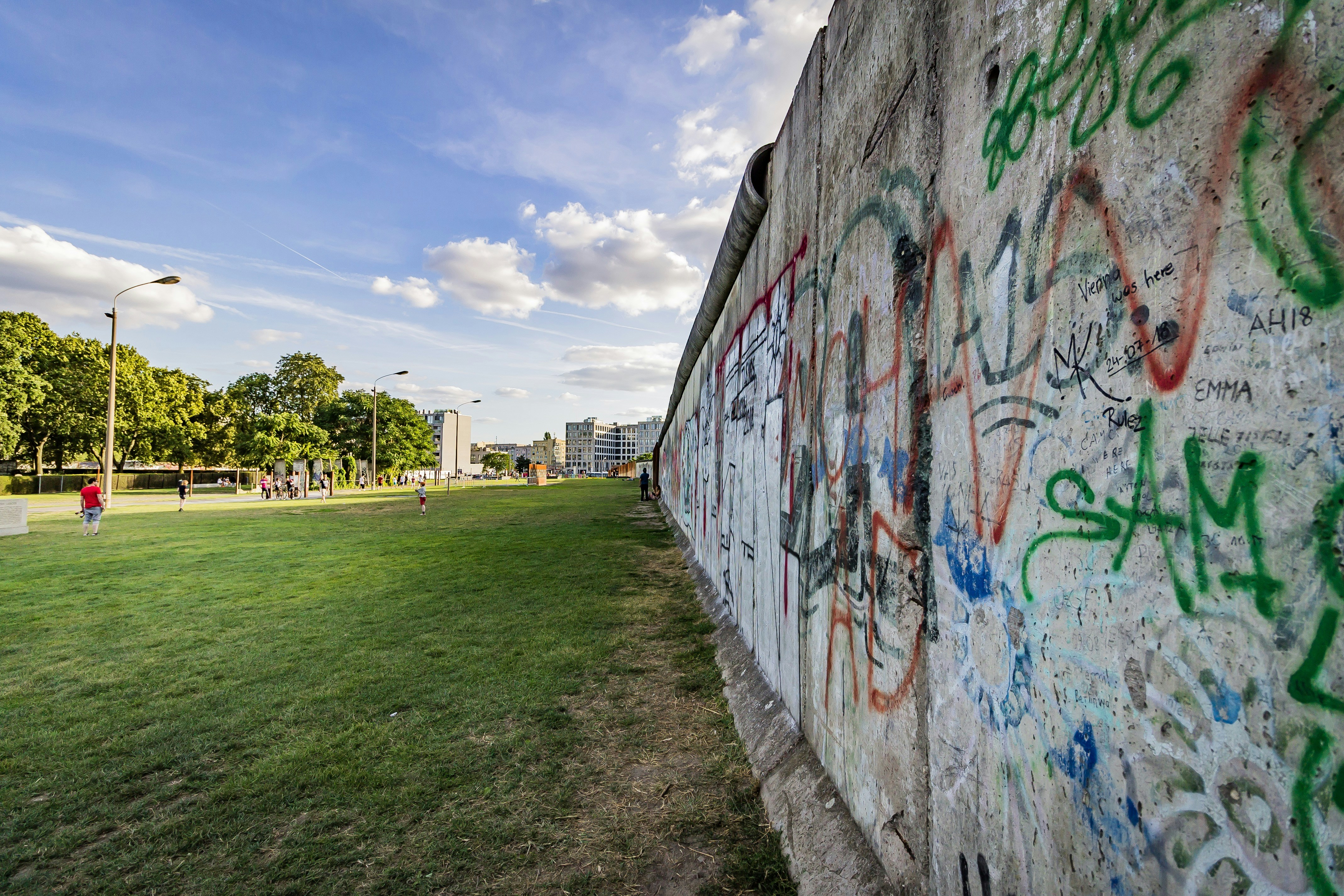
Pair this with Berliner Mauer for a morning of hard twentieth-century surfaces, or with the rest of Berlin if you want softer contrast. The tower is blunt, cold, and honest. That is the appeal.
01 What to see.
The Demolition Line and the Surviving Northern Towers
Walk the serpentine paths up Humboldthöhe and the ruin reveals itself in halves. Two concrete corner towers stand 39 metres tall on a base of 70.5 by 70.5 metres, walls 3.5 metres thick — wider than a Berlin U-Bahn carriage is long. The opposite corners simply aren't there.
French engineers detonated 41 tonnes of dynamite across three attempts in February and March 1948. The southern corners collapsed. The northern pair held, and the blasting stopped when engineers worried about the Ringbahn tracks nearby.
Stand at the base and read the asymmetry like a page. One side: sheer weathered grey concrete, layered in decades of graffiti over 1940s stencils. The other side: jagged rebar, blown rubble, the exact line where the demolition gave up.
The Rooftop Platform at 85 Metres
Roughly 280 steps inside the surviving tower, no elevator, no handrail sympathy. You emerge onto an open terrace with picnic tables and a wind that reminds you this was once a 128mm gun platform firing 26-kilogram shells at 14,800 metres altitude.
This is one of the few high viewpoints in Berlin where the Fernsehturm at Alexanderplatz drops out of frame entirely. Photographers come for exactly that absence — Wedding and Mitte rolling north without the usual needle puncturing the skyline.
Go after leaf-fall. Summer canopy swallows the south-facing sight lines; November through March gives you the clean panorama, icy platform included. Sunset is the local consensus, and the locals are right.
Inside with Berliner Unterwelten — 10°C, Total Dark, 250 Bats
Tours run April through October only. November to March the tower belongs to roughly 250 bats across six species — Berlin's third-largest bat sanctuary — hibernating in the coldest rooms. Book Tour 2 (90 minutes, €17) for three floors; Tour E (€65, three hours) is alpine terrain with vertical drops.
Bring a proper headlamp. The darkness is total, and when the guide kills the lights you can still catch faint glow from wartime Leuchtfarbe — luminous paint marking blackout-era exits, ghost-visible on the concrete. Original German stencils label rooms in 1940s operational shorthand, and tree roots from the surface push through the reinforced ceiling like slow green fists.
The interior sits at 10°C year-round. On a 30-degree July afternoon your breath fogs within a minute of descent. Closed shoes, warm jacket, no toilets on site — and a structure built to shelter 15,000 Berliners from the sky, now being reclaimed from below by water, roots and mineral stalactites.
02 In pictures.


Plan and listen to Flakturm Humboldthain with Audiala.
Audio guide in your pocket, itinerary in your browser. Built for the way you actually visit.
03 Visitor logistics.
The practical scaffolding for a good visit — kept short.
Getting There
Take U8, U6, or S1/S2/S25/S41/S42 to Gesundbrunnen — about a 7-minute walk (494m) to the tower. Follow the blue-and-white Berliner Unterwelten signs from Brunnenstraße 105. Bus 247 stops closer to the park entrance if stairs at the station feel like too much.
Opening Hours
The park and hilltop viewpoint stay open 24/7, year-round, free. Guided interior tours run May through October only — the bunker hosts Berlin's third-largest bat hibernation colony from November to April. As of 2026, tours reopen on the standard April 1 schedule.
Time Needed
Exterior and summit viewpoint: 30–60 minutes. Humboldthain Spezial guided tour adds 2.5 hours. Budget 3–4 hours for the full experience with a park walk and a döner stop on Müllerstraße afterward.
Cost & Tickets
Hilltop exterior is free. As of 2026, the Humboldthain Spezial tour costs €55 (2.5 hrs); the Humboldthain Extrem tour (€65, 3 hrs) remains suspended for structural safety works with no restart date. Book online via berliner-unterwelten.de up to 30 days ahead — no on-site ticket sales at the bunker.
Accessibility
Not wheelchair accessible. The interior tour demands 150+ steps, rubble-terrain hiking, and 60cm-wide shaft descents — Berliner Unterwelten requires visitors be 'bergwanderfähig' (mountain-hiking fit) and strictly 18+. The exterior spiral path up the hill is paved and walkable for most mobility levels.
05 Tips for visitors.
Small things that change the day.
Dress for 10°C inside
The bunker sits at 10°C/50°F year-round, even in August heat. Bring a warm layer and ankle-high hiking boots with grip soles — sneakers, sandals, or heels mean denied entry at the door.
No photos inside
Cameras and phones are banned during the interior tour, strictly enforced to protect loaned eyewitness artefacts. Exterior and summit views are fully photographable — bring the camera, leave it in the bag below.
Come at sunset
Berlin.de ranks the hilltop among the city's best sunset spots. Winter and autumn actually give sharper south-facing views toward Mitte and the TV Tower once the trees drop their leaves.
Eat on Müllerstraße
Skip the Gesundbrunnen mall. Walk five minutes to Imren Grill for lamb dürüm or Yildiz Gözleme (Müllerstraße 133) for Turkish pastry and black tea — both budget, both Wedding institutions.
Station, not park
The park itself is safe day and evening — families, joggers, picnickers. Watch bags at Gesundbrunnen station (standard Berlin transit-hub pickpocket caution) and ignore anyone with a clipboard asking for petition signatures.
Silvester viewpoint
On New Year's Eve, locals climb the hill for panoramic fireworks across northern Berlin — the ~85m elevation beats most Mitte rooftops. Bring gloves, a thermos, and arrive before 23:00 for a good spot.
No loos on site
No toilets at the tower or on the tour route. Use Gesundbrunnen station facilities before you head up — the Spezial tour runs 2.5 hours with no break.
Tuesday detour
The Humboldthain Club at the S-Bahn station runs Open Decks & Table Tennis every Tuesday — eight years running, free, techno-adjacent. Pair it with the sunset hilltop climb for a full Wedding evening. Or walk south toward Alexanderplatz for the tourist version.
Where to Eat
Don't Leave Without Trying
Dining Tips
- check Cash is king — many Wedding cafes are cash-only. Carry €30–50 for casual meals.
- check Breakfast service typically runs until 2 pm at popular cafes — arrive early or risk missing items.
- check Tip by rounding up or stating the total you want to pay when handing cash to the server (bill €16.30 → say '17').
- check Reservations not needed for casual cafes, but for groups of 4+ at restaurants, call ahead.
- check Service is included in menu prices by law. Tips are optional, but 5–10% for good service is standard.
- check Lunch runs 12–2 pm, dinner 6–9 pm. Evening service often runs until 11 pm in popular spots.
Restaurant data powered by Google
04 A history of reinvention.
The Castle Hitler Ordered in a Rage
On the night of August 25, 1940, RAF bombers crossed Berlin for the first time. Hitler was reportedly furious. Within weeks he signed a Führerbefehl ordering three flak tower complexes for the capital — bomb-proof gun platforms doubling as civilian shelters, built to a medieval-castle aesthetic he personally approved.
Humboldthain became Flakturm III. Records show construction ran from October 1941 to April 1942 — roughly six months, around 800 labourers, about 90 million Reichsmarks. The walls ended up 3.5 metres thick. The roof, 5 metres. Those dimensions are why the tower is still standing.
Friedrich Tamms and the Windows That Made No Sense
The architect was Friedrich Tamms, a 36-year-old bridge engineer from Schwerin whom Albert Speer pulled into the General Building Inspectorate in 1938. When Hitler's flak tower order landed in September 1940, Tamms got the file. He had to design a 70-metre bomb-proof skyscraper, satisfy the Luftwaffe's ballistics specs, and make it look like a Germanic castle — all in time for the next bombing season. What was at stake for him personally was the commission of a lifetime: these towers were meant to become propaganda monuments to the air war after German victory, his name on the base of each one.
So he cut windows into them. Real windows, sealed with steel during the war. Every military engineer who walks into Humboldthain notices this and frowns. Windows in a bunker make no sense — unless the building is meant to outlive the war. Tamms was designing for Germania, Speer's planned world-capital Berlin. After victory, the gun platforms would come off the corners and the towers would become apartments or Luftwaffe offices. The windows are the smoking gun of that fantasy.
The turning point came in spring 2014, when Berliner Unterwelten acquired 21 sand-lime relief stones that had been cut for Humboldthain and never installed — eight honour-wreath stones, thirteen double-sword stones, each weighing up to 1.7 tonnes. Decorative facade pieces for a monument to the Luftwaffe, ordered while Berlin burned. Tamms survived the war, reinvented himself as city planner in Düsseldorf, and died in 1980 without serious denazification consequences. The stones he commissioned sat in storage for 69 years. You can see them on Tour 2 today.
The Last Position in Berlin
The French Demolition That Refused to Demolish
Listen to the full story in the app
The whole Flakturm Humboldthain,
told well.
Audio guides for 1,100+ cities across 96 countries. History, stories, and local insight — offline ready.

06 Frequently asked.
The questions travellers send us most about Flakturm Humboldthain.
Is Flakturm Humboldthain worth visiting?
Yes — especially for WWII history buffs, Berlin regulars, or anyone chasing a free sunset view. The hilltop exterior is open 24/7 with no ticket, and the guided interior tour is one of the most visceral history experiences in the city. Skip only if you have mobility limits or zero interest in Nazi-era architecture.
How do I get to Flakturm Humboldthain from central Berlin?
Take U8 or U6 to Gesundbrunnen, then walk about 7 minutes (494m) south into Volkspark Humboldthain. S1, S2, S25, S41, and S42 also stop at Gesundbrunnen. Bus 247 serves the park directly. No parking — public transport only.
Can you visit Flakturm Humboldthain for free?
Yes. The park, the rubble hill, and the rooftop viewing platform cost nothing and stay open around the clock. Only the guided interior tour with Berliner Unterwelten requires a ticket (€55 for the 2.5-hour Humboldthain Spezial, May–October only).
How long do you need at Flakturm Humboldthain?
Plan 30–60 minutes for the exterior and rooftop, or 2.5 hours if you book the Humboldthain Spezial interior tour. Combine both plus a walk through the park and it's a half-day visit. Add time for a dürüm on Müllerstraße after.
What is the best time to visit Flakturm Humboldthain?
Sunset on a weekday between April and October — the rooftop catches golden light over north Berlin and the crowds thin out. Autumn and winter actually give better city sight lines because bare trees open the view south toward the TV tower. Interior tours run May–October only; the tower closes in winter for bat hibernation.
Can you go inside Flakturm Humboldthain?
Yes, but only on a guided tour with Berliner Unterwelten, and only May through October. The Humboldthain Spezial runs 2.5 hours and costs €55, covers 3 of the 7 floors plus the Mutter-Kind bunker ruins. Must be 18+, book online in advance — no on-site sales. Hiking boots and a flashlight mandatory; no photography allowed inside.
Why is half of Flakturm Humboldthain destroyed?
French occupation engineers detonated 41 tonnes of dynamite across three attempts in 1947–48 to demolish it. The first blast on 28 February 1948 failed entirely. The third, on 13 March 1948, brought down the two southern corner towers — the northern half survived, officially spared to protect the Soviet-controlled Ringbahn railway nearby.
What should I not miss at Flakturm Humboldthain?
The rooftop viewpoint at sunset — one of the few spots in Berlin where the TV tower doesn't photobomb your shot. Inside the tower, ask the guide to kill the flashlights so you can see the faint WWII luminous paint (Leuchtfarbe) still glowing on walls. Outside, descend the serpentine path to the Rosarium below — roses blooming at the foot of a gun tower is the whole Berlin metaphor in one spot.
Verified, and shown.
Researched and written by the Audiala editorial team from historical records, architectural archives, and local expertise.
Construction dates, wartime function, French demolition timeline, post-war burial under rubble
2014 discovery of 21 uninstalled relief stones, gabion reinforcement works, volunteer rubble clearing
Standard 90-minute tour details, price, meeting point, season
2.5-hour specialist tour, €55, Mutter-Kind bunker access, booking info
3-hour alpine-grade tour (currently suspended), €65, climbing iron requirements
Dress code, age limit, mandatory gear, accessibility restrictions
Photography ban inside tours, booking rules, general policies
April 1 2025 season reopening, ongoing rubble removal stats
Association background and project summary
75th-anniversary coverage of the 1948 French demolition attempts, tonnage of dynamite used
General flak tower design specs, armament, Berlin complex system
Comparison data on art storage in Berlin flak towers, Nefertiti and Pergamon Altar context
Artificial hill creation 1950s, park opening 1952, rubble volume estimates
Biography of the flak tower architect, post-war career in Düsseldorf
Tamms's role as Speer's executor, 1940 appointment, design aesthetic
Why the towers have windows — planned post-war Germania reuse
Final 3 May 1945 surrender, Soviet 89th Division siege, 203mm howitzer failure
Siege details, visitor experience, structural asymmetry after demolition
Cultural heritage framing, northern vs southern tower distinction
Local opinion, sunset viewpoint reputation, no TV tower in photo sight lines
Sunset atmosphere, free access, local weekend ritual
Ranked city viewpoint listing
Official Berlin tourism listing the flak tower among top sunset spots
13m climbing wall specs, DAV member access, route grades
Park access, transit info, general visitor overview
First-hand interior tour account, sensory details, temperature
Visitor reviews, emotional responses, photography restrictions confirmed
Physical details, demolition line visible in structure, WWII labels
Two-tower confusion, Mutter-Kind bunker context, tour tips
German-language visitor perspective, historical context
Free access confirmation, viewpoint info
Annual museum night participation listing
Adjacent music venue, Tuesday Open Decks & Table Tennis tradition
Outdoor pool in the park, summer facilities
Neighborhood character, demographics, food scene
Visitor discussion of Wedding area safety perceptions
Neighborhood guide, transit options
Ernst Michelin-starred, MARS, Café Pförtner, mid-range dining options
Yeşil Fırın, Imren Grill, Yildiz Gözleme budget food
Gesundbrunnen station transit caution, common scams
Leopoldplatz rougher-zone context
Drone flight rules over Berlin
Restricted airspace info around Reichstag, outside Humboldthain zone
Official German drone flight planning portal
Last reviewed