An introduction.
Researched by the Audiala editorial team from historical records, architectural archives, and local expertise.
TThe world's oldest business school teaches strategy inside a building designed to save dying babies. ESCP Business School's Berlin campus occupies the Kaiserin-Auguste-Viktoria-Haus in Charlottenburg — a neo-baroque complex opened in 1909 as the world's first scientific facility for preventing infant mortality, commissioned by a German Empress who visited poor families incognito. Cross the Heubnerweg gate and you're walking into a building a Jewish-born architect designed, a Nazi-era racial hygiene clinic later occupied, and French MBA students now fill with espresso machines and laptops. The contradictions are the reason to come to this corner of Germany's capital.
The building sits behind Charlottenburg Palace, and not by accident. Empress Auguste Victoria — known in Berlin as Kirchenjuste for her Protestant piety — placed it deliberately next to the imperial residence to announce that infant welfare was her personal mission. Records show that around 1900, up to 30% of babies born in parts of Germany died before their first birthday, most from gastrointestinal illness tied to unsafe feeding. The Empress wanted architecture that said: we're fighting this.
ESCP moved in after a 1996–1997 renovation turned the neglected clinic into lecture halls, a library with 52 study seats, and a student forum with a piano. The institution rarely mentions what happened here between 1934 and 1944. Archive catalogs show the Charlottenburg district health office running an outpatient clinic for 'hereditary and racial hygiene' on the same grounds — processing sterilization recommendations and marriage-loan eligibility in walls built to save every child. Those files remain under restricted access today.
Book a campus tour in advance, because walk-ins aren't accepted. The February 2026 Open Day is the easiest public entry. Pair the visit with the palace gardens immediately behind the site and a longer walk through Berlin's Charlottenburg district.
01 What to see.
The Entrance Portal and Its Imperial Ghosts
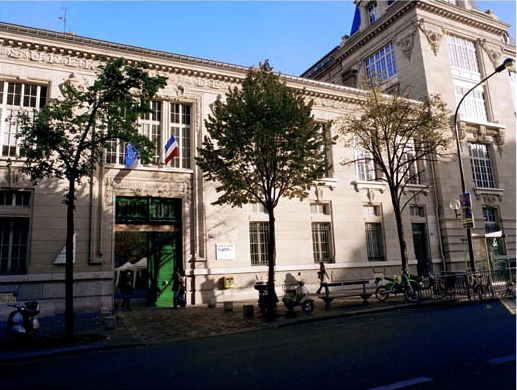
Walk up to Heubnerweg 6 and look above the limestone door frame. You'll find a coat of arms cartouche, an imperial crown, and two stone putti carved by Josef Rauch and Ernst Westphal in 1908. This is Wilhelmine Germany in full voice — and it now greets MBA students heading to finance lectures.
The building opened on 4 June 1909 as the Kaiserin-Auguste-Viktoria-Haus, the world's first scientific facility to fight infant mortality. Alfred Messel designed the neo-Baroque facade modeled on the old Kammergericht on Lindenstraße, then died in March 1909 — three months before the empress cut the ribbon. He never saw it finished, the same fate that would claim his Pergamon Museum design.
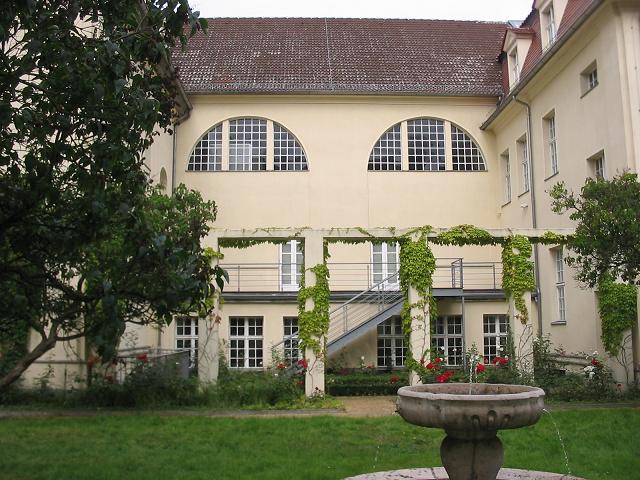
The yellow-tinted plaster warms beautifully in late-afternoon light. White casement windows with glazing bars line the 2½-story wings. Red-tiled mansard roofs crown the whole complex. Stand on the far side of Heubnerweg for the full risalit-and-gable view — the ornamentation concentrates at the portal, leaving the rest of the facade almost austere.
The Great Hall and Its Missing Ceiling
Inside the central building sits the grand lecture hall, and it's half a ghost. Two side galleries ride on Ionic columns. Thermal windows flood the room with the same daylight that early-20th-century pediatricians believed would heal sick infants.
What's gone matters as much as what remains. The original vaulted ceiling and semicircular apse were stripped out during 1950s post-war reconstruction, leaving a flatter, plainer room where a far grander one used to sing. Imagine the acoustics before — vaults amplifying voices, apse curving sound back at the audience. Today's lectures echo through a diminished shell.
The wing layout still carries its original medical logic. North wing: mothers and infants. South wing: pregnant women and postpartum patients. Now those rooms are classrooms and rector offices, piano music drifting up from the Forum café. A library with 52 seats occupies spaces that once held incubators. The floor plan is a century-old argument about care, repurposed for strategy seminars.
Walk the Grounds, Then Cross to Charlottenburg
02 In pictures.




Plan and listen to Escp Business School with Audiala.
Audio guide in your pocket, itinerary in your browser. Built for the way you actually visit.
03 Visitor logistics.
The practical scaffolding for a good visit — kept short.
Getting There
Bus 309 or M45 to Schlosspark-Klinik drops you 150m from the gate — two-minute walk. From U-Bahn, take U7 to Richard-Wagner-Platz then M45, or U2 to Sophie-Charlotte-Platz and walk 15 minutes north. S41/S42 to Jungfernheide works too, nine minutes on foot.
Opening Hours
As of 2026, the campus is not a public site. Gates open Mon–Fri 07:30–18:00 for staff and students only, closed weekends and German public holidays. Public access happens through official Open Days — the next confirmed one is February 2026, registration via escp.eu/events.
Time Needed
Facade from the street: 10–15 minutes. Open Day full program with tour, lecture and admissions chat: 2–4 hours. Combine a facade look with a walk through Schloss Charlottenburg gardens next door and budget 45–60 minutes.
Cost
Free. Exterior viewing from Heubnerweg costs nothing, and Open Day entry is free once you register online. The library and interiors stay restricted to ESCP students, faculty and alumni.
Accessibility
Terrain is flat — Charlottenburg has no hills. The 1909 building has mixed interior accessibility typical of renovated historic structures; ESCP publishes no specific wheelchair data, so email the campus before visiting if you need step-free routes. Berlin's accessBerlin app maps accessible transit nearby.
05 Tips for visitors.
Small things that change the day.
Shoot The Facade
The neo-Baroque front on Heubnerweg is freely photographable from the public pavement, no permit needed. Morning light hits the eastern wings best; interior photography during Open Day requires asking on arrival.
Eat At Kleine Orangerie
Five-minute walk into Schlosspark, inside a historic pavilion facing the palace — budget-friendly schnitzel and breakfast that locals actually eat. Skip the palace courtyard tourist cafes and head here instead.
Savignyplatz For Dinner
Fifteen minutes south, classic old-West-Berlin restaurant strip — mid-range to splurge. Schwarzes Café runs 24 hours on weekends and has been a neighborhood institution for decades.
Slip Into Schlosspark
The campus backs directly onto Charlottenburg Palace gardens — one of Berlin's finest Baroque parks, free, open year-round. Enter via Spandauer Damm and you can photograph, picnic or just sit under the lime trees.
Safe, But Watch Ku'damm
Charlottenburg-Westend around the campus is among Berlin's lowest-crime pockets. Pickpocket risk rises the closer you get to Ku'damm and KaDeWe 15 minutes east — clipboard petition scams and fake-police ID requests are the two to know.
Book Open Day Early
The February 2026 in-person Open Day is the only realistic way inside. Registration on escp.eu/events fills up — if spots close, the online Open Day gives a virtual tour instead.
Read The Stones First
Before you arrive, know this was the world's first scientific infant-health institute, inaugurated 4 June 1909 under Empress Auguste Victoria's patronage. Architect Alfred Messel died in March 1909 and never saw it open — the gravitas is in the backstory, not the signage.
No Luggage Storage
The campus has no lockers or bag storage. Nearest options are Berlin Hbf (~30 min) or Zoologischer Garten station (~15 min by bus) — drop bags before heading out.
Where to Eat
Don't Leave Without Trying
Dining Tips
- check Cash still rules in Berlin. Many independent restaurants and all street vendors are cash-only. Carry €20–30 as backup even if you plan to use cards.
- check Tipping is expected (5–10% of the bill). Tell the server the total amount you want to pay when settling—do not leave cash on the table.
- check Germans eat early: breakfast 7–9 AM, lunch 12–2 PM, dinner 6–9 PM. Late seatings after 9 PM are rare outside trendy spots.
- check Many family-run restaurants close one fixed day per week (Ruhetag), most commonly Monday. Check hours in advance for smaller places.
- check Reservations recommended for popular restaurants, especially Friday–Sunday dinner and Sunday brunch. 1–3 days ahead usually works.
- check Karl-August-Platz market (Charlottenburg, near ESCP) runs Wednesday & Saturday, 8:00 AM–1:30 PM, for fresh local produce and products.
Restaurant data powered by Google
04 A history of reinvention.
A House Against Death
In autumn 1905, Empress Auguste Victoria tasked her Cabinet Councillor Karl von Behr-Pinnow with building a national response to Germany's infant mortality crisis. He brought in Alfred Messel and Ludwig Hoffmann — two of the most influential architects in Wilhelmine Berlin — along with Edmund May, and organized the fundraising that turned an Empress's instinct into stone.
The result opened on 4 June 1909 as the Kaiserin-Auguste-Viktoria-Haus zur Bekämpfung der Säuglingssterblichkeit im Deutschen Reich: the world's first scientific facility for preventing infant death. What the building would become over the next 115 years was nowhere in the founders' script.
The Architect Who Died Before the Empress Arrived
Alfred Messel designed the complex while visibly dying. Born into a Jewish family in Darmstadt, he had converted to Protestantism in 1899 — almost certainly under the professional pressure Jewish architects faced in Wilhelmine Berlin. By 1906, when Ludwig Hoffmann invited him to co-design the Empress's project, his health was already failing. He worked through it anyway, producing a four-wing neo-baroque plan with a chapel at its spiritual center.
On 24 March 1909, Messel died. Seventy-two days later, Empress Auguste Victoria presided over the inauguration of his building without him. Edmund May finished the construction. Hoffmann took over Messel's unfinished Pergamon Museum across the city — another building its designer never saw completed. Berlin lost its most inventive architect at 55, and his most personal commission opened as a kind of architectural obituary.
The twist took decades to surface. In 1958, Messel received an honorary grave at Alter St.-Matthäus-Kirchhof in Schöneberg — awarded by the same city that had stripped his name from streets during the Third Reich. A Jewish-born architect's neo-baroque complex, with its Christian chapel, still stood inside walls a Nazi-era clinic had used for racial hygiene work. The grave came late. The reckoning with his building has not arrived at all.
From Infant Ward to Racial Hygiene Clinic
The Commissioner's Long Shadow
Listen to the full story in the app
The whole Escp Business School,
told well.
Audio guides for 1,100+ cities across 96 countries. History, stories, and local insight — offline ready.

06 Frequently asked.
The questions travellers send us most about Escp Business School.
Can you visit ESCP Business School Berlin?
Not as a walk-in tourist — it's a working private university, gated and not open to the public. Your two real options: attend the annual Open Day (next confirmed: February 2026, free, register at escp.eu/events) or view the neo-baroque facade from Heubnerweg, which is freely photographable from the street.
Is ESCP Berlin worth visiting?
Yes if you care about architecture or medical history — the building is the Kaiserin-Auguste-Viktoria-Haus, a Denkmalschutz-listed 1909 complex that was the world's first scientific infant-mortality prevention center. Skip it if you only want the business school; the interior is closed to tourists. Pair the exterior with Schloss Charlottenburg gardens directly behind the campus and you've got a solid hour.
How do I get to ESCP Berlin from the city centre?
Easiest route: U2 to Sophie-Charlotte-Platz, then 15-minute walk north along Sophie-Charlotten-Straße to Heubnerweg 6–10. Bus M45 or 309 to Schlosspark-Klinik drops you 150 metres from the gate. From Berlin Hbf, allow 30–40 minutes door-to-door.
How long do you need at ESCP Berlin?
10–15 minutes for the facade alone, 2–4 hours for a full Open Day programme. Budget 45–60 minutes if you combine the exterior with a walk through Schloss Charlottenburg's baroque gardens that border the campus to the south.
What is the Kaiserin-Auguste-Viktoria-Haus?
The 1909 neo-baroque building ESCP occupies — commissioned by Empress Auguste Victoria to combat German infant mortality, which ran as high as 295 per 1,000 births around 1900. Workers under architects Alfred Messel and Ludwig Hoffmann built it in 1907–1909; Messel died three months before the 4 June 1909 inauguration. It stood as a children's clinic until 1994, then ESCP moved in after a 1996–97 renovation.
Can you visit ESCP Berlin for free?
Yes — the Open Day and all exterior viewing are free. The Open Day includes a guided campus tour, a sample lecture, and an admissions chat; register in advance via escp.eu/events since walk-ins aren't accepted.
What should I not miss at ESCP Berlin?
The limestone entrance portal on Heubnerweg — look up for the imperial crown, cartouche, and putti carved by Josef Rauch and Ernst Westphal, Wilhelmine iconography now bolted onto a French business school. Then walk through the back into Charlottenburg palace gardens; the red mansard roofline reads beautifully from the park's elevated walks.
Where should I eat near ESCP Berlin?
Kleine Orangerie in the Schlosspark pavilion (5-minute walk) — breakfast and schnitzel in a historic setting, budget-friendly and locals go there. For dinner, Opera Italiana on Spandauer Damm 51 stays open till midnight. Skip the palace café.
Verified, and shown.
Researched and written by the Audiala editorial team from historical records, architectural archives, and local expertise.
Core building history: 1907–1909 construction, architects, wing layout, interior losses
Official Berlin monument protection record; facade materials, configuration
Current campus info, facilities, opening hours
Open Day registration and programme
Timeline of EAP arrival in Berlin at Europa-Center
Architect biography, March 1909 death, Pergamon Museum connection
Messel's Jewish heritage and 1899 conversion
Berlin city architect role, Messel friendship
Behr-Pinnow biography, 1925 eugenic association founding
Cabinet Councillor role and later racial-hygiene advocacy
Nazi-era racial hygiene outpatient clinic attached to KAVH, 1934–1944
Archival records of the racial hygiene clinic
1912 Messel publication interior chapel view
Institutional history of Kaiserin-Auguste-Viktoria-Haus
Empress biography, 1921 death at Haus Doorn
Empress Auguste Victoria's religious nickname and church patronage
Messel's parallel unfinished project completed by Hoffmann
Around-1900 infant mortality figures
Dr. Gerhard Paul Joppich 1942 directorship, HJ/BDM programmes
Centennial overview of the building's medical history
Supplementary building history
Archive portal entries on KAVH
Messel original drawings: facade, plan, courtyards, chapel interior
Primary source archive of the institution
District-level recognition of ESCP as cultural asset
Library facilities, 52 seats, access rules
Online campus tour
Remote Open Day alternative
Previous year Open Day programme
General Open Day landing page
March 2020 COVID field hospital conversion
Germany-specific anniversary programming
Student community overview
Student perspective on campus facilities and atmosphere
Club list including Doktor Faust bar
Marketing rationale for Berlin campus
Trip planning for campus access
Nearby transit hub
Transit routing options to campus
Street-level transit directions
Parking options including P+R Jungfernheide
Adjacent palace park information
West Berlin neighbourhood context
Nearby café in Schlosspark pavilion
Menu and pricing
Spandauer Damm 3 restaurant reviews
Charlottenburg-Wilmersdorf safety ranking
Common scams in central Berlin
Business school reputation context
Student reviews of Berlin campus
German perspective on the school
French perspective on Berlin campus
Exchange student campus life accounts
Last reviewed