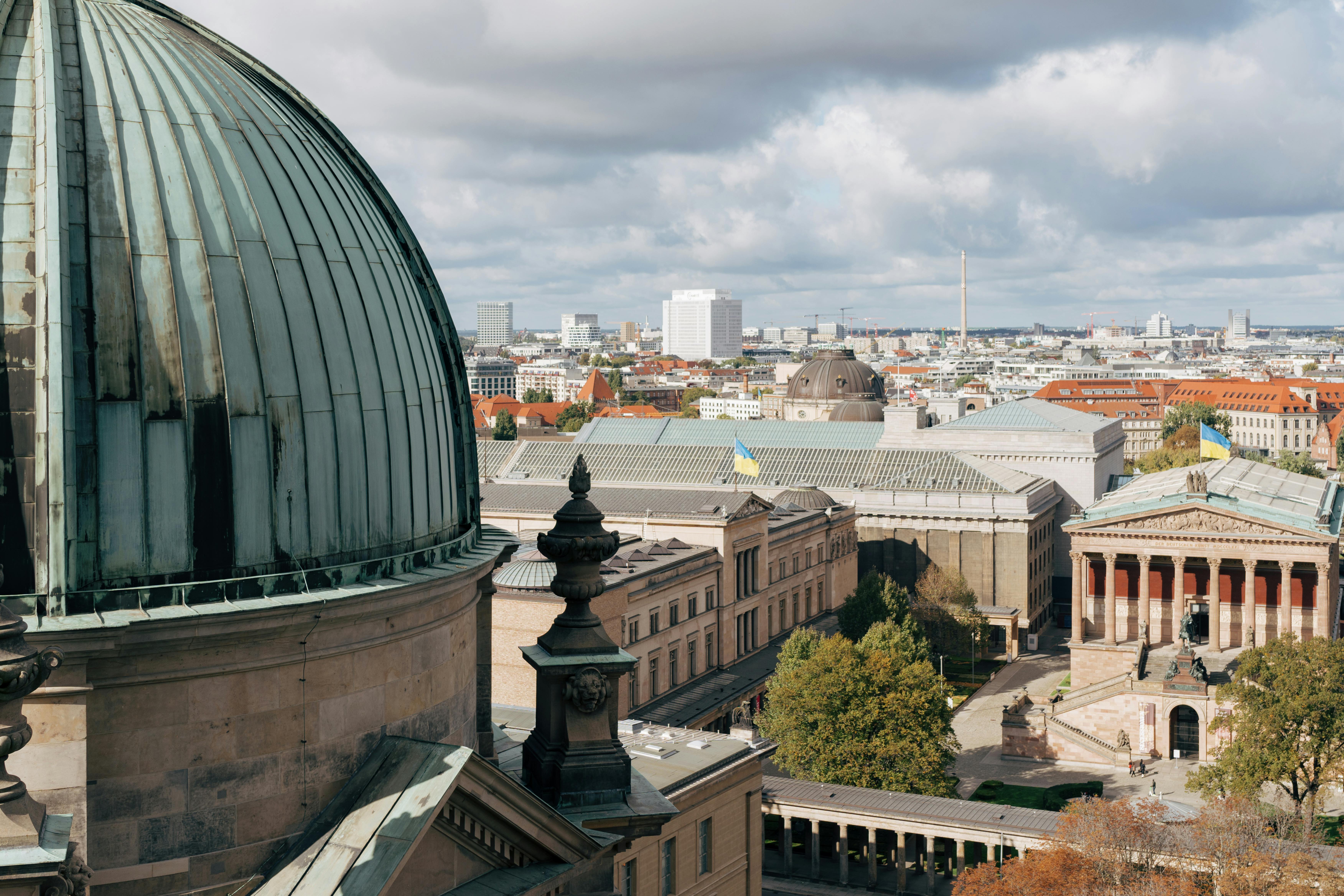
An introduction.
Researched by the Audiala editorial team from historical records, architectural archives, and local expertise.
TThe highest point of the Berliner Balkon — the exact ridge where a post mill turned in the wind from 1808 to 1936 — now sits beside a recycling depot. This is the only place in Berlin, Germany, where the Barnim plateau's edge falls visibly into the ancient glacial valley below, a 15-metre drop that locals in Kaulsdorf and Mahlsdorf nicknamed the "Berlin Balcony" because standing here feels exactly like that. Come for the view east toward Brandenburg. Stay because almost no tourist ever does.
The Balkon is not a monument. It's a natural escarpment shaped by a Nordic glacier about 12,000 years ago, then quietly farmed, windmilled, bombed over, paved with a €900,000 EU-funded concrete path in 2004, and declared a landscape protection area in August 2012. Twenty-five hectares. Free, open always, unsupervised.
You reach it from the far eastern edge of the city, well past where most visitors stop. The reward is a horizon line Berlin otherwise refuses to give you — flat, enormous, agricultural, with the federal B1/B5 humming along the ridge above and the Kaulsdorfer Seen glinting somewhere to the south.
This guide treats the Balkon as what it actually is — a slice of Ice Age geology with 20th-century scars still showing, and a neighbourhood that keeps rebuilding its own benches when the district runs out of budget.
01 What to see.
The Edge Itself — 15 Metres of Ice Age
Walk to the rim where the Barnim plateau quits. Fifteen metres down — roughly a four-storey building — the ground falls into the Warschau-Berliner Urstromtal, a glacial outwash valley carved 12,000 years ago when a Nordic ice sheet dumped its last load of till here and retreated north. This is the only place in Berlin where you see that drop undeveloped, unbuilt, raw.
From the central viewpoint at the top of the Gloritbeton path, three glacial lakes glint in the floor below: Butzer See, Habermannsee, Elsensee. On clear mornings the Müggelberge rise 8 kilometres southeast, their 30-metre watchtower poking the horizon at 114 metres. Köpenick's towers stack up in the middle distance.
The sensation is specific. Wind catches you differently on the rim than in the sheltered valley — you feel the escarpment as weather, not just geography. Skylarks in summer. Nightingales in spring. No traffic noise, because there's no traffic to make any.
The Windmill Ghosts and the Teenagers' Benches
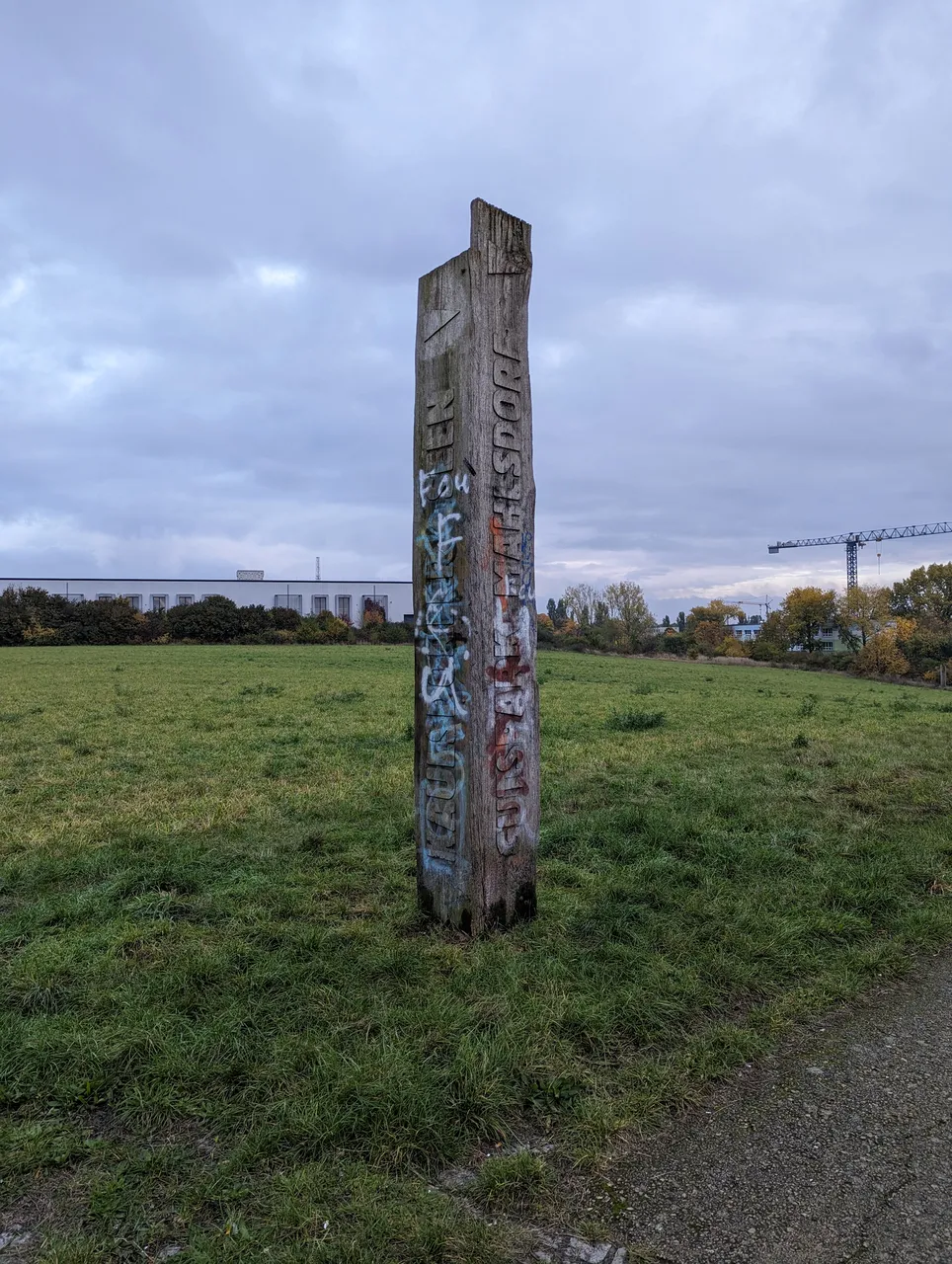
On the highest point of the slope, a Bockwindmühle — a post mill whose entire body rotated on a central wooden trestle to face the wind — stood from 1808 to 1936, when the district tore it down as an eyesore. What remains is a wooden artwork: four stelae, oversized gear-wheel fragments, chair-scale seating, all meant to collapse 12,000 years of geology and 228 years of milling into one viewing platform.
Vandals got to it. Repeatedly. The district authority removed the most damaged steles on safety grounds, ruled out reinstallation in 2022 for budget reasons, and the sculpture group sits diminished. Then five teenagers from Mahlsdorf showed up with timber and concrete, built three new benches, and bolted them in along the rim.
Sit on one. The slope in front of you is active farmland — grain and clover rotating through the seasons on a protected 25-hectare conservation zone granted Landschaftsschutzgebiet status in August 2012. Autumn strips the fields and exposes the raw moraine contours most clearly.
The Grüne Runde Loop — Balcony, Lakes, Gründerzeit
Do it as a circuit. Start at Mahlsdorf S-Bahn (S5, 850 metres from the rim), walk the Gloritbeton path to the central viewpoint — the €900,000 EU-funded concrete is frost-resistant and wheelchair-accessible, an engineering concession laid across raw glacial till in 2004. Descend the escarpment face, looking back up at the moraine material you were just standing on.
Follow the path into the Kaulsdorfer Seen conservation area. Habermannsee is a drinking-water protection zone, so no swimming. Elsensee is privately owned, 13.3 hectares, 14.5 metres deep, dug out of sand extraction between 1968 and 1995 and now passing convincingly for a natural lake.
Loop back through Gutspark Mahlsdorf — 18 hectares of landscape park, originally an orchard, redesigned in 1892, restored 1993–95 — and end at the Gründerzeitmuseum, which documents the Wilhelminian decades when the windmill above still turned. The whole thing is roughly three hours at a photographer's pace. Bring water; there's no café on the rim.
02 In pictures.


Plan and listen to Berliner Balkon with Audiala.
Audio guide in your pocket, itinerary in your browser. Built for the way you actually visit.
03 Visitor logistics.
The practical scaffolding for a good visit — kept short.
Getting There
Take S-Bahn S5 to S Mahlsdorf, then walk about 10 minutes up Alt-Mahlsdorf (B1/5) to the entry opposite Neuenhagener Straße. Faster option: bus 195 or 269 to Kressenweg stop, then a 5-minute walk up to the central viewpoint. By car, follow B1/5 and turn at the Garni Hotel 'An der Weide' into the small informal parking area.
Opening Hours
Open 24/7, year-round, with no gates, no staff, and no seasonal closure. As of 2026, entry remains completely free. Paths stay passable in winter but the Gloritbeton surface gets slick after frost or heavy rain.
Time Needed
Viewpoint-only stop: 20–30 minutes. Loop walk to Butzer See: roughly 2 hours over 7–9 km of easy-to-moderate terrain. Full green route combining the Balkon, Kaulsdorfer Seen, and Gründerzeitmuseum runs about 1h45 of walking (9.8 km) — plan a half-day if you add the museum visit.
Accessibility
The ~25-hectare path network is officially barrier-free, paved with frost-resistant Gloritbeton laid in the €900,000 EU project of 2004. The 15-metre gradient is gentle via the paths, not a scramble. No railing guards the main viewpoint — keep small children and wheelchair users back from the edge.
Cost
Free, always. No tickets, no booking, no audio guide fee. If you pair with the Gründerzeitmuseum Mahlsdorf down the road, that's the only paid stop on the route (Wed and Sun opening only, so check before you come).
04 Tips for visitors.
Small things that change the day.
Drones grounded
The slope became Landschaftsschutzgebiet Barnimhang in August 2012, and Berlin's conservation rules generally ban drone flight over such areas. Fly elsewhere unless you've cleared it with the Bezirksamt Marzahn-Hellersdorf.
Go for clear light
Spring mornings and autumn afternoons give the best view toward the Müggelberge in Köpenick — the payoff is horizon distance, not lushness. Skip foggy or overcast days; the whole point is being able to read the glacial valley stretching west.
Eat on Hönower Straße
Nothing on-site, not even a kiosk. Walk into Mahlsdorf afterwards for Café Kunst & Krümel or Café Mahlsdorf (budget, Hönower Str. 65), or Trattoria La Stalla for a mid-range Italian sit-down.
Chain the whole loop
Don't treat the Balkon as a standalone stop. Link it with the Kaulsdorfer Seen lakes and the Gründerzeitmuseum at Gutshaus Mahlsdorf (Hultschiner Damm 333) — Charlotte von Mahlsdorf's Victorian-furniture house, where the basement functioned as an underground queer gathering space in DDR East Berlin.
No toilets on site
Zero facilities across the entire 25-hectare area. Use cafés in Mahlsdorf centre before or after, or the Klinikum Kaulsdorf hospital a few bus stops away.
Dogs on leash
Berlin-wide leash rule applies, and this is a protected landscape zone — stay on paths and keep the dog close. Meadows on either side of the ridge are active agricultural land, not off-leash romping ground.
Calibrate expectations
It's a 15-metre escarpment, not a cliff. Come for the geological oddity — the only visible break between the Barnim plateau and the Warsaw-Berlin glacial valley anywhere in the city — not for Alpine drama.
Where to Eat
Don't Leave Without Trying
Schnitzelei Mitte
local favoriteOrder: Schnitzel vom Kalb (veal schnitzel) with potato salad is the signature—hearty, perfectly executed, unpretentious. Vegan options include outstanding mushroom schnitzel.
Berlin institution (7,274 reviews) beloved by locals for generous portions done right; complimentary welcome beer and welcoming staff make it feel like a neighbourhood gem.
Nomad Berlin
local favoriteOrder: Sweetbreads are executed with remarkable precision; brunch is legendary—sourdough bread, avocado spread, French toast with tiramisu cream.
Highly acclaimed neighbourhood spot with international dishes cooked to exacting standards; brunch is packed, so reserve ahead. Modern Berlin energy without pretension.
RIVO Spreeterrassen
local favoriteOrder: Steak and lobster arancini are spectacular; pair with exceptional wine menu for full effect.
Riverside terrace with Oberbaumbrücke and Wall ruins framed perfectly; excellent wine selection, romantic atmosphere, attentive service.
Blumental
cafeOrder: Pistachio-raspberry pancakes—tartness balances sweetness perfectly. Specialty coffee drinks expertly made; sourdough and pastries outstanding.
Minimalist design, calm study-friendly vibe, devoted local following. Pastries and house-made treats reveal care; coffee program serious.
Dining Tips
- check Tipping: Tell the server your total when paying (e.g., 'eighteen euros, please') rather than leaving cash on the table—5–10% is standard.
- check Cash essential—many restaurants and cafés, especially in creative neighbourhoods, cash-only. Carry €20–50.
- check Dinner starts 18:30; kitchens close around 23:00.
- check Reservations: Popular spots, peak hours (20:00), weekends require booking. Casual places accept walk-ins.
- check Payment: Visa/Mastercard at mid-range and upscale spots; EC/Girocard (German debit) is local standard. €10 minimum for cards at some places.
Restaurant data powered by Google
05 The Ridge That Remembers
Records show the Bockwindmühle stood on the summit from 1808 to 1936 — 128 years of grinding grain for Mahlsdorf and Kaulsdorf before it came down. No surviving archive names the builder. The 1808 date itself sits in local histories without a primary citation, so treat it as attributed rather than documented.
Everything else about this slope is written in a heavier hand. The federal road along the ridge — today's B1/B5 — is the old Reichsstraße 1, a route Napoleon marched, the Wehrmacht rolled out along, and the Red Army rolled back down. The Balkon watched all of it from below.
Charlotte von Mahlsdorf and the Rolling Pin
Seven hundred metres from the Balkon viewpoint, on Alt-Mahlsdorf, Lothar Berfelde was born on 18 March 1928 into a house ruled by terror. Her father Max — NSDAP member since the late 1920s, local political leader in Mahlsdorf — beat his family and pushed Lothar into the Hitler Youth at fourteen. In 1944, with the mother gone and the war closing in, Max held a service revolver to his child and demanded a choice.
Lothar killed him in his sleep with a rolling pin. She was sixteen. A Berlin court convicted her in January 1945 as an "asozialer Jugendlicher" — four years in juvenile prison, cut short by the regime's collapse weeks later.
She became Charlotte von Mahlsdorf, opened the Gründerzeitmuseum in 1960 in the Gutshaus down the road, sheltered one of the GDR's earliest gay support groups (HIB) in the basement from 1973, and — according to post-reunification Stasi files — filed reports on those same gatherings as IM Vera. She claimed coercion; scholars still argue. She died 30 April 2002. Doug Wright won a Pulitzer writing her as I Am My Own Wife. Walk the Balkon and then walk to the museum. The two places explain each other.
12,000 Years in the Mud
April 22, 1945
Listen to the full story in the app
The whole Berliner Balkon,
told well.
Audio guides for 1,100+ cities across 96 countries. History, stories, and local insight — offline ready.
06 Frequently asked.
The questions travellers send us most about Berliner Balkon.
Is Berliner Balkon worth visiting?
Yes, if you want a Berlin most tourists never see. It's the only spot in the city where the Barnim plateau's Ice Age edge drops visibly into the glacial valley below — 15 metres of raw geology inside an otherwise flat capital. Pair it with the Gründerzeitmuseum down the road and you get geology, DDR queer history, and three lakes in one afternoon.
How do I get to Berliner Balkon from Berlin city centre?
Take the S-Bahn S5 to Mahlsdorf (roughly 25 minutes from Alexanderplatz), then walk about 10 minutes up Alt-Mahlsdorf to the viewpoint. Alternatively, U5 to Kaulsdorf-Nord then bus 269 to the Kressenweg stop, which leaves you a 5-minute walk from the northern entry path.
How long do you need at Berliner Balkon?
Twenty to thirty minutes for the viewpoint alone. Budget 1h45 to 2h15 for the full loop combining the Balkon, Butzer See and Kaulsdorfer Seen (7–9 km, easy terrain). Add another 1–2 hours if you include the Gründerzeitmuseum on Hultschiner Damm.
Can you visit Berliner Balkon for free?
Yes, completely free, 24/7, no tickets, no staff, no gates. It's a public landscape protection area (Landschaftsschutzgebiet Barnimhang since August 2012) with a barrier-free Gloritbeton path built in 2004 for around €900,000 in EU funding.
What is the best time to visit Berliner Balkon?
Autumn for the light and air — clear days reveal the Müggelberge hills on the southeastern horizon and the slope's farm contours after harvest. Spring brings nightingales and skylarks plus emerging crops; winter strips the fields bare and exposes the raw glacial geology most clearly. Avoid after heavy rain when the Gloritbeton gets slippery.
What should I not miss at Berliner Balkon?
The central viewpoint with its wooden gear-wheel sculpture marking the Bockwindmühle that stood here 1808–1936. Walk the full descent path to see the escarpment face from below, then continue 700m south to the Gründerzeitmuseum — Charlotte von Mahlsdorf's 17-room museum, which doubled as an underground queer meeting place in DDR East Berlin. End at Café Kunst & Krümel on Hönower Straße.
Are there toilets or cafes at Berliner Balkon?
No. Nothing on site — no WC, no kiosk, no staff. Nearest options sit about 10–15 minutes away in Mahlsdorf: Café Mahlsdorf and Café Kunst & Krümel on Hönower Straße 65, or the Klinikum Kaulsdorf hospital for reliable toilets.
Is Berliner Balkon accessible for wheelchairs?
Mostly yes. The main path is paved with frost-resistant Gloritbeton and described as barrier-free by the district; the 15m elevation is handled by gentle gradients, not stairs. Note there's no railing at the main viewpoint, and the informal parking area off the B1/B5 near Hotel An der Weide is small.
Verified, and shown.
Researched and written by the Audiala editorial team from historical records, architectural archives, and local expertise.
Geological origin, 1808–1936 windmill dates, Landschaftsschutzgebiet designation August 2012, Gloritbeton path 2004
Official district page confirming barrier-free paths, 25-hectare size, free access
Car access via B1/B5, parking at Hotel An der Weide, entry points
Barrier-free path network confirmed, district-guided walks
ALBA recycling facility location at highest point, windmill memorial placement
Wooden stele vandalism and removal for safety reasons
Budget constraints blocking 2022 reinstallation
Five teenagers built three wooden benches September 2023
SPD 2022 motion for complete redesign concept
Redesign proposal details including new benches with backrests
Village history, April 1945 Red Army advance, contemporary eyewitness accounts
Nazi-era Mahlsdorf history
Forced labor camp housing up to 1,400 Russian and Ukrainian laborers, liberation April 23, 1945
Forced labor camp details and memorial context
Post-war ordnance removal statistics for district
Biographical details, 1944 patricide, Stasi IM Vera collaboration, Gründerzeitmuseum founding 1960
Local district biographical record
1945 conviction as asoziale Jugendliche, persecution history
Trans icon profile and museum context
Museum founding, Mulackritze pub interior, 17-room collection
Visitor info for Gründerzeitmuseum Mahlsdorf
Museum description and Treasure designation
Honorary grave award confirmation
Local film evenings about Charlotte
District Pride Week program linked to Charlotte's legacy
Transit stops, nearest bus/S-Bahn lines
Official 17km green walking route through Barnimhang and lakes
7.12km, 1h49, easy difficulty rating
8.69km moderate loop with GPX
9.83km route including Kaulsdorfer Seen and Gründerzeitmuseum
Visitor reviews noting no railing at viewpoint
Bus 269 official timetable serving Kressenweg stop
Bus 195 official timetable serving the area
Nearby café rated 4.5/5, Hönower Str. 65
Leash requirements for public spaces
Autumn sensory description of Berliner Balkon
Bockwindmühle history, 1708 reference, 1936 demolition
Urban biodiversity research on Berlin green spaces
Bird species, reptiles, amphibians documented in Berlin
Walking route combining Balkon, lakes, museum
Am Barnimhang cycling/hiking trail
GPS Wanderatlas tour reports and coordinates
German Federation of Tour Guides offering custom Kaulsdorf/Mahlsdorf tours
Local Berlin city magazine endorsement
Top 11 things to do in Hellersdorf
Official 20 green main walking routes network
Easter walk traditions including Berliner Balkon
Local art café on Hönower Straße, Mahlsdorf
Local café and restaurant listings
German Landschaftsschutzgebiet drone restrictions
Researched from Wikidata, Wikipedia & official sources · fact-checked · How we make our guides →