Type 2+ letters to search all countries, cities, and places
/Ctrl KEsc
travel_explore
Type 2+ letters to search all countries, cities, and places
Press Enter to open the top result
Berlin Palace
Berlin·Germany·52° N · 13° E·Updated Jul 2026
A baroque palace erased in 1950 now stands again with a modern heart: Berlin's most argued-over landmark is part museum, part memory battle on Spree Island.
Free courtyard and roof terrace; exhibition prices vary
Best season
December for the Schlossplatz Christmas market
How can a palace be both one of Berlin's oldest seats of power and one of its newest buildings? Berlin Palace in Berlin, Germany, answers that riddle in stone, concrete, and argument, which is exactly why you should visit: few places show the city's habit of destroying, rebuilding, and disputing itself so openly. Today you stand before honey-colored baroque facades, a modern east front facing the Spree, and a dome rising beside Berlin Cathedral and [Museum Island is implied nearby, but not linked because no page provided], while footsteps ring across the Schlüterhof and the air smells of river water, warm sandstone, and espresso from the courtyard cafes.
At first glance, the place looks settled. Kings once lived here, war damaged it, Germany rebuilt it, end of story. Not even close.
Records show this ground has carried a Dominican monastery, a Hohenzollern residence, a revolutionary square, a bombed shell, the socialist Palace of the Republic, and now the Humboldt Forum. Walk here after Alexanderplatz or Brandenburg Gate, and the contrast hits hard: few Berlin landmarks wear their political scars this openly.
Visit for the architecture, yes, especially the recreated baroque facades and the dome that still needles public debate. But stay for the harder pleasure of the place: every portal asks who gets to choose what a capital remembers, and what it would rather blast into dust.
Researched by the Audiala editorial team from historical records, architectural archives, and local expertise.
What to see
Schlüterhof
Surprise: the palace feels most convincing once you step inside it. Schlüterhof, the central courtyard, rises around you like a stone theater, with reconstructed Baroque facades on three sides and one modern wall that refuses to pretend 1950 never happened; the carved sandstone, rebuilt from about 23,000 elements and more than 2,800 figures, throws back every footstep and café voice until the whole court hums like a shell held to your ear. Look up. Andreas Schlüter designed this space to impress a dynasty, yet what lands now is something stranger and better: a royal courtyard that behaves like a public square, where Berliners drift through with coffee and the old palace finally stops being an argument and starts being a place.
Roof Terrace
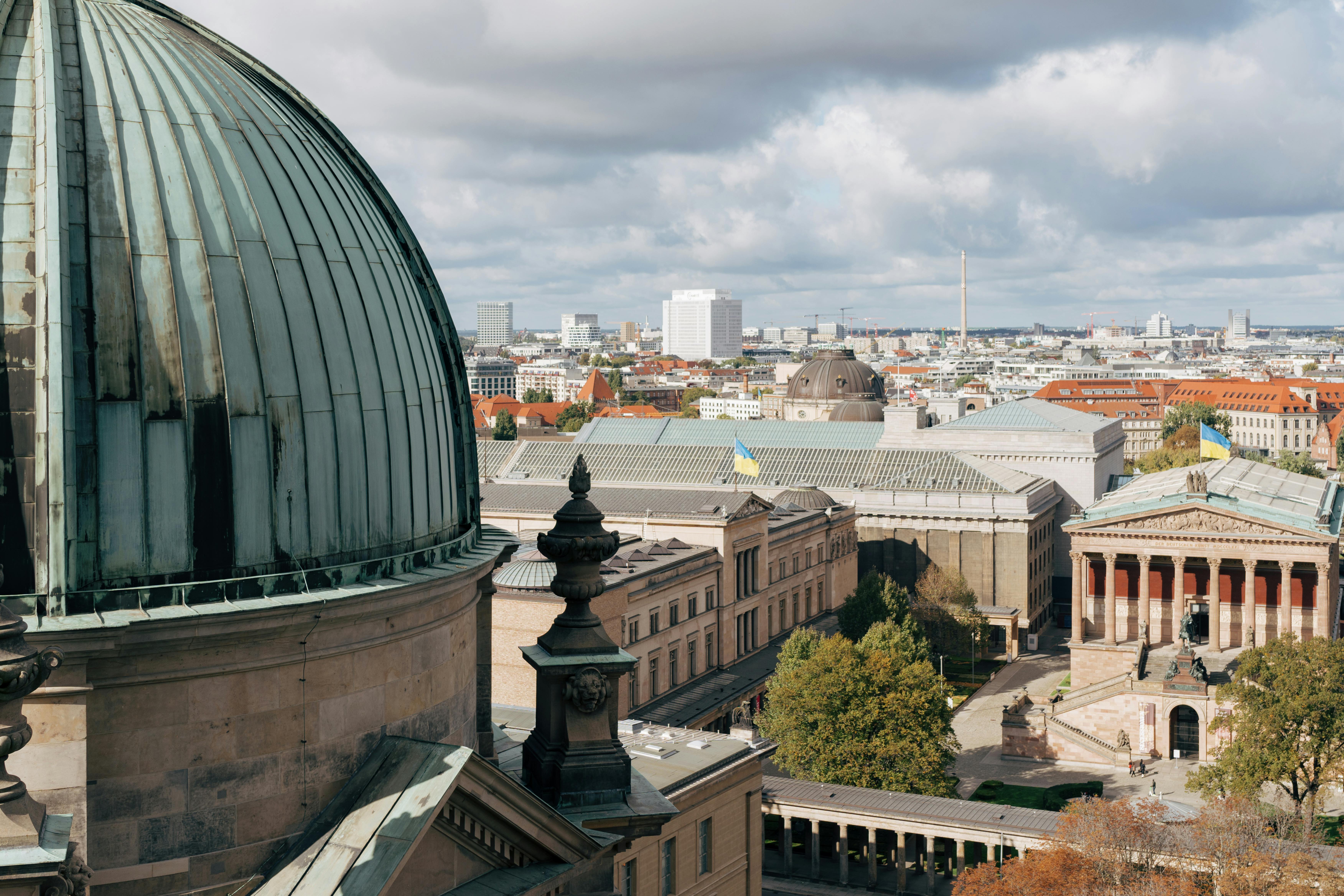
Thirty meters up, roughly the height of a 10-storey building, the roof terrace explains Berlin faster than any history lecture could. Berlin Cathedral swells close enough to study its copper ribs, Alexanderplatz pricks the horizon with its TV Tower, and on a clear day the line toward Brandenburg Gate reads like a ruler laid across the city; then, on the hour, Emeka Ogboh’s sound installation rolls through the air and turns the skyline into something you hear as much as see. Stay for that moment. Most visitors snap their photos and leave, missing the point that this roof is less a lookout than a correction: Berlin is not one neat story, and from up here the gaps, scars, domes, cranes, and triumphal gestures all sit in the same frame.
Through the Palace: Passage, Cellar, and Spree Edge
Start at Lustgarten, cut through the great Passage as Franco Stella intended, and treat the portals as city gates rather than museum doors. The light shifts fast: bright square outside, cool stone shadows within, then the Palace Cellar below, where the only surviving fragments of the original residence run through winding corridors with lower ceilings, colder air, and masonry that feels close enough to touch, before you come back out to the quieter Spree terrace where the river softens the whole performance. This is the route I’d choose over a rushed gallery march. You move from Baroque spectacle to archaeological survival to waterside pause in less than an hour, and the palace reveals its real subject: not Prussian grandeur alone, but Berlin’s habit of demolishing, rebuilding, doubting itself, and carrying on anyway.
Plan your visit
Getting There
Berlin Palace operates for visitors as the Humboldt Forum at Schloßplatz, 10178 Berlin. The easiest route is U5 to Museumsinsel or buses 100, 300, N5 to Lustgarten and 147 to Berliner Schloss, each about 1 minute on foot; from Alexanderplatz the walk is about 15 minutes via Rotes Rathaus, and from Hackescher Markt about 10 minutes. Drivers can use the Dom Aquarée, Bebelplatz, or Rathauspassagen garages, while coaches have stopping space on Rathausstraße from 09:00 to 22:30.
Opening Hours
As of 2026, the main exhibitions are open Wednesday to Monday from 10:30 to 18:30 and closed every Tuesday. The roof terrace keeps the same general pattern but stays open until 20:00 on Friday, and it can shut at short notice in snow, ice, or technical trouble. Restaurant Baret on the roof runs longer, usually 11:00 to midnight, which makes late-evening roof access possible even after gallery hours fade out.
Time Needed
Give the facade, courtyard, and free ground-floor spaces 45 to 75 minutes if you just want the building and its atmosphere. One paid exhibition or the roof terrace usually needs 1.5 to 2.5 hours, while a first serious visit with BERLIN GLOBAL or one major collection plus a break runs 3 to 4 hours. The full museum haul can eat 5 to 6 hours easily, which is why the two-day ticket exists.
Accessibility
The building is one of the easier big museum stops in central Berlin for step-free access: lifts reach the exhibition floors, the roof terrace is wheelchair accessible, and tactile floor guidance and tactile plans are provided. Service dogs are welcome, wheelchair-accessible toilets are available, and 22 disabled parking spaces sit on the south side of Schloßplatz without prior registration. The ground outside is mostly flat urban paving, so distance is the real obstacle, not hills.
Cost & Tickets
As of 2026, the combined exhibition day ticket costs 14 EUR, reduced 7 EUR; the two-day ticket is 18 EUR, reduced 9 EUR; and a day group ticket is 50 EUR for up to five adults. The roof terrace costs 3 EUR, a media guide 3 EUR, and children and teens up to 19 enter free, while many public areas such as the Castle Cellar, Sculpture Hall, and some displays cost nothing at all. If you plan to see more than one major collection, the two-day ticket is the better bargain by a wide margin.
History
A Palace Berlin Could Not Stop Rewriting
Records show Elector Frederick II laid the foundation stone on 31 July 1443, then moved into the new residence in 1451. He was not giving Berlin a decorative upgrade; he was planting princely authority beside a stubborn town that preferred its own freedoms.
What followed was less a single building than a relay of regimes. The Hohenzollerns enlarged it, Andreas Schlüter and Johann Friedrich Eosander von Göthe turned it into baroque theater, revolutionaries claimed its balconies, East Germany demolished the ruin in 1950 and 1951, and reunified Germany approved a partial reconstruction in 2002 before reopening the site as the Humboldt Forum.
The turning point
The Architect Who Made the Palace Famous and Nearly Lost Everything to Its Mud
The surface story says Berlin Palace is a triumph of baroque confidence, the grand Prussian set piece you see today in cream stone and swaggering sculpture. That version gives Andreas Schlüter the role of genius decorator and leaves it there.
But one detail refuses to behave: the lost Münzturm at the northwest corner. Records show Schlüter began the tower in 1702, and by 1706 it was leaning on Berlin's treacherous ground. For Schlüter, the stakes were personal. He had tied his reputation to turning a patched-together residence into the court image Frederick I wanted, and the tower's failure gave his enemies exactly what they needed.
The turning point came when Schlüter fell from favor and Johann Friedrich Eosander von Göthe took over, with the damaged tower later dismantled. The revelation is harsh and human: the man most responsible for the palace's fame was politically broken by one of its engineering disasters, while the palace itself survived to absorb the credit and forget the humiliation.
Once you know that, the facades stop looking serene. You see a building won by ambition, soft ground, court rivalry, and salvage, and the whole place feels more Berlin than Prussia: brilliant, unstable, and never quite finished.
When the Square Turned Revolutionary
Records show that on 18 March 1848, crowds gathered outside the palace to press King Friedrich Wilhelm IV for reforms. Around 2:30 pm, two shots rang out; whether accidental or not, people in the square heard betrayal. By night, central Berlin had become a barricade city. The royal residence was no longer just a home for power. It had become the spark point of revolt.
Demolition Was a Decision
Many visitors assume World War II simply erased the palace. War wrecked it, yes, and by February 1945 the building was a burned shell, but records show East German authorities then chose demolition in 1950 and 1951 as an ideological break with Prussian monarchy. That matters when you face today's reconstruction: this is not a faithful return of what stood here, but a modern building with three recreated historic facades, a modern east side, and a memory war built into its walls.
Tips for visitors
Photo Rules
Private photos are generally allowed inside and out, but exhibition floors ban flash, tripods, selfie sticks, and extra lighting. Watch the signs anyway: some temporary rooms tighten the rules, and drones are prohibited over this part of Mitte.
Bag Size Matters
Backpacks larger than A4 or 30 x 20 x 10 cm have to go into the cloakroom or the limited lockers, and oversized luggage beyond normal cabin-bag scale won't be accepted. Pack light if you're coming straight from the station.
Buy Official Tickets
Use the Humboldt Forum website or the foyer box office, especially if someone near Alexanderplatz tries to sell you a combined museum pass. Crowded U-Bahn stretches around Museumsinsel and event days on Schlossplatz also attract pickpockets, so keep your bag in front of you.
Eat With Intent
For convenience, Restaurant Baret on the roof is the obvious splurge, with skyline views and a bill to match; Lebenswelten Bistro downstairs is the quicker budget-to-mid-range fallback. If you want old Berlin over museum catering, walk to Zur Letzten Instanz on Waisenstraße for mid-range classics, and skip the lazier tourist menus along Unter den Linden unless location matters more than lunch.
Best Visit Window
Monday is a smart play because many Museum Island museums close then, while the Humboldt Forum stays open and feels less like a corridor of umbrellas and school groups. For the roof terrace, late afternoon gives the best light on the cathedral dome and the Spree, but wind up there can cut through a jacket even in mild weather.
Pair It Nearby
This place makes the most sense as part of a central Berlin circuit: combine it with Alexanderplatz for the TV Tower axis or walk west later toward Brandenburg Gate. Keep your paid time focused here, then use the free courtyard and terrace views as the hinge between Berlin's royal past and its argument with itself.
Traditional Berlin and German brasserie€€star4.6(6049)
Order: Order the Charlottenburger Parade if you want a broad hit of old-school Berlin cooking, or the zander fillet for something a little lighter but still rooted in the local menu.
This is the obvious pick when you want the Berlin Palace area to actually feel like Berlin. The room leans old-world, the portions are generous, and even mixed reviews on service still concede that the food is the reason to come.
Mediterranean-leaning breakfast and lunch cafe€€star4.7(2945)
Order: Go for the salad plate with its mix of eight salads, hummus, and tzatziki, then add the orange cake if you have room.
This is the kind of cafe people stumble into after a museum morning and then talk about for the rest of the day. Reviews keep circling back to fresh food, warm service, and breakfasts that feel more generous than the usual Mitte quick stop.
Modern international bistro with strong brunch and cocktails€€star4.7(1564)
Order: Dinner is the move here: share across the menu, and pair it with a spicy margarita or the Orchard cocktail.
Nomad feels like the version of Mitte locals still defend. People rave about rich, carefully balanced dishes and a brunch worth coming back for, even when service timing slips a little on busy nights.
All-day brunch cafe with Asian and Western comfort dishes€€star4.8(1238)
Order: Order the Rabbit Drop egg sandwich on brioche if you want something savory, or the French toast with lotus for the table if you lean sweet.
The appeal here is not just the food, though the portions sound properly generous. It is the calm, plant-filled atmosphere and a menu that dodges boring cafe formulas without turning into a stunt.
checkBerlin Palace sits in visitor-heavy Mitte, so the immediate area is convenient but not always where Berlin eats best.
checkFor stronger food scenes, look toward Hackescher Markt and Spandauer Vorstadt, Rosenthaler Vorstadt and Torstraße, Kreuzberg, Neukölln, Prenzlauer Berg, Friedrichshain, and Charlottenburg.
checkBerlin food culture is not just traditional German: Turkish and Middle Eastern street-food staples like döner, falafel, and shawarma are part of the city’s identity.
checkLunch in Germany usually falls between 12:00 and 14:00, with many people eating closer to 12:00 to 13:00.
checkDinner often lands between 18:00 and 20:00, though Berlin is looser about this than more traditional schedules.
checkDo not assume Monday service. Monday has long been a common restaurant closing day, and Monday-Tuesday closures are common enough that both are worth checking.
checkHackescher Markt has a weekly market on Thursday and Saturday, but the timing is inconsistent across sources, so verify before going.
checkMarkthalle Neun is one of the city’s most useful food stops: Street Food Thursday runs 17:00-22:00 at Eisenbahnstraße 42/43.
They Blew Up Berlin's Baroque Palace. Now It Has Been REBUILT
The Aesthetic City16 min280K
Explore Berlin
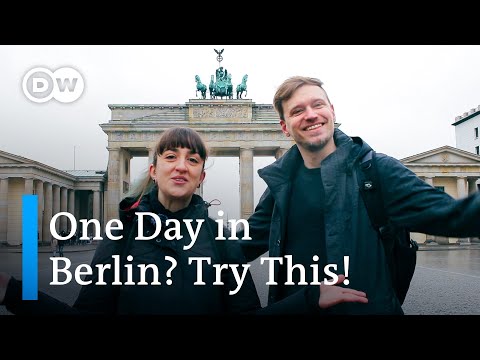
A Day in Berlin – What you MUST See: Join Alemanizando on a Special Tour Through the German Capital
DW Travel19 min240K
Frequently asked
Is Berlin Palace worth visiting?
Yes, if you go in knowing it is a rebuilt shell with a very live argument inside it, not a preserved royal residence. The surprise is the contrast: carved Baroque sandstone outside, bright modern interiors within, and a palace cellar below where the air cools and the history finally feels rough-edged. Go for the Schlüterhof courtyard, the roof terrace 30 metres up, and the uneasy story of a site that has served kings, revolutionaries, and museum curators in turn.
How long do you need at Berlin Palace?
Give it 2 to 4 hours for a first visit, and longer if you care about the exhibitions. A quick look at the exterior, courtyard, free palace cellar, and roof terrace can fit into about 60 to 90 minutes, but BERLIN GLOBAL alone averages about 120 minutes and the major museum collections run about 90 minutes each. The two-day ticket exists for a reason.
How do I get to Berlin Palace from Alexanderplatz?
Walk if the weather is decent; it takes about 15 minutes and the route is better than the U-Bahn. Head past Rotes Rathaus toward Schloßplatz, with the TV Tower behind you and the palace dome slowly rising ahead like a stone stage set. If you want the fastest public-transport option, U5 to Museumsinsel leaves you about 1 minute from the entrance.
What is the best time to visit Berlin Palace?
Late morning on a weekday is the sweet spot, and summer is best if you want the building to feel alive rather than ceremonial. The Schlüterhof carries more sound then, the terraces are usable, and the roof gives long views across Museum Island and Berlin Cathedral when the light is clean. Winter can be handsome in a colder, harder way, but the roof terrace may close in snow or ice.
Can you visit Berlin Palace for free?
Partly, yes. The building has free areas including the Palace Cellar, Sculpture Hall, Humboldt Laboratory, courtyards, and some public spaces, while the main exhibitions require a paid ticket; as of July 2026, the standard day ticket is 14 EUR and the roof terrace ticket is 3 EUR. Children and young people up to age 19 also enter many areas free.
What should I not miss at Berlin Palace?
Do not skip the Palace Cellar, even if everyone else is rushing upstairs for the view. It is the one place where the site stops posing and starts confessing, with surviving masonry, monastery traces, and lower, cooler corridors under all that reconstructed grandeur. After that, climb to the roof terrace for the full political geography of central Berlin spread out around you.
Sources & attribution10
Researched and written by the Audiala editorial team from historical records, architectural archives, and local expertise. Last updated July 2026.
Humboldt Forum Visit — Current visitor overview, official location, and general planning information for the Berlin Palace site as operated through the Humboldt Forum.
Humboldt Forum Admission Tickets — Official ticket prices, free-entry categories, roof terrace pricing, and average exhibition visit times used for timing and cost answers.
Humboldt Forum Roof Terrace — Official roof terrace hours, weather-related closures, height, views, and hourly sound installation details.
Humboldt Forum Palace Cellar — Official description of the Palace Cellar as a surviving historic layer beneath the rebuilt palace.
Humboldt Forum History of the Site — Official site history used to frame the palace as a layered political and architectural location rather than a simple reconstruction.
Berlin.de Berlin Palace — Berlin city visitor information confirming the palace’s identity, historical milestones, and the roof terrace as a major visitor feature.
Humboldt Forum Accessibility — Official access information supporting transport proximity and step-free visitor details.
Humboldt Forum Building Site Reconstruction — Official reconstruction background used to describe the palace as a rebuilt exterior with a modern interior rather than an untouched historic residence.
Berlin on a Monday — Recent local walking guidance used for the practical route from Alexanderplatz and the Monday visit context.
Humboldt Forum Urban Spaces — Official explanation of the Schlüterhof courtyard and the building’s public passages, used for experiential detail.
Saved and recently read places — kept on this device only.
Photo credits (5)
Berliner Schloss-8044 — GodeNehler — CC BY-SA 4.0 (https://creativecommons.org/licenses/by-sa/4.0/) — Source: https://commons.wikimedia.org/wiki/File:Berliner_Schloss-8044.jpg
The Dome Of Berlin Palace — AusleseBeeren — CC BY-SA 4.0 (https://creativecommons.org/licenses/by-sa/4.0/) — Source: https://commons.wikimedia.org/wiki/File:The_Dome_Of_Berlin_Palace.jpg
View from Rooftop of Humboldt Forum in Berlin — Fronl — CC BY-SA 4.0 (https://creativecommons.org/licenses/by-sa/4.0/) — Source: https://commons.wikimedia.org/wiki/File:View_from_Rooftop_of_Humboldt_Forum_in_Berlin.jpg
Exterior of Humboldt Forum-(Berlin)-2026-03-msu-8595 — Matthias Süßen — CC BY-SA 4.0 (https://creativecommons.org/licenses/by-sa/4.0/) — Source: https://commons.wikimedia.org/wiki/File:Exterior_of_Humboldt_Forum-(Berlin)-2026-03-msu-8595.jpg
Strictly necessary cookies keep the site working. Analytics (PostHog, Google Analytics) measures how each visitor uses our pages. Marketing loads YouTube videos and walking-route maps without a tap and lets Google Analytics set advertising cookies. We never sell your data. You can change this any time from the footer.
Analytics and marketing cookies are optional and only load if you agree. Details under Customize.
Privacy
Cookie preferences
Pick what you're okay with. You can change this any time from the footer.
Strictly necessary
Always on
Sign-in, language, navigation. Always on.
Product analytics
PostHog (EU) and Google Analytics record which pages you view and how you use them, under a random identifier stored in your browser. Helps us see which pages work and which need fixing. Google's ad personalisation stays off. No selling.
Marketing
Loads YouTube videos and the walking-route maps (OpenFreeMap) without a tap; without it, they load only when you tap them. If analytics is also on, Google Analytics may set advertising cookies. Ad personalisation stays off.