How can Berlin Cathedral in Berlin, Germany, look like a Protestant answer to St. Peter's and still never have been a bishop's seat at all? That tension is the reason to come: the Berlin Cathedral rises above the Lustgarten in oxidized copper, wet stone, and gold mosaics, while the Spree glints beside Museum Island. Visit for the dome climb, yes, but also for the argument the building makes about power, faith, and Berlin's habit of rebuilding itself with the scars still showing.
From the square, the cathedral feels oversized on purpose. The main dome lifts 98 meters into the Berlin sky, about the height of a 30-storey block, and the sandstone facade catches the light in a way that turns pomp into theatre.
Step inside and the mood changes. Footsteps soften on the floor, the air smells faintly of stone and polish, and the vast preaching church opens under a ceiling that seems designed to make every whispered doubt sound smaller than empire.
But the place gets more interesting once you stop taking the word "cathedral" at face value. Records show this is the fourth church on the site, consecrated in 1905, and much of what you see now is a survival story shaped by war, East German editing, and a long argument over what Berlin should remember.
Researched by the Audiala editorial team from historical records, architectural archives, and local expertise.
What to see
The Sermon Church and Imperial Staircase
Berlin Cathedral saves its best trick for the moment you step past the granite stair and into the imperial sequence: a staircase built to flatter dynasties, then a preaching church so tall it seems to lift the sound of your shoes into the dome. Friedrich August Stuler began the long argument over this site in the 1840s, Julius Carl Raschdorff gave it its present form between 1894 and 1905, and the result feels less like private devotion than public theater, with mosaic, polished stone, and gold catching the light above you like a stage set that forgot to be modest. Stay a minute in the center and look up. The building stops reading as a church and starts reading as a statement about what Prussia wanted Berlin to believe about itself.
The Hohenzollern Crypt and Dome Walk
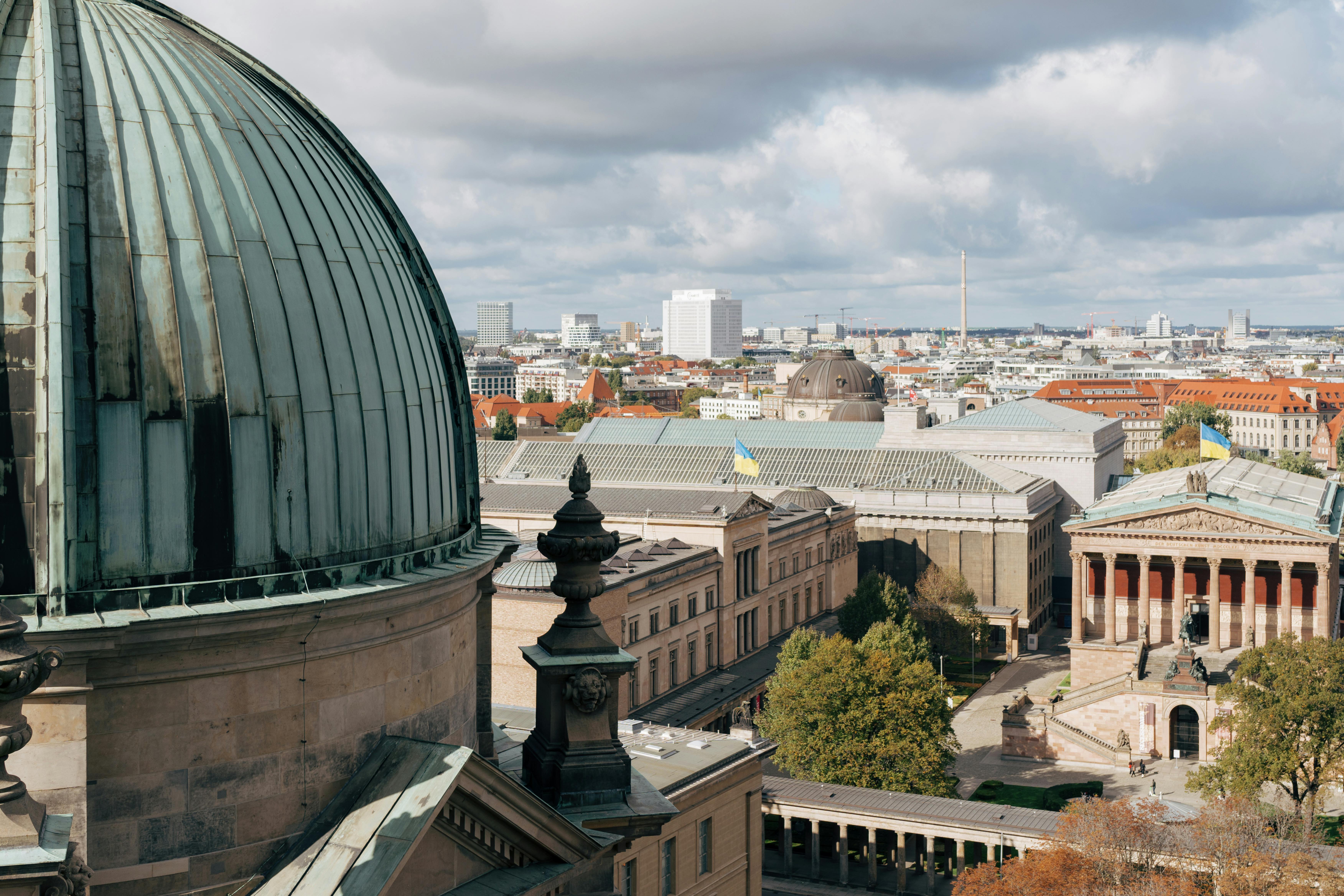
The emotional center of the visit sits underground, not overhead: the Hohenzollern Crypt holds 90 burials from the late 16th to the early 20th century, rows of sarcophagi in bronze and stone that turn royal self-confidence into something colder and much quieter. Then you climb 270 steps to the dome gallery, 50 meters above the ground, about as high as a 16-story apartment block, and Berlin opens around you in every direction, from the museums of Museum Island to the bulk of Berlin Palace. That contrast is the point. Few places in Berlin let you move from dynastic death to open sky in one ticket.
Circle the Cathedral Before You Enter
Do not take the postcard view from the Lustgarten and call it done; the more revealing side is the Spree, where the cathedral still shows its original three-part composition and the missing north section reminds you that war and reconstruction changed the silhouette you see today. Walk the river edge first, listen for the bells with their warm, rounded tone, then go inside and climb only after you have seen the exterior from the water side. The building makes more sense that way, and it becomes stranger too: less a generic grand church, more a damaged imperial monument still trying to control the skyline.
Plan your visit
Getting There
Berlin Cathedral stands at Am Lustgarten 1, a one-minute walk from U5 Museumsinsel, with tram M4, M5 and M6 stopping at Spandauer Straße and buses 100 and 300 at Museumsinsel. From S Hackescher Markt, walk about 10 minutes southwest toward Lustgarten; from Alexanderplatz, follow Karl-Liebknecht-Straße for about 15 minutes, or drive to nearby garages at DomAquarée, Bebelplatz, or Rathauspassagen.
Opening Hours
As of 2026, sightseeing hours are Monday to Friday 9:00-18:00, Saturday 9:00-17:00, and Sunday 12:00-17:00; from June 1 to August 31, closing extends to 19:00 on those same daily patterns. Last admission is always 60 minutes before closing, and services, prayers, concerts, or weddings can shut the nave to visitors without much romance about it.
Time Needed
Plan 45-60 minutes for a brisk look at the main church and crypt, especially if you skip the dome climb. A proper visit takes about 90 minutes with the included audio guide, and 90-120 minutes feels right if you want the crypt, museum, dome stairs, and a pause in the cafe.
Accessibility
As of 2026, the cathedral offers a barrier-free route to the main sanctuary, crypt, museum, shop, cafe, and toilets, using a self-service lift on the north side and another lift in the south tower area. The dome remains out of reach for reduced-mobility visitors, with 270 steps rising like a narrow stone chimney, and the Jablonski and Schleiermacher rooms are also not barrier-free.
Cost & Tickets
As of 2026, standard admission is 15 EUR, reduced admission 12 EUR, and Berlin WelcomeCard admission 11 EUR; the audio guide is included, which saves you from paying extra for context. Tickets can be bought online, at cashless machines, or at the ticket desk, and one adult can bring up to four children under 18 on the family-style ticket for the same 15 EUR.
Photo Gallery
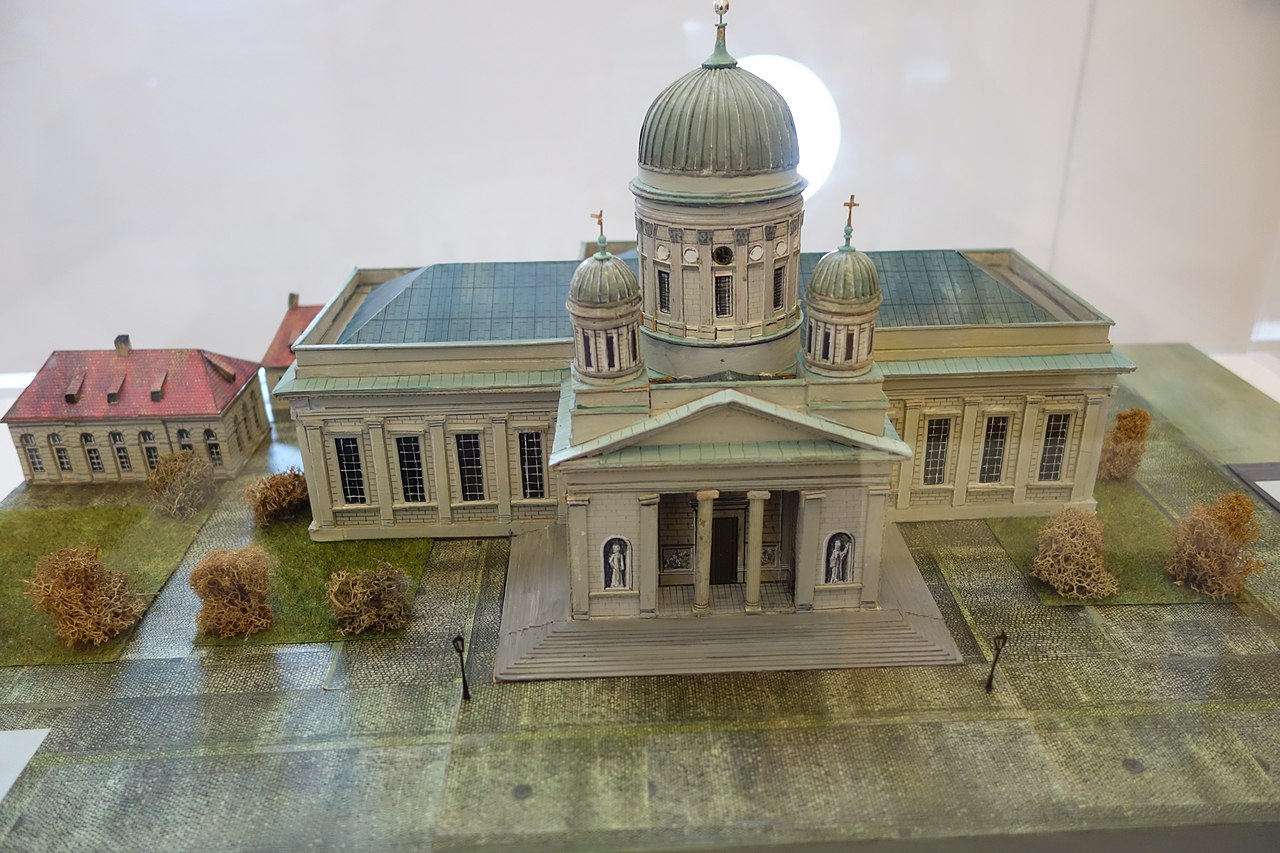
A detailed scale model presents Berlin Cathedral’s domed architecture, columned entrance and landscaped grounds. The model is displayed under soft indoor lighting. · Ray Swi-hymn from Sijhih-Taipei, TaiwanA historic view of Berlin Cathedral’s grand interior shows its coffered barrel vault, monumental columns, organ pipes and long rows of pews. · Ray Swi-hymn from Sijhih-Taipei, TaiwanThe monumental entrance of Berlin Cathedral frames a colorful biblical mosaic beneath elaborate arches and bronze angels. Two visitors at the gates reveal the immense scale. · Sergey GalyonkinBerlin Cathedral’s copper dome rises behind the Lustgarten colonnade and fresh spring foliage. Visitors gather beside a fountain in the clear midday light. · Ray Swi-hymn from Sijhih-Taipei, TaiwanA detailed model reveals the arches, columns and sweeping imperial staircase inside Berlin Cathedral, paired with a historic photograph of the same interior. · Ray Swi-hymn from Sijhih-Taipei, TaiwanTwo weathered religious sculptures occupy a tall, softly lit niche inside Berlin Cathedral. One figure holds a tablet inscribed with Roman numerals. · Ray Swi-hymn from Sijhih-Taipei, TaiwanTwo black-and-white photographs document Berlin Cathedral’s domes and neoclassical exterior. Reflections from gallery lights appear on the framed display. · Ray Swi-hymn from Sijhih-Taipei, Taiwan
History
An Imperial Church With a Missing Wing
Berlin Cathedral looks ancient from a distance, but that is one of its better tricks. Records show the current building belongs to the Wilhelmine period, not the Middle Ages, and stands on a site that changed with the Hohenzollern court, the Reformation, the Prussian Union, the bomb war, and the GDR.
That makes the building less a fixed monument than a stack of political decisions in stone. You can read the whole city here: court ambition across from the Berlin Palace, cultural prestige beside Museum Island, and postwar damage that Berlin never fully hid.
The turning point
The Cathedral That Was Never Quite What It Pretends to Be
At first glance, the story seems simple: an old cathedral crowns central Berlin, seat-like in its authority, resting where it has always belonged. The dome, the imperial staircases, the dynastic crypt, the thunderous scale of the nave all push you toward that reading.
Then the details start to misbehave. Official cathedral history states that Berlin Cathedral has never been a bishop's seat in the strict sense, and records show the present building was consecrated only in 1905 after an earlier church was demolished in 1893. Julius Carl Raschdorff, the architect chosen by Wilhelm II, had more than a commission at stake; he was betting his reputation on proving that Protestant Prussia could build with the same monumental swagger people associated with Rome. The turning point came when the emperor approved Raschdorff's grand design after multiple proposals, clearing the way for a church that was meant to glorify dynasty as much as devotion.
That surface story exists because the building was supposed to persuade. It told Berliners that empire was ordained, cultured, permanent. War wrecked that claim in 1944, and East German authorities drove the point home in 1975 when they demolished the north-side Memorial Church and rebuilt the cathedral in simplified form. Once you know that, the place looks different: less like a seamless relic, more like a staged self-portrait with one corner torn away.
Before the Big Dome
Records show the site's church history reaches back to the 15th century, when the Hohenzollern court anchored its worship here. The collegiate foundation was confirmed in 1465, the Reformation remade the church in 1539, and the building kept changing with each shift in power. What visitors see now is the fourth major church on the spot, which is why any claim that this is a single medieval survivor collapses fast.
War, Ruin, and Repair
Cathedral accounts describe 24 May 1944 as the night fire broke through the dome and crashed into the church below. The congregation later worshipped in makeshift crypt spaces while the main body stood damaged for decades. The restoration completed in 1993 returned the cathedral to use, but not to its exact 1905 form; the missing northern section still reads like a sentence Berlin never finished.
Tips for visitors
Dress Properly
This is still a working church, not a stage set. Staff can refuse entry for very short shorts or skirts, off-the-shoulder tops, and low-cut clothing, and men are expected to remove hats unless religion says otherwise.
Photo Limits
Private photos are allowed, but flash and tripods are banned, and cameras go quiet during services, prayers, rehearsals, and concerts. If you hear the organ warming up, assume the rules will tighten before your lens does.
Watch the Square
Lustgarten, Unter den Linden, and the Hackescher Markt approach draw pickpockets, and Berlin officially warns about shell-game scammers near the bridge by the palace-cathedral zone. Ignore anyone inviting you to a street game, and if a supposed officer wants to inspect your cash, ask for ID or call 110.
Eat Nearby
Inside the cathedral, Dom-Cafe works for coffee and cake at budget-to-mid prices, especially after the dome stairs. For something better, try Father Carpenter on Münzstraße 21 for a mid-range brunch, Zur letzten Instanz on Waisenstraße 14-16 for old Berlin dishes at mid-range prices, or Baret at the Humboldt Forum for a splurge and a sharp view back toward Berlin Palace.
Go Early
Weekday mornings are the least clogged, and summer light on the dome and Lustgarten has a pale gold sheen that flatters all that imperial excess. Arrive early enough for the nave, then cross to Museum Island before the tour groups thicken like a queue at airport security.
Pack Light
Bags larger than A3 and any suitcase are barred, and the basement lockers are limited. If you are carrying proper luggage, stash it at Alexanderplatz or Friedrichstraße station first; otherwise you may spend your visit negotiating with a locker shortage instead of looking at the crypt reopened in March 2026.
Where to Eat
local_dining
Don't Leave Without Trying
CurrywurstDoner kebabPfannkuchenBulettenEisbein
Nante-Eck | Restaurant Berlin Mitte
local favorite
Traditional Berlin and German brasserie€€star4.6(6049)
Order: Order the Charlottenburger Parade if you want the full old-Berlin effect, or the Zanderfilet for something more polished. Reviews also single out the liver with apples as simple and genuinely good.
This is the most convincing local classic in the group: frosted glass, terrace, big-city brasserie energy, and a menu built around the kind of hearty Berlin food visitors actually come looking for. Service can be uneven, but people keep saying the food is the reason to come.
Mediterranean-leaning breakfast and lunch cafe€€star4.7(2945)
Order: Go for the salad plate with its mix of eight salads, hummus, and tzatziki, then add the orange cake if you're lingering. Breakfast gets strong praise too.
This is the kind of cafe you want after a museum morning: friendly owner, fresh food, and a room that feels properly lived in rather than staged for Instagram. The menu sounds simple, but the reviews keep coming back to freshness and generous presentation.
Order: Start with the Punjab Naan Pocket, then order the Tamarind Prawn Bowl if you're hungry. Reviews also mention the chai and the fresh mango pickle as standouts.
Berlin does migration-shaped casual eating better than almost anywhere in Europe, and this place makes that point nicely. The food sounds fresh, filling, and smarter than the average bowl shop, with warm service that people mention again and again.
Contemporary Asian restaurant with cocktails€€star4.8(2223)
Order: Order the Pandan Duck if you want the dish people rave about, or the mixed starter plate if you're sharing. The General Beef and cocktails also get strong mentions.
This is the stylish dinner pick: elegant room, polished plates, and the kind of atmosphere that makes people stay longer than planned. It is not old Berlin cooking, but it reflects the international side of central Berlin very well.
checkAround Berlin Cathedral you are in Mitte, where the choice is broad and central rather than narrowly traditional.
checkBerlin food culture splits between old Berlin hearty dishes and migration-shaped casual eating, so it makes sense to mix a classic German meal with street-food-influenced spots.
checkIf you want a planned dinner on Monday or Sunday evening, check hours in advance; Monday has long been the classic Ruhetag for many Berlin restaurants, even if that pattern is changing.
checkBreakfast on workdays commonly starts around 06:30-08:00, while weekends stretch later toward brunch.
checkBrunch usually starts no earlier than 10:00 and more often around 11:00.
checkLunch service is commonly available around 11:30-14:00.
checkDinner is commonly served from about 18:00-21:00.
checkFor market eating, Markthalle Neun is strongest for Street Food Thursday from 17:00-22:00.
Food districts:Mitte for broad central choice near Berliner DomKreuzberg for stronger local food scenes and Markthalle NeunNeukolln for the Maybachufer marketPrenzlauer Berg for Kollwitzplatz marketFriedrichshain for local food scenesCharlottenburg for local food scenes and Karl-August-Platz marketSchoneberg for local food scenes and Winterfeldtplatz market
Restaurant data powered by Google
Frequently asked
Is Berlin Cathedral worth visiting?
Yes, especially if you want one place that shows Berlin's imperial ambition, war damage, and afterlife in a single visit. The current building dates to 1894-1905, so what you see is not a medieval survivor but a grand Protestant showpiece beside Museum Island. Best moment: move from the bright main church down into the Hohenzollern Crypt, where 90 burials turn all that pomp quiet.
How long do you need at Berlin Cathedral?
Plan on 90 minutes if you want the visit to feel complete. That gives you time for the main church, the crypt, and the dome gallery 50 meters up, reached by 270 steps, about the height of a 16-storey building. If you skip the climb, 45 to 60 minutes can work.
How do I get to Berlin Cathedral from Berlin?
The easiest route is public transport to U5 Museumsinsel, then a one-minute walk to Am Lustgarten 1. You can also use S-Bahn to Hackescher Markt and walk about 10 minutes, or come by tram M4, M5, or M6 to Spandauer Straße. From Alexanderplatz, the walk down Karl-Liebknecht-Straße takes about 15 minutes and the dome stays in view like a green compass point.
What is the best time to visit Berlin Cathedral?
Weekday mornings are the best time to visit if you want softer crowds and more room to hear your own footsteps under the dome. Summer brings later closing, with opening extended until 19:00 from June 1 to August 31, but last admission is still 60 minutes before closing. Avoid times that overlap with services, concerts, or prayers unless you are there for the liturgy, because sightseeing access can tighten.
Can you visit Berlin Cathedral for free?
Usually no, not for standard sightseeing. Regular admission in 2026 is 15 EUR, and that includes the audio guide; services and some special events are free, but they are not the same as a full tourist visit. A rare example was the one-off free open day on February 28, 2026 for the crypt reopening.
What should I not miss at Berlin Cathedral?
Do not miss the Hohenzollern Crypt, the Imperial Staircase, and the dome gallery. Most people rush to the big interior, but the better secret is outside on the Spree side, where the building's three-part composition still reads clearly and the missing north section leaves a visible scar from 1975. Once you notice that broken symmetry, the cathedral stops being just grand and starts telling the truth.
Sources & attribution11
Researched and written by the Audiala editorial team from historical records, architectural archives, and local expertise. Last updated July 2026.
Berlin Cathedral Architecture — Used for the dome height, 270-step climb, Spree-side composition, reduced postwar profile, and what to notice on the exterior.
Berlin Cathedral Visitor Service — Used for current opening hours, summer extension, last admission rule, ticket prices, audio guide inclusion, and the 90-minute visit recommendation.
Berlin Cathedral House Rules — Used for access restrictions during services, concerts, prayers, and other church events.
Strictly necessary cookies keep the site working. Analytics (PostHog, Google Analytics) measures how each visitor uses our pages. Marketing loads YouTube videos and walking-route maps without a tap and lets Google Analytics set advertising cookies. We never sell your data. You can change this any time from the footer.
Analytics and marketing cookies are optional and only load if you agree. Details under Customize.
Privacy
Cookie preferences
Pick what you're okay with. You can change this any time from the footer.
Strictly necessary
Always on
Sign-in, language, navigation. Always on.
Product analytics
PostHog (EU) and Google Analytics record which pages you view and how you use them, under a random identifier stored in your browser. Helps us see which pages work and which need fixing. Google's ad personalisation stays off. No selling.
Marketing
Loads YouTube videos and the walking-route maps (OpenFreeMap) without a tap; without it, they load only when you tap them. If analytics is also on, Google Analytics may set advertising cookies. Ad personalisation stays off.