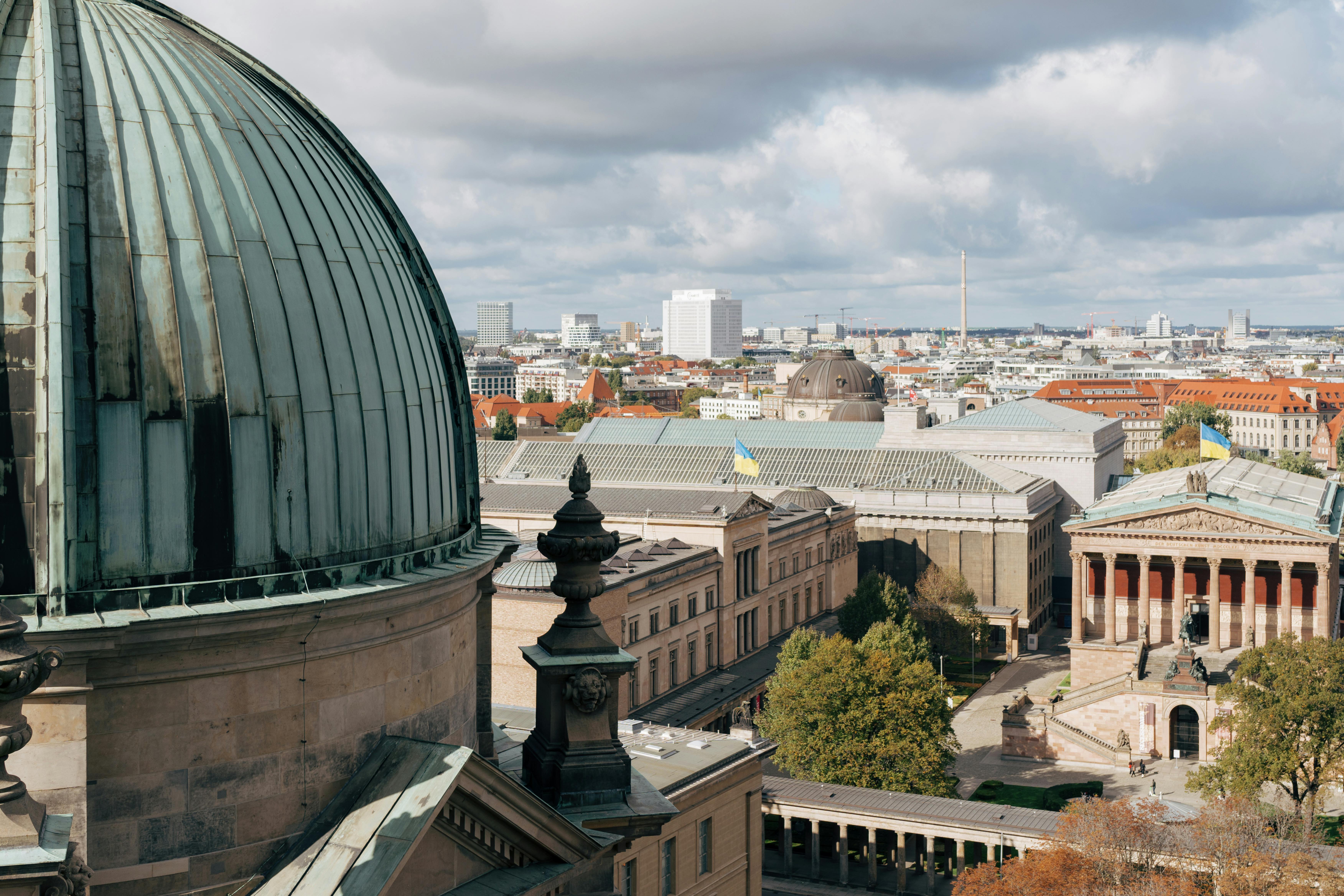
Why does Alexanderplatz in Berlin, Germany, feel both too empty and too full at once? You come for that contradiction: a square famous not for postcard prettiness but for showing Berlin in the raw, from Prussian naming rituals to East German spectacle to the city's blunt talent for reinvention. Today the place opens in hard planes of pale stone, tram bells, frying oil, snippets of many languages, and the slow spin of the World Clock while the TV Tower needles the sky just beyond the square's edge.
Most visitors expect an old European plaza with tidy facades hugging the edges. Alexanderplatz refuses that script. Its width, its exposed sightlines, and its slightly disorienting scale come from a 1960s socialist redesign that treated public space like a stage set, built for mass movement, mass visibility, and politics performed in the open.
That makes it one of the best places in Berlin to read the city against itself. Records show the square took its current name in 1805 after Tsar Alexander I visited Prussia, then grew into a transport knot, a shopping district, a bombed ruin, a GDR showpiece, and now a meeting ground where Berliners still say the same thing they did decades ago: meet me under the clock.
Come here for atmosphere, not prettiness. Stand still for ten minutes and the square explains Berlin Cathedral, Museum Island, and the old royal center by contrast: those places preserve Berlin's monuments, but Alexanderplatz preserves its public nerve.
Researched by the Audiala editorial team from historical records, architectural archives, and local expertise.
What to see
World Clock and Fountain of International Friendship
Alexanderplatz makes sense once you stop treating it like a square and start reading it like a stage set, and the best front-row seat is the 1969 World Time Clock beside the Fountain of International Friendship. Stand on the mosaic compass rose under your shoes, look up at the 24-sided cylinder turning through world cities, and remember the sly mechanical secret below: records note that the clock still runs with help from a modified Trabant gearbox, a tiny piece of East German practicality keeping time for Tokyo, Havana, and Berlin at once. A few steps away, water slips down 17 copper bowls into the fountain basin, softening the tram screech and station rumble, and suddenly this hard-paved expanse feels less like transit infrastructure and more like the place Berlin chose to meet itself.
Fernsehturm
Berlin’s TV Tower rises just off the square like a piece of Cold War science fiction that refused to become obsolete, built between 1965 and 1969 with a concrete shaft and a steel sphere meant to echo Sputnik. The observation deck sits 203 meters up, roughly the height of stacking 40 double-decker buses on end, and the elevator ride flips the mood in seconds: below, buskers, tram bells, shopping bags, and wind over the paving; above, a calm ring of glass where the city suddenly reads as a legible map, with Museum Island to the west and the scar of the old border still visible if you know where to look. Go late in the day if you can, when low sun turns Berlin copper and grey and the square below starts to look less like chaos than a very deliberate argument about how a capital should present itself.
From Alex to Marienkirche
The smartest short walk here takes barely ten minutes and changes centuries under your feet: start under the World Clock, cut past the Behrens-built Alexanderhaus and Berolinahaus from 1930 to 1932, then head west toward St. Mary’s Church. The square’s hard surfaces, retail glare, and metallic noise give way to brick, grass, and shadow near the church and Rathausforum, and that contrast is the whole point; one moment you are inside the GDR’s grand urban choreography, the next you are standing in a medieval interior while the Fernsehturm hovers outside like an unwanted but fascinating guest. And that’s the secret of Alexanderplatz: don’t come looking for prettiness, come to watch Berlin change masks in a single block.
Plan your visit
Getting There
Alexanderplatz sits on Berlin’s main east-center transport knot, so the easy move is public transit: U2, U5, U8, S3, S5, S7, S9, plus trams M2, M4, M5 and M6 all stop here. From BER Airport, the simplest direct ride is the S9 into the city; from Museum Island, walk about 14-18 minutes, and from Berlin Palace or the Humboldt Forum area, about 15 minutes. Drivers can use 24/7 garages at Park Inn, RathausPassagen, or Q-Park Am Alexanderplatz, though the square works best on foot once you arrive.
Opening Hours
As of 2026, Alexanderplatz itself has no museum-style opening hours because the square is public space and effectively accessible around the clock. What changes is the rhythm: commuter traffic starts early, evenings stay busy, and event setups around the World Clock and Fountain can temporarily eat into open plaza space. Fixed services nearby keep their own schedules, including the WC-Center at Mon-Sat 07:00-22:00 and Sun 10:00-22:00, while the station Sanifair stays open 24/7.
Time Needed
Give Alexanderplatz 15-30 minutes if you only want the essentials: the World Clock, the TV Tower backdrop, and the square’s big, windy DDR scale, which hits like a paved parade ground the size of a few city blocks stitched together. Stay 45-60 minutes if you want coffee, photos, and time to watch the commuter theater. A fuller look with nearby Berlin Cathedral, Marienkirche, or Nikolaiviertel makes more sense at 1.5-3 hours.
Accessibility
The square itself is broadly flat and paved, so the main obstacles are crowds, long signal crossings, weather exposure, and occasional construction or event barriers rather than hills. S+U Alexanderplatz has lifts, and BVG can deploy a mobile ramp for barrier-free boarding on some U-Bahn services; accessible toilets are available at the WC-Center beside the police station and at the station Sanifair. If you plan to add the TV Tower, check separately: that building is not barrier-free for visitors with limited mobility.
Cost & Tickets
As of 2026, Alexanderplatz costs nothing to enter: no admission fee, no booking system, no official skip-the-line product. Paid basics matter more here than tickets, including €0.50 for the WC-Center and 24-hour station lockers on the ground floor near the DB center; Alex Oase lockers on the square start at €1.50 for 4 hours. Save your money for what sits around the square, whether that means a meal in Nikolaiviertel or a timed ticket for the TV Tower.
Photo Gallery
Playful black-and-white creatures cover a construction wall at Alexanderplatz. Berlin’s surrounding buildings rise behind the mural in bright daylight. · Flocci NivisThe Fernsehturm rises above Alexanderplatz as cyclists and pedestrians cross the busy square beneath a bright summer sky. · Sludge GModernist office towers and a towering floodlight mast rise above Alexanderplatz beneath a clear blue Berlin sky. The square appears quiet in bright daylight. · Dirk Ingo FrankePlayful black-and-white creatures cover temporary walls at Alexanderplatz. Modern Berlin architecture rises behind the artwork under bright daylight. · Flocci NivisThe Urania World Clock stands above the crowds at Alexanderplatz under a vivid blue sky. Modern buildings frame this busy Berlin meeting place. · Jo VertBerlin’s TV Tower rises above Alexanderplatz, framed by modern buildings, construction cranes, traffic and cyclists on a bright, clear day. · Sebastian WallrothRed cranes rise behind a web of tram wires at Alexanderplatz in Berlin. Bright daylight sharpens their silhouettes against the clear blue sky. · Roy Zuo
History
A Square Built to Be Seen, Then Used Against Power
Alexanderplatz began as an edge condition, not a center. Sources agree that the site stood outside medieval Berlin's walls, and documented history shows it later served as a market ground before King Friedrich Wilhelm III renamed it in 1805 for Tsar Alexander I during a moment when Prussia needed Russian friendship against Napoleon.
What followed was less a tidy evolution than a stack of regime changes pressed into stone. The square saw barricades in 1848, became a transport node in the late 19th century, absorbed literary fame through Alfred Doblin's 1929 novel, then re-emerged after war as the GDR's giant open-air statement about how a socialist capital should look.
The turning point
The Clock That Outlived the State
At first glance, the World Clock looks like a friendly bit of urban furniture, the obvious place to meet before dinner or a train. That surface story is true enough. Since its public handover on 30 September 1969, Berliners have treated it as a rendezvous machine, practical and oddly tender in a square that can otherwise feel as hard as poured concrete.
But something doesn't quite fit. Why would a tightly controlled state place a monument to world time, with cities circling the globe, in the middle of East Berlin? Documented sources name industrial designer Erich John as the clock's creator, and what was at stake for him was personal as well as professional: the GDR wanted a polished symbol for its 20th anniversary, and failure in that system did not mean a bad review, it meant political trouble.
The revelation sits in the irony. John turned a state commission into a civic object more useful than ideological, and the turning point came on 4 November 1989, when hundreds of thousands filled Alexanderplatz to demand change while the clock kept rotating above them. Once you know that, the square looks different: the World Clock stops reading as socialist decor and starts reading as witness, a piece of propaganda that Berlin quietly stole for itself.
Before the Concrete Expanse
Long before the TV Tower defined the skyline, Alexanderplatz had rougher work to do. Sources indicate the area functioned as a cattle market by 1681, and some accounts also place executions here in earlier centuries, which suits the geography: this was the city's threshold, where trade, punishment, and movement collided before Berlin absorbed the ground into its expanding body.
A Stage for Revolt
Documented history places street fighting here during the March Revolution of 1848, and the square kept that political muscle. It returned in 1989 on a scale almost absurd to imagine now, with a crowd estimated between 500,000 and one million people, enough to turn the paved void into something like a civic sea, cold air above it, homemade banners flicking, state power suddenly looking smaller than its own square.
Tips for visitors
Meet Under Alex
Berliners rarely say the full name. They say meet 'under the World Clock,' and that landmark saves you from the classic Alexanderplatz problem: a square so broad and busy it can feel as hard to pin down as an airport forecourt.
Watch Your Pockets
Alexanderplatz is one of Berlin’s officially named pickpocket hotspots, and shell-game scams still work the crowds here. Keep your phone zipped away near station exits, ignore anyone running a street betting game, and refuse any 'police' check unless uniformed officers show clear ID and take you to a real police point.
Photo Rules
Casual street photography on the square is normal, but commercial shoots on public land in Mitte need permits. Inside BVG areas, the rules tighten; and if you combine the stop with the TV Tower, private photos are fine but tripods and drones are banned.
Eat Nearby, Not Here
Alexanderplatz does fast food well and lingering badly. For budget, try Burgermeister at Dircksenstraße 113 or Dolores Burritos at Rosa-Luxemburg-Straße 7; for a calmer mid-range meal, walk into Nikolaiviertel for Fischer & Lustig, Poststraße 26, or Zur Gerichtslaube, Poststraße 28.
Best Time
Come early in the morning for softer light on the TV Tower and fewer bodies pushing through the tram stops, or arrive after dusk if you want the square at its most electric and least flattering. Wind cuts across the paving with no mercy, especially in colder months, so a jacket matters more here than on the tighter streets around Museum Island.
Use It As Pivot
The square makes more sense as a hinge than as a destination you linger in for hours. After you’ve taken in the World Clock and the East Berlin scale, walk west to Berlin Cathedral or Museum Island, or slip south into Nikolaiviertel if you want central Berlin to feel human again.
Where to Eat
local_dining
Don't Leave Without Trying
CurrywurstDöner kebabBulettenPfannkuchenEisbein
Beast Berlin
fine dining
Steakhouse and cocktail-focused grill€€star4.7(1828)
Order: Go for the rib eye for two if you're sharing, or the beef Wellington if you want the kitchen's more precise side. The meatballs and one of the dessert cocktails are worth adding if you're settling in for the evening.
This is the rare Alexanderplatz-area place people talk about for the food, not just the location. Reviews keep returning to serious meat cookery, strong cocktails, attentive service, and the kind of live-music dinner that feels like a proper night out rather than a quick refuel.
Order: Order a burger menu and do not skip the fries. Reviewers rave about the bacon burger, the special burger menu, and fries that punch far above the usual frozen-fast-food standard.
Alexanderplatz can be full of places that trade on foot traffic. This one seems to win people over anyway. The vibe is relaxed, the staff gets mentioned again and again, and the burgers sound consistently better than they need to be for such a central address.
Order: Get the eggs Benedict with a fresh juice or one of the smoothies. If you want something lighter, the sandwiches and baguettes seem to do the job without fuss.
Not every meal near Alexanderplatz needs to be a project. This is a useful breakfast-and-lunch stop with a calmer feel, solid morning plates, and enough regular-customer energy in the reviews to suggest people come back because it works.
Berlin-style casual restaurant and cocktail bar€€star4.6(7994)
Order: If you want something distinctly Berlin, order the currywurst. Burgers are the safer all-rounder, and the cocktail list is part of the point here.
This is a big, busy central Berlin all-rounder, but it earns its place for one reason: it gives you access to local fast-food classics like currywurst without sending you across the city. Think casual, quick, and lively rather than intimate.
checkBerlin is especially good for quick local classics and multicultural casual food, and around Alexanderplatz that matters more than chasing one old-school dining street.
checkBreakfast and brunch are a real Berlin habit, especially on weekends, and some cafes run brunch late into the afternoon or even all day.
checkUseful citywide eating rhythm: brunch often runs 10:00-15:00, lunch roughly 12:00-14:30, and dinner commonly starts from 19:00, with many places busier around 20:00-21:00. This is a practical convention, not a hard rule.
checkHackescher Markt weekly market runs on Thursday and Saturday; reported hours are Thursday 9:00-18:00 and Saturday 10:00-18:00, but the exact hours are not fully confirmed.
checkKollwitzplatz organic market runs on Thursday and Saturday; Thursday 12:00-19:00 is confirmed, while Saturday 9:00-16:00 is reported but not fully confirmed.
checkMaybachufer weekly market runs Tuesday and Friday from 11:00-18:30.
checkWinterfeldtplatz weekly market runs Wednesday and Saturday; Saturday 8:00-16:00 is confirmed, while Wednesday closing time varies between 13:00 and 14:00 depending on source.
checkMauerpark flea market on Sunday is one to remember for casual street-food eating rather than produce shopping.
Yes, if you want Berlin in one hard, noisy, memorable frame. Alexanderplatz is not a pretty old square; it is a giant East Berlin stage where tram bells, fountain spray, chain stores, protest history, and the TV Tower all collide. Stand under the World Clock, look up at the 368-meter TV Tower rising like a steel needle taller than three football fields laid end to end, and the place starts making emotional sense.
How long do you need at Alexanderplatz?
Give Alexanderplatz 45 to 60 minutes if you want more than a rushed photo. That is enough time to circle the World Clock, hear water stepping down the fountain’s copper bowls, and walk toward St. Mary’s Church or the TV Tower edge. If you fold in coffee, rooftop views, or a walk toward Museum Island, plan 1.5 to 3 hours.
How do I get to Alexanderplatz from Berlin?
The easiest way is by public transport, because Alexanderplatz is one of Berlin’s biggest interchange stations. Official BVG listings show U-Bahn lines U2, U5, and U8, S-Bahn lines S3, S5, S7, and S9, plus trams M2, M4, M5, and M6. If you are already in the historic center, walking often makes more sense; from Museum Island it is roughly 14 to 18 minutes on foot.
What is the best time to visit Alexanderplatz?
Late afternoon into blue hour is the sweet spot. The square’s broad paving catches low light, the World Clock glows, and the TV Tower starts to feel cinematic instead of merely oversized. December adds Christmas market lights and the smell of mulled wine, but it also brings thicker crowds and less breathing room.
Can you visit Alexanderplatz for free?
Yes, Alexanderplatz itself is completely free because it is a public square, not a ticketed monument. You can walk the plaza, meet under the World Clock, and watch the city churn around you at any hour. Paid extras begin when you step into nearby facilities such as toilets, rooftops, or the TV Tower.
What should I not miss at Alexanderplatz?
Do not miss the World Clock, and do not make the mistake of only looking up. The best detail sits under your shoes: the compass-rose mosaic at the clock’s base, while nearby the Fountain of International Friendship spills water through 17 copper bowls. Then turn west for the shock cut into older Berlin, where the harsh plaza gives way to St. Mary’s Church and the road toward Museum Island.
Sources & attribution8
Researched and written by the Audiala editorial team from historical records, architectural archives, and local expertise. Last updated July 2026.
visitBerlin — General overview of Alexanderplatz, its history, atmosphere, free public access, and nearby landmarks.
Berlin.de Attractions and Sights — Official city description of Alexanderplatz as a major square and transport hub, plus historical context.
BVG Station Overview — Official current transport lines serving Alexanderplatz, including U-Bahn, S-Bahn, and tram connections.
Museum Island Berlin FAQ — Walking-time reference used for the distance between Museum Island and Alexanderplatz.
Berlin.de World Clock — Details on the World Clock, including its role as a meeting point and its physical design elements.
Berlin Monument Database — Physical details of the Fountain of International Friendship, including the 17 copper bowls and material design.
Sven Foerter — Pexels License (https://www.pexels.com/license/) — Source: https://www.pexels.com/photo/6744935/
20220812 Alexanderplatz Berlin-Mitte 01 — Flocci Nivis — CC BY 4.0 (https://creativecommons.org/licenses/by/4.0/) — Source: https://commons.wikimedia.org/wiki/File:20220812_Alexanderplatz_Berlin-Mitte_01.jpg
Alexanderhaus with Fernsehturm, Berlin (29311907091) — Sludge G — CC BY-SA 2.0 (https://creativecommons.org/licenses/by-sa/2.0/) — Source: https://commons.wikimedia.org/wiki/File:Alexanderhaus_with_Fernsehturm,_Berlin_(29311907091).jpg
Alexanderplatz 23.04.2013 11-09-50 — Dirk Ingo Franke — CC BY 3.0 (https://creativecommons.org/licenses/by/3.0/) — Source: https://commons.wikimedia.org/wiki/File:Alexanderplatz_23.04.2013_11-09-50.jpg
20220812 Alexanderplatz Berlin-Mitte 02 — Flocci Nivis — CC BY 4.0 (https://creativecommons.org/licenses/by/4.0/) — Source: https://commons.wikimedia.org/wiki/File:20220812_Alexanderplatz_Berlin-Mitte_02.jpg
Alexanderplatz (12424) — Jo Vert — CC BY-SA 3.0 (https://creativecommons.org/licenses/by-sa/3.0/) — Source: https://commons.wikimedia.org/wiki/File:Alexanderplatz_(12424).jpg
Alexanderplatz 2023 — Sebastian Wallroth — CC BY 4.0 (https://creativecommons.org/licenses/by/4.0/) — Source: https://commons.wikimedia.org/wiki/File:Alexanderplatz_2023.jpg
(20250322) Berlin 33 — Roy Zuo — CC BY-SA 4.0 (https://creativecommons.org/licenses/by-sa/4.0/) — Source: https://commons.wikimedia.org/wiki/File:(20250322)_Berlin_33.jpg
Alexanderplatz (4208555357) — Thomas Quine — CC BY-SA 2.0 (https://creativecommons.org/licenses/by-sa/2.0/) — Source: https://commons.wikimedia.org/wiki/File:Alexanderplatz_(4208555357).jpg
20220812 Construction Berlin 02 — Flocci Nivis — CC BY 4.0 (https://creativecommons.org/licenses/by/4.0/) — Source: https://commons.wikimedia.org/wiki/File:20220812_Construction_Berlin_02.jpg
Alexanderplatz 23.04.2013 11-12-29 — Dirk Ingo Franke — CC BY 3.0 (https://creativecommons.org/licenses/by/3.0/) — Source: https://commons.wikimedia.org/wiki/File:Alexanderplatz_23.04.2013_11-12-29.JPG
20130922 Bundestagswahl 2013 in Berlin by Olaf Kosinsky2675 — Olaf Kosinsky — CC BY-SA 3.0 DE (https://creativecommons.org/licenses/by-sa/3.0/de/) — Source: https://commons.wikimedia.org/wiki/File:20130922_Bundestagswahl_2013_in_Berlin_by_Olaf_Kosinsky2675.JPG
(20250322) Berlin 32 — Roy Zuo — CC BY-SA 4.0 (https://creativecommons.org/licenses/by-sa/4.0/) — Source: https://commons.wikimedia.org/wiki/File:(20250322)_Berlin_32.jpg
Strictly necessary cookies keep the site working. Analytics (PostHog, Google Analytics) measures how each visitor uses our pages. Marketing loads YouTube videos and walking-route maps without a tap and lets Google Analytics set advertising cookies. We never sell your data. You can change this any time from the footer.
Analytics and marketing cookies are optional and only load if you agree. Details under Customize.
Privacy
Cookie preferences
Pick what you're okay with. You can change this any time from the footer.
Strictly necessary
Always on
Sign-in, language, navigation. Always on.
Product analytics
PostHog (EU) and Google Analytics record which pages you view and how you use them, under a random identifier stored in your browser. Helps us see which pages work and which need fixing. Google's ad personalisation stays off. No selling.
Marketing
Loads YouTube videos and the walking-route maps (OpenFreeMap) without a tap; without it, they load only when you tap them. If analytics is also on, Google Analytics may set advertising cookies. Ad personalisation stays off.