Plan and listen to Stolperstein Dedicated To Josef Fleischer with Audiala.
Audio guide in your pocket, itinerary in your browser. Built for the way you actually visit.
Introduction
The Stolperstein dedicated to Josef Fleischer in Baden-Baden is a poignant micro-memorial, embedded in the city’s urban landscape to commemorate a victim of Nazi persecution. Part of a Europe-wide project initiated by artist Gunter Demnig, these “stumbling stones” are small brass plaques placed at the last freely chosen residences of those targeted by the Nazis. The stone for Josef Fleischer, located at Lichtentaler Straße 36, serves as a solemn reminder of his life, deportation, and murder, inviting both residents and visitors to reflect on the personal histories entwined with Baden-Baden’s streets (Stolpersteine.eu; Germany.info; Baden-Baden Tourist Office).

Project Origins and Significance
The Stolpersteine (“stumbling stones”) project is the world’s largest decentralized Holocaust memorial, with over 107,000 stones installed across more than 1,900 municipalities in Europe by 2024. Initiated by Gunter Demnig in the 1990s, the project’s aim is to restore dignity and individuality to victims of Nazi persecution by inscribing their names and fates on brass plaques set into pavements at their last self-chosen residences (Stolpersteine.eu; claudiatravels.com).
Each Stolperstein bears the phrase “Hier wohnte” (“Here lived”), followed by personal details, thus embedding remembrance in everyday life and making history visible and tangible for all.
The Memorial’s Artistic and Historical Concept
Each Stolperstein is a 10 x 10 cm brass plate, handcrafted and set flush with the pavement. The minimalist design is intentional: it catches the light, prompting passersby to notice and reflect, but does not obstruct movement. The artistic concept is rooted in the idea that “A person is only forgotten when his or her name is forgotten,” echoing a Talmudic teaching.
These stones serve as decentralized memorials—living reminders of individual stories erased by the Nazi regime (stadtwiki-baden-baden.de).
National Socialism and Baden-Baden’s Victims
From 1933 to 1945, millions—including Jews, Roma and Sinti, LGBTQ+ individuals, people with disabilities, and political dissidents—were persecuted and murdered under National Socialism. Baden-Baden, with its vibrant Jewish community, lost many residents to deportations to camps such as Gurs and Auschwitz. Stolpersteine in the city mark the last chosen residences of these victims, making the memory of their lives and fates a permanent part of the urban fabric (gedenkbuch.baden-baden.de).
Stolpersteine in Baden-Baden: Local Context and Implementation
Since 2008, Baden-Baden has participated actively in the Stolpersteine project, with hundreds of stones now installed citywide (de.wikipedia.org). Local schools and organizations contribute to research, commemorations, and sponsorships, ensuring ongoing education and engagement with this aspect of the city’s history.
Many stones are clustered in areas where several victims lived, making self-guided remembrance walks both impactful and educational.
Practical Visitor Information
Location and Directions
- Stolperstein for Josef Fleischer Address:
Lichtentaler Straße 36, 76530 Baden-Baden, Germany
This site is centrally located, just a short walk from the Kurhaus, Casino, and the lush Kurpark. From Baden-Baden Hauptbahnhof, take the 201 bus or any bus heading toward Leopoldsplatz; from there, Lichtentaler Straße is nearby and easily reached on foot (Wander in Germany).
Visiting Hours and Accessibility
- Open: 24 hours a day, year-round
- Admission: Free; no ticket required
- Accessibility: The memorial is installed flush with the public sidewalk and is wheelchair accessible, though some areas of the city center may have uneven paving.
Guided Tours and Events
Guided tours focusing on Jewish history and Stolpersteine are available through the Baden-Baden Tourist Office and local organizations. These tours often include historical context and personal stories, enriching the experience.
Visitor Etiquette
- Pause and reflect quietly at the stone.
- Consider placing a small stone or flower as a sign of remembrance.
- Respect privacy of local residents.
- Photography is permitted but should be discreet and respectful.
- Participate in the cleaning tradition with a soft cloth, if you wish.
The Josef Fleischer Stolperstein: Inscription and Meaning
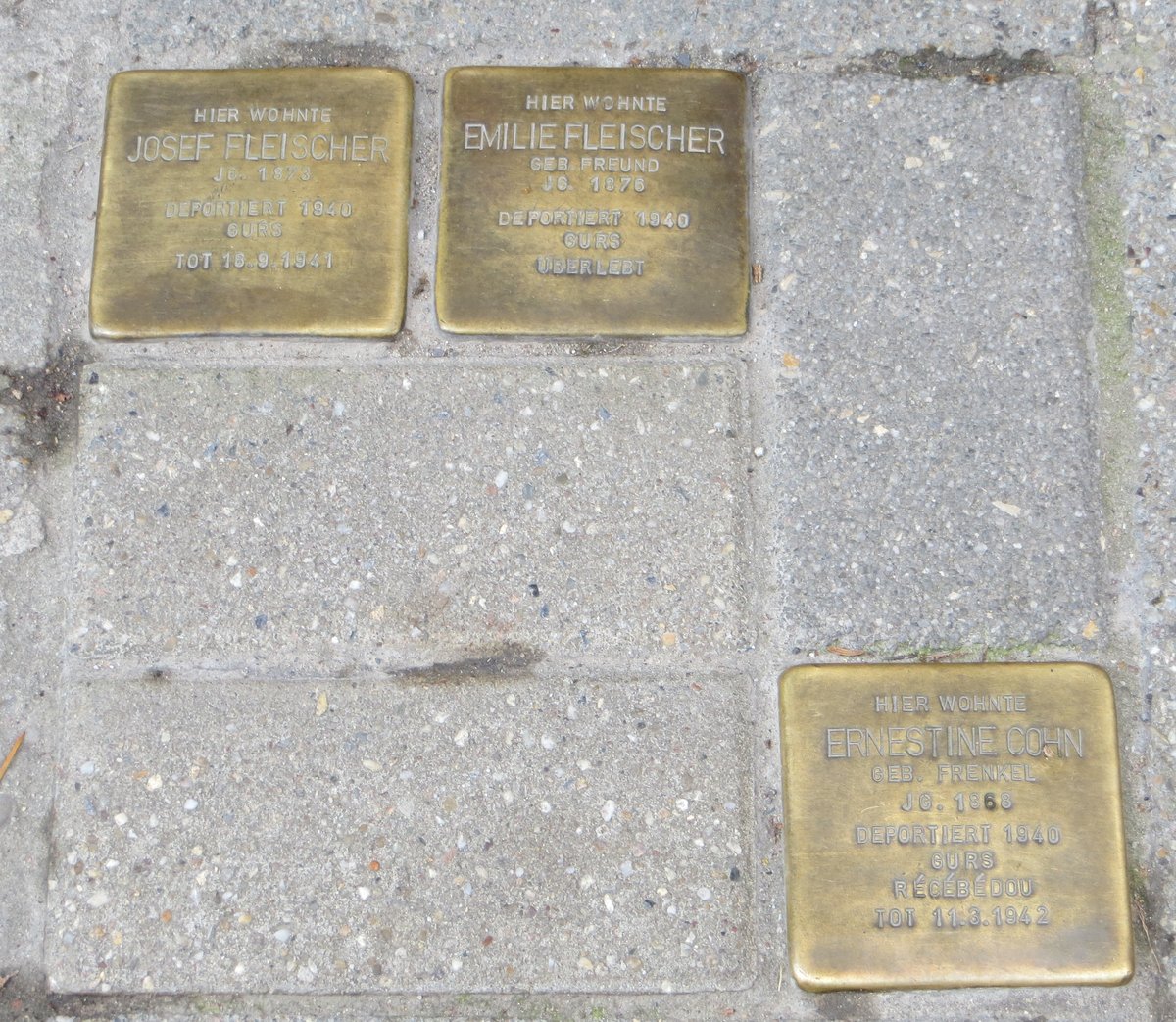
The Stolperstein for Josef Fleischer reads:
Hier wohnte
Josef Fleischer
Jg. 1882
Deportiert 1940
Gurs
Ermordet 1942 Auschwitz
Translation:
Here lived
Josef Fleischer
Born 1882
Deported 1940
Gurs
Murdered 1942 Auschwitz
This inscription personalizes the tragedy, linking Josef Fleischer’s fate to a specific place and time, and restoring his name and story to the city (gedenkbuch.baden-baden.de; tracesofwar.com).
Nearby Attractions and Extended Remembrance
- Kurhaus and Casino: Iconic landmarks nearby, reflecting Baden-Baden’s spa heritage (Wander in Germany).
- Lichtentaler Allee: Scenic promenade suitable for reflective walks.
- Museum Frieder Burda: Modern art museum close by.
- Other Stolpersteine: Additional memorial stones within walking distance, including those for Ernestine Cohn and Emilie Fleischer (Mapcarta).
Frequently Asked Questions (FAQ)
Q: Where is the Josef Fleischer Stolperstein located?
A: Lichtentaler Straße 36, Baden-Baden. See Mapcarta or Wikidata for maps.
Q: What are the visiting hours and is there a fee?
A: Open 24/7, no admission fee.
Q: Are guided tours available?
A: Yes, check with the Baden-Baden Tourist Office for schedules.
Q: Is the memorial accessible for visitors with mobility issues?
A: Yes, it is installed in a flat sidewalk area, but check local conditions for any temporary obstacles.
Q: Can I take photos?
A: Yes, respectfully and without disturbing others.
Practical Tips for Visitors
- Prepare emotionally by reading about Josef Fleischer and the Stolpersteine project.
- Dress comfortably for walking.
- Bring a soft cloth for the cleaning tradition, if desired.
- Use translation tools as inscriptions are in German.
- Respect the solemnity of the site and the privacy of nearby residents.
Listen to the full story in the app
The whole Stolperstein Dedicated To Josef Fleischer,
told well.
Audio guides for 1,100+ cities across 96 countries. History, stories, and local insight — offline ready.
Verified, and shown.
Researched and written by the Audiala editorial team from historical records, architectural archives, and local expertise.
Researched from Wikidata, Wikipedia & official sources · fact-checked · How we make our guides →