Plan and listen to Stolperstein Dedicated To Irene Deutsch with Audiala.
Audio guide in your pocket, itinerary in your browser. Built for the way you actually visit.
Introduction: The Stolperstein for Irene Deutsch—History and Significance
In the historic spa town of Baden-Baden, Germany, the Stolperstein dedicated to Irene Deutsch stands as a poignant reminder of the city’s Jewish history and the individual stories lost during the Holocaust. Stolpersteine, or “stumbling stones,” are small brass plaques embedded in European sidewalks to honor victims of Nazi persecution. Initiated in 1992 by the Berlin artist Gunter Demnig, the project now constitutes the world’s largest decentralized memorial, with over 116,000 stones installed across 31 countries as of 2025 (stolpersteine.eu; germany.info).
Each Stolperstein is placed in front of the victim’s last freely chosen residence and is engraved with their name, birth year, deportation details, and fate. This small but powerful monument at Rettigstraße 4, Baden-Baden, marks the final home of Irene Deutsch before her deportation to Gurs in 1940 and subsequent murder at Auschwitz in 1942. Her memorial, like others throughout the city, serves as a call to remembrance, reflection, and education (Stadtwiki Baden-Baden; gedenkbuch.baden-baden.de).
This guide provides historical context, visitor information, and practical tips to ensure a meaningful and respectful visit to the Stolperstein for Irene Deutsch and to deepen understanding of Baden-Baden’s role in Holocaust memory (goodnews4.de; claudiatravels.com).

Origins and Concept of Stolpersteine
The Stolpersteine project was launched by artist Gunter Demnig as a decentralized memorial to the victims of National Socialism—including Jews, Sinti and Roma, political prisoners, and others. Each 10 x 10 cm brass plaque is installed at the last freely chosen residence of a victim, beginning with the inscription “Hier wohnte…” (“Here lived…”), followed by personal and historical details (netzwerk-erinnerungskultur.de; stolpersteine.eu).
The project is deeply participatory, involving local historians, schools, and relatives in research and installation. The aim is to restore identity and dignity to those whom the Nazis sought to erase, embedding memory directly into everyday urban life.
Stolpersteine in Baden-Baden: Local Context
Baden-Baden has embraced the Stolpersteine project, with over 200 stones—including the memorial for Irene Deutsch—commemorating local victims. The city’s Jewish community, once vibrant, was devastated by Nazi policies and violence. Thanks to local working groups and historians, the stories behind each Stolperstein are researched and shared, ensuring that remembrance is both accurate and personal (goodnews4.de).
However, remembrance in Baden-Baden has not been without controversy, with debates ongoing about the preservation and recognition of other Holocaust-related sites (such as the former synagogue). This highlights the complexity and importance of ongoing engagement with history.
Irene Deutsch: Life, Fate, and Memorialization
Biographical Background
Irene Deutsch was born in Metz in 1910 and moved with her family to Baden-Baden in 1919. Like many of the town’s Jewish residents, her life was marked by escalating persecution following the Nazi rise to power in 1933. The Deutsch family faced increasing restrictions, social exclusion, and ultimately, deportation (gedenkbuch.baden-baden.de).
During the November Pogrom of 1938 (Kristallnacht), Baden-Baden’s Jewish institutions were destroyed, and mass arrests followed. In 1940, Irene was deported to the Gurs camp in France, and later, in 1942, murdered in Auschwitz.
The Stolperstein
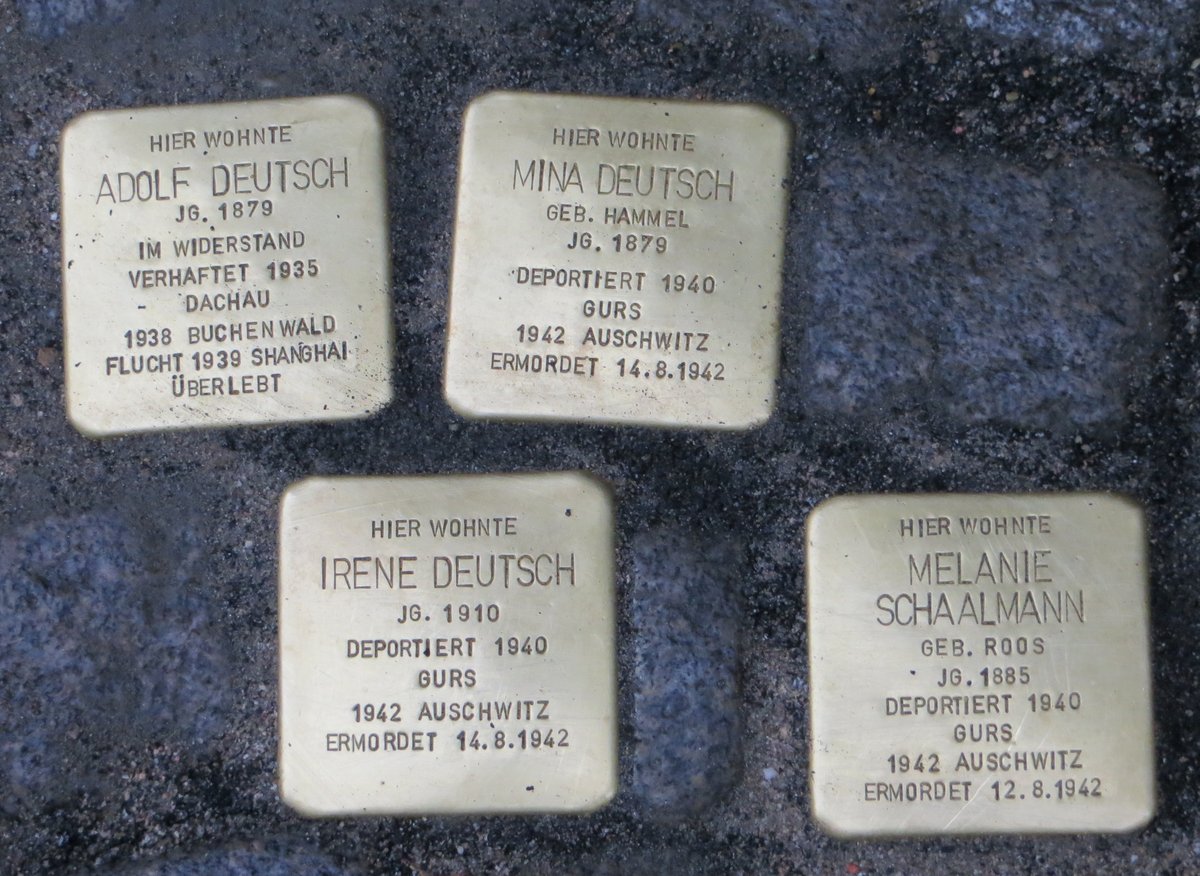
The Stolperstein for Irene Deutsch is located at Rettigstraße 4—the address marking her last freely chosen home. The inscription reads:
Hier wohnte
IRENE DEUTSCH
JG. 1910
DEPORTIERT 1940 GURS
1942 AUSCHWITZ
ERMORDET 14.8.1942
This succinct memorial restores her identity and legacy within the city’s landscape (Gedenkbuch Baden-Baden).
Symbolism, Social Impact, and Community Involvement
Stolpersteine are designed to be encountered in daily life, prompting spontaneous acts of remembrance and reflection (stolpersteine.eu). Their placement reintroduces victims’ names into public space, countering the dehumanization of the Holocaust.
Community involvement is integral: local schools, descendants, and residents participate in research, cleaning, and ceremonies. Annual remembrance events take place around International Holocaust Remembrance Day (Jan 27) and the anniversary of Kristallnacht (Nov 9) (folklife.si.edu).
While most communities support the project, some debate the appropriateness of ground-level memorials. Proponents assert that the act of “stumbling” is metaphorical—a prompt to pause, reflect, and remember (fabriziomusacchio.com).
Visitor Information
Location
- Address: Rettigstraße 4, 76530 Baden-Baden, Germany (Stadtwiki Baden-Baden)
- Easily accessible from the city center and main transport hubs.
Visiting Hours and Accessibility
- Open: 24/7, year-round; part of the public sidewalk.
- Admission: Free; no tickets or prior arrangement required.
- Accessibility: Pavement is generally accessible, but some uneven cobblestones may exist.
What to Expect
- The Stolperstein is a small, polished brass plaque flush with the sidewalk.
- There are no interpretive panels or staff on site; the memorial is intentionally understated.
- Visitors are encouraged to pause, read, and reflect. Placing a small stone or flower is a traditional sign of respect.
Etiquette
- Be respectful: this is both a memorial and a grave marker.
- Photography is permitted, but be mindful of residents.
- Keep noise to a minimum and avoid blocking the sidewalk.
Frequently Asked Questions (FAQ)
Q: Where is the Stolperstein for Irene Deutsch located?
A: Rettigstraße 4, 76530 Baden-Baden.
Q: When can I visit?
A: Anytime, 24/7; no tickets or fees required.
Q: Are there guided tours?
A: Periodically, through local organizations and the tourist office. Self-guided tours are also possible with digital apps.
Q: Is the site accessible?
A: Yes, though some pavement may be uneven.
Q: How can I learn more?
A: Use the Stolpersteine Guide app or visit online databases for biographies and maps.
Q: Can I take photos?
A: Yes, but please respect residents and the solemn nature of the site.
Listen to the full story in the app
The whole Stolperstein Dedicated To Irene Deutsch,
told well.
Audio guides for 1,100+ cities across 96 countries. History, stories, and local insight — offline ready.
Verified, and shown.
Researched and written by the Audiala editorial team from historical records, architectural archives, and local expertise.
Researched from Wikidata, Wikipedia & official sources · fact-checked · How we make our guides →