Plan and listen to Stolperstein Dedicated To Berta Dreifuss with Audiala.
Audio guide in your pocket, itinerary in your browser. Built for the way you actually visit.
Introduction
In the elegant spa town of Baden-Baden, Germany, the Stolperstein dedicated to Berta Dreifuss stands as a powerful and personal memorial to a victim of Nazi persecution. Stolpersteine—German for "stumbling stones"—are small brass plaques embedded in sidewalks at the last freely chosen residences of those who suffered under National Socialism. Initiated by artist Gunter Demnig in the 1990s, the Stolpersteine project has grown into the world’s largest decentralized memorial, with over 107,000 stones in more than 1,800 communities across 21 countries (Wikipedia; motl.org).
The Stolperstein for Berta Dreifuss brings to light the individual story of a Jewish resident whose life was ended by the Holocaust. Located in a residential neighborhood near Baden-Baden’s historic center, this memorial restores a name, a life, and a story to the fabric of daily life, inviting reflection and remembrance (claudiatravels.com; goodnews4.de).
Visitors are welcome to explore these memorials at any time. The Stolperstein for Berta Dreifuss is just one among many in Baden-Baden, all of which are freely accessible, embedded in pedestrian-friendly sidewalks and suitable for those with mobility aids (baden-baden.com; Mapcarta). Baden-Baden’s broader cultural and historical offerings—including the Old Synagogue memorial and local museums—provide additional context to the city’s Jewish heritage and the enduring impact of the Holocaust.
This guide presents a detailed overview of the Stolperstein dedicated to Berta Dreifuss, including its history, location, visiting information, cultural significance, and tips for a meaningful experience. It also highlights digital resources, nearby attractions, and guidance on respectful engagement (baden-baden.com; Jewish History Baden).

Why Visit the Stolperstein for Berta Dreifuss?
Stolpersteine in Baden-Baden offer a unique and deeply moving way to engage with European history. Each stone, including that of Berta Dreifuss, honors the memory of an individual victim and prompts reflection on the tragic consequences of intolerance. Whether you are a historian, a respectful traveler, or someone seeking meaningful cultural experiences, a visit to these memorials is both enriching and sobering.
What Are Stolpersteine?
Stolpersteine are cobblestone-sized brass memorials created by Gunter Demnig beginning in 1992. Each honors a victim of National Socialism—primarily Jews, but also Roma, Sinti, disabled people, political dissidents, and others—by marking the last freely chosen residence or workplace of the individual. The stones are inscribed with names, dates, and fates, transforming the urban landscape into a decentralized, personal memorial (claudiatravels.com).
Historical Context: Berta Dreifuss and the Stolperstein Project
The Stolperstein project is the world’s largest decentralized memorial, commemorating victims of National Socialism across Europe. The stones bear the inscription “Hier wohnte” (“Here lived”), followed by the person’s name, birth year, fate, and, if known, the date and place of death or emigration (motl.org).
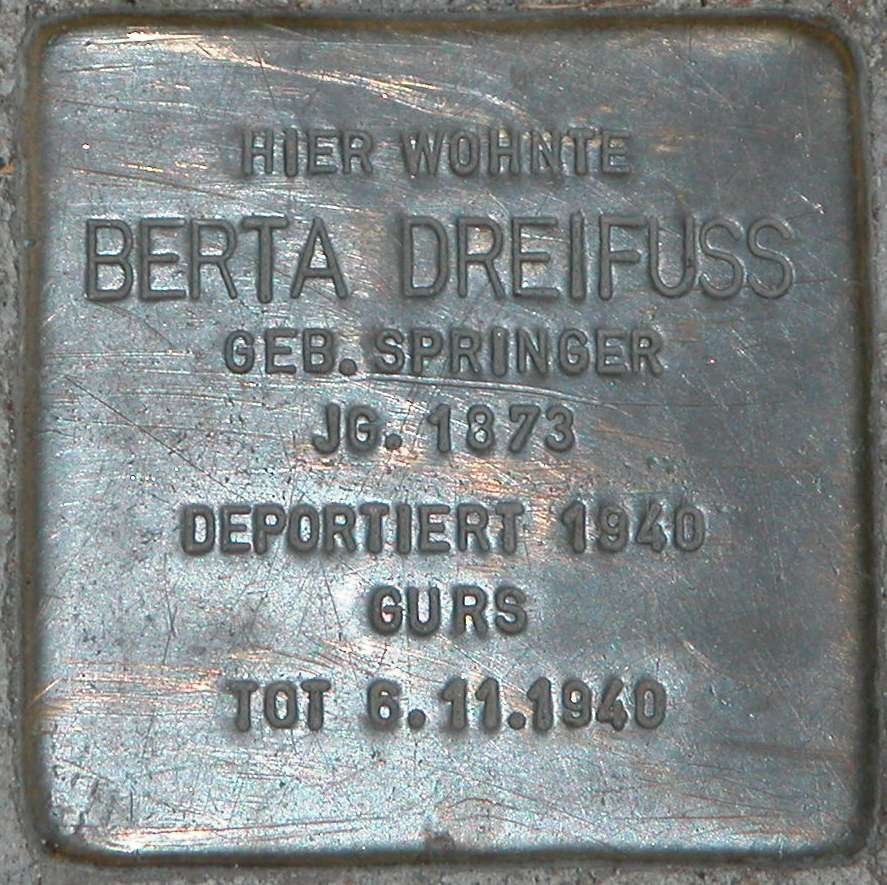
Berta Dreifuss was a Jewish resident of Baden-Baden who was deported and murdered during the Holocaust. Her Stolperstein is a tangible reminder of her life and of the broader tragedy suffered by the city’s Jewish community. In Baden-Baden, over 200 Stolpersteine have been installed since 2008, each representing a unique story and a call to personal remembrance (goodnews4.de).
Location and How to Find the Stolperstein
The Stolperstein for Berta Dreifuss is located at her last freely chosen address in Baden-Baden. While the exact street address can be found via local resources or the official Stolpersteine database, it is typically in a residential area within walking distance of the city center (Mapcarta).
To find it:
- Start at the Baden-Baden Tourist Information Office for maps and directions.
- Use digital resources like the Stolpersteine Guide App or Jewish History Baden for interactive maps and biographies.
- Look for the brass plaque in the sidewalk, inscribed with: “Hier wohnte Berta Dreifuss,” her birth year, date of deportation, and fate.
Visiting Hours, Tickets, and Accessibility
- Hours: Stolpersteine are accessible 24/7, year-round, as they are located outdoors on public sidewalks. There are no restricted hours.
- Tickets: No admission fees or tickets are required.
- Accessibility: Most Stolpersteine are easily accessible for wheelchair users and those with mobility aids, though standard caution should be used at street crossings (baden-baden.com).
For a contemplative experience, early mornings or late afternoons are recommended.
Cultural Significance and Symbolism
The placement of Stolpersteine at ground level is intentional—passersby “stumble” upon them, prompting a pause for remembrance. The polished brass catches the light, ensuring the names remain visible and present in daily life. Each stone serves as a silent witness to a darker chapter in the city’s history, weaving individual memory into the fabric of the community (motl.org; claudiatravels.com).
Guided Tours, Special Events, and Educational Programs
- Guided Tours: Occasionally available through the Baden-Baden Tourist Office and local historical societies. These provide deeper context and highlight multiple Stolpersteine.
- Commemorative Events: Held on significant dates such as International Holocaust Remembrance Day (January 27) and Kristallnacht (November 9), often involving local schools and civic groups (goodnews4.de).
- Educational Programs: Local schools and the Arbeitskreis Stolpersteine collaborate on research and installation ceremonies, fostering intergenerational remembrance.
Nearby Attractions and Complementary Sites
While in Baden-Baden, consider visiting:
- Old Synagogue Memorial: The site of the destroyed Grand Synagogue, marked by a commemorative plaque (ABC News).
- Baden-Baden Museum and Frieder Burda Museum: For exhibitions on local history and art.
- Lichtentaler Allee and Caracalla Spa: For relaxation and further exploration of the city’s heritage.
Visitor Etiquette and Respectful Engagement
- Quiet Reflection: Maintain a respectful silence at the memorial.
- Photography: Discreet photography is permitted, but avoid disturbing residents.
- Commemoration: It is customary to leave a small stone or flower on the Stolperstein. Some locals clean the stones, especially on commemorative dates.
- Behavior: Avoid blocking sidewalks or building entrances. Trivializing conversations or behavior are inappropriate (kummuni.com; tappedouttravellers.com).
Frequently Asked Questions (FAQ)
Q: Where exactly is the Stolperstein for Berta Dreifuss?
A: Embedded in the sidewalk at her last freely chosen residence in Baden-Baden. Confirm the address with the Tourist Information Office or the official Stolpersteine database.
Q: Are there set visiting hours or tickets required?
A: No. Stolpersteine are accessible at any time, free of charge.
Q: Is the site wheelchair accessible?
A: Yes, it is located on public sidewalks.
Q: Are guided tours available?
A: Yes, guided remembrance walks are occasionally offered. Check with local tourism offices for current schedules.
Q: How should I behave at the memorial?
A: Quiet, respectful behavior is expected. Small acts of remembrance, like placing flowers or stones, are welcomed.
Listen to the full story in the app
The whole Stolperstein Dedicated To Berta Dreifuss,
told well.
Audio guides for 1,100+ cities across 96 countries. History, stories, and local insight — offline ready.
Verified, and shown.
Researched and written by the Audiala editorial team from historical records, architectural archives, and local expertise.
List of places with stolpersteine. Wikipedia
(2024). Claudiatravels.com
(2024). Goodnews4
Baden-Baden.com
Jewish History Baden
(2023). ABC News
Researched from Wikidata, Wikipedia & official sources · fact-checked · How we make our guides →