
Top 10 Things to Do in Aachen Germany! 🇩🇪
Bucket List Urban Adventures
3 min
17K
AachenGermany 50° N · 6° E Updated Jul 2026
Thirty kings and twelve queens were crowned here, but Aachen Cathedral makes most sense outside too: on Münsterplatz, where empire meets daily city life.
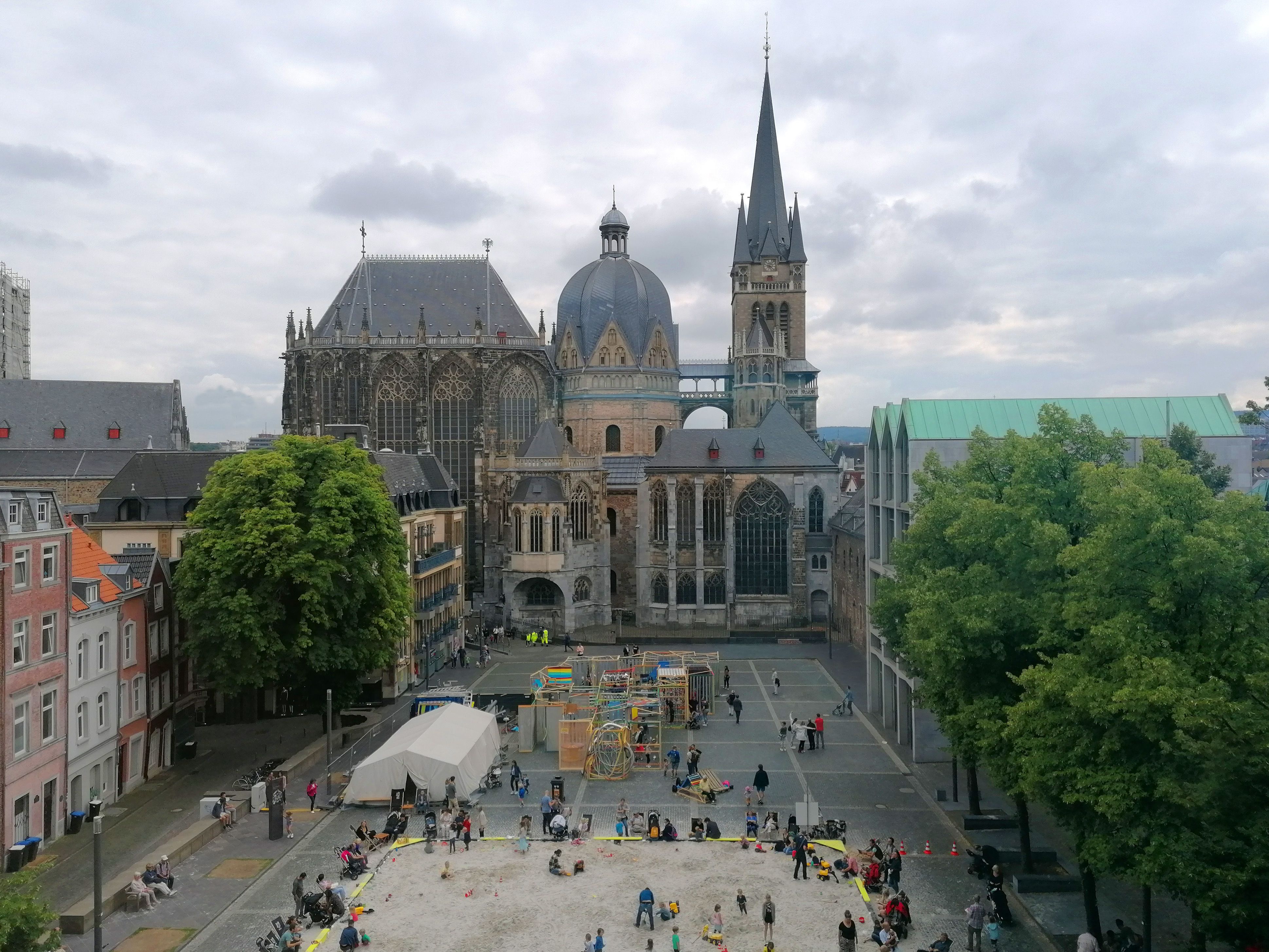 Photo: Peter Hölterhoff / Pexels
Why does Europe’s grandest story of power begin in a church that still feels, at its core, like a place made for prayer rather than spectacle? Aachen Cathedral in Aachen, Germany answers that question better than any museum label could: you come for Charlemagne, for the coronation throne, for the first German UNESCO World Heritage site, and then the building catches you with bronze doors, candle smoke, worn stone steps, and gold light moving across an octagon built to make empire look eternal. The surprise is that it still works on two levels at once. It is a monument, yes, but also a living cathedral where voices, relics, processions, and silence keep doing the job they were made to do.
The first look can be disorienting. A compact Carolingian core from the late 8th and early 9th century sits beside a Gothic choir so tall and glass-heavy that it feels less like an extension than an argument, as if one age of faith decided the previous age was no longer large enough.
Records show this place has carried more than one burden at once: imperial chapel, royal coronation church, pilgrimage shrine, bishop’s seat, wartime survivor. Few buildings in Aachen have had to prove themselves so often.
Come for the scale of the story, but pay attention to the textures under it: the echo under the dome, the cool marble, the traffic of worshippers and visitors sharing the same floor. That overlap is the point.
History
Aachen Cathedral looks like a collage of centuries because it is one, yet its central function has barely shifted. Scholars date the Carolingian core to the late 8th and early 9th century under Charlemagne, and Mass is still celebrated here in the bishop’s church of Aachen more than 1,200 years later.
What endured was not the exact shape of the building. Fire, French occupation, 19th-century remaking, and wartime damage changed the fabric again and again. The continuity lies in use: rulers came to borrow legitimacy, pilgrims came to see relics, local worshippers still come for prayer, music, and ritual.
The turning point
At first glance, the story seems simple: this is Charlemagne’s cathedral, so the plain marble seat high in the gallery must be Charlemagne’s throne. That neat version suits tourists, and for centuries it suited rulers even more, because sitting there made them look like heirs to the founder of a revived western empire.
But the cathedral’s own records introduce doubt. The first documented mention of a throne here appears in 936 at the coronation of Otto I, and the church states clearly that whether Charlemagne himself used this seat remains uncertain. Even the marble complicates the legend: lightly incised lines on one slab resemble an ancient Nine Men's Morris board, suggesting the stone had a previous life before becoming royal furniture.
The revelation is better than the myth. Otto I did not need a chair proved beyond doubt to be Charlemagne’s; he needed a visible link to Charlemagne strong enough to persuade bishops, nobles, and rivals that the line of power still ran through Aachen. That was the turning point. From 936 onward, documented tradition made the throne politically real, whether or not the emperor who built the chapel ever sat on it.
Look up at the gallery now and the seat changes in front of you. It stops being a relic of one man and becomes a machine for manufacturing continuity, a narrow platform where ambition, memory, and ritual were compressed into marble.
Yes, easily. You are walking into the late-8th- and early-9th-century church of Charlemagne, then into a building where 30 kings and 12 queens were crowned between 936 and 1531. The best shock comes inside: a dense imperial octagon of bronze, marble, and mosaic suddenly gives way to the Gothic choir, whose 25.55-meter windows rise like a wall of glass taller than an eight-story building.
Give it 45 to 75 minutes for the cathedral, or 90 minutes to 2 hours if you add the treasury. The free-access visit can be done in 20 to 30 minutes, but the paid guided tour lasts about 45 minutes and is the part that gets you into the Gothic choir and up to the imperial throne. Skip that, and you miss the building's best reveal.
The easiest route is bus to Elisenbrunnen, then a short walk. Lines 11, 14, 21, 44, and SB63 run from Aachen Hauptbahnhof to Elisenbrunnen, and from there the cathedral is about 5 minutes on foot through the pedestrian center. Walking the whole way takes about 15 to 20 minutes, with the old town tightening around you street by street.
Go early or late in the visiting window on a weekday if you want the cathedral at its best. That gives you a better chance of hearing footsteps instead of crowd noise, and the shift from the darker octagon to the bright choir lands harder when the space is calmer. Advent is atmospheric because the Christmas market wraps around the cathedral, but expect heavier crowds and more noise.
Yes, the cathedral itself is free to enter. Free access covers the entrance hall, the octagon, and the hexadecagon, but the Gothic choir and the Hochmünster with the imperial throne require a paid guided tour. Private interior photos also cost 1 euro, paid to the cathedral staff.
Do not miss the contrast between the Carolingian octagon and the Gothic choir, because that is the whole argument of the building in stone and light. On the guided tour, look hard at the imperial throne: its plain marble slabs may include scratched lines from an old board game, a small clue that this seat of kingship was made from reused antique material. Outside, pause by the wolf and pinecone at the entrance, where Aachen's devil legend still clings to the bronze doors.
Built from cited sources · see the method · How we make our guides →
1 places to discover — a few worth pairing.
Saved and recently read places — kept on this device only.
Photos may have been resized or cropped.


