Place
Germany Updated Jul 2026
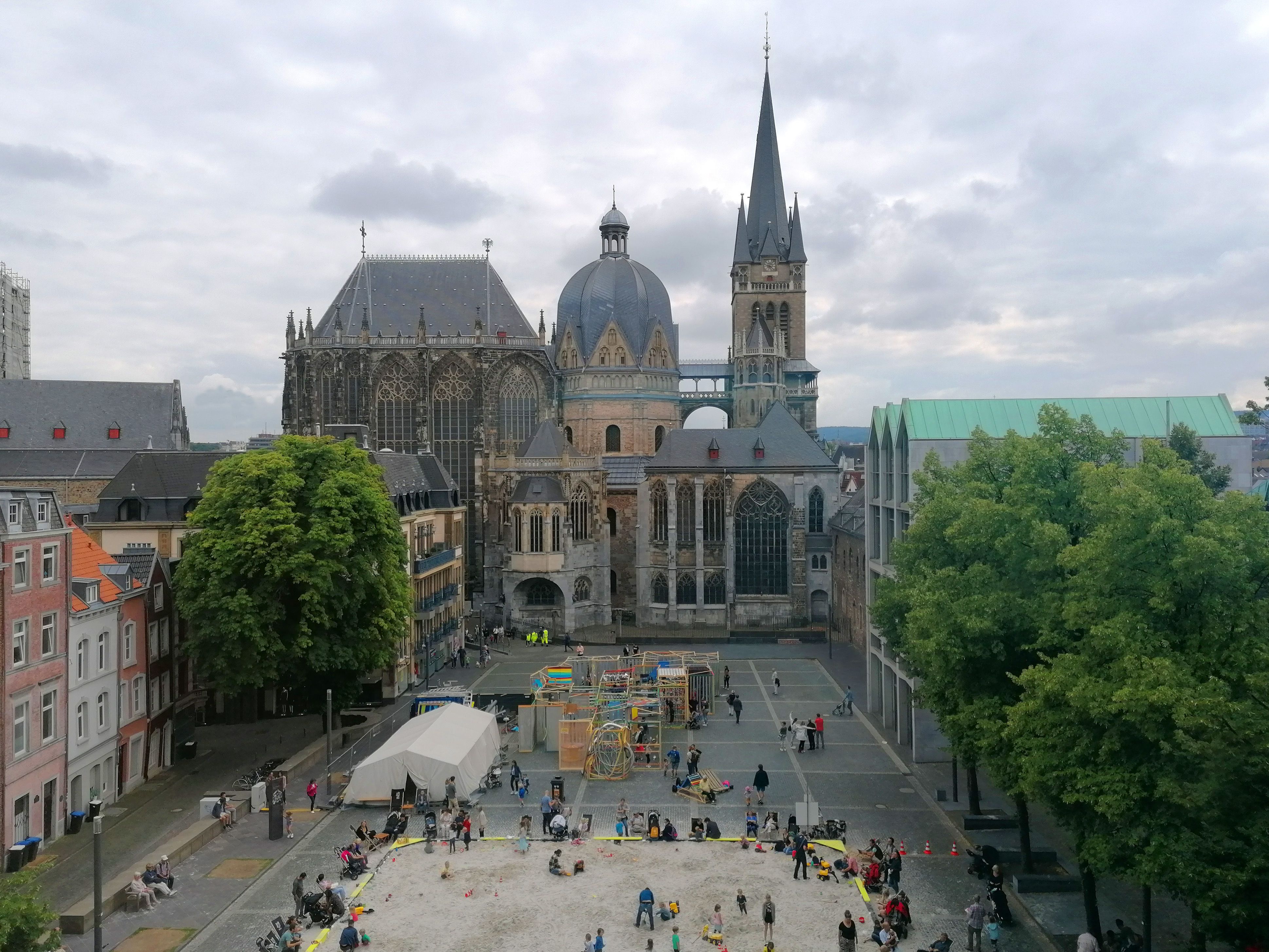
The water under Burtscheid comes up at 74°C — hot enough to scald, sulfurous enough that you smell the district before you reach it. Aachen sits in Germany's far western corner, close enough to Belgium and the Netherlands that a bus ride takes you across two borders before lunch. The Romans came for those springs. Charlemagne came for the springs too, then stayed and built an empire's chapel around the habit of bathing.
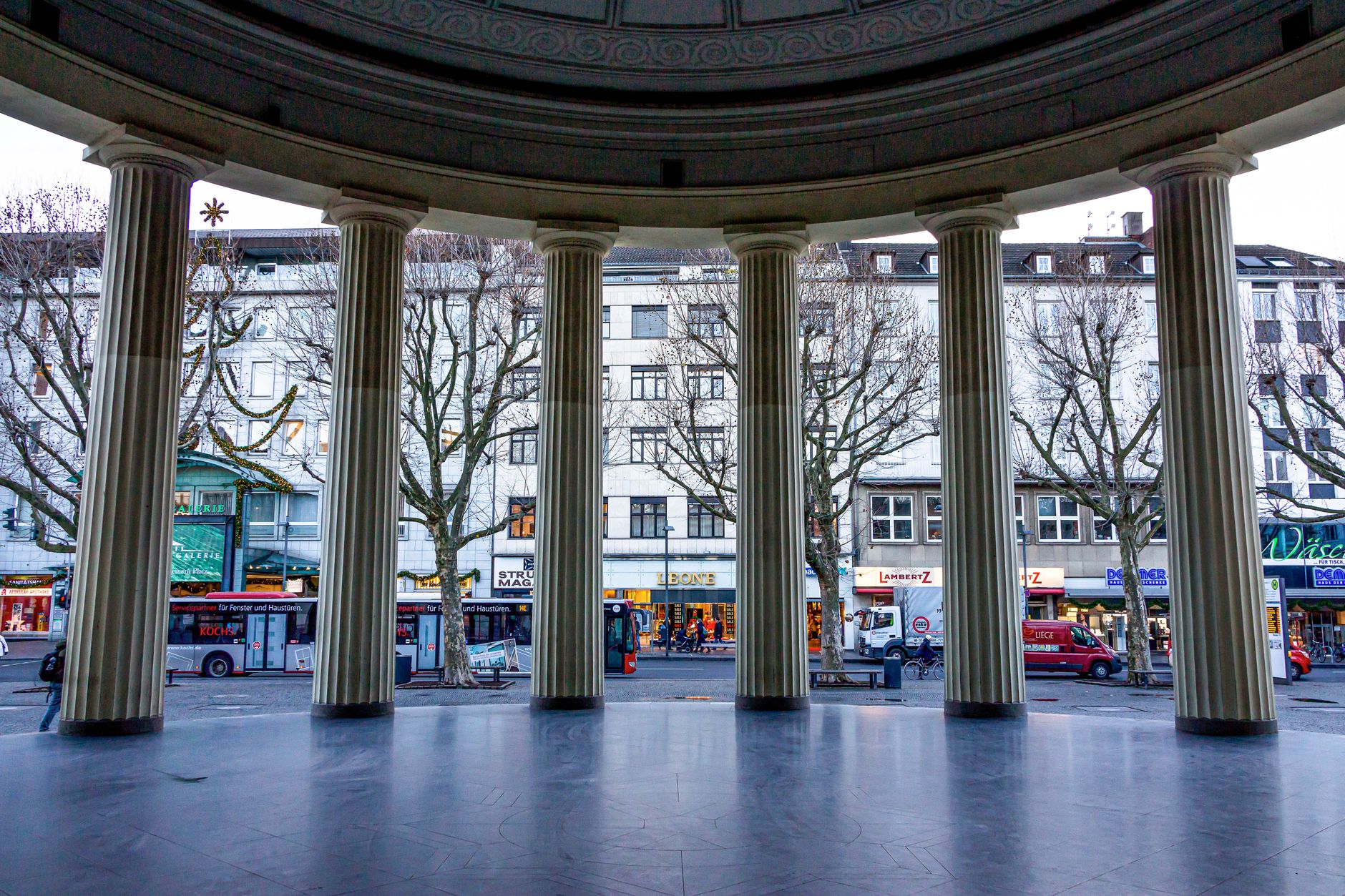 Photo: Sergio Scandroglio / Pexels
Built from cited sources · see the method · How we make our guides →
The octagon at the heart of the cathedral went up between 793 and 813, and it still stops people mid-sentence. Gold mosaic climbs the dome; the light arriving through the upper windows lands differently depending on the hour, and the acoustics turn a whispered word into something that follows you. Upstairs in the gallery sits a plain marble throne, six steps and four slabs, worn smooth. German kings were crowned in this building from 936 to 1531 — thirty-odd of them, on that unremarkable chair.
Walk five minutes from the cathedral and the register changes completely. Pontstraße runs northwest toward the medieval Ponttor, and it belongs to the students: kebab counters at 2am, bar windows fogged in winter, bicycles chained to anything vertical. Aachen is a university town with an imperial past, and the two versions of the city sit closer together than they do almost anywhere else — the coronation route and the pub crawl use the same cobbles.
It rains here. A lot. Near St. Nicholas Church you'll find the Regenschirmdamen, bronze women under bronze umbrellas, which is the local sense of humour rendered in metal. When the weather wins, do what everyone else does: buy Printen — the spiced, rock-hard gingerbread the city has made for two centuries — order a Reisfladen at Van den Daele, and let the afternoon go.
Not every monument, just the ones we'd walk you past ourselves.

Where to wander, by quarter — each with its own rhythm.
Before you go
From a Celtic healing spring to the seat of the Holy Roman Empire — and back to a university town on three borders
Flint tools and hearth traces around today's Elisenbrunnen put people here roughly five thousand years ago. They came for the reason everyone since has come: water surfacing at around 74°C, hot enough to scald a hand held under it. Most scholars read the finds as seasonal camps rather than a settled village. The springs had already decided where Aachen would stand.
Before Rome arrived, local Celts credited the springs to Grannus, a healing god also venerated in Gaul and Britain. The evidence is thin — votive deposits, later Roman dedications — but the name itself is the strongest witness. Aachen descends, through Aquae Granni, straight from that god's name. Nothing else from these people survived; the word did.
Roman engineers channelled the sulphur springs into two bath complexes and hung a spa town off the road between Cologne and Maastricht, deep inside the province of Germania Inferior. Soldiers came down from the Rhine limes to soak their joints; the water smelled then exactly as it smells now, of struck matches and warm stone. No legionary fortress, no forum worth the name — Aachen's first identity was purely medicinal. Excavated foundations still sit under the Büchel and the Hof.
Frankish annals record Pepin the Short keeping Christmas and Easter at 'Aquis villa' — the earliest surviving name-check of the place. By then Rome's baths were rubble the Franks were reusing as a royal farmstead with very good plumbing. The court came for the water and stayed for the hunting in the Ardennes forest edge. Pepin's son would take that habit considerably further.
After decades of ruling from the saddle, Charlemagne settled on Aachen as his principal winter residence and began building a palace complex to match the ambition. Einhard, his biographer, gives the reason plainly: the king loved to swim, and the hot springs let him hold court in the pool with a hundred men in the water alongside him. The empire ran from Denmark to Rome, and its paperwork ran from this valley. He was not a native — he made it the centre by force of preference.
An octagon inside a sixteen-sided ambulatory, 31 metres to the crown of the dome — nothing north of the Alps had looked like this for four centuries. The marble columns and bronze grilles were shipped up from Rome and Ravenna with papal permission, which is to say the building quotes the empire it intended to replace. Tradition credits Pope Leo III with the consecration; the architect Odo of Metz signed nothing but is named in a later inscription. Stand under the dome at noon and the gold tesserae throw light down the walls like coins dropped in water.
He died on 28 January 814 after a fever turned to pleurisy, aged around 66, and was buried the same day inside his own chapel — unusual haste, recorded without explanation. The grave made Aachen a shrine as well as a seat of government, and every later German king would trade on that. Otto III had the tomb opened in the year 1000; accounts of finding the emperor seated and crowned are legend, not record. His bones now sit in the Karlsschrein a few metres from where he bathed.
Norse raiders working up the Meuse burned the palace and, according to Frankish chroniclers, used Charlemagne's chapel as a stable. Sixty-seven years after the emperor's death, his capital had no army worth the name and no walls that mattered. The chapel survived because stone does not burn easily. Everything wooden around it did.
Otto I chose Aachen deliberately, sitting on the plain marble throne in the cathedral's upper gallery — six slabs, reportedly cut from the steps of the Church of the Holy Sepulchre in Jerusalem, with no ornament at all. The gesture worked: over the next 595 years, thirty German kings climbed those same steps to be crowned here. The throne is unpolished and slightly crooked. That's the point — the power was borrowed from the man buried downstairs.
Frederick I Barbarossa confirmed Aachen as a Free Imperial City, answerable to the emperor and nobody in between. He had already engineered Charlemagne's canonisation the previous year through an antipope — a saint in the family tree being useful in a quarrel with Rome. Aachen got its charter, its own courts, and roughly seven centuries of prickly independence. Not bad for a town of a few thousand people around a bathhouse.
Fresh from his own coronation, Frederick II took a hammer and drove the final nails into the Karlsschrein himself, sealing Charlemagne's bones inside a gilded reliquary shaped like a church, 204 centimetres long and covered in silver figures of his imperial successors. Court chroniclers made much of the emperor doing manual labour in public. The shrine took twenty years and the best goldsmiths in the Rhineland to finish. It still sits in the choir, opened only for the pilgrimage.
The Black Death reached Aachen in 1349 and did what it did everywhere — killed a large share of a crowded town in a few months. What followed was worse in a different way: across the Rhineland, Jewish communities were blamed and destroyed, Aachen's among them. Records of the aftermath are fragmentary and the local details disputed. The pattern across neighbouring cities is not.
Every seventh summer the cathedral displays four textile relics — including a cloth said to be the Virgin's cloak — from the gallery above the crowd, a practice formalised in the mid-14th century and still running. Medieval pilgrims arrived in the tens of thousands and bought small mirrors, believing a reflected glimpse of the relics carried the blessing home. The badge trade financed a good deal of the city's building. The next Heiligtumsfahrt falls in 2028.
The Gothic choir hall was consecrated on the 600th anniversary of Charlemagne's death, its builders showing off with roughly 1,000 square metres of stained glass held up by almost nothing. The windows run over 25 metres — taller than a seven-storey building — and the locals nicknamed the whole thing the Glashaus. Grafting it onto Charlemagne's squat octagon produced the odd double personality the cathedral still has. Round and dark at one end, vertical and blazing at the other.
Ferdinand I was the thirty-first and final ruler crowned in Aachen. Reformation politics, Habsburg convenience and Frankfurt's superior banking finished the tradition; from 1562 the ceremonies moved permanently down the Main. Aachen lost its one irreplaceable function in a single generation. The throne stayed, empty, which is more or less how the city has traded ever since.
A fire that broke out on the night of 2 May 1656 — a baker's premises, by the traditional account — ran through the timber-framed centre and destroyed some 4,600 houses, roughly four-fifths of the city. The cathedral and the Rathaus survived, scorched. What went up in flames was the medieval town; what replaced it was Baroque, which is why Aachen's streets look younger than its history. The rebuilding took decades and money the city no longer really had.
Born in Aachen in 1701 and dead there in 1763, Couven became the architect who gave the post-fire city its Baroque and Rococo face, working across the triangle of Aachen, Liège and Maastricht. His interiors — panelling, stucco, the fussy elegance of a merchant class with spa money — survive in the Couven Museum on Hühnermarkt. He designed for bankers and clothiers, not emperors. The shift tells you exactly what Aachen had become.
The Treaty of Aix-la-Chapelle ended the War of the Austrian Succession in October 1748, negotiated by exhausted diplomats in a town everyone had already come to for the cure. Aachen's second career — neutral ground with good water and better gambling — was now fully established. Delegates complained about the food and the prices. The city's name was on the document, which was the point.
Revolutionary armies took Aachen in 1794 and dissolved six centuries of imperial freedom without much ceremony. Under the annexation confirmed in 1801 it became capital of the Département de la Roer, a French prefecture with a French mayor. Napoleon and Joséphine came to take the waters in 1804, and he made a show of admiring Charlemagne — the comparison was doing useful work for him. The city's guilds, monasteries and old constitution did not come back.
The Congress of Vienna handed the Rhineland to Prussia, and Catholic, French-speaking, thoroughly Rhenish Aachen found itself administered by Protestant Berlin. It was not a happy match and remained not a happy match for a century. Prussian money did build the Elisenbrunnen between 1822 and 1827, the neoclassical colonnade where you can still smell the sulphur water from the street. Drinking it now requires a doctor's note.
Tsar Alexander I, Metternich, Wellington and Castlereagh spent autumn 1818 in Aachen deciding when to end the occupation of France and how to police post-Napoleonic Europe. It was the first of the great-power congresses and, socially, the peak of Aachen's spa century — the gambling rooms took a fortune off the visiting nobility. Diplomacy by day, roulette by night. Within thirty years the casino was closed and the aristocrats had moved on to Baden-Baden.
The line linking Cologne to Antwerp reached Aachen in 1841 and turned a spa town into an industrial one within a generation. Needles, cloth, glass, machinery and the coal of the Aachener Revier moved out; the smart carriages of the cure-takers thinned. Aachen made needles in industrial quantity — a trade so identified with the city that the word stuck to it. The 19th century treated the springs as a municipal amenity rather than a business.
Aachen's Polytechnicum admitted its first cohort in 1870 — 223 students, a modest technical school for a mining and textile region. It became RWTH Aachen, and today it holds around 47,000 students in a city of roughly 250,000, which is why a quarter of the people you pass are under thirty and speaking four languages. Peter Debye studied here from 1901 and took a Nobel Prize in chemistry in 1936. The school outlived every industry it was founded to serve.
The banker and industrialist Suermondt handed the city 104 paintings in 1882, an act that created the museum now bearing his name and earned him honorary citizenship the same year. He had already sold a larger portion of his collection to Berlin to cover debts — the Aachen gift was what remained, and it was still very good. Dutch and Flemish masters, medieval sculpture, a serious collection in a provincial town. He died five years later in the city.
Ludwig Mies was born on Steinkaulstraße in 1886 and grew up in his father's stone-carving workshop, learning materials before he learned drawing. He attended the local trade school, worked on stucco decoration for Aachen builders, and left for Berlin in 1905 at nineteen without a degree of any kind. The reverence for a cut edge and a good slab of marble that shows up in Barcelona in 1929 started in that yard. He never designed a building in his home town.
On the night of 9-10 November 1938 the Aachen synagogue on Promenadenstraße was set alight and gutted, Jewish shops were smashed, and men were dragged off to camps. The community had been part of the city's commercial life for generations; within a few years it was effectively gone. A new synagogue stands on the same site, opened in 1995. The memorial names the people, which is the only useful kind.
American forces surrounded Aachen in September 1944 and spent five weeks fighting street by street through the ruins; the garrison surrendered on 21 October. The battle cost the US First Army around 5,000 casualties and left roughly 80 percent of the historic centre wrecked, though the cathedral — sandbagged, its glass removed — came through with damage that could be repaired. Of some 165,000 residents, a few thousand were still in the cellars at the end. Aachen was the first major German city taken by the Western Allies, a fact the propaganda on both sides worked hard.
The Americans appointed Oppenhoff, a lawyer who had refused Nazi party membership, to run occupied Aachen in October 1944. On the night of 25 March 1945 an SS Werwolf commando parachuted in and shot him at his own front door in Aachen-Eilendorf. He was 42, and he had spent his brief term arguing with the occupiers about food rations for a starving city. The killers were Germans; that detail is the whole story of that spring.
A group of Aachen citizens founded the Karlspreis in 1949 and awarded it first in 1950, honouring work toward European unity in the Coronation Hall of the Rathaus. The list since reads as a register of postwar Europe: Churchill, Monnet, Havel, Merkel in 2008, Macron in 2018. A city on the Belgian and Dutch borders, bombed flat by a European war, decided its export would be integration. The ceremony still happens under Rethel's 19th-century frescoes of Charlemagne, which is either heavy-handed or exactly right.
UNESCO inscribed Aachen Cathedral in 1978, in the very first round of listings, making it Germany's earliest World Heritage Site and one of the twelve original entries worldwide. The citation names the octagon as the model that shaped church building across the north for two centuries. The treasury alongside it holds around 130 objects, including the Cross of Lothar with a Roman cameo of Augustus set into the gold. Roughly 1.25 million people came through in 2025 to look at a room 31 metres high and 1,200 years old.
The Carolus Thermen opened in 2001 on the edge of the Stadtgarten, pumping the same mineral water the legionaries used into pools at around 38°C. Five thousand years after the first camps at the springs, the reason to come is unchanged — everything else about the city has been rebuilt at least twice. Coal is finished, the needle works are gone, and 47,000 students now sit where the empire's paperwork was drafted. The water kept its schedule throughout.
Emperor of the Romans · c. 748–814
Made Aachen his capital; died and buried here in 814
He picked Aachen for the hot water — the springs suited a man who reportedly swam with his court and made them join him. The chapel he raised around 796 was the tallest vaulted space north of the Alps for two centuries, and he was buried in it in January 814. He'd recognise the octagon instantly and be baffled by the queue for the gift shop.
Architect · 8th century, dates unknown
Designed the Palatine Chapel, c. 793–813
Almost nothing survives about the man beyond the attribution, which makes his one confirmed building carry the whole reputation. He borrowed the octagon-inside-a-sixteen-sided-shell from Ravenna's San Vitale and then improved the geometry — the proportions resolve on the number eight, over and over. Most of the architects who copied him for the next four hundred years never knew his name.
Holy Roman Emperor · 980–1002
Opened Charlemagne's tomb in 1000; buried in the cathedral 1002
In the year 1000 he had Charlemagne's grave opened, and chroniclers describe him removing a relic and finding the body seated and intact — a story that reads as legend but did enormous political work for him. Two years later he was dead at 21 and buried in the same church. His ambition to rebuild the Roman Empire from Aachen and Rome outlived him by exactly nobody.
Holy Roman Emperor · c. 1122–1190
Crowned in Aachen 1152; had Charlemagne canonised 1165
He pushed an antipope into declaring Charlemagne a saint in 1165, which converted Aachen from a coronation site into a pilgrimage destination with cash flow. The vast wheel chandelier he donated still hangs over the octagon, 4.2 metres across and lit with 48 candles on feast days. A propaganda object that turned out to be a beautiful one.
News agency founder · 1816–1899
Ran his pigeon service from Aachen, 1850
The telegraph line from Berlin ended at Aachen and the Belgian line started at Brussels, leaving a 120-kilometre gap that trains took nine hours to close. Reuter flew pigeons across it and beat the railway by six hours, selling stock prices to bankers who paid for the margin. Everything Reuters became started with that hole in the map — the International Newspaper Museum on Pontstraße tells the story where it happened.
Architect · 1886–1969
Born here, Steinkaulstraße; worked in his father's stone yard
The man who gave the twentieth century its glass boxes learned proportion in an Aachen stonemason's workshop, cutting and setting his father's material before he ever drew a plan. He had no formal architecture degree and never really needed one. The cathedral he grew up beside is the exact opposite of everything he later built, which may be the point.
Where locals actually book dinner — not the tourist menus.
A hard, dark, spiced gingerbread protected under EU origin rules, sweetened traditionally with beet syrup rather than honey. Nobis and Lambertz both sell them by the bagful near the cathedral; the softer chocolate-coated versions are the gateway, but the plain Kräuterprinten are the real thing and will test your molars.
Aachen blood sausage, usually served fried with apple sauce and mashed potato. It shows up on menus in the older Altstadt pubs rather than the tourist-facing terraces, and it's the clearest surviving trace of the city's pre-spa-resort kitchen.
A flat rice-pudding tart on yeast dough, sold in every decent Aachen bakery and treated as the default Sunday afternoon cake. Order it with coffee and you've done the local ritual correctly.
Beef marinated for days in vinegar and spice, then braised and finished with a sauce thickened by raisins and Printen crumbs — the region folds its own gingerbread back into dinner. Sweet-sour and heavy; a winter dish that makes no sense in July.
A 17th-century building on Büchel operating as a café since 1890, with dark panelling, tiled stoves, and a Reisfladen worth the queue. Touristy, yes, and still better than the alternatives on the market square.
Being 5 km from two borders shows up on the plate: Trappist beers on tap as a matter of course, Belgian fries with mayonnaise from street windows, and Dutch stroopwafels in the markets. Line 50 runs to Maastricht at quarter-hourly intervals if you want to eat at the source.
The stretch between Markt and Ponttor feeds thousands of RWTH students on small budgets, which means Turkish, Vietnamese, Syrian, and Italian food priced for people who cannot afford to be sentimental about it. Skip the restaurants ringing the cathedral and walk ten minutes north instead.
Small things that change how the city treats you.
The city, as it actually looks.


Yes, if you care about how Europe got assembled. The Palatine Chapel, built 793–813, is the oldest surviving vaulted structure north of the Alps and served as the coronation church for German kings — the throne upstairs is the real thing, not a replica. Add hot springs the Romans were already using and a border you can cross on a city bus, and a small city carries more weight than its size suggests.
Two days covers the city properly; three lets you take a day trip. Day one is the cathedral, Treasury, Rathaus and Centre Charlemagne, all within a ten-minute walk of each other. Day two belongs to Burtscheid, the Frankenberger Viertel and a long soak at Carolus Thermen. Monschau or the Dreiländereck fills the third.
RE1 and RE9 regional trains run the route in 60–70 minutes, several times an hour. From Cologne Bonn Airport a direct FlixBus takes about an hour five for roughly €8, which beats the train transfer at Köln Hbf. Düsseldorf Airport is 1.5–2 hours by DB.
No. The system is entirely buses, run by ASEAG across roughly 180 routes, plus regional and international trains through the Hauptbahnhof. The historic core is small enough that most visitors never board anything — Hbf to the cathedral is a 15–20 minute walk.
It ranks among Germany's safer mid-sized cities and violent crime is rare. The Bahnhofsviertel gets a bit rough after dark, so stick to the lit main routes into the centre at night. Standard pickpocket care on busy buses and at the Christmas market covers the realistic risk. Emergency number is 112.
Charlemagne. He made it his capital, built the chapel around 796, and was buried there in 814 — thirty German kings were crowned on the same spot between 936 and 1531. Beyond that: thermal springs hot enough to scald, printen gingerbread, RWTH's engineering faculty, and the CHIO equestrian tournament each summer.
May to September, when it sits at 15–22°C and the outdoor programming runs. December brings the Christmas market around the cathedral, worth the 1–5°C and the sleet if markets are your thing. Spring and autumn are the quiet, cheaper compromise — bring a waterproof regardless of month.
Easily. The Dreiländereck at Vaalserberg is a short bus ride away, where Germany, Belgium and the Netherlands meet at the highest point in the Netherlands — 323 metres, which tells you something about the Netherlands. There's a viewpoint tower and a hedge maze at the top.
Cheaper than Cologne or Düsseldorf, largely because 45,000 RWTH students keep prices honest around Pontstraße. Cathedral entry is free outside services; the Treasury and Rathaus charge modest admission. The main splurge is Carolus Thermen, and it's worth it.
No. English is widely spoken in hotels, museums and restaurants, helped by the university and the border traffic from Belgium and the Netherlands. Öcher Platt, the local dialect, survives mainly in carnival songs and street names. A Guten Tag still buys goodwill.
Saved and recently read places — kept on this device only.
Photos may have been resized or cropped.