
An introduction.
Researched by the Audiala editorial team from historical records, architectural archives, and local expertise.
WWhy does the most ceremonial room in France carry a ceiling showing Germany kneeling — and why was that the exact spot where Prussia crowned its Kaiser in 1871? The Palace of Versailles, twenty kilometres southwest of Paris, stacks contradictions like this on every cornice. Come for the gilt and mirrors; stay because each room hides the opposite of what its decoration claims. France's most visited monument is also its strangest argument with itself.
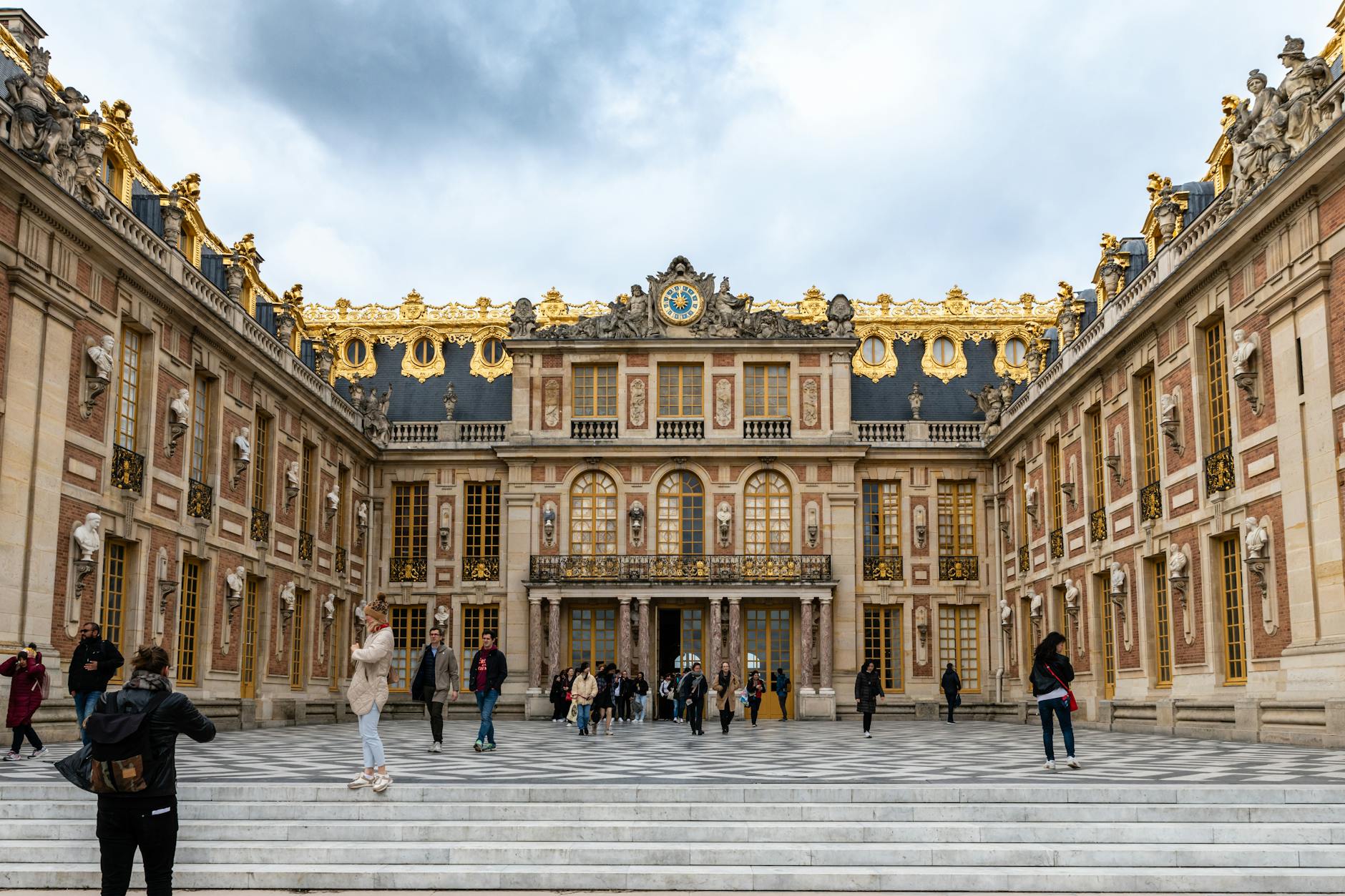
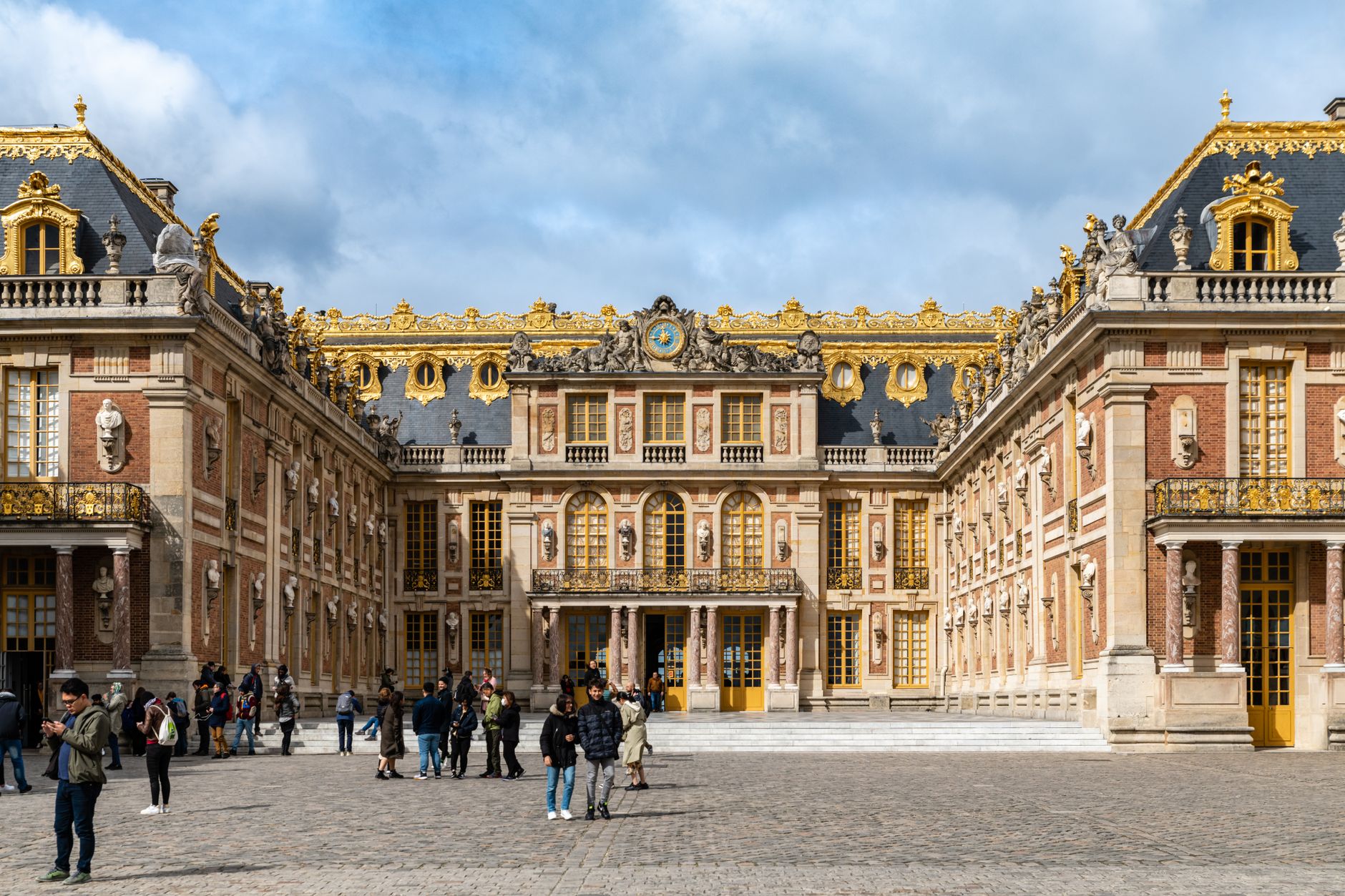
Today you arrive across cobbles wider than a football pitch, past gold-tipped iron gates that catch the morning sun. Inside, footsteps echo on parquet that has carried the boots of Sun King courtiers, Prussian officers, American presidents and, on Bastille Day, drone-show technicians wiring the Grand Canal. The smell is wax, old stone, dust off velvet ropes.
Most palaces freeze. Versailles never has. Louis XIV moved the court here in 1682, and the Republic still convenes its joint parliament in the South Wing whenever it rewrites the Constitution. The same room that received the Doge of Genoa in 1685 hosted Xi Jinping in 2024.
Three and a half centuries of uninterrupted statecraft. That's the story most guidebooks miss while pointing at chandeliers.
01 What to see.
The Hall of Mirrors
73 metres long, 357 mirrors facing 17 arched windows that look out over Le Nôtre's gardens — and at sunset, the whole gallery turns amber. Charles Le Brun spent fourteen years painting the vault overhead, a running propaganda reel of Louis XIV's reign in heroic Roman dress, finished in 1684. Stand on the central axis and the garden doubles back on itself in the glass: same trees, same light, twice over.
This is also where the Treaty of Versailles ended the First World War in 1919, on a desk you can still see. Pause there. Same parquet held the king's daily walk to mass and the diplomats who broke an empire — different centuries, identical reflections.
The Bosquets — Le Nôtre's Hidden Rooms
Le Nôtre designed fifteen bosquets — outdoor rooms walled in trellis and hornbeam, reached through discreet gates off the main alleys. The Marquis de Dangeau called them fontaines renfermées, enclosed fountains, and that secrecy is the point. Slip through a gap in the green and a marble cascade or a colonnade nobody mentioned waits for you.
Find the Bosquet de la Salle de Bal. Last grove Le Nôtre built, 1680–1685, an amphitheatre of greenery with the only true cascade at Versailles — eight tiered marble ramps crusted in millstone and shell, gilt lead vases at the crown, boxwood steps facing it like a theatre. During the Grandes Eaux Musicales from April through November, Lully and Handel play in the trees while fountainiers turn 17th-century valves with a lyre-shaped iron called the clé lyre.
Walk the Trianon estate at dusk
02 In pictures.





Plan and listen to Palace of Versailles with Audiala.
Audio guide in your pocket, itinerary in your browser. Built for the way you actually visit.
Tickets & tours.
These are guided options from our partners — same price as booking direct.
Prices are indicative — final pricing and availability are confirmed at checkout. Audiala may earn a commission from bookings made through these links.
Also on GetYourGuide
More tours for Palace of Versailles
Curated from GetYourGuide. Same price as official, free cancellation on most.

Versailles Palace and Gardens Full Access Ticket
from
€25

Versailles: Skip-the-Line Tour of Palace and Gardens Access
from
€69

From Paris: Versailles Palace & Gardens with Transportation
from
€45

Versailles: Skip-the-Line Guided Palace Tour and Full Access
from
€78

Palace of Versailles and Gardens Passport Entry Ticket
from
€52
Prices shown are indicative — final pricing and availability are confirmed at checkout. Audiala may receive a commission from bookings made via these links.
03 Visitor logistics.
The practical scaffolding for a good visit — kept short.
Getting There
RER C to Versailles Château Rive Gauche is the standard route from central Paris (~40 min, 10-min walk to the gates). Locals prefer Transilien Line N from Gare Montparnasse to Versailles Chantiers — about 12 minutes, cleaner, fewer pickpockets, then a 20-min walk. By car: A13 to Versailles Centre exit, park at Place d'Armes (paid).
Opening Hours
As of 2026, the Palace runs Tuesday–Sunday, closed Mondays. Low season (1 Nov–31 Mar): 9:00–17:30, last entry 17:00. High season (1 Apr–31 Oct): 9:00–18:30, last entry 18:00. The Trianon estate opens later — 12:00 daily — and the gardens stay free for pedestrians except on Musical Fountains days.
Time Needed
Palace State Apartments alone: 2–3 hours if you keep moving. Palace plus formal gardens: 4–5 hours. Full estate including Grand Trianon, Petit Trianon, and Marie-Antoinette's Hamlet: a full 6–8 hour day. The half-day plans most guidebooks suggest underestimate the walking distances badly.
Cost & Tickets
2026 Passport (full estate, timed Palace slot): €25 low season, €35 high season; €3 EEA discount with ID from 14 January 2026. Under-18s and EEA residents under 26 enter free. The entire estate is free on the first Sunday of each month from November through March — Palace timed booking still required.
Accessibility
The main Palace is fully wheelchair-accessible via lifts and ramps; the Hall of Mirrors included. Free wheelchair loan at the Gabriel Pavilion, Grand Trianon, and Petit Trianon (interior use only). Disabled visitor plus one companion enter free with mobility card; use Entrance A (Dufour Pavilion). Upper floors of both Trianons and the attic Napoleon rooms have no lift access.
05 Tips for visitors.
Small things that change the day.
Beat the Hall of Mirrors crush
Aim for the 9am opening slot or the last 90 minutes before closing — midday in the Galerie des Glaces is sardine-tin territory. Wednesday and Thursday are the calmest days; Tuesday and weekends are the worst.
Bag size limit is strict
Under the Vigipirate plan, bags larger than 55×35×20 cm (cabin size) are banned across the entire estate, including gardens and Trianon. On-site lockers only fit cabin-size; leave the suitcase at your Paris hotel.
Photography rules
No flash, no tripods, no selfie sticks inside any Palace building. Drones are forbidden over the entire estate. Group photo gatherings in the Cour d'Honneur or formal gardens require a permit — solo handheld shots are fine.
Where locals actually eat
Skip the Place d'Armes chains. In Quartier Saint-Louis, La Table du 11 (1-Michelin-star, ~€85–140 tasting) is the splurge; its sister Le Bistrot du 11 covers mid-range at €35–55. For budget, hit the Marché Notre-Dame stalls (Tue/Fri/Sun mornings) — oysters, cheese, charcuterie at a third the price.
Pickpockets and ticket touts
RER C trains and the Versailles-Château station exit are the active pickpocket zone — keep bags front-loaded. Anyone selling 'skip-the-line' tickets outside the gates is reselling official ones at markup; buy direct at chateauversailles.fr and book a timed slot, or face a 2–3 hour queue.
Free park, ticketed palace
The wider Park (separate from the formal Gardens) is free year-round for pedestrians and cyclists — locals jog and picnic at the Grand Canal. Rent a bike or rowboat there to cover the 1.6 km canal axis without exhausting your legs before Marie-Antoinette's Hamlet.
Skip to the Trianon side
On peak days, enter through the Trianon gate on Boulevard de la Reine instead of fighting the Place d'Armes crowd. Walk back through the gardens to the main Palace — the queue is shorter and you arrive at the Hall of Mirrors against the tourist current.
2026 highlights to time around
The 'Gardens of the Enlightenment, 1700–1800' exhibition runs at Grand Trianon from 5 May to 27 September 2026. Louis XVI's reconstructed bed unveils in spring. The free European Museum Night falls on 23 May 2026 — advance booking required, no cloakroom that evening.
Where to Eat
Don't Leave Without Trying
Dining Tips
- check Always greet staff with 'Bonjour' or 'Bonsoir'—it is non-negotiable etiquette.
- check Service is included in the price; tipping is not required, though small change for exceptional service is appreciated.
- check Reservations are highly recommended, especially for dinner near the Palace.
- check Lunch is typically served between 12:00 and 14:30; dinner service rarely begins before 19:30.
- check Ask for 'une carafe d'eau' if you would like free, high-quality tap water.
- check Look for the 'formule' (set menu) at lunch for the best value.
Restaurant data powered by Google
04 A history of reinvention.
The Stage That Never Closed
Versailles was never a museum first. From the moment Louis XIV moved the court here on 6 May 1682, the Palace worked as the operating theatre of French power: where ambassadors were received, treaties signed, marriages negotiated, dynasties ended. That function never stopped. It only changed costumes.
Walk the Hall of Mirrors today and you cross the same parquet that carried the Doge of Genoa in 1685, Siamese envoys in 1686, Persian ambassadors in 1715, Wilhelm I's coronation party in 1871, the Treaty signatories on 28 June 1919, and Charles III in 2023. Records show the Republic still gathers its joint parliament here to amend the Constitution. Versailles remains the room France uses to perform itself to the world.
Pierre de Nolhac and the Resurrection
The royal apartments you walk through feel like they survived the centuries intact — Louis XIV's bedchamber where Louis XIV left it, Marie-Antoinette's writing table still placed for her dawn correspondence.
But the dates stop adding up. The Revolution stripped the palace of nearly every movable object in 1793. Louis-Philippe gutted the rest in 1837 to install his Musée de l'Histoire de France, ripping out most of the palace's toilets to free wall space for battle paintings. By 1890 Versailles was a half-forgotten provincial museum with mismatched furniture and the wrong rooms labelled.
Pierre de Nolhac arrived in 1892. Curator until 1920, he spent twenty-eight years tracking down dispersed furniture, identifying scattered inventories, restoring the royal apartments piece by piece. His memoir gave the movement its name: La Résurrection de Versailles. On 28 June 1919, with the Treaty hours from signature, Nolhac personally escorted the German signatories Hermann Müller and Johannes Bell through Madame Victoire's chamber and up to the Hall of Mirrors. He recorded tears in Müller's eyes. The curator who had spent half his life reassembling Louis XIV's palace was the man who walked the vanquished Germans to the room where, forty-eight years earlier, their empire had been proclaimed.
Every gilt frame, every silk panel, every restored chair you photograph is Nolhac's detective work, not Louis XIV's leftover. The Versailles you see is a resurrection, not a survival.
What Changed
What Endured
Listen to the full story in the app
The whole Palace of Versailles,
told well.
Audio guides for 1,100+ cities across 96 countries. History, stories, and local insight — offline ready.

06 Frequently asked.
The questions travellers send us most about Palace of Versailles.
Is the Palace of Versailles worth visiting?
Yes, but plan a full day or you'll resent the rush. The palace alone is sardine-tight in the Hall of Mirrors by 11am; the Trianon estate and Marie-Antoinette's Hamlet, twenty minutes' walk away, are where the visit actually breathes. Skip it only if you refuse to book a timed slot online — the walk-up queue runs two to three hours.
How long do you need at the Palace of Versailles?
Six to eight hours for the full estate, three at absolute minimum for palace highlights only. Palace state apartments take two hours, gardens another two, and the Trianon plus Queen's Hamlet a further two with the walk. Day-trippers who allot a half-day always regret it.
How do I get to Versailles from Paris?
Take RER C to Versailles Château Rive Gauche, a ten-minute walk from the gates and roughly forty minutes from central Paris. Locals prefer SNCF Transilien Line N from Gare Montparnasse to Versailles Chantiers — twelve minutes, cleaner carriages, fewer pickpockets than RER C. Bus 171 from Pont de Sèvres drops you directly at the Place d'Armes.
What is the best time to visit the Palace of Versailles?
Wednesday or Thursday morning at 9am opening, or the last ninety minutes before close. Avoid Tuesdays (Louvre's closed day pushes crowds here) and weekends. For the Hall of Mirrors at its best, come late afternoon when the seventeen west-facing windows pour amber light into 357 mirrors.
Can you visit the Palace of Versailles for free?
The gardens and park are free year-round for pedestrians and cyclists, except on Musical Fountains days. The palace itself is free for under-18s, EEA residents under 26, disabled visitors plus a companion, and on the first Sunday of each month from November through March. Free entry still requires booking a timed Palace slot online.
What should I not miss at the Palace of Versailles?
The Hall of Mirrors, obviously — but look up at the War Room ceiling next door, where stucco shows Germany kneeling under an eagle, the same nation that signed the 1919 Treaty in the next room. Then walk to the Bosquet de la Salle de Bal, an outdoor amphitheatre with the only cascade in the gardens, eight tiers of marble encrusted with millstone and shells. Skip the standard route and book the King's Private Apartments tour at 10am to see the astronomical clock programmed to run until the year 9999.
Are there bag size restrictions at Versailles?
Yes, anything larger than 55×35×20 cm (cabin size) is banned across the entire estate under the Vigipirate security plan. On-site lockers accept cabin-size bags only — there's nowhere to leave a suitcase, so don't arrive between trains with luggage. Strollers are an exception and let through.
Is the Palace of Versailles wheelchair accessible?
The main palace is fully accessible including the Hall of Mirrors, with lifts, ramps, and free wheelchair loans at the Gabriel Pavilion for interior use. The Trianon ground floors work, but upper floors of both Petit and Grand Trianon have no lifts. Use Entrance A at the Dufour Pavilion; UK Blue Badge is recognised in France.
Verified, and shown.
Researched and written by the Audiala editorial team from historical records, architectural archives, and local expertise.
Official opening hours for palace and Trianon estate, transport directions from Paris, accessibility provisions
Official 2026 prices: Passport €25 low / €35 high season, Trianon €15, EEA reduced rates
Free-entry categories: under-18, under-26 EEA, disabled visitors plus companion, first Sunday Nov–Mar
Wheelchair access details, Entrance A routing, free wheelchair loan locations, Trianon limitations
Vigipirate bag size limit 55×35×20 cm and on-site locker capacity
Confirmation of busiest/quietest days and timed-slot booking guidance
Visit duration estimates: 2–3 hours palace only, 6–8 hours full estate
1979 inscription with criteria i, ii, vi recognising court life and decorative arts heritage
2026 events calendar including Royal Opera season and current exhibitions
Bastille Day, 15 August Fire Night, Independence Day Night Fountains programming
Last reviewed
Researched from Wikidata, Wikipedia & official sources · fact-checked · How we make our guides →


