Pont Du Gard
Vers-Pont-Du-GardFrance 43° N · 4° E Updated Apr 2026
Built around 50 AD, this Roman aqueduct carried 35,000 m³ of water daily across a river gorge — and took just 5 years to construct.
- Time needed
- Half day
- Best season
- Spring (April–May)
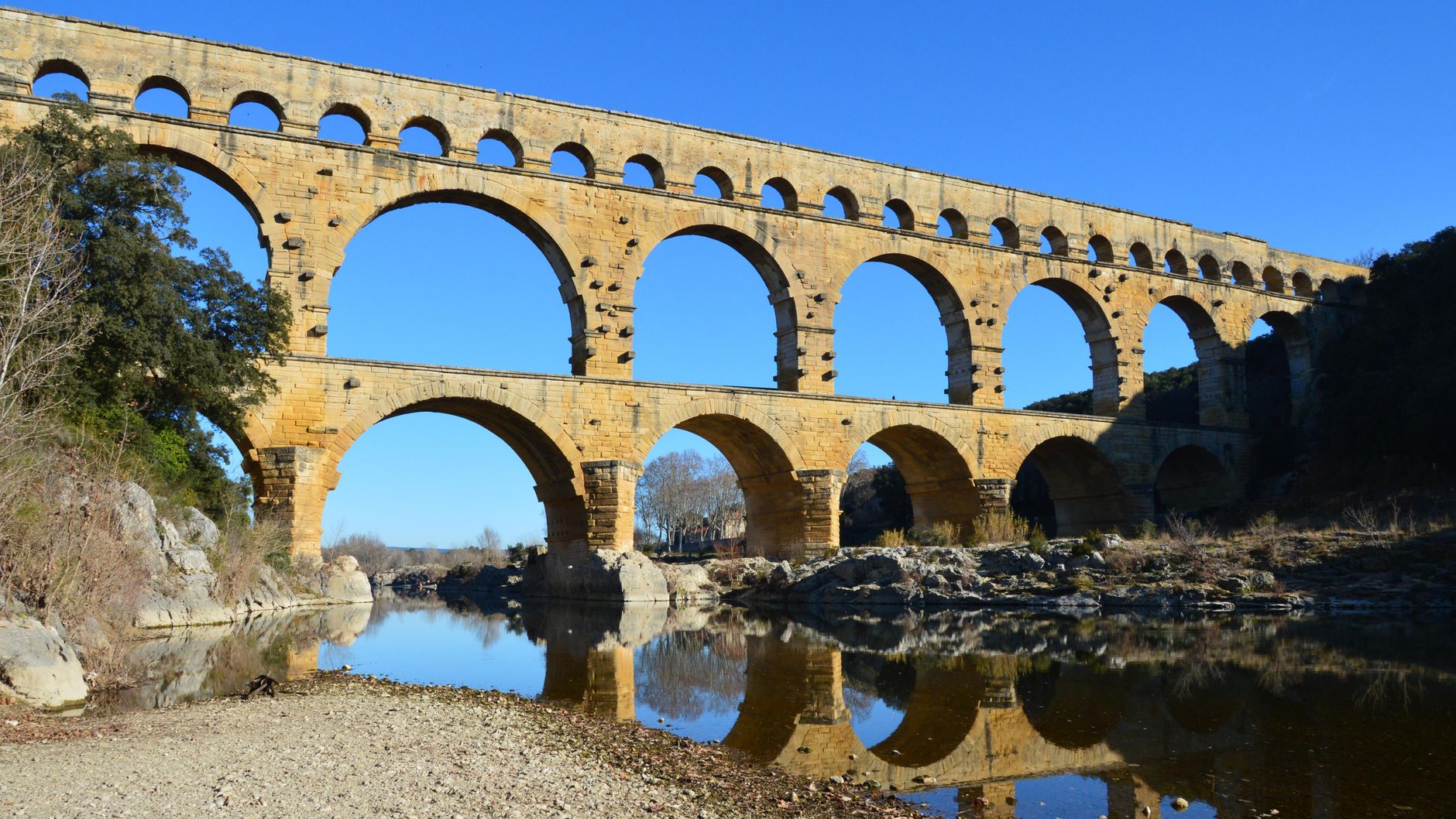
Every drop of water that reached the Roman city of Nîmes traveled for nearly 27 hours through 50 kilometers of stone channel — and the most spectacular stretch of that invisible river stands right here, three tiers high above the Gardon valley. The Pont du Gard, near the village of Vers-Pont-du-Gard in southern France, is the tallest aqueduct bridge the Romans ever built, and two thousand years later it still looks like it could carry water tomorrow. Come for the engineering. Stay for the way late-afternoon light turns 50,000 tonnes of limestone the color of warm honey.
The numbers alone are staggering: 48.8 meters tall — roughly the height of a 16-story building — with three stacked arcades of 6, 11, and 35 arches respectively. The massive blocks of the lower tiers, some weighing 6 tonnes, were fitted without mortar. You can still see the projecting bosses the Roman builders left on the stone faces, originally used to grip the blocks with ropes and pulleys, never trimmed off because nobody expected tourists.
But what makes the Pont du Gard more than an engineering curiosity is its setting. The Gardon River curls beneath the lowest arches, shallow enough to wade in summer, flanked by scrubby Mediterranean garrigue that smells of thyme and hot dust. Kayakers pass underneath. Swimmers lounge on the pale gravel banks. The UNESCO World Heritage designation, granted in 1985, protects the structure and the surrounding landscape, but the place has never felt like a museum.
Vers-Pont-du-Gard itself is a quiet Provençal village, more a staging post than a destination. The real draw is the bridge and the 165-hectare cultural site around it, which includes a museum, walking trails through the old Roman quarry at L'Estel, and enough shade to survive a July afternoon. Plan for at least half a day — the kind of half-day that quietly becomes a full one.
What to see
-
The Three-Tiered Aqueduct Bridge
Here's what no photograph prepares you for: the Pont du Gard is 48.77 metres tall — roughly the height of a 16-storey building — and it was built around 50 AD without a single drop of mortar. Six arches on the bottom, eleven in the middle, originally 47 small ones across the top, all stacked in honey-gold shelly limestone quarried just 600 metres downstream. The Romans cut each block so precisely that gravity and friction alone have held 50,000 tonnes of stone in place for nearly two millennia. Walk across the lower level on the 1747 Pitot Bridge (designed by engineer Henri Pitot to mimic the Roman work so closely that most visitors never realise it's an 18th-century addition) and run your hand along the stone. You'll feel the difference — the Roman blocks are rougher, more massive, still bearing the groove marks of 1st-century quarrymen's tools. Look closer at the piers and you'll spot something almost nobody notices: engraved letters and numerals, positioning codes carved by builders to mark exactly where each stone belonged in the assembly sequence. They're easiest to read in low raking light, early morning or late afternoon, when shadows pool in the shallow cuts. Stand beneath the central arch — deliberately widened to 24.52 metres (three metres broader than its neighbours) to let the Gardon's violent flash floods pass — and clap once. The vaulted limestone soffit throws back a resonance you can feel in your chest. The smaller side arches produce a thinner, quicker echo. The Romans engineered this bridge to carry 40,000 cubic metres of water a day from Uzès to Nîmes; what they also made, whether they intended to or not, is an instrument. -
The Third-Level Water Channel (Guided Tour Only)
The guided "Immersion" tour costs €15 and involves climbing roughly 80 steps to the summit of the aqueduct, where you step inside the specus — the actual channel where water flowed for five centuries. This is the single most extraordinary thing you can do here, and it books out fast, so reserve online before you arrive. The conduit is narrow, barely shoulder-width in places, and dimly lit. Your fingertips find the walls coated in opus signinum, the pinkish Roman waterproofing mortar that still lines sections of the channel — smooth and cool, polished by centuries of flowing water, textured nothing like the rough limestone outside. The air smells faintly of ancient lime and damp mineral. Nearly 49 metres below, the river is a pale ribbon; the wind is stronger up here than you'd expect, and looking down through the gaps between the small upper arches produces a genuine lurch of vertigo. What strikes you most, though, is the intimacy. Down at river level the Pont du Gard is a monument, an abstraction of Roman power. Up here, inside the working guts of the thing, it becomes a pipe. A brilliantly engineered, absurdly ambitious pipe, built by identifiable human hands whose tool marks you can trace with your own. -
The Mémoires de Garrigue Trail & Roman Quarry
Most visitors photograph the bridge, cross it, and leave. They miss the 1.4-kilometre Mémoires de Garrigue trail — a looping open-air museum through 15 hectares of restored Mediterranean scrubland on the left bank, threaded with dry-stone walls and capitelles (tiny corbelled stone shepherds' huts that look like something from a fairy tale, though they date to centuries of hard agricultural labour). In summer, the garrigue exhales wild thyme, rosemary, and lavender so intensely you taste it. Cicadas produce a wall of sound from late June through August that borders on physically aggressive. The trail leads past an orientation table with views of the bridge in its valley context — from here, you can finally perceive the subtle upstream curve engineered into the structure to resist river currents, invisible from close up. Then continue 600 metres downstream to the Roman quarry, where the extraction faces still show the marks of where each block was prised free. Combine this with the right bank belvedere — the classic elevated viewpoint where late-afternoon sun turns the limestone a deep amber — and you have a 3-to-4-hour circuit that transforms the Pont du Gard from a single postcard image into the centre of an entire engineered landscape. Wear proper shoes. Bring water. In winter, you may have it entirely to yourself.
Plan your visit
- Getting There
- By car, take the A9 motorway to exit 23 (Remoulins), then follow the RN100 toward Uzès — it's 27 km from Nîmes, 21 km from Avignon. By bus, Line 121 from Nîmes costs €2 and takes about 54 minutes; Line 115 connects from Avignon and Alès. A gorgeous 32 km car-free greenway (Voie Verte) links Beaucaire to Uzès and passes right through the site — the ViaRhôna cycle route also swings by.
- Opening Hours
- As of 2026, the site and car parks open daily from 8:00 AM to midnight, year-round — but your car must be out by midnight or you'll face a fixed penalty fee. The museum, cinema, and Ludo center follow seasonal schedules that shift monthly, so check the official site before visiting. Guided tours to the aqueduct's top tier run on a separate timetable and require advance booking.
- Time Needed
- A quick walk from the car park to photograph the bridge and back takes 1.5–2 hours. For the full experience — museum, film screening, guided tour up 80 steps to the third tier where Roman engineers once walked — plan 3.5 to 4.5 hours. The guided tour alone is a substantial commitment, but standing inside the water channel 49 metres above the Gardon is the kind of thing you remember decades later.
- Cost & Tickets
- As of 2026, parking is €9/car/day (convertible to a free annual pass within 14 days via their website). Discovery areas (museum, cinema, Ludo) cost €8 for adults; under-18s and disabled visitors enter free. Guided tours to the top tier run €15/adult, €6 for children 4–17. An audio guide in 8 languages is €4. Present a valid liO train ticket for reduced rates (€6 discovery, €13 guided tour).
- Accessibility
- All paved pathways across the site are wheelchair-accessible, and free wheelchairs are available on request. Cultural buildings and Les Terrasses restaurant have elevators; the museum includes tactile exhibits and radio theater for sensory discovery. The one exception: the guided tour to the third tier involves 80 steps and rough garrigue paths, making it inaccessible for reduced mobility.
Photo Gallery




History
Fifty Kilometers of Gravity
Around 50 AD, the Roman colony of Nemausus — modern Nîmes — was booming. Its population had swollen past 20,000, and the existing wells and springs couldn't keep up with the demand of public baths, ornamental fountains, and private villas that any self-respecting Roman city required. The solution was an aqueduct, sourced from the Fontaine d'Eure springs near Uzès, 20 kilometers north as the crow flies but 50 kilometers as the water flows. The entire channel drops just 12.6 meters over that distance — a gradient of roughly 1 in 3,000, or about the thickness of a coin per meter. One miscalculation and the water would have pooled, reversed, or burst through the channel walls.
The Pont du Gard was the most audacious segment: a three-tier bridge spanning the Gardon gorge at a point where the valley is both narrow enough to cross and deep enough to demand something colossal. Records show the structure was built during the reigns of Claudius or Nero, and the official site claims nearly a thousand laborers completed it in about five years, though that figure lacks independent confirmation. What is certain is that the aqueduct delivered an estimated 30,000 to 40,000 cubic meters of water daily to Nîmes — enough to fill about 16 Olympic swimming pools — for roughly five centuries.
The turning point
Henri Pitot and the Bridge That Saved the Bridge
By the early 18th century, the Pont du Gard was in serious trouble. Centuries of use as a toll bridge and footpath had taken their toll — literally. Local lords had allowed travelers to cross the second tier for a fee, and cart traffic had worn the ancient stonework thin. Worse, some of the pier faces had been hacked away to widen the passage, leaving the structure dangerously weakened. The bridge that once carried water now risked collapsing under the weight of commerce.
Enter Henri Pitot, a hydraulic engineer from Languedoc best known for inventing the Pitot tube, still used today to measure fluid velocity in aircraft. In 1743, the provincial government of Languedoc commissioned Pitot to design a new road bridge alongside the aqueduct, relieving the Roman structure of traffic once and for all. Pitot faced a delicate problem: his new bridge had to attach to the downstream side of the Pont du Gard without destabilizing it. He studied the Roman construction methods closely, matched his pier widths to the ancient ones, and completed the road bridge by 1747. The intervention was controversial — purists argued that bolting a modern structure onto a Roman monument was vandalism — but Pitot's pragmatic calculation was correct. Without the bypass, the Pont du Gard would almost certainly have been shaken apart by another century of wheeled traffic.
Pitot's bridge still stands beside the aqueduct today, visibly different in stone color and style but structurally respectful. It was the first act of what became a long, sometimes contentious history of conservation — a story of engineers and architects arguing over how much intervention is too much, a debate that continues into the present.
Toll Bridge, Quarry, Survivor
The Quarry at L'Estel
Tips for visitors
Come at Golden Hour
Arrive in the last two hours before sunset — the Gardon River reflects the honey-coloured limestone, the tour buses have left, and you can photograph the bridge without 200 strangers in frame. Morning light hits the upstream face; evening light gilds the downstream arches.Eat Facing the Arches
Les Terrasses on the right bank offers regional cuisine with a direct terrace view of the monument — reserve ahead at 04.66.63.91.37. For budget bites, the Bistro du Pont du Gard on the left bank does salads and sandwiches with misting fans in summer. Picnicking is explicitly allowed everywhere on-site; tables sit near the Old Mill on the left bank.Top Tier Is Non-Negotiable
The guided tour up 80 steps to the aqueduct's third level lets you peer into the actual water channel that carried 40,000 cubic metres daily to Nîmes — that's 16 Olympic swimming pools every 24 hours. Book in advance; slots fill quickly in summer, and this is the only way to access the top.Combine with Uzès
The town of Uzès — where the aqueduct's source springs still flow — sits just 14 km north and has a spectacular Saturday morning market, a medieval ducal palace, and the kind of café-lined squares that justify a second espresso. The greenway connects the two if you're cycling.Parking Pass Trick
Your €9 parking ticket can be converted into a free annual pass within 14 days at abonnement.pontdugard.fr — useful if you're staying in the region and want to return at dawn or dusk without paying again.Swimming at Your Risk
The Gardon River beneath the bridge is swimmable under a municipal decree that makes it explicitly at-your-own-risk — no lifeguards, strong currents after rain. On calm summer days, locals wade in from the left bank beaches. Check river conditions before plunging in.
Frequently asked
Is Pont du Gard worth visiting?
Absolutely — it's the tallest Roman aqueduct bridge ever built, standing nearly 49 metres high (picture a 16-storey building made of golden limestone, assembled without a drop of mortar around 50 AD). Beyond the structure itself, you can swim in the Gardon River beneath it in summer, walk inside the actual water channel on a guided tour, and explore a 1.4 km trail through Mediterranean garrigue dotted with ancient dry-stone shepherd huts. The sensory experience — cicadas screaming in July, the echo under the central arch, the smell of wild thyme baking in the sun — makes this far more than a photo stop.
How long do you need at Pont du Gard?
Plan 3 to 4 hours for a proper visit that includes the museum, a guided tour to the top tier, and time at the river. If you only want to walk across the lower level and take photos, 90 minutes is enough, but you'll miss the best parts — particularly the guided tour inside the 2,000-year-old water conduit at the summit, which alone takes about an hour including the 80-step climb.
Can you visit Pont du Gard for free?
Yes — walking to the monument, crossing the lower-level bridge, and accessing the riverbanks costs nothing. You only pay for parking (€9 per car per day), the museum and cultural spaces (€8 for adults, free for under-18s), or a guided tour to the third level (€15 for adults). Arriving by bike via the 32 km Voie Verte greenway from Beaucaire or Uzès eliminates the parking fee entirely.
How do I get to Pont du Gard from Nîmes?
It's 27 km northwest of Nîmes — about 25 minutes by car via the A9 motorway (exit 23, Remoulins), then follow the RN100 towards Uzès. By public transport, bus line 121 runs from Nîmes to the site for €2, taking roughly 54 minutes. The Voie Verte cycling greenway also connects Beaucaire to Uzès via the bridge if you prefer two wheels.
What is the best time to visit Pont du Gard?
October offers the ideal combination: golden autumn light at a low angle that turns the limestone amber, comfortable walking temperatures, and far fewer visitors than summer. For photography specifically, arrive before 9 AM any season — you'll often have the lower walkway nearly to yourself, and morning mist sometimes rises off the Gardon. Summer (June–August) brings swimming and cicadas but also extreme heat and packed car parks; winter gives you solitude and the chance to see the river in dramatic flood, revealing exactly why the Romans widened that central arch.
What should I not miss at Pont du Gard?
The guided tour to the third level is non-negotiable — you climb 80 steps to walk inside the actual Roman water channel, touching the original opus signinum waterproofing mortar that's been there since the 1st century. Also seek out the Roman quarry 600 metres downstream on the left bank, where extraction marks from the original builders are still visible in the rock face. On the lower-level piers, look for small carved letters and numerals at eye height — these are the assembly codes Roman engineers used to position each of the estimated 50,000 tonnes of stone blocks.
Can you swim at Pont du Gard?
Yes, in summer — the Gardon River beaches directly adjacent to the bridge are open for swimming at your own risk under a municipal decree. The water is clear and refreshing in July and August when levels are low, and the experience of floating beneath a 2,000-year-old aqueduct is genuinely surreal. You can also kayak through the Gardon Gorges and pass directly under the central arch, which is arguably the most dramatic way to encounter the monument.
Is there a guided tour at Pont du Gard?
Yes — the flagship 'Immersion' guided tour (1 hour, €15 adults / €6 children aged 4–17) takes you up 80 steps to the third tier and inside the ancient water conduit itself, the only way to access the top of the aqueduct. Book online in advance as places are limited, arrive 15 minutes early, and wear proper walking shoes — the return path crosses uneven garrigue terrain. The tour is not accessible to visitors with reduced mobility.
Sources & attribution 8
- Pont du Gard Official Website — Primary source for construction date (~50 AD under Claudius/Nero), visitor practical information including ticket prices, opening hours, parking, guided tour details, accessibility, transport options, EV chargers, and on-site amenities.
- UNESCO World Heritage Centre — Pont du Gard — Architectural dimensions (48.77 m height, 24.52 m central arch span, 360 m original length), construction technique details (dry stone, assembly marks, cutwater piers, curvilinear plan), historical context of the Pitot Bridge (1746), and the flour mill and hotel buildings on site.
- Gard Tourisme — Information on the Mémoires de Garrigue trail (1.4 km, 15 hectares), summer swimming and heat warnings, canoeing through the Gardon Gorges, Veni Vici trail race, museum scenography description, 11 million stone blocks / 50,000 tonnes estimate, Voie Verte greenway, and the Pont du Gard Tour smartphone app.
- Wikipedia — Pont du Gard — Confirmation of 1st-century AD construction, the 50 km aqueduct from Uzès to Nîmes, water volume (30,000–40,000 m³/day), post-Roman use as a toll bridge, stone looting, and the Pitot road bridge dates (1743–1747).
- Perfectly Provence — Practical visitor advice including recommended visit duration, seasonal opening hour variations, guided tour access to the third tier, and picnicking information.
- Rome2Rio — Bus route information from Nîmes to Vers-Pont-du-Gard including Line 121, fare (€2), and approximate journey time (54 minutes).
- Le Long Weekend — Practical details on car park closing times and late-departure fees.
- Pont du Gard Facebook Page — Viewpoint recommendations including the Belvédère de la Rive Droite ('vue plongeante') and Belvédère de la Rive Gauche for photography.
Built from cited sources · see the method · How we make our guides →
Pick up where you left off
Saved and recently read places — kept on this device only.
Photo credits (6)
- SlimMars 13 — Pexels License (https://www.pexels.com/license/) — Source: https://www.pexels.com/photo/30187645/
- Carsten Ruthemann — Pexels License (https://www.pexels.com/license/) — Source: https://www.pexels.com/photo/15545179/
- Hub JACQU — Pexels License (https://www.pexels.com/license/) — Source: https://www.pexels.com/photo/33203770/
- SlimMars 13 — Pexels License (https://www.pexels.com/license/) — Source: https://www.pexels.com/photo/30187770/
- SlimMars 13 — Pexels License (https://www.pexels.com/license/) — Source: https://www.pexels.com/photo/11617573/
- SlimMars 13 — Pexels License (https://www.pexels.com/license/) — Source: https://www.pexels.com/photo/11617554/
Photos may have been resized or cropped.