


Place
France Updated Jul 2026
Before you see Vallon-Pont-d'Arc, France on a map, you hear it: paddles knocking against canoe hulls, cicadas drilling in the heat, and the low rush of the Ardèche slipping under a limestone arch 54 meters high. The surprise is that this small Ardèche town holds two different kinds of grandeur at once. One is geological and blindingly obvious at Pont d'Arc. The other lies underground, in the nearby Chauvet Cave, where artists were drawing lions and rhinoceroses around 30,000 to 32,000 years ago.
 Photo: The original uploader was Vpe at French Wikipedia. · CC BY-SA 2.0 FR
Built from cited sources · see the method · How we make our guides →
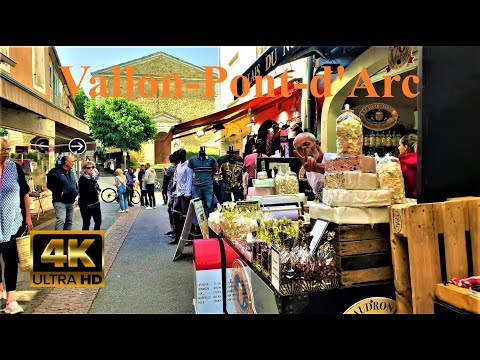
Vallon can look, at first glance, like a summer machine built for river fun: kayak rentals, ice cream, market stalls, damp swimsuits drying on car windows. That's only half true. The old center still keeps its trading-village bones, with the covered grain market, the 1630s château now used as the town hall, and squares that fill on Thursday mornings with goat cheese, charcuterie, apricots, and the warm smell of roast chicken turning on spits.
The landscape explains the town's mood. Pont d'Arc marks the entrance to the Ardèche Gorges, and the road through the canyon keeps pulling you toward one more belvedere, one more sheer drop, one more bend of pale stone above green water; at Serre de Tourre, the river sits about 200 meters below, small as a ribbon dropped in a crack. Then Vallon changes register again at Grotte Chauvet 2, where the replica stands in for a cave too fragile to open, and prehistory stops being a schoolbook chapter and starts to feel close enough to breathe on the glass.
What stays with you is the contrast between deep time and holiday time. One minute you're buying Picodon and a scoop of chestnut ice cream in the village, the next you're standing in a landscape shaped by vanished rivers and looking at the evidence of minds as alert as our own. Vallon-Pont-d'Arc is not just a base for the gorges. It's a place that quietly rearranges your sense of scale.
Not every monument, just the ones we'd walk you past ourselves.
Where to wander, by quarter — each with its own rhythm.
Before you go
From painted cave walls to a UNESCO-era heritage town
Deep inside what is now called Chauvet Cave, Aurignacian artists covered the walls with lions, rhinos, horses, and bears. UNESCO identifies these as the earliest known figurative drawings yet found, and that fact changes the scale of Vallon-Pont-d'Arc completely. This is not a village that wandered into history late. Human imagination was working here while mammoths still moved across Europe.
A collapse at the cave entrance shut Chauvet off from the outside world for millennia. That accident preserved charcoal marks, paw prints, and the breathless silence of the chambers almost like a locked room. Few sites get that kind of luck.
Nearby caves, especially Grotte d'Ebbou, show that people kept using this limestone country long after the painters of Chauvet were gone. Archaeological evidence points to Neolithic, Chalcolithic, Bronze Age, and Iron Age occupation. The Ardèche gorge was never empty scenery.
Most scholars date the first phase of the hilltop stronghold at Le Chastelas to the 11th century, above an inhabited site that was probably older than the castle itself. Stone walls rose on the ridge while houses clustered below, watching the Ardèche plain and the routes through it. Power liked the high ground then.
A tax survey recorded 103 houses at Vieux Vallon, which meant more than half the settlement still clung to the old elevated site. You can almost hear the practical noise of it: animals, cooking fires, boots on packed earth, wind scraping the ruined walls. Medieval Vallon was denser and more defensive than the village you see today.
Local sources disagree on the exact year, but the old castle was destroyed during the French Wars of Religion in the late 16th century. That was more than a military loss. It cracked the hilltop order that had structured Vallon for centuries.
A first Protestant temple stood in Vallon during the early 17th century, proof that Reformed worship here had real weight and local backing. This part of southern Ardèche did not experience the confessional wars as distant Parisian theory. They were lived block by block.
Henri, duc de Rohan, leading Protestant forces, captured the Chastelas and ordered it demolished. The act was coldly practical: ruined fortresses cannot be reused against you. Vallon's skyline changed with one military decision.
As Louis XIII moved through the region after the Huguenot campaigns, part of the passage at Pont d'Arc was deliberately collapsed to hinder resistance. Even a natural arch could be pulled into civil war. The gorge was beautiful, yes, but it was never innocent.
By 1639, the new seigneurial chateau in the plain was complete after roughly a decade of work, much of it imposed on local people. The bill reportedly reached 10,000 livres. With that, authority moved down from the old ridge to the lower town, and Vallon's center of gravity shifted for good.
The present Protestant temple was completed in 1823, giving visible form to a community that had survived repression, war, and long interruption. Protestant Vallon was no passing episode. It kept rebuilding.
Jules Ollier de Marichard was born in Vallon in 1824 and would become one of Ardèche's early prehistorians. He belonged to the generation that began reading caves and stone tools as evidence rather than curiosity. For a place later defined by prehistoric art, that matters.
The annexation of Chames helped form the commune in something close to its modern shape. That matters because Chames sits at the mouth of the gorge, near the river route that now defines Vallon's public image. Administrative borders can look dry on paper. Here they helped decide the map visitors know.
Auguste Sabatier, born in Vallon, became one of the major French Protestant theologians of the 19th century. His career unfolded far beyond Ardèche, but his birthplace tells you something about the religious texture of this village. Vallon produced thinkers as well as canoe postcards.
Construction of the present Saint-Saturnin church began in the 1860s on the foundations of the older building. New masonry replaced a site damaged in the confessional violence of earlier centuries. Stone remembers arguments longer than people do.
Anna Guerin was born in Vallon in 1878 and later helped create the remembrance poppy campaign that spread across France, Britain, and the Commonwealth after the First World War. Her connection to the village is easy to miss. Then you realize a global symbol of mourning began with a woman from this small Ardèche commune.
In September 1890, a catastrophic flood tore through the Ardèche basin and left a recorded high-water mark near Vallon. Flood markers can look modest until you picture the river climbing to that line, brown and fast and loud enough to drown speech. The gorge gives beauty, but the river keeps its temper.
The commune inaugurated its memorial to the dead of 1914-1918 in 1923. Like so many French village monuments, it turned grief into stone in the center of daily life, where markets and ordinary errands could never quite ignore it. Memory here stands outdoors.
French forces linked to de Lattre's army crossed the Ardèche near Salavas in August 1944 after the German retreat had already shattered local infrastructure. Vallon was liberated in the turbulence of that advance, with the river again acting as both obstacle and route. Geography kept choosing sides because armies kept forcing it to.
On 25 September 1948, the commune officially became Vallon-Pont-d'Arc. The change did more than decorate the map. It tied the town's civic identity to the great limestone arch that had always overshadowed it.
Born in 1980 and later associated with the Vallon-Pont-d'Arc canoe-kayak scene, Benoit Peschier embodied the athletic identity the river gave the town in the late 20th century. His Olympic gold would come later. The current started here.
The Gorges de l'Ardeche National Nature Reserve was created in January 1980, placing legal protection over one of France's most dramatic river corridors. That decision matters because beauty without rules tends to get consumed. Vallon's future was being defended in administrative French and survey lines.
On 18 December 1994, Jean-Marie Chauvet, Eliette Brunel, and Christian Hillaire rediscovered the sealed cave near Vallon. Few modern discoveries have so violently enlarged a place's historical importance. One evening underground, and Vallon was suddenly speaking to the whole history of image-making.
UNESCO inscribed the Decorated Cave of Pont d'Arc, known as Chauvet Cave, on the World Heritage List in June 2014. International recognition did not create the cave's value, of course. It changed who had to pay attention.
The replica site, first inaugurated in April 2015 and then opened to the public days later, solved a difficult problem: how do you share a fragile masterpiece without destroying it? Grotte Chauvet 2 gave visitors scale, darkness, and the shock of those painted animals while the original remained protected. Smart compromise. Rare thing.
Humanitarian organizer · 1878–1961
Born here
Anna Guérin left this small Ardèche town and changed the way whole countries remember their war dead. She helped turn the red remembrance poppy into an international ritual; she'd probably recognize Vallon's stubborn local pride at once, even if the souvenir stalls would puzzle her.
Theologian · 1839–1901
Born here
Auguste Sabatier was born in Vallon before becoming one of the major Protestant thinkers of 19th-century France. A town marked by Catholic and Protestant layers clearly left its trace on him; the old temple and church still hold that tension in stone.
Prehistorian · 1824–1901
Born here; died here
Jules Ollier de Marichard spent his life reading the Ardèche ground long before prehistory became fashionable. In a place now defined by Chauvet, his story feels almost prophetic: a local man looking at caves and rock with more patience than most of his century could manage.
Speleologist · born 1952
Co-discovered Chauvet Cave here in 1994
On 18 December 1994, Jean-Marie Chauvet helped open a door into Ice Age Europe just outside Vallon-Pont-d'Arc. Few people have altered a town's cultural gravity so completely; one cave discovery turned a river village into a place scholars and travelers cross continents to understand.
Olympic canoeist · born 1980
Associated with the Vallon-Pont-d'Arc canoe club
Benoît Peschier won Olympic gold in slalom, and his connection to Vallon makes perfect sense once you watch the river traffic here. This is a town where paddles lean against walls like umbrellas; he'd still find plenty of people treating the Ardèche as both playground and discipline.
Small things that change how the city treats you.
Yes, especially if you want more than a pretty river stop. Vallon-Pont-d'Arc gives you the 54-meter natural arch of Pont d’Arc, the Ardèche Gorges, and access to the Chauvet Cave replica built around some of the oldest known figurative art on earth.
Two to three days works well for most people. That gives you time for Grotte Chauvet 2, a canoe trip or scenic drive through the gorges, and a slower half-day in the old village or on a short walk like Le Chastelas.
No, the original Chauvet Cave is closed to protect the paintings. Visitors go to Grotte Chauvet 2 Ardèche, a full-scale replica and interpretation site that explains the cave’s art, geology, and Ice Age context.
A car helps a lot if you want the belvederes, nearby villages, or cave sites beyond town. Vallon itself is walkable, but the big experiences around it stretch across the gorges, river access points, and day-trip villages.
Yes, and many people do. The beaches around Pont d’Arc are one of the town’s main summer draws, but arrive early in hot weather because parking and riverbank space tighten quickly.
It can be in peak summer, but it doesn't have to be. Costs rise around Pont d’Arc and during school holidays, while market food, craft snacks, village cafés, and self-drive viewpoints keep a stay far cheaper than booking every activity.
Yes, generally. The real hazards are practical rather than urban: summer traffic, heat, crowded riverbanks, and underestimating outdoor activities in the gorges.
Choose the road if you want the views, and the river if you want the full physical experience. The tourist route has 11 belvederes over 29 km, while a canoe descent puts you under the cliffs and through the current that shaped the gorge.
Saved and recently read places — kept on this device only.
Photos may have been resized or cropped.