Château De Saint-Jean-D'Angle
Saint-Jean-D'AngleFrance 45° N · 0° W Updated Aug 2026
A ruin in 1994, bought that December by an industrialist who poured 76,000 litres of lime-water into its ramparts to save it from collapse.
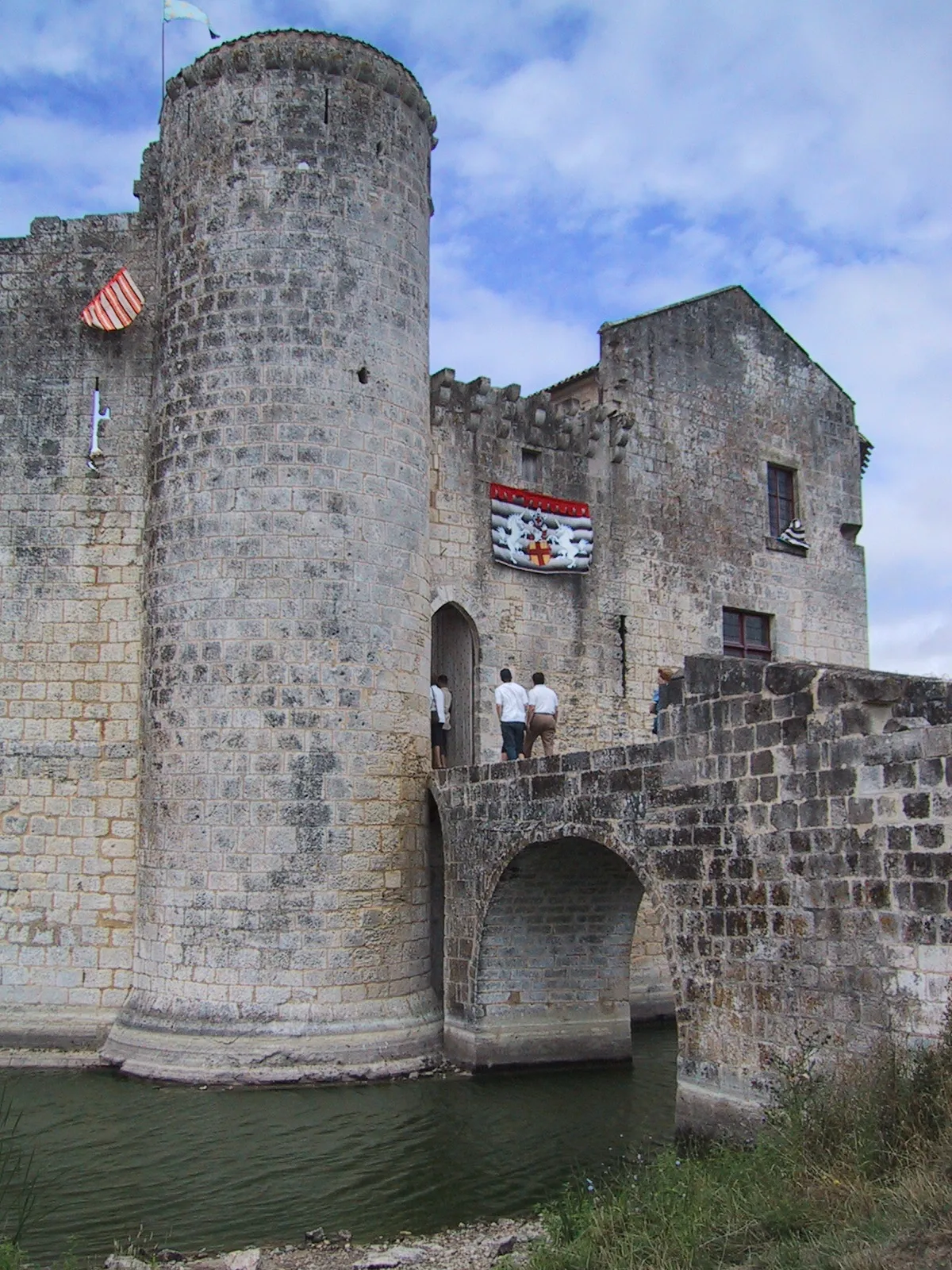 Photo: Salix · CC BY 2.5
- Time needed
- 3+ hours
- Entry
- €15 adults / €12.50 children 4-13
- Best season
- July-August (daily opening, free costumes)
The proudest dynastic statement at Château de Saint-Jean-d'Angle is bolted to a toilet. A 1624 plaque set into the outer face of the rampart latrines carries Charlotte de Saint-Gelais-Lusignan's coat of arms, crowned by the fairy Mélusine in her bath — the family's mythical ancestress, presiding over a sanitation upgrade. That collision of grandeur and plumbing is the whole place in miniature, and it's the reason this salt fortress at Saint-Jean-d'Angle, on the marsh edge of Charente-Maritime in western France, deserves more than a photo from the car park.
The castle sits low, ringed by water, on ground that used to be the shoreline of something much bigger. The Gulf of Saintonge once pushed inland here, and the marshes it left behind made salt — which in the twelfth century meant money, and money meant walls. Everything defensive you're looking at was paid for by seasoning.
What you walk through today is not one castle but four or five stacked on top of each other. Records show the fortifications finished in the thirteenth century, the living quarters reworked across the fourteenth and fifteenth, Charlotte's windows and bridge cut in the seventeenth, and then a hundred years of nothing at all. By the early 1990s the ruin was roofless and, by several accounts, held upright mainly by the ivy eating it.
The site now trades as the Château Fort de la Fée Mélusine, with a medieval-themed play area for children and a fairy story stitched through the signage. Take the branding lightly and the stonework seriously. Come for the masonry and the plaque; let the kids have the playground while you find the graffiti.
What to see
-
The shell wall, the rampart walk, and the marsh it was built to tax
You get dressed before you cross the bridge. Costumes are free at the gate — knight, page, castellan — and the effect is unreasonable: a curtain wall traditionally dated to around 1180 stops being a photo subject and becomes somewhere you're standing inside. Tradition credits Guillaume de Lusignan and Denise d'Angle, though no charter survives to prove it. What the Ministry's own record does confirm is the shape: a polygonal ring wall on a motte, no central keep, lodgings ranged in an L around the courtyard, moat all the way round.
Climb to the chemin de ronde and the reason for all of it lands. No mountain to watch, no river crossing, no pass. Only an ocean of marsh — some 6,000 hectares of salt pans stretching toward Brouage, ten kilometres off. Salt was the sole way to carry fish and meat through a European winter, and this wall stood over the road it left by. The castle isn't a castle in a view. It's a tollbooth on a commodity.
And it very nearly went. When the state classified it on 21 March 1994 the place was roofless and half-swallowed by brambles, stone sliding out of the ramparts. Alain Rousselot bought the ruin that December and spent 1995 to 2000 putting it back — 76,000 litres of lime-and-water grout, enough to fill a small swimming pool, poured into every cavity in the wall. Europa Nostra gave the work a heritage award for it. His line on the result: over 800 years old, and properly maintained it will still be here in another 800.
-
The lions on the doorway — and the fleurs-de-lis scratched in the latrine
Most visitors walk straight past the finest carving here. The doorway into the 15th-century logis is flamboyant Gothic done properly: colonnettes, pinnacles, an accolade curling to a point, and above it a heraldic shield held up by two lions. Shoot it from below or you flatten the whole thing into wallpaper.
Then go looking for the amateur work. A survey of the walls records anchors and boats, crosses, a church steeple — cut into the logis, the tower and the latrines, exactly the parts still reachable during the centuries of abandonment. Boats, this far inland, because navigation was what everyone here did for a living. And fleurs-de-lis inside the privy and around its door. Royal emblem, in a toilet, carved by people whose names nobody bothered to write down. That's a single published survey, so ask at the desk before you go hunting.
The lines are shallow and softened by weather. They read in raking light or not at all, which makes early morning and late afternoon the only honest times to look; run your fingertips across the jamb instead of staring at it head-on. While you're below courtyard level, take the stair out of the larder — a shoulder-width shaft you turn sideways in, twenty metres of wall overhead, and then daylight. Best thirty seconds in the building.
-
Three hours, in costume: castle first, park after
Do it in this order and the day makes sense. Costume at the gate, then the stone castle while the sun is still low and the graffiti still legible — courtyard, guard room, the deep pit, the latrines, the larder stair, the rampart walk last for the marsh panorama. Reckon on an hour before you've had enough of walls.
Then walk out to the timber motte, the reconstructed fort of the year 1000 on its earthen mound, and turn around. Wooden palisade in front of you, stone shell wall behind: two centuries of military technology in one sightline, and the clearest lesson on the whole 15-hectare estate. From there the medicinal garden's twelve planted squares, the Aliénor rose garden, and the barefoot path — shoes off, and yes, do it. The musical forest is the one genuinely odd thing on site.
Time the trebuchet demonstration and don't miss it; the release is loud, the landing louder, and the machines are the last working ones in Charente-Maritime. Note they're cancelled outright during extreme-heat alerts, and a mound with no shade in August is exactly as hot as that sounds. Budget three hours. Adults €15, children 4 to 13 €12.50, under-fours free, and the ticket office shuts an hour before the site does — arriving at four in the afternoon buys you a rushed castle and nothing else.
Plan your visit
- Getting There
- Car only. Set GPS to 2 route de Marennes, 17620, on the D733 between Rochefort and Marennes — about 10 minutes from Rochefort, 15 from Marennes, 35 from La Rochelle. Free parking sits beside the gate, with coach bays, bike racks and a reserved PMR space. Nearest stations are Rochefort (TER, 15 km) and Surgères (TGV), but no bus reaches the village, so budget for a taxi or a rental.
- Opening Hours
- As of 2026 the season runs 4 April to 1 November, then shuts for winter. Daily 10:30–19:00 from 4 April to 3 May and again 4 July to 31 August; 09:00–18:00 from 4 May to 3 July and 14:00–18:00 from 1 to 18 September, both of those periods closed Wednesday and Saturday. The site closes completely 20 September to 16 October, reopening 17 October to 1 November, 10:30–18:30, for the Halloween run. Ticket desk stops selling one hour before closing. Third-party listings copy stale hours — call 05 46 82 76 03 to confirm.
- Time Needed
- The owners say three hours and they mean it. A family working through the trebuchet demo, archery, forty-odd wooden games and the barefoot trail will fill a half-day. Want only the monument — shell keep, motte, gardens, Mélusine carving? Sixty to seventy-five minutes covers it. Add another hour per escape game.
- Cost and Tickets
- As of 2026, €15 adult and €12.50 for children aged 4 to 13, dropping to €12.50 and €11.50 for groups of twelve or more. Cash, card and chèques-vacances accepted; book ahead through the site's Elloha widget. There are no free-entry days — this is private property, so Journées du Patrimoine costs the same as any Tuesday. A Gîtes de France booking gets you €13/€11, and the Rochefort Océan Carte Privilège shaves a couple of euros off across the network.
- Accessibility
- Accessible entrance, ramp, PMR parking bay and a WC with grab bars and turning room, plus a reduced rate for disabled visitors. Strollers roll fine on the main circuit. But this is fifteen hectares of grass and gravel wrapped around a reconstructed earthen motte — the mound top and rampart walk mean slopes and stairs, and no lift exists. Wheelchair users get the gardens, animals and games; the high ground stays out of reach.
Photo Gallery


History
Salt, Stone, and a Fairy in the Bath
Tradition credits the stone castle to Guillaume de Lusignan around 1180, and four separate sources repeat it. All of them hedge — réputé construit, reputed to have been built. No founding charter has surfaced. Treat 1180 as an inherited date rather than a proven one.
What isn't in doubt is the reason for building at all. The Lusignans were among the hardest-nosed lords in Poitou, and this corner of Saintonge sat on the Anglo-French seam, where oaths of loyalty were demanded, refused, and enforced with armed men. A fortress here guarded salt pans and a frontier at once.
The turning point
Charlotte Disarms the House
By the early 1600s the castle had been shot at for decades. The Wars of Religion had left the walls pocked by successive musketry attacks, and Charlotte de Saint-Gelais-Lusignan inherited a machine built for a war that was over. Her problem was social, not military. A fortress you cannot live in announces a family that no longer matters.
The turning point is dated by the building itself. In 1624 she pulled out the drawbridge and replaced it with a fixed stone one — a bridge that cannot be raised, which is a decision you make only once. Then came wide windows cut through defensive masonry, a garden, and the rampart latrines. Every change traded safety for comfort, and said so out loud.
Then she signed her work. Her arms went onto the outer wall with the date, and above them the fairy Mélusine in her bath, the ancestress the Lusignan line claimed as its own. One modern synthesis puts her death on 4 April 1652, though that date rests on a single source. The inscription, unlike the paperwork, is still there.
Built on Salt
Bought Two Days Before New Year
Tips for visitors
Know What You Bought
This is a medieval theme park built inside a classified Historic Monument, not a furnished château tour — you get a costume and a riddle sheet, not period rooms and a guide. Owner André Rousselot is candid about why: the family couldn't afford the upkeep, and the interior holds only sixty people, so events never paid the bills.Take the Costume
Knight and princess outfits are lent free in July and August, adults included, and nobody here will look at you sideways for wearing one. Arrive early — the cabin's best sizes vanish by midday.Find Mélusine on the Wall
The fairy ancestress of the Lusignan family is carved into the castle wall, and almost every visitor walks past without spotting her. Local tradition credits her with the castle surviving sixteen sieges — a lovely story with no charter behind it, so enjoy it as legend.Bring a Picnic
The snack bar opens in July and August and not one day beyond, and the village has essentially no restaurant. Shaded picnic tables sit under a weeping willow facing the walls — packing lunch is what everyone local does. For a proper meal, drive to La Cabane aux Marées at Port de la Cayenne in Marennes for oysters with bread and shallot vinegar (budget), or Le Champlain inside Brouage citadel (mid-range).Sun, Mud and Mosquitoes
Fifteen hectares with thin shade, ringed by salt marsh — hat, water and repellent earn their place in the bag, and marsh ground turns to mud after rain. During a canicule alert the site shifts to 09:00–19:00, hands out misters and free refills, and cancels the trebuchet firing, which is the one thing children came for.The Wednesday-Saturday Trap
From 4 May to 3 July and again in September, the gates stay shut on Wednesdays and Saturdays — the two days weekend trippers most often pick. The site also closes entirely from 20 September to 16 October.Pack a Pen
The riddle booklet for children and the quiz for adults both need one, and the site tells you so in advance rather than selling you one at the desk. Wear shoes you can slip off, too — there's a barefoot sensory trail.Follow the Salt
The castle went up around 1180 to guard salt marshes, and that white gold funded everything you're standing in. Chain it with Brouage citadel (10.6 km) and the Marennes oyster claires (11.9 km) — those basins are old salt pans, and one in every two oysters eaten in France is refined in them.
Frequently asked
Is Château de Saint-Jean-d'Angle worth visiting?
Yes, if you're travelling with children — and only with clear eyes if you're not. This is a genuine Monument Historique (classified 21 March 1994) wrapped inside a 15-hectare medieval leisure park: free costumes at the gate, working catapults, a farmyard, barefoot trails. Adults hoping for furnished period rooms and a guided architecture tour will feel oversold at €15; adults who lean into the costume and the rampart walk get a Europa Nostra-award restoration and a view over an ocean of salt marsh.
How long do you need at Château de Saint-Jean-d'Angle?
Allow three hours — the official guidance, and it's honest rather than inflated. Kids who do every activity will burn a half-day; a history-only circuit of the castle, the motte and the gardens runs 60 to 75 minutes. Add roughly an hour on top for either escape game, which must be booked separately.
How do I get to Château de Saint-Jean-d'Angle from La Rochelle?
Drive — about 45 minutes, and there's no confirmed bus or train serving the village. Set the GPS to 2 route de Marennes, 17620 Saint-Jean-d'Angle, on the D733 corridor between Rochefort and Marennes; parking on site is free, with coach bays, bike racks and a reserved PMR space. Rochefort is the nearest station at roughly 11 km, but you'll still need a taxi or hire car from there.
What is the best time to visit Château de Saint-Jean-d'Angle?
Late morning in April or October, when the light rakes low across the stone. The season runs early April to 1 November only, and the site closes Wednesdays and Saturdays through the May–June and September shoulder periods — a trap that catches weekend trippers. July and August bring the full machine, snack bar included, but the mound is unshaded and trebuchet demos get cancelled during heat alerts.
Can you visit Château de Saint-Jean-d'Angle for free?
No — it's privately owned, with no free-entry days, not even Heritage Days. Adult admission runs to €15 in 2026, children 4–13 to €12.50, and under-fours go in free. The Carte Privilège Rochefort Océan knocks it to about €13.50 and €11 if you're already buying discounted services elsewhere in the network.
What should I not miss at Château de Saint-Jean-d'Angle?
The graffiti. Anchors, boats, crosses, a church steeple and — best of all — fleurs-de-lis scratched inside the latrines and around their doorway, cut by nobodies during the long centuries the castle stood abandoned. The lines are shallow and wind-softened; you find them with raking light, not by looking straight on. Then find the flamboyant Gothic doorway on the 15th-century logis, with its heraldic shield held up by lions, and the tight little stair climbing out of the larder beneath the courtyard.
Who built Château de Saint-Jean-d'Angle?
Guillaume de Lusignan, traditionally dated to around 1180, though every French source says "réputé construit" and no founding charter has surfaced. He built it to guard salt — thousands of hectares of marsh whose white gold all northern Europe came to buy. Fortifications were finished in the 13th century, the residential range reworked in the 14th and 15th, and in 1624 Charlotte de Saint-Gelais-Lusignan swapped the drawbridge for a fixed stone one and cut big windows into a war-scarred shell.
Is Château de Saint-Jean-d'Angle good for kids?
It's built for them, more than for you. Free knight and princess costumes at arrival, over 40 old wooden skill games, children's archery, a farmyard, three sensory trails including a barefoot path and a musical forest, plus stone-throwing demonstrations from what the region calls its last working catapults. The two escape games are 12-plus and need an accompanying adult; bring a pen, because the riddle booklet requires one.
Sources & attribution 12
- POP / Base Mérimée — notice PA00105188 — French Ministry of Culture record: classification as Monument Historique on 21 March 1994, polygonal plan on a reconstituted motte, dating of the 12th–13th century fortifications and 14th–15th century campaigns, flamboyant doorway and lion-supported shield.
- Château Fort de la Fée Mélusine — official site — Site content and visit structure: rampart walk open to visitors, guard room, escape games in two previously closed rooms, roseraie Aliénor, sensory trails, and the three-hour recommended visit length.
- Château Fort de la Fée Mélusine — history page — Owner chronology including the 1406 Saint-Gelais marriage, the purchase of the ruin by Alain Rousselot in December 1994 and the restoration begun January 1995.
- Rochefort Océan Tourisme — St Jean d'Angle, the medieval village — Salt-economy context, 20 m curtain walls, Charlotte de Saint-Gelais-Lusignan's 17th-century works, the 76,000 litres of lime water used in the rampart restoration, and the instruction to look for the Mélusine engraving on the walls.
- Royan Atlantique Tourisme — Château Fort de la Fée Mélusine — 2026 admission prices, group rates, free entry under four, heatwave protocol with cancelled trebuchet demonstrations, and the three sensory trails.
- Office de Tourisme Île d'Oléron–Marennes — 2026 opening calendar including the Wednesday and Saturday closures in the shoulder seasons, and the ticket office closing one hour before the site.
- Des Murs à lire — graffitis du château fort de Saint-Jean-d'Angle — Survey of the engraved graffiti: anchors, boats, crosses, a church steeple, and fleurs-de-lis inside and at the entrance of the latrines, concentrated in the logis, tower and latrines.
- European Heritage Awards / Europa Nostra — Award citation for the rescue of the ruin, the 6,000 hectares of salt marsh the castle protected, and a conflicting siege count and 1047 date flagged as unreliable.
- L'Hebdo 17 — interview with André Rousselot — Clarifies that Alain Rousselot restored the castle and his son André opened it to the public in 2013, plus the economics behind turning a monument into a leisure park.
- Passion Charente-Maritime — Château fort de Saint-Jean-d'Angle — On-site detail: the twelve squares of the medieval herb garden, reconstructed domestic scenes in the logis, the Mélusine woodland clearing with wish-ribbons, and the riddle booklet and adult quiz.
- Guide Charente-Maritime — Château fort de Saint-Jean-d'Angle — Annual visitor numbers, named castle elements (oubliette, chemin de ronde, well, guard room) and distances to Brouage, Rochefort, Marennes and Trizay.
- Wikipédia — Château de Saint-Jean-d'Angle — Owner succession from 1310 onward and the 1624 carved inscription recording Charlotte de Saint-Gelais-Lusignan's repairs.
Built from cited sources · see the method · How we make our guides →
More in Saint-Jean-D'Angle.
2 places to discover — a few worth pairing.

Pick up where you left off
Saved and recently read places — kept on this device only.
Photo credits (9)
- Château de Saint-Jean-d’Angle — Jacques DASSIÉ — CC BY-SA 4.0 (https://creativecommons.org/licenses/by-sa/4.0/) — Source: https://commons.wikimedia.org/wiki/File:Château_de_Saint-Jean-d’Angle.jpg
- Château de Saint-Jean-d’Angle Vue du donjon — Jacques DASSIÉ — CC BY-SA 4.0 (https://creativecommons.org/licenses/by-sa/4.0/) — Source: https://commons.wikimedia.org/wiki/File:Château_de_Saint-Jean-d’Angle_Vue_du_donjon.jpg
- Château de St Jean d'Angle-Entrance — Salix — CC BY 2.5 (https://creativecommons.org/licenses/by/2.5/) — Source: https://commons.wikimedia.org/wiki/File:Château_de_St_Jean_d'Angle-Entrance.JPG
- Saintt-Jean-d'Angle-Restauration-Château-4 — Jacques DASSIÉ — CC BY-SA 4.0 (https://creativecommons.org/licenses/by-sa/4.0/) — Source: https://commons.wikimedia.org/wiki/File:Saintt-Jean-d'Angle-Restauration-Château-4.jpg
- St-jean-angle1 — Salix — CC BY-SA 3.0 (https://creativecommons.org/licenses/by-sa/3.0/) — Source: https://commons.wikimedia.org/wiki/File:St-jean-angle1.JPG
- Chateau St Jean d'Angle — Loki90 — CC BY-SA 3.0 (https://creativecommons.org/licenses/by-sa/3.0/) — Source: https://commons.wikimedia.org/wiki/File:Chateau_St_Jean_d'Angle.JPG
- Saintt-Jean-d'Angle-Restauration-Château-1 — Jacques DASSIÉ — CC BY-SA 4.0 (https://creativecommons.org/licenses/by-sa/4.0/) — Source: https://commons.wikimedia.org/wiki/File:Saintt-Jean-d'Angle-Restauration-Château-1.jpg
- Saintt-Jean-d'Angle-Restauration-Château-2 — Jacques DASSIÉ — CC BY-SA 4.0 (https://creativecommons.org/licenses/by-sa/4.0/) — Source: https://commons.wikimedia.org/wiki/File:Saintt-Jean-d'Angle-Restauration-Château-2.jpg
- Saintt-Jean-d'Angle-Restauration-Château-3 — Jacques DASSIÉ — CC BY-SA 4.0 (https://creativecommons.org/licenses/by-sa/4.0/) — Source: https://commons.wikimedia.org/wiki/File:Saintt-Jean-d'Angle-Restauration-Château-3.jpg
Photos may have been resized or cropped.