Type 2+ letters to search all countries, cities, and places
/Ctrl KEsc
travel_explore
Type 2+ letters to search all countries, cities, and places
Press Enter to open the top result
Basilica of Saint-Denis
Saint-Denis·France·48° N · 2° E·Updated Jul 2026
More than 70 royal tombs rest here, but the shock is the light: the church where Gothic learned to breathe still rises above the market square of Saint-Denis.
Why does the most royal church in France feel, at first glance, like a place of absences? The Basilica of Saint-Denis in Saint-Denis, France, draws you in because it is where Gothic architecture first learns to breathe and where the French monarchy lies in pieces, memory rebuilt after violence. Today the stone glows a pale honey under high vaults, light slips through stained glass into the choir, and rows of recumbent kings and queens seem to sleep in a silence broken only by footsteps and the low echo of prayer.
Most visitors come for the obvious reasons: Abbot Suger's 12th-century experiment with height, ribs, and glass changed European architecture, and the royal necropolis gathers more than seventy tombs and effigies in one place. But Saint-Denis is better when it unsettles you. This is the church that taught Notre-Dame how to be Gothic, yet it also shows how fragile power looks once crowns become bones.
The building still works on the senses before it works on the intellect. You pass from the hard daylight of the parvis into cool air that smells faintly of stone and wax, then into a choir where the chapels open like a ring of lanterns. Come for the birth of Gothic, yes, but also for the sharper pleasure of seeing France argue with itself in tomb sculpture, broken lineage, and one missing spire now rising again above the west front.
And the setting matters. Saint-Denis is not a museum district polished for postcards; it is a living town north of Paris, and the basilica still serves as cathedral, parish church, construction site, and memory machine all at once. Few places show so clearly how a monument can remain sacred, political, and unfinished.
Researched by the Audiala editorial team from historical records, architectural archives, and local expertise.
What to see
Suger’s Chevet and the Wall of Light
The surprise at Saint-Denis is that Gothic architecture does not begin with a facade but with a feeling: you leave the heavier, dimmer body of the church and step into the chevet Abbot Suger consecrated on 11 June 1144, where stone suddenly behaves like a frame for light. Seven radiating chapels open without solid partitions, the columns rise like a grove of pale trunks, and the restored glass throws colored bands across the floor so softly that even the shuffle of shoes seems to quiet down; what changed here was not decoration but ambition, a new idea that walls could thin, vaults could lift, and worship could happen inside something closer to a jeweled lantern than a fortress.
The Royal Necropolis and the Tombs That Still Watch You
Most visitors come for the kings and queens, then realize the real shock is their gaze: more than 70 tombs and recumbent figures fill the crossing and transept, yet many of the effigies keep their eyes open, turned east toward resurrection rather than shut in death. Slow down at the tomb of Henri II and Catherine de Medici, where bronze virtues guard a two-storey monument of white and black marble, the dead shown below as naked bodies and above as rulers at prayer; it is less a memorial than an argument about power, decay, and the awkward fact that even monarchs end up lying still under cold stone.
Crypt to Garden: the Best Combined Route
Begin in the crypt, where the air turns cooler and the mood tightens at once, then look for the details that hurried visitors miss: carved capitals from Suger's time, the Bourbon vault, and Queen Arégonde's sarcophagus tucked into an ambulatory chapel like a footnote from the 6th century that somehow survived the rest of French history. Finish outside in the medieval garden if it is open, because the chevet makes the most sense from there: the double row of flying buttresses shows its engineering plainly, the stone smells faintly damp after rain, and the whole building stops being a textbook first and becomes what it really is, a risky, brilliant experiment that remade church architecture across Europe.
Plan your visit
Getting There
Metro Line 13 to Basilique de Saint-Denis is the cleanest arrival: the station sits about 100 meters away, a two-minute walk to 1 rue de la Legion d'Honneur. From RER D Saint-Denis, walk about 15 minutes or take Tram T1 for about 5 minutes; from Paris by car, come via Porte de la Chapelle and the A1, exit Saint-Denis centre-ville, then use Indigo Parking Basilique at 4 Place du Caquet, about 100 meters away, because the square itself is largely pedestrianized.
Opening Hours
As of 2026, the basilica opens April-September Monday-Saturday 10:00-17:45 and Sunday 12:00-17:45; October-March Monday-Saturday 10:00-16:45 and Sunday 12:00-16:45. January 1, May 1, and December 25 are closed, religious services can cut visiting time, and the official French page currently lists reduced hours on July 29, August 29, and August 30, 2026, so check again before setting out.
Time Needed
Give it 45-60 minutes if you want the royal tombs and crypt without reading every stone face. Most people need about 1 hour 30 minutes, and 2 to 2.5 hours feels right if you want the full route, the crypt, the new mediation stops, and the Fabrique de la Fleche without sprinting through France's dead kings.
Accessibility
The weak link is the metro: Basilique de Saint-Denis station has no elevator, so wheelchair users will have a far easier time arriving by car or drop-off, with two PMR spaces on rue de la Legion d'Honneur about 50 meters from the entrance. Inside, the nave and south transept are accessible, the crypt needs staff help via lift, the entry ramp is very steep at roughly 22-23 percent, and the chevet remains out of reach for visitors with reduced mobility.
Cost & Tickets
As of 2026, admission costs 17 euros Tuesday-Sunday for the Royal Necropolis plus the Fabrique de la Fleche, but Monday drops to 11 euros because the Fabrique closes that day. The 26 euro combined ticket with the Pantheon can save money if you plan both, under-18s and many 18-25 visitors enter free, and European Heritage Days on September 19-20, 2026 are free for everyone.
Tickets & tours.
These are guided options from our partners — same price as booking direct.
Prices are indicative — final pricing and availability are confirmed at checkout. Audiala may earn a commission from bookings made through these links.
History
Where France Buried Its Kings and Broke Their Story
Records show a shrine stood over the martyr's tomb by the 5th century, and Dagobert I's burial in 639 turned Saint-Denis into the long memory of the French crown. From that point on, the abbey was never just a church. It was a royal stage, a workshop of political theology, and the point from which the town itself grew.
Most scholars treat the basilica's fame as a double inheritance: saintly legend below, architectural revolution above. The chevet consecrated on 11 June 1144 under Abbot Suger made light itself part of the argument, while the 13th-century nave and transept gave that argument the scale we read today. Think less village church, more stone manifesto.
The turning point
The Tombs Lie, and That Is the Point
At first glance, the story seems simple: this is where the kings of France are buried, each body resting beneath the elegant effigy you see in the dim nave and crypt. Tourists read the recumbent figures as faithful markers, as if the monument had preserved monarchy intact in marble and black stone. The whole church appears to promise continuity.
But the dates refuse to behave. The National Convention ordered the royal tombs destroyed on 1 August 1793, and the profanations that followed in August and October opened coffins, stripped lead, and dumped remains into mass graves. Henri IV became the turning point: accounts recorded that when his coffin was opened on 12 October 1793, his body appeared so well preserved that it was displayed before being thrown into the trench, a grotesque public lesson in the fall of kings.
The hidden truth is that Saint-Denis survives by reconstruction, not by untouched survival. Alexandre Lenoir fought to save many funerary monuments from destruction, and Louis XVIII then ordered mixed royal remains reburied in an ossuary in 1817, which means the sculpted order above no longer matches the bodily reality below. What was at stake for Lenoir was personal as well as historical: if he failed, the monarchy's sculpted memory would vanish into lime pits and scrap lead.
Once you know that, the basilica changes in front of you. The effigies stop looking like tomb labels and start looking like arguments with loss, each carved face part memorial, part salvage operation. And the church becomes stranger, better, and more honest: less a vault of sleeping kings than a place where France tried, after the fact, to put its dead and its story back together.
Suger Writes Himself Into Stone
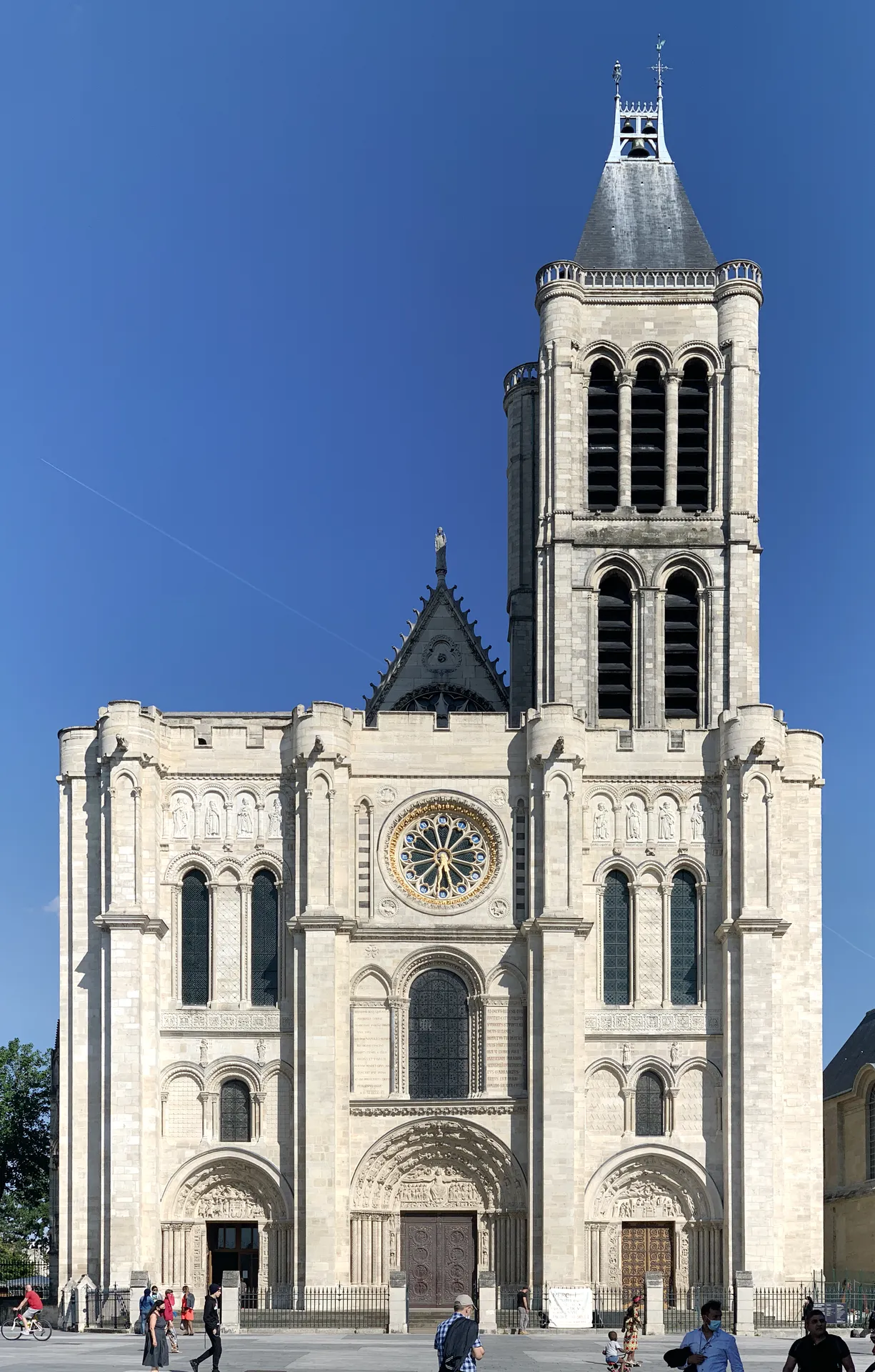
Abbot Suger, who led Saint-Denis from 1122 to 1151, was building more than a choir. Records and his own writings show a man trying to bind theology, monarchy, and the abbey's prestige into one radiant machine of light. According to the archaeology material, he even had himself represented kneeling on the facade, a small act of self-insertion that most visitors miss. Modest? Hardly. Effective? Completely.
The Spire That Vanished
The west front looks slightly wrong once you notice it: one tower complete in intention, the other absent for nearly two centuries. Lightning struck the north spire in 1837, storms in 1845 weakened it further, and demolition followed in 1846-1847. That missing half became part of the monument's identity, which is why the reconstruction launched with a foundation stone on 14 March 2025 matters so much. For the first time in around 180 years, Saint-Denis is regaining a skyline people had almost learned to treat as natural.
Tips for visitors
Active Cathedral
Saint-Denis is still a working cathedral, not a tomb warehouse with better lighting. No food and no smoking are posted rules, and if a service is under way, keep your voice low and your phone buried unless you want to feel every echo of your bad decision in the nave.
Photo Limits
Casual personal photos appear to be tolerated, but professional shoots need prior authorization, and the monument also bars photographing staff or visitors in identifiable form without consent. If your visit depends on tripods, drones, or staged shots, ask first rather than arguing later in a royal necropolis.
Daytime Only
The basilica itself is manageable by day, but the surrounding center works like a busy market-and-transit district, with the usual risks of phone snatching and distracted-wallet loss. Use the metro stop right by the monument, keep valuables out of sight near the station and market streets, and skip aimless wandering after dark unless you know the area.
Where To Eat
Café de la Fleche is the easiest stop and stays open beyond the visit route, good for a quick budget to low-mid-range pause in the Jardin Pierre-de-Montreuil. For a proper sit-down meal, the official site points to Marguerite Charlie and O'Grand Breton in the pedestrian center, both mid-range; if you want something nearby with more local flavor than royal grandeur, Les Arts does solid Moroccan-Mediterranean cooking a short walk away.
Best Visit Window
Tuesday to Sunday is the sweet spot because Monday gives you a reduced visit with the Fabrique de la Fleche closed. Early afternoon brings the best stained-glass light, but Friday or Sunday can feel noisier during festival or worship periods, so aim for a weekday morning if you want the tomb effigies in relative hush.
Pair The District
Don't flee back to central Paris the second you exit. Walk the 1.7-kilometer historic route toward the Stade de France, browse the center market if it's running, or add the Paul Eluard art and history museum nearby; the point of Saint-Denis lives outside the doors, where kings lie inside and market shoppers pass outside.
Where to Eat
local_dining
Don't Leave Without Trying
Saint-Denis does not have one documented signature local dish in the sources reviewed.Market produce and everyday shopping from the Marché de Saint-DenisNorth African dishes such as couscous and tagine, which are part of the area's restaurant mixCrêpes and galettesClassic brasserie cooking
Au Rendez-Vous
local favorite
Creperie and dessert cafe€€star4.9(769)
Order: Order a buckwheat galette, especially the salmon version, then follow with a sweet crepe. Reviews also single out the chai latte.
This feels like the kind of place people return to because the room has personality and the owner clearly cares. The reviews keep circling back to warmth, freshness, and crepes that taste made for someone rather than for a queue.
Cafe-restaurant with vegetarian-friendly lunch dishes€€star4.8(42)
Order: If you want a light lunch after the Basilica, go for one of the fresh vegetarian dishes reviewers mention.
The address does half the work here: you are right by the Basilica, which makes it the obvious pause point before or after a visit. The small review base is promising rather than loud, with praise for fresh cooking, good service, and vegetarian options that do not feel like an afterthought.
Order: The sausage starter is the dish with repeat-customer energy, and reviews also praise the roasted chicken, cheeseburger, pasta, and the mashed or roasted potatoes alongside.
This is the solid neighborhood brasserie pick: generous portions, fair prices, and staff who help you through the menu instead of performing Paris indifference. Nothing about it sounds staged, which is exactly the point.
Casual contemporary restaurant with pasta and comfort dishes€€star4.7(236)
Order: Get the truffle pasta. It is the one dish reviewers call out by name, and it is the safest bet.
This is the useful modern fallback when you want something easy, comfortable, and reasonably priced. Reviews are not spotless, which makes the strong praise for the staff and the better dishes more believable.
checkThe food story here is the market and the city's cross-cultural cooking, not a single named regional specialty.
checkMarché de Saint-Denis is the key food stop near the Basilica. Market days are Tuesday, Friday, and Sunday.
checkThe market hall and outdoor stalls may keep different hours, and published schedules conflict. Verify current times on saintdenis.fr before relying on them.
checkSunday is not a dead day here: it is a market day, so the center is busier than a typical French Sunday morning.
checkMonday is the weaker day around the Basilica quarter. Closures are more likely then.
checkPlan around French meal times: lunch runs roughly from 12:00 or 12:30 to 15:00, while dinner usually starts around 19:30.
checkThe gap between lunch and dinner is real. In mid-afternoon, expect cafes and continuous-service spots to be easier than full restaurants.
checkService is included in France, so tipping is optional. Rounding up or leaving small change is enough.
Food districts:Basilique de Saint-Denis and the centre-ville around Rue de la Légion d'HonneurMarché de Saint-Denis around Rue Gabriel-Péri and Place du 8-Mai-1945Avenue du Président Wilson for brasserie-style and casual restaurant options
Restaurant data powered by Google
Watch & Explore Basilica of Saint-Denis.
Explore Saint-Denis
Basilica Saint-Denis: The Royal Tombs that Were Opened and Destroyed During the French Revolution
Evelyn Edwards - Queen of the Castles3 min17K
Explore Saint-Denis
La nécropole des rois de France - Basilique de Saint-Denis
Nota Bene20 min403K
Frequently asked
Is Basilica of Saint-Denis worth visiting?
Yes, especially if Notre-Dame left you wanting the moment Gothic architecture first snaps into focus. Abbot Suger’s choir, consecrated in 1144, turns stone into light, and the royal necropolis holds more than 70 tombs and recumbent figures, so you move from colored glass overhead to centuries of French dynastic theater under your feet.
How long do you need at Basilica of Saint-Denis?
Plan on 1 hour 30 minutes for a solid visit. That matches the official guided visit and audioguide rhythm, but give yourself up to 2 hours if you want the crypt, the royal tombs, and the Fabrique de la Fleche without rushing past details like the open-eyed effigies and the cool, compressed air of the lower spaces.
How do I get to Basilica of Saint-Denis from Paris?
The easiest route from Paris is Metro Line 13 to Basilique de Saint-Denis. The station sits about 100 meters from the entrance, a walk shorter than a city block, though wheelchair users should know the station has no elevator and may find car drop-off or another route easier.
What is the best time to visit Basilica of Saint-Denis?
Late morning or early afternoon on a Tuesday to Sunday is your best window. You get the fullest visit then, including the Fabrique de la Fleche, and the chevet’s stained glass does its best work when the light is alive rather than flat, while summer also opens the medieval garden on select dates.
Can you visit Basilica of Saint-Denis for free?
Sometimes, but not as a rule. Free entry applies to visitors under 18, many 18 to 25 year olds in the EU or resident in France, some disability and education categories, and European Heritage Days on September 19-20, 2026, while the monument does not take part in the usual first-Sunday free scheme.
What should I not miss at Basilica of Saint-Denis?
Do not miss Suger's chevet, the royal recumbents, and the crypt ossuary. The chevet is where Gothic light stops being theory and becomes a physical thing, the tombs reward close looking with lions, dogs, and eyes fixed toward resurrection, and the crypt changes the whole visit by reminding you that many of the bodies were torn from their graves in 1793 and later gathered into an ossuary instead.
Sources & attribution8
Researched and written by the Audiala editorial team from historical records, architectural archives, and local expertise. Last updated July 2026.
Official Basilica History — Used for the basilica’s historical importance, royal necropolis role, and core chronology.
Saved and recently read places — kept on this device only.
Photo credits (8)
Basilica of Saint Denis, Saint Denis, France — Ninaras — CC BY-SA 4.0 (https://creativecommons.org/licenses/by-sa/4.0/) — Source: https://commons.wikimedia.org/wiki/File:Basilica_of_Saint_Denis,_Saint_Denis,_France.jpg
Basilica of Saint Denis North Transept Rose Window, Paris, France - Diliff — Diliff — CC BY-SA 3.0 (https://creativecommons.org/licenses/by-sa/3.0/) — Source: https://commons.wikimedia.org/wiki/File:Basilica_of_Saint_Denis_North_Transept_Rose_Window,_Paris,_France_-_Diliff.jpg
Basilica of Saint Denis, Saint Denis, France 02 — Ninaras — CC BY-SA 4.0 (https://creativecommons.org/licenses/by-sa/4.0/) — Source: https://commons.wikimedia.org/wiki/File:Basilica_of_Saint_Denis,_Saint_Denis,_France_02.jpg
Basilica of Saint Denis, Saint Denis, France 03 — Ninaras — CC BY-SA 4.0 (https://creativecommons.org/licenses/by-sa/4.0/) — Source: https://commons.wikimedia.org/wiki/File:Basilica_of_Saint_Denis,_Saint_Denis,_France_03.jpg
Dagobert — Cgoodwin — CC BY 3.0 (https://creativecommons.org/licenses/by/3.0/) — Source: https://commons.wikimedia.org/wiki/File:Dagobert.jpg
Basilique St Denis façade ouest St Denis Seine St Denis 20 — Chabe01 — CC BY-SA 4.0 (https://creativecommons.org/licenses/by-sa/4.0/) — Source: https://commons.wikimedia.org/wiki/File:Basilique_St_Denis_façade_ouest_St_Denis_Seine_St_Denis_20.jpg
Strictly necessary cookies keep the site working. Analytics (PostHog, Google Analytics) measures how each visitor uses our pages. Marketing loads YouTube videos and walking-route maps without a tap and lets Google Analytics set advertising cookies. We never sell your data. You can change this any time from the footer.
Analytics and marketing cookies are optional and only load if you agree. Details under Customize.
Privacy
Cookie preferences
Pick what you're okay with. You can change this any time from the footer.
Strictly necessary
Always on
Sign-in, language, navigation. Always on.
Product analytics
PostHog (EU) and Google Analytics record which pages you view and how you use them, under a random identifier stored in your browser. Helps us see which pages work and which need fixing. Google's ad personalisation stays off. No selling.
Marketing
Loads YouTube videos and the walking-route maps (OpenFreeMap) without a tap; without it, they load only when you tap them. If analytics is also on, Google Analytics may set advertising cookies. Ad personalisation stays off.