

Place
France Updated Jul 2026
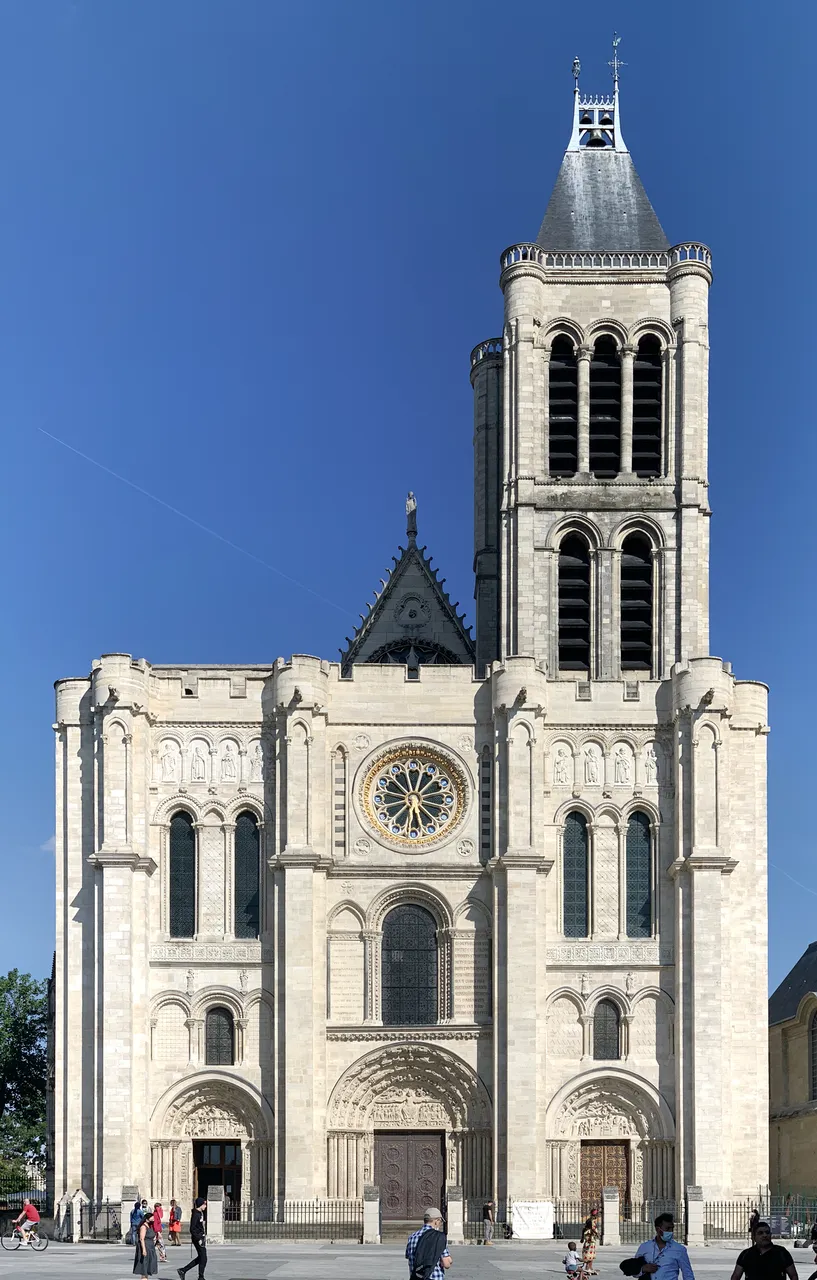
Church bells, market vendors, and the rumble of RER trains share the same air in Saint-Denis, France, and that mix tells you almost everything. One minute you are standing before the west facade of the Basilique-Cathedrale de Saint-Denis, where French kings and queens lie under carved stone canopies; ten minutes later you are buying mint, cassava, and phone chargers in the largest market in the Paris region. Paris feels close. Saint-Denis feels different.
 Photo: Claude Shoshany · CC BY 2.5
Built from cited sources · see the method · How we make our guides →
The surprise here is scale. Abbot Suger rebuilt the abbey church in the 12th century with the pointed arches, rib vaults, and flood of light that helped shape Gothic architecture across Europe, yet the town around it never turned into a polished museum set. Life crowds in at full volume: Tuesday, Friday, and Sunday market days around Place Jean-Jaures and Place du 8-Mai-1945, schoolchildren on the parvis, the smell of grilled chicken and coriander drifting off side streets.
Saint-Denis carries French royal memory in one hand and contemporary France in the other. The basilica holds more than 70 royal tombs, including Louis XVI and Marie-Antoinette, while the streets beyond it speak in dozens of accents and eat across continents. You feel that most clearly in the centre, where a medieval pilgrimage stop became a working-class suburb, then a city shaped again by the 1998 World Cup and the 2024 Olympics.
Come here for the basilica, certainly, but stay long enough to see the rest of the argument. The canal has turned into a 5-kilometre open-air wall of street art, Le 6b fills an old industrial building with studios and parties, and the Stade de France still casts its giant ring over La Plaine like a piece of national theatre. Saint-Denis changes your sense of what a Paris suburb can hold.
Not every monument, just the ones we'd walk you past ourselves.
Where to wander, by quarter — each with its own rhythm.
Before you go
Curated from places in this city. Same price as official sites.
Prices shown are indicative — final pricing and availability are confirmed at checkout. Audiala may receive a commission from bookings made via these links.
From a martyr's grave north of Paris to a city of factories, football, and Olympic afterlives
Long before abbots and kings, this patch of plain already held the dead. Excavations uncovered a Neolithic burial here, which means Saint-Denis began not as a suburb of Paris but as a place people considered worth returning to, generation after generation.
Tradition holds that Denis, the first bishop of Paris, was martyred and buried here after his execution. Legend later gave him the habit of walking while carrying his severed head; archaeology is less theatrical, but it does point to an early Christian burial focus at the site. The city took his name, which is no small inheritance.
Between 460 and 480, builders raised the first known church above Denis's grave, reusing carved Roman stone like a city making a new religion out of old masonry. Most scholars place it in these years, and tradition attributes the act to Sainte Genevieve. Either way, the site stopped being a cemetery and became a destination.
King Dagobert I was buried at Saint-Denis, turning a holy shrine into the burial ground of power. That single coffin changed the city's future. From then on, the road to French monarchy ran through the abbey choir, past incense, candle smoke, and stone effigies.
On 24 February 775, Charlemagne attended the dedication of a rebuilt basilica at Saint-Denis. The ceremony tied the abbey even more tightly to royal ritual and imperial ambition. What had been sacred ground became one of the kingdom's political stages.
Charles the Bald ordered a defensive enclosure around Saint-Denis as Viking raids shook the region. The move tells you what the abbey had become: wealthy enough to attract attack, important enough to defend. Prayer alone was no longer considered a strategy.
Louis VI took the red war banner, the oriflamme, from Saint-Denis before facing imperial threat. That gesture mattered because banners are never just cloth. Saint-Denis became the place where French kings wrapped war in sanctity.
Abbot Suger began remaking the western front of the abbey with three portals and a rose window, then pushed the choir toward something Europe had not yet seen. He wanted height, glass, procession, radiance. The result was less a renovation than a new way of thinking in stone.
On 11 June 1144, Suger's new choir was consecrated in the presence of the king. Pointed arches, rib vaults, and flying buttresses worked together to pull walls open for stained glass and colored light. Stand inside on a gray day and you still feel the argument: more height, more light, more heaven.
Under Louis IX, Saint-Denis was formally confirmed as the royal necropolis of France. Tombs were reorganized, sculpted effigies multiplied, and the abbey became a stone genealogy of the monarchy. Few places in Europe carried so much dynastic memory under one roof.
During the Hundred Years' War, Saint-Denis built new walls against English attack. By then it was no longer only an abbey with a village nearby; it was a substantial town with markets, workshops, and enough wealth to fear for. Stone ramparts usually mean prosperity had become vulnerable.
On 10 November 1567, Catholic and Protestant forces clashed at Saint-Denis during the Wars of Religion. Arquebus fire tore through the field, cavalry crashed in, and the aged constable Anne de Montmorency was fatally shot. The royal shrine of French unity had become a battlefield of French fracture.
Henri IV renounced Protestantism at Saint-Denis on 25 July 1593 to claim Paris and stabilize the crown. The choice of place was deliberate and sharp. If you wanted to make a king look legitimate in France, this was the room.
Revolutionary authorities ordered the royal graves destroyed and the town itself was renamed Franciade. Coffins were broken open for lead, bodies hauled out, and more than 170 sets of remains thrown into mass pits. Few scenes capture the French Revolution more coldly than this one: monarchy reduced to salvage material.
On 15 December 1805, Napoleon established a school of the Legion of Honour in the former abbey buildings for daughters of decorated servicemen. The shift was radical. Rooms that had once housed monks and royal ritual now held lessons, uniforms, and the scratch of pens on desks.
The opening of the Canal Saint-Denis linked the town more efficiently to the Seine and to Parisian commerce. Factories followed: chemical works, metallurgy, rail infrastructure, smoke. The air changed first, then the skyline, then the class politics.
After storm damage and structural fears, the basilica's north tower and spire were dismantled in 1846. Saint-Denis lost the vertical accent that had defined its silhouette for centuries. The façade looked abruptly unfinished, like a sentence cut off mid-clause.
Socialists won the municipal elections in May 1892, giving Saint-Denis the political identity that would cling to it for decades: la ville rouge. This was a workers' town by then, forged by factories and rent, not court ceremony. The old royal necropolis now belonged to the industrial left. France can be that ironic.
Paul Eluard was born in Saint-Denis on 14 December 1895, at 46 boulevard de Chateaudun, now boulevard Jules-Guesde. He would become one of the central poets of Surrealism, but his origin matters: he came from this northern belt of workers, traffic, and hard edges. Saint-Denis gave him the ground note before Paris gave him the movement.
Jacques Doriot became mayor in 1930 as a communist strongman of the red suburb. Then he veered toward fascism, founded the Parti populaire français in 1936, and turned Saint-Denis into one of the grimmer laboratories of French political violence. Cities remember betrayals longer than slogans.
Allied bombing in April and summer 1944 hit La Plaine Saint-Denis hard, killing civilians and smashing working-class streets in the approach to liberation. Then, between 25 and 28 August, FFI fighters and Leclerc's 2nd Armoured Division fought through the city and freed it. Saint-Denis paid in rubble before it could celebrate in flags.
Built for the 1998 World Cup, the Stade de France announced a different Saint-Denis to the world. Its designers sank the pitch and stands 11 meters below the forecourt so the structure would not rise above the basilica, which is the sort of urban compromise France occasionally gets right. On 12 July 1998, when France won the World Cup here, the city stepped into a new national myth.
On 13 November 2015, suicide bombers attacked outside the Stade de France during the France-Germany match, pulling Saint-Denis into one of the darkest nights in recent French history. Five days later, a police raid on rue du Corbillon shook the city again with gunfire, explosions, and thousands of rounds fired. The place that held royal tombs and World Cup euphoria now carried another kind of memory.
For the Paris 2024 Olympics and Paralympics, Saint-Denis hosted athletics and ceremonies at the Stade de France while the new Aquatics Centre opened beside it with a broad timber roof and a promise of neighborhood use after the cameras left. The Olympic Village spread across Saint-Denis and its neighbors, bringing cranes, security cordons, and a strange temporary gloss. Beneath it all, the basilica remained where it had always been, older than every spectacle and still setting the line of the horizon.
On 14 March 2025, the foundation stone was laid for the reconstruction of the basilica's lost north tower and spire, nearly 179 years after dismantling. The project aims to restore a skyline broken since 1846 and to do it in public view, with craft and construction treated as part of the story. Saint-Denis has always known how to build memory out loud.
Abbot and royal adviser · c. 1081–1151
Led the Abbey of Saint-Denis
Suger rebuilt the abbey church with light in mind, not just power, and that decision changed architecture across Europe. Stand under the vaults he imagined and you can feel his argument still working: stone should lift, not press down.
Poet · 1895–1952
Born here
Éluard was born in Saint-Denis before he became one of the great Surrealist and Resistance poets. The city keeps him close in its museum, which feels right; his writing had that same mix of tenderness and hard edges you still find in the streets here.
Carmelite nun and princess · 1737–1787
Lived in the Carmelite convent in Saint-Denis
Louis XV's youngest daughter left court life and withdrew to the Carmelite convent that now houses the Paul Eluard Museum. She traded Versailles silk for convent walls; Saint-Denis still suits that sort of reversal, where grandeur and austerity keep sharing the same address.
Where locals actually book dinner — not the tourist menus.
Small things that change how the city treats you.
The city, as it actually looks.
Yes, especially if you care about architecture, French history, or places that still feel like real cities instead of stage sets. The basilica changed European church design in the 12th century, and the market, canal murals, and stadium district give the day more texture than a single monument stop.
One full day is enough for the essentials. Give the basilica two hours if you like tomb sculpture, then add the market, canal walk, Paul Eluard Museum, or a stadium tour depending on your mood.
The quickest route depends on which part of Saint-Denis you want. Line 13 reaches Basilique de Saint-Denis and Porte de Paris, line 14 reaches Saint-Denis Pleyel, and RER D or RER B works better for the station and Stade de France side.
Orly is now unusually easy because metro line 14 runs direct to Saint-Denis Pleyel in about 40 minutes. From CDG, RER B is best for La Plaine-Stade de France, while Beauvais has a direct A02 airport coach to Saint-Denis Université.
Mostly yes in daylight, with the same pickpocket habits you would use in Paris. After dark, the bigger transport hubs and stadium areas need more caution, especially when the streets empty out or a match crowd spills through at once.
No, not by Paris standards. Transport is cheap with a Navigo card, the market is one of the better places to eat without paying central-Paris prices, and several of the city's pleasures are walks: the canal, street art, and the old center.
Saint-Denis is famous for the Basilica-Cathedral of Saint-Denis, the burial place of French kings and queens and one of the first true Gothic buildings. It is also known for Stade de France, the vast regional market, and a canal edge covered in contemporary murals.
Start with the basilica, then choose between three very different moods: the royal tombs, the 220-stall market, or the Stade de France and Olympic district. If you have extra time, walk Street Art Avenue or visit the Paul Eluard Museum in the old Carmelite convent.
Saved and recently read places — kept on this device only.
Photos may have been resized or cropped.