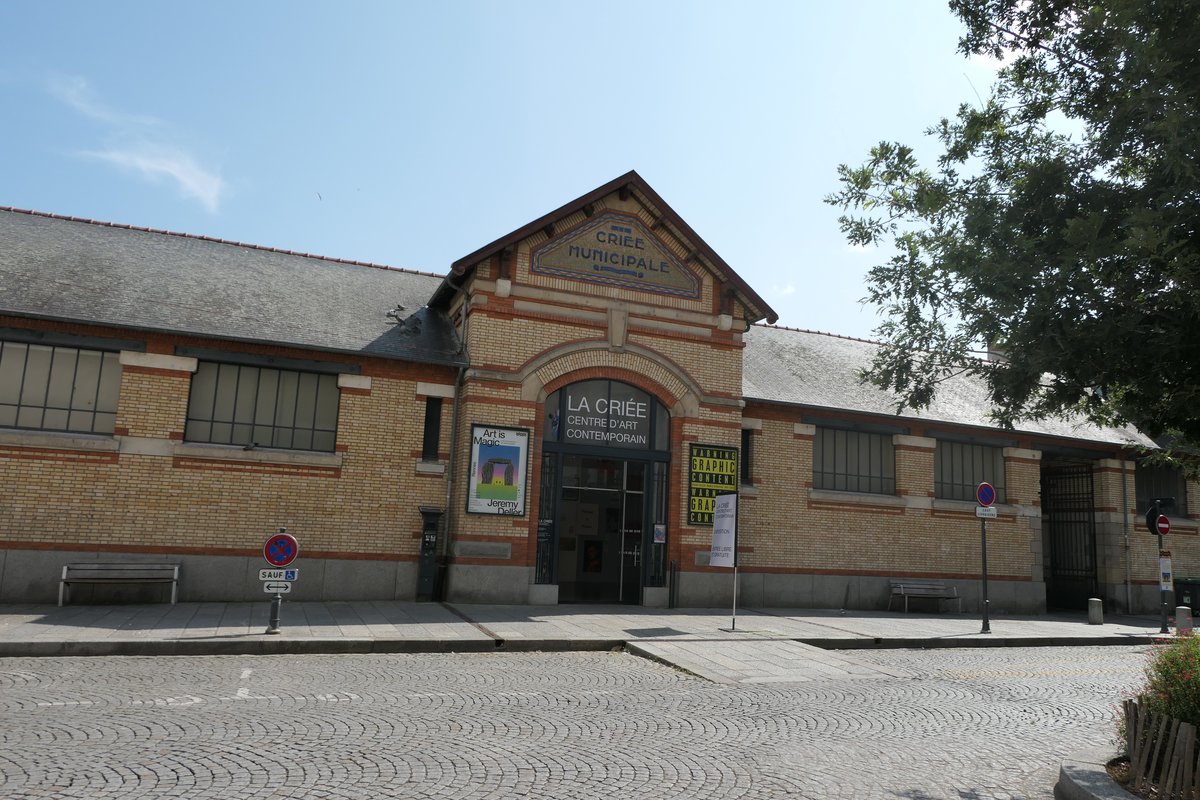
The blue letters above the door still spell out "Criée municipale" — fish market — but no fish has been sold here since the 1960s. Step inside the northern hall of Rennes's Halles Centrales, in Brittany, France, and you find white walls hung with the work of living artists instead of crates of mackerel on ice. La Criée centre d'art contemporain trades on that contradiction: a free art space wearing the skin of a covered market, where the architecture remembers a job it no longer does.
The building is the work of Emmanuel Le Ray, Rennes's city architect, who broke ground in 1913 and watched a world war stop everything cold. Construction resumed in 1920. The doors opened to merchants on 29 April 1923, though the finishing work dragged on until 1926.
Today only the northern hall belongs to art. The rest of the Halles became a food market again — rebranded "La Criée – Marché Central" in 2018 — so the name does double duty across one roof. The art center sits inside, admission free, and since 2018 it has carried the French Ministry of Culture's label of "centre d'art contemporain d'intérêt national."
Come for the shows, which change with the seasons. Stay for the strange overlap of a 1920s auction hall and contemporary work that has nothing to do with fish — except the room it stands in.
Researched by the Audiala editorial team from historical records, architectural archives, and local expertise.
What to see
The Art Center Inside the Fish Hall
Walk under the geometric blue lettering that still spells "Criée municipale" and you enter a room that smelled of fish until the 1960s. Emmanuel Le Ray, Rennes' city architect, raised this northern hall between 1913 and 1923, paused by the First World War, and merchants auctioned their catch beneath its iron ribs for four decades. Since 1986 it shows contemporary art instead, free of charge. The conversion kept the bones — the wide-span hall, the light pouring through high glazing — so a single installation can breathe across a volume built for noise and ice and shouting buyers.
Le Ray's Halles Centrales Architecture
Step back across the square and look at the whole building, not just the art. Le Ray designed it as a modern, hygienic market to replace the old grain hall, and the 1923 inauguration gave Rennes one of its first reinforced-concrete-and-steel civic structures. The pediment, the blue lettering, the rhythm of the bays — all of it earned a "Patrimoine du XXe siècle" label in June 2000. Half the building now feeds the city as a covered food market; the other half feeds the eye. Same roof, two appetites.
Through the Halles and Out into Rennes
Give yourself an hour. See the current show inside La Criée, then cross into the market hall next door for oysters and Breton butter, and carry both out into the medieval streets toward Place des Lices. The art center changes its exhibitions in thematic seasons under director Sophie Kaplan, so what you saw last spring won't be there this one — check before you go. Free entry means you can drop in twice in a day. Most people don't realize the two halves were once a single fish auction.
Plan your visit
Getting There
Place Honoré Commeurec, behind place de la République in the dead center of Rennes. Métro line A drops you at République, a 200-metre walk; line B stops at Colombier, a few minutes more. Buses C5 and C6 halt right outside at the stop named "La Criée," and there's a STAR bike-share dock at the door.
Opening Hours
As of 2026, the art center opens Tuesday to Sunday, 1pm to 7pm, closed Mondays and on 1 January, 1 May, and 25 December. The hall has no air conditioning, so it can shut during summer heatwaves. Between shows it closes entirely for install and teardown, so check la-criee.org before you set out.
Time Needed
It's one ground-level hall with a single rotating exhibition. A quick look runs 15 to 25 minutes; linger over the work and it's 30 to 45. Pair it with the food market under the same roof or place de la République for a fuller afternoon.
Cost & Tickets
Free. Always, no ticket, no booking, no queue, since it's a single hall that never backs up. Guided visits, family workshops, and artist talks are free too; for a group or guided tour, call ahead on 02 23 62 25 10.
Accessibility
The whole exhibition sits on one flat, ground-level floor, so it's wheelchair accessible with no stairs, ramps, or elevators to manage. Parking at the building itself is tight, with about 32 open-air spaces at €0.70 per 15 minutes; the larger Colombier and Vilaine car parks sit a short walk away.
History
The Hall That Stopped Selling Fish
Before the concrete, there was grain. A halle aux grains stood on this site and had been pressed into service for fish sales, and records show the municipality wanted something modern and hygienic to replace it. Le Ray delivered the Halles Centrales over a span that ran, on and off, from 1913 to 1926.
The wholesale auction — fish first, then fruit and vegetables — ran for decades. According to the center's own history, the gavel fell for the last time in the 1960s. The hall went quiet. What do you do with a market that no longer has a trade?
The turning point
Catherine Elkar and the Year the Walls Changed Hands
The northern hall reopened as a contemporary art venue in 1986, run at first as an association under director Yannick Miloux, who filled it with monographic shows of established names. Useful, respectable — and, for a city wanting more, not quite enough. The arrangement had a ceiling.
Then in 1996 Frac Bretagne, directed by Catherine Elkar, took over the management of the place. For Elkar this was the moment of consolidation: a loose association became an institution with a regional collection's weight behind it. Three years later, in 1999, the city formally established it as "La Criée centre d'art contemporain," a facility of the City of Rennes. The fish hall now had a name that admitted what it had become.
The line that followed — Larys Frogier from 1999 to 2011 building international partnerships and artist production, then Sophie Kaplan from September 2012 with her thematic "seasons" and residencies — flows from that handover. The director chronology here rests on the center's own account, so treat the exact dates as its telling rather than independently confirmed.
A Name in Geometric Blue
Look up at the pediment before you go in. The words "Criée municipale" are still set into the facade in blocky blue lettering, geometric and confident, a piece of 1920s municipal pride that nobody bothered to remove. On 20 June 2000 the building earned the "Patrimoine du XXe siècle" heritage label, recognition that Le Ray's market was itself worth keeping — letters and all.
One Roof, Two Lives
Visitors often assume the whole building is the art center. It isn't. Only the northern hall shows art; the rest returned to its market vocation and was rebranded "La Criée – Marché Central" in 2018. So the same name now covers an art space and a food market under one roof — free admission on the art side, stalls and produce on the other. Easy to confuse, worth getting right.
Tips for visitors
Two Things, One Roof
"La Criée" names both the free contemporary art center in the north hall and the food market that fills the rest of the 1920s building. Locals usually mean the market; the art crowd means the gallery. They share the address but run separately.
Galette-Saucisse Ritual
The sacred Rennais street food is a grilled sausage rolled in a cold buckwheat galette, eaten by hand, plain or with caramelized onions as tradition dictates. Find it at the market stalls Saturday morning until 1pm. It's also the snack of choice at Stade Rennais matches.
Lices Beats It For Buzz
For market atmosphere, locals rank the Saturday Marché des Lices on place des Lices, running since 1622, well above the Halles. Treat La Criée as the everyday covered option and the art stop; save Les Lices for the Saturday crowds and the best galette-saucisse.
Odorico Mosaics Overhead
WikiRennes credits the building's polychrome ceramics to the Odorico workshop of mosaicist Isidore Odorico, a genuine local-pride detail most guidebooks skip. Look up before you look at the art.
Photography Etiquette
The gallery publishes no formal photo rules, but standard art-space manners apply: no flash near the works. Some shows restrict shooting, so ask staff before you start.
Skip Peak Heat
With no air conditioning, the hall can close on the hottest summer days. Visit in the morning shoulder of the 1pm–7pm window, or aim for spring and autumn for the surest open doors.
Apéro Nearby
Bar Expo at 2 rue Jules Simon does apéro boards, burgers, and DJ nights a step from the halls (budget–mid). Walk a few minutes to rue Saint-Michel, nicknamed "rue de la Soif," for a dense run of bars and crêperies.
The Real Catch Is Price
The neighborhood is central and safe; keep normal big-city pickpocket awareness around the République transit hub on market days. The honest local gripe isn't crime but cost: market prices run high in holiday periods, so buy quality goods here, not a cheap snack.
Where to Eat
local_dining
Don't Leave Without Trying
Galette-saucisse — grilled pork sausage in buckwheat galette, iconic Rennes street food from market stallsCrêpes (sweet) and galettes (savory) — core Breton dishes, often paired with cidreCidre (traditional cider) — served in bowls or cups, classic pairing with galettesCoucou de Rennes — local heritage hen breed, prized for poultry dishesBreton seafood — oysters, mussels, Atlantic catches, salted-butter caramel
La Crique - Restaurant, produits de la mer et huitres
fine dining
Seafood & Oyster Bar€€star4.9(307)
Order: Cancale oysters and the oyster shot — fresh, briny, iconic. Mussels and black cod ceviche are equally exceptional.
Hidden gem run by Nicolas and his chef wife with genuine passion. Fresh Breton oysters sourced with deep knowledge, warm hospitality, impeccable execution — every visit feels personal.
Natural Wine Bar & French Contemporary€€star4.8(761)
Order: Duck with delicate leeks; finish with pistachio dessert. Wines thoughtfully curated by the owner.
Natural wine bar with kitchen technique that matches the drinks list's care. Elegant without pretension, strong local following who trust the sourcing and execution.
Order: Starters are standout — visitors call them the best of a two-week French vacation. Changing seasonal menu cooked with evident care.
Charming, rustic terrace facing a small church. Quick, friendly service and divine food at moderate prices — locals eat here when they want something special without fuss.
Order: Daily plat du jour is unbeatable value — haddock called 'the best I have ever eaten' at €15. Careful presentation and technique throughout.
Stylish yet approachable, set on Place des Lices at the heart of the Saturday market zone. Elegant without pretension; fine-dining care meets family-friendly warmth and real value.
checkMarché des Lices on Saturday mornings (7:30–13:30) is galette-saucisse central and peak local life — steps from La Criée.
checkLunch strict: 12:00–14:00. Dinner opens ~19:30–20:00. Dead zone 2–7 PM at most places.
checkMany restaurants closed Sunday and Monday — check ahead; options are sparse.
checkService included by law. Tipping not mandatory; round up or leave a few euros for excellent service.
checkCard primary, contactless common. Carry cash for markets and small crêperies.
checkBook dinner 2–6 weeks ahead for popular spots; lunch easier a few days before.
Food districts:Place des Lices / La Criée — Saturday market hub, galette-saucisse vendors, covered-hall food shoppingPlace Sainte-Anne — half-timbered buildings ringed with bars, cafés, restaurants, big terracesRue Saint-Michel (Rue de la Soif) — 13+ bars in high density, lively evening drinksRue Saint-Georges — pedestrian cobbled street near Parliament of Brittany, restaurants and crêperies
Restaurant data powered by Google
Frequently asked
Is La Criée in Rennes worth visiting?
Yes, if you like contemporary art and free entry — it's a single rotating exhibition hall, not a sprawling museum. La Criée centre d'art contemporain has occupied the north hall of Rennes' 1920s covered market since 1986, earning the Ministry of Culture's "centre d'art contemporain d'intérêt national" label in 2018. Pair it with the food market in the same building and you've got a half-hour of art plus oysters and galette-saucisse next door.
How long do you need at La Criée?
Plan 15 to 25 minutes for a quick look, 30 to 45 if you read everything. It's one ground-floor hall showing a single rotating exhibition, so you won't get lost. Build the rest of your outing around the food market and place de la République a few steps away.
Is La Criée free to visit?
Yes — entry is always free, no ticket and no booking. Guided visits, family workshops, and artist talks cost nothing either, though group or guided visits should be booked ahead on 02 23 62 25 10. There's never a queue; it's a single hall.
What are the opening hours of La Criée Rennes?
Tuesday to Sunday, 1pm to 7pm, closed Mondays. It also shuts on 1 January, 1 May, and 25 December. Two catches: the building has no air conditioning and may close during heatwaves, and it closes between shows for install — so check la-criee.org that an exhibition is actually running before you go.
How do I get to La Criée from Rennes city center?
Take métro line A to République, about a 200-metre walk, or line B to Colombier. The address is Place Honoré Commeurec, central and flat, roughly 3 minutes on foot from place de la République. Buses C5 and C6 stop right at "La Criée," and there's a STAR bike station at the door.
What's the difference between La Criée art center and La Criée market?
Same 1920s building, two separate occupants — locals usually mean the food market when they say "la Criée." The art center is the free contemporary-art hall on the north side since 1986; "La Criée – Marché Central" is the food market rebranded in 2018, with around 28 stalls selling fish, cheese, oysters, and crêpes. The pediment still reads "Criée municipale," but the fish auction it names ended back in the 1960s.
What should I not miss at La Criée?
Look up at the polychrome ceramics and mosaics, credited to the Odorico workshop, Rennes' famed mosaicists, then catch the galette-saucisse stand at the market — a grilled sausage in a cold buckwheat galette, eaten by hand. Time your visit for the Marché à Manger food event on the first Sunday of the month, or "Les Snackés" apéro on the third Friday. For market buzz, locals still rank the Saturday Marché des Lices, running since 1622, above this one.
Sources & attribution12
Researched and written by the Audiala editorial team from historical records, architectural archives, and local expertise. Last updated May 2026.
Strictly necessary cookies keep the site working. Analytics (PostHog, Google Analytics) measures how each visitor uses our pages. Marketing loads YouTube videos and walking-route maps without a tap and lets Google Analytics set advertising cookies. We never sell your data. You can change this any time from the footer.
Analytics and marketing cookies are optional and only load if you agree. Details under Customize.
Privacy
Cookie preferences
Pick what you're okay with. You can change this any time from the footer.
Strictly necessary
Always on
Sign-in, language, navigation. Always on.
Product analytics
PostHog (EU) and Google Analytics record which pages you view and how you use them, under a random identifier stored in your browser. Helps us see which pages work and which need fixing. Google's ad personalisation stays off. No selling.
Marketing
Loads YouTube videos and the walking-route maps (OpenFreeMap) without a tap; without it, they load only when you tap them. If analytics is also on, Google Analytics may set advertising cookies. Ad personalisation stays off.