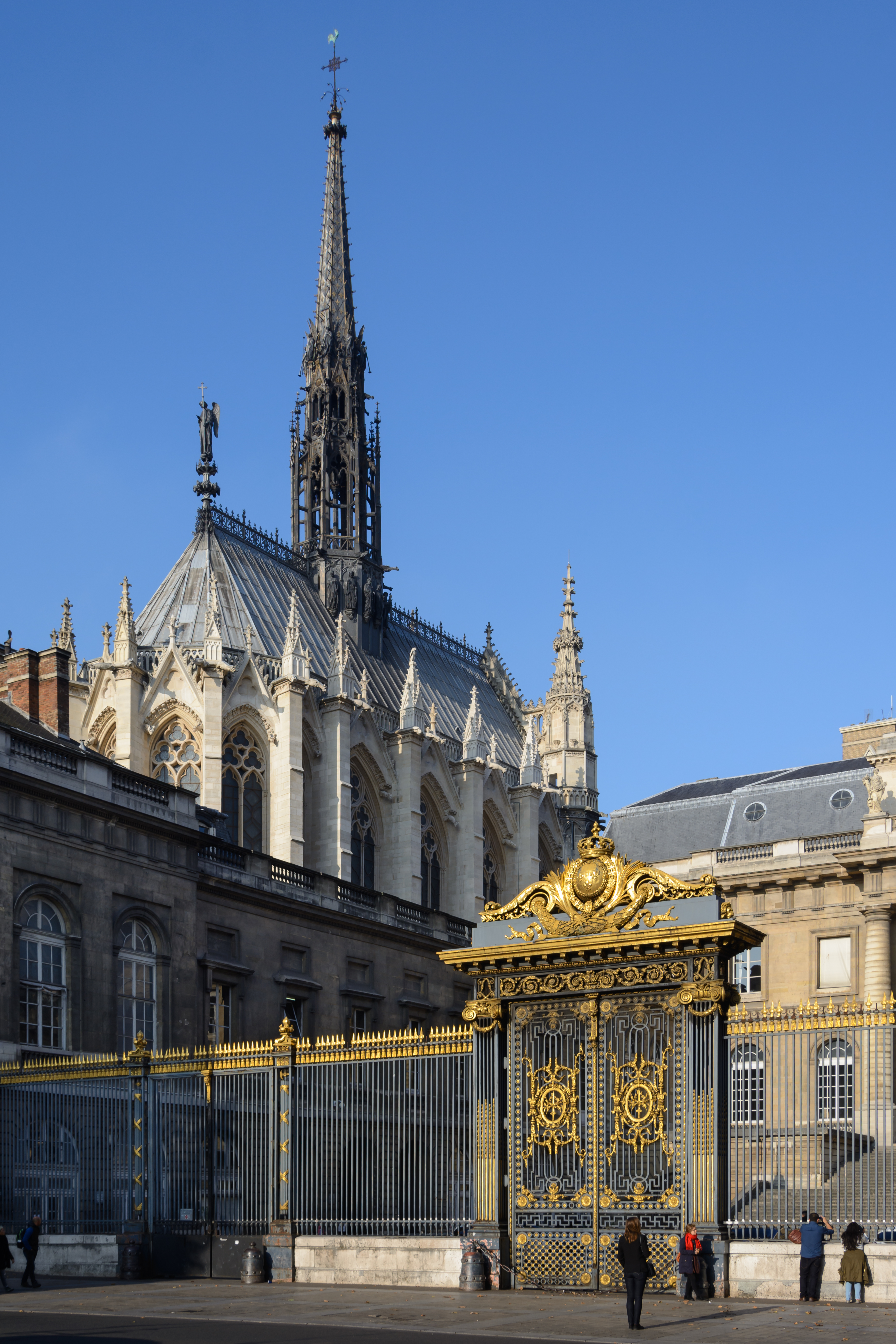
An introduction.
Researched by the Audiala editorial team from historical records, architectural archives, and local expertise.
WWhy would a king bankrupt his treasury to buy a circle of dried thorns? In 1239, Louis IX paid 135,000 livres tournois for the Crown of Thorns — roughly half his annual revenue, and more than three times what it cost to build the chapel meant to house it. Step inside the Sainte-Chapelle on the Île de la Cité in Paris, France today and you stand in the answer: 600 square metres of 13th-century stained glass climbing fifteen metres to a vault painted deep blue with gold stars, the whole upper chapel built as a single jewelled reliquary around an empty platform.
The relic is gone. It was moved to Notre-Dame de Paris in 1806, and the silver-gilt Grande Châsse that held it — itself worth 100,000 livres — was melted for bullion in the Revolution. What remains is the architecture of devotion without the object of devotion. A box without its diamond.
And yet the box is the point. Walk up the cramped spiral stair from the lower chapel, where palace servants once heard Mass, into the upper chapel reserved for the king and his court, and the building does what Louis paid for it to do: it stops you. Light pours through 1,113 figures of glass — Genesis, Exodus, the Passion, the relics' own arrival in Paris — and the stone reduces to almost nothing. Records show the master builder's name was already lost by the 16th century.
Plan thirty minutes minimum, an hour if the sun is high. Combine with a slow walk to Notre-Dame ten minutes east, where the Crown itself now lives — together they tell one story across two buildings.
01 What to see.
The Upper Chapel — 1,113 stained-glass scenes, 15 lancets of cobalt and ruby
Climb the tight spiral stair from the dim lower chapel and the room above hits like a struck bell. Fifteen lancets, each about 15 metres tall, dissolve the walls into 1,113 biblical scenes — roughly two-thirds of the glass is original 13th-century, set in 1248. The stone is barely there. Hidden iron tie-chains thread through the masonry at window-springing height, taking the thrust so the architects could shrink the walls to skeletal mullions and let the glass do the work.
Read the windows the way the medieval audience did: bottom to top, snaking left-right then right-left, the narrative climbing toward heaven. The dominant cobalt and ruby throw colored shapes that drift across the opposite wall minute by minute as the sun moves. Late morning lights the south side; come back after 4pm and the west rose takes over.
Look for the Relics Bay window behind the eastern tribune — most visitors face it without reading it. It shows Louis IX in August 1239, barefoot in a penitent's robe, carrying the Crown of Thorns into Paris after paying Baldwin II's Venetian creditors 135,000 livres tournois. The chapel itself cost 40,000. The reliquary that held the crown cost 100,000. The building, in other words, was the cheaper container.
The Rose of the Apocalypse — flames frozen in 15th-century stone
The west rose is younger than the rest, added around 1485 under Charles VIII, and it shows. While the lancets are severe Rayonnant geometry, the rose is full Flamboyant — its 9-metre tracery shaped into licks of stone fire, curling like flames caught mid-flicker. Eighty-nine panels carry the Book of Revelation across it: the Lamb, the seven seals, the Whore of Babylon, the New Jerusalem.
Time your visit. Around 5pm on a clear afternoon, the dropping sun strikes the rose head-on and the stone flames literally burn red — the apocalypse window doing exactly what it was painted to do. Look low and right of the rose for Charles VIII's salamander emblem, a small flex of royal patronage tucked into the masonry. Then turn around and watch the colored light from the rose pool on the east apse, mixing with the cobalt from the lancets behind you. The whole chapel becomes a slow kaleidoscope.
Don't skip the Lower Chapel
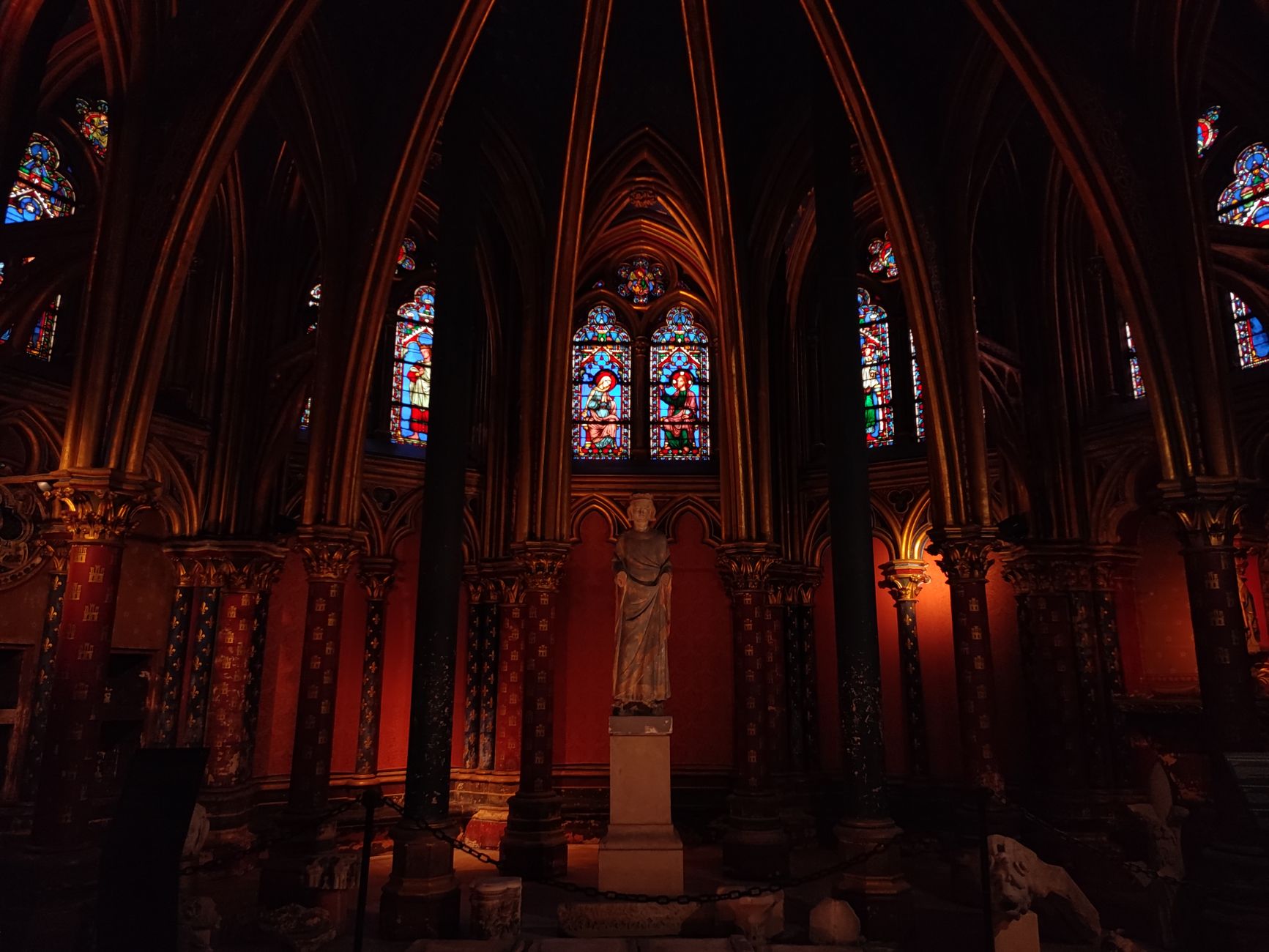
Almost everyone bolts up the stairs. Stay five minutes. The lower chapel was the staff and palace-servant church, and its low 6.6m vault is painted deep ultramarine with gold fleurs-de-lys and the Castile castles of Blanche of Castile, Louis IX's mother — a quiet name-check from a son who never forgot who put him on the throne at twelve. The 140 carved capitals are each a different plant: oak, ivy, vine, fern, maple. No two repeat. Walk the side aisles close enough to read them at eye level.
Look for the internal flying buttresses tucked against the walls — a structural sleight-of-hand that lets the upper chapel's glass-skin walls exist at all without external mass blocking the view. The compression here is the point. Cool, dim, low-ceilinged, almost crypt-like. Then climb the worn spiral treads and let the upper chapel detonate. Pair with a combined ticket to the Conciergerie next door, and walk ten minutes east afterwards to Notre-Dame de Paris, where the Crown of Thorns itself now lives — the relic that justified building all of this in the first place.
02 In pictures.


Plan and listen to Sainte-Chapelle with Audiala.
Audio guide in your pocket, itinerary in your browser. Built for the way you actually visit.
03 Visitor logistics.
The practical scaffolding for a good visit — kept short.
Getting There
Métro 4 to Cité drops you 100m from the door at 10 boulevard du Palais. RER B/C Saint-Michel–Notre-Dame is a 6-min walk across Pont Saint-Michel; from Notre-Dame it's 500m flat west along Île de la Cité. Driving is pointless — the island is mostly pedestrianized.
Opening Hours
As of 2026: 9:00–19:00 from 1 April to 30 September, 9:00–17:00 from 1 October to 31 March. Last admission 30 min before closing. Closed 1 January, 1 May, 25 December.
Time Needed
30–45 min for a quick look at lower and upper chapels — matches the booked 30-min slot. With the €3 audioguide and time to read the 1,113 stained-glass scenes, budget 60–90 min. Add 15–30 min for the courthouse security queue on busy days.
Cost & Tickets
New 2026 tariffs from 12 January: €22 individual non-EEA, €16 EEA resident. Combined ticket with the Conciergerie next door is €30/€23 — the smart buy if you're doing both. Free for under-18s, EU 18–25s, and the first Sunday of Jan, Feb, Mar, Nov, Dec only (not summer).
Accessibility
Disabled visitor + 1 companion enter free; book a slot anyway, they sell out. Lower chapel has a small ramp; upper chapel reached by a staff-escorted elevator in the adjacent building (capacity 2 wheelchairs). Plan a weekday — the lift's weekend availability is unreliable, and there are no dedicated accessible toilets on site.
05 Tips for visitors.
Small things that change the day.
Best Light
Skip the noon orthodoxy. Late afternoon is when the west-facing rose window throws its strongest color across the upper chapel walls — book the 16:00–17:00 slot in winter, later in summer.
Airport-Style Security
You're entering an active courthouse, so the screening is strict and items get confiscated permanently — knives, Swiss-army tools, scissors, glass bottles, aerosols, motorbike helmets, scooters. Leave anything sharp at the hotel or stash it via Nannybag/Bounce; there is no on-site cloakroom.
Photo Rules
Photography permitted, no flash. Tripods, monopods and selfie sticks are confiscated at security; drones are forbidden outright since the Palais de Justice sits in restricted Vigipirate airspace.
Pickpockets & Petition Scam
Île de la Cité, Châtelet and Saint-Michel RER are top pickpocket zones — crossbody bag, zipped, no phone in back pocket. Watch for young women with clipboards faking a deaf-mute charity petition near the entrance; walk straight past without engaging.
Eat Off The Island
Brasserie Les Deux Palais opposite the entrance is convenient (€20–35) but tourist-priced. For better value cross to Place Dauphine for Le Caveau du Palais (bistro, €35–55), or walk 10 min to Île Saint-Louis for a Berthillon scoop (€4–6) — making ice cream there since 1954.
Don't Skip Downstairs
Most visitors rush past the lower chapel to reach the glass. Linger — the starry blue vault overhead was the parish church for palace servants, and it's the colour you'll think about on the way home.
Book A Timed Slot
Walk-up entry is essentially impossible in season. Reserve a 30-min window on sainte-chapelle.fr, load the e-ticket before you arrive (signal inside the Palais is weak), and bring ID — police do random checks around the courthouse perimeter.
Where to Eat
Don't Leave Without Trying
Dining Tips
- check Service is included by law (15% service compris); tipping is not required, though rounding up or leaving 5-10% for exceptional service is appreciated.
- check Most traditional restaurants close between lunch (14:00-14:30) and dinner (19:30).
- check Many bistros and markets are closed on Sundays or Mondays; check hours in advance.
- check Cash is still king at market stalls and some smaller bistros, even if cards are widely accepted elsewhere.
- check Service tablet prompts for tips are common now, but locals often skip them or select 'autre' to leave a smaller cash tip.
Restaurant data powered by Google
04 A history of reinvention.
A Reliquary Mistaken for a Chapel
Records show construction began sometime after 1238 and the chapel was consecrated on 26 April 1248 — under seven years for a building that redefined what stone and glass could do. Louis IX, born 25 April 1214 at Poissy, had bought the Passion relics from Baldwin II of Courtenay, the Latin Emperor of Constantinople, who had pawned the Crown of Thorns to a Venetian banker named Niccolò Quirino. Louis bought the debt, then the relic. Pope Innocent IV declared that Christ had symbolically crowned the French king with His own crown.
Weeks after the consecration Louis sailed for the Seventh Crusade. He was captured at Mansurah in April 1250, ransomed for 400,000 livres tournois, and died of dysentery outside Tunis on 25 August 1270. He was canonized in 1297. The chapel survived him by five centuries before the Revolution emptied it, the 19th century rebuilt it, and the 21st century is still arguing about how much of what you see is real.
The Architect Who Wasn't There
For nearly four centuries, every guidebook named Pierre de Montreuil as the genius behind the Sainte-Chapelle. He was a documented royal mason, buried at Saint-Germain-des-Prés in March 1267, and the attribution felt right — the building's grace seemed to demand a named hand. Tourists still hear the name on tours.
But the attribution rests on a single 16th-century manuscript at the Bibliothèque nationale de France. The royal accounts for the 1240s — the documents that would have named the actual master — are lost. Modern scholars (the Musée de Cluny dossier is explicit: "l'identité de son architecte demeure à ce jour un mystère") have rejected Montreuil since the late 1990s. A 2018 paper called the attribution simply "généalogie d'une erreur."
Here is the revelation: the most influential Gothic architect in French history is anonymous. Whoever designed the upper chapel — possibly the same hand who built Louis's earlier chapel at Saint-Germain-en-Laye around 1238 — vanished from the record entirely. The building remembers him; no one else did. Once you know this, the chapel reads differently. The thinness of the walls, the audacity of replacing structure with light, the iron chains threaded through the stone to hold it all together — these aren't the signature of a celebrity. They're the work of someone who finished the job, was paid, and disappeared.
From Flour Store to National Laboratory
The West Rose Is Two Centuries Late
Listen to the full story in the app
The whole Sainte-Chapelle,
told well.
Audio guides for 1,100+ cities across 96 countries. History, stories, and local insight — offline ready.

06 Frequently asked.
The questions travellers send us most about Sainte-Chapelle.
Is Sainte-Chapelle worth visiting?
Yes — it holds 1,113 stained-glass scenes across 15 windows that turn 70% of the upper chapel walls into a cobalt-and-ruby light box. Most Parisians treat it as the anti-Notre-Dame: smaller, harder to find, more transcendent. Skip it only if you can't tolerate the airport-style security queue.
How long do you need at Sainte-Chapelle?
Budget 45 to 90 minutes inside, plus up to 30 minutes for security. A quick visit covers both chapels in 30–45 min; reading the windows panel by panel with the audioguide pushes it to 90. Pair it with the Conciergerie next door and you're at 2.5–3 hours total.
How do I get to Sainte-Chapelle from central Paris?
Take Metro line 4 to Cité station, about 100 metres from the entrance at 10 Boulevard du Palais. RER B or C to Saint-Michel–Notre-Dame works too — cross Pont Saint-Michel and you're there in five minutes. From Notre-Dame it's a flat 500-metre walk west along Île de la Cité.
What is the best time to visit Sainte-Chapelle?
Late afternoon on a sunny day, when the west-facing 1485 rose window catches the sinking sun and burns red across the nave. The 9:00 weekday opening or the last hour before closing keep crowds thinnest. Avoid summer midday — sun sits too high to strike the walls and the queue tops an hour.
Can you visit Sainte-Chapelle for free?
Yes, if you fit one of several categories: under 18s, EU residents aged 18–25, disabled visitors plus a companion, jobseekers, and ICOM cardholders all enter free. Everyone else pays €22 (€16 for EEA residents) under the tariffs effective 12 January 2026. The first Sunday of January, February, March, November and December is also free — but not in summer.
What should I not miss at Sainte-Chapelle?
The upper chapel's east-facing apse with its seven 15-metre lancets is the obvious one — stand centre nave, facing the altar. Don't skip the lower chapel: its starry blue vault painted with gold fleurs-de-lys and 140 hand-carved capitals (no two alike) is locally rated higher than guidebooks suggest. Look for the small grille-screened oratory on the upper chapel's south side, where Louis XI hid to attend Mass unseen after 1471.
Is the Crown of Thorns still at Sainte-Chapelle?
No — Napoleon moved it to Notre-Dame's treasury in 1806, and after firefighters rescued it from the 2019 fire it now sits in a new Sylvain Dubuisson reliquary inside the reopened cathedral. Public veneration runs every Friday 3pm–6:30pm. Sainte-Chapelle today holds zero relics; the silver Grande-Châsse that once cost 100,000 livres was melted down in the Revolution.
Do you need to book Sainte-Chapelle in advance?
Yes — entry is by 30-minute timed slot and slots regularly sell out, especially since Notre-Dame reopened in December 2024 and visitor traffic to Île de la Cité surged. Book through the Centre des Monuments Nationaux site or a combined ticket with the Conciergerie (€30). Load your e-ticket before arrival — phone signal inside the Palais de Justice is patchy.
Verified, and shown.
Researched and written by the Audiala editorial team from historical records, architectural archives, and local expertise.
Official opening hours, 2026 tariffs, prohibited items, transport, security rules
Timed-slot booking and combined Sainte-Chapelle + Conciergerie tickets
Disability access, elevator policy, free admission for disabled visitors + companion
Independent accessibility report on elevator and bathroom availability
Construction history, relic acquisition, 1248 consecration, restoration timeline
Official Monument Historique notice and re-classification 10 September 2021
1991 inscription as part of Paris, Banks of the Seine; criteria (i) and (ii)
Detail on the Flamboyant rose window added under Charles VIII c.1485
15-metre lancet dimensions, light effects, narrative reading order
1,113 scenes count, visitor logistics, neighbourhood context
Hidden details: oratory recess, consecration crosses, original vs restored glass
Current location and veneration schedule of the Crown of Thorns
Expanded weekly veneration schedule starting December 2025
2019 fire rescue narrative and 2024 return to Notre-Dame
Nearby dining options on Île de la Cité and Latin Quarter
Living Charpentier-centred concert series founded 2023 with Ensemble Correspondances
Last reviewed
Researched from Wikidata, Wikipedia & official sources · fact-checked · How we make our guides →


