
Introduction
Ask any Parisian why the Sacré-Cœur Basilica crowns Montmartre and you'll hear the same answer: revenge against the Commune. The records disagree. Its founding Vœu was drafted on 8 December 1870, before the Paris Commune existed. The truth folded into these white travertine walls is stranger than the usual tour — climb the steps in Paris, France for the city's widest free panorama, the longest unbroken Eucharistic adoration in the country, and a basilica still called a 'verrue versaillaise' by the secularists who walk past it every morning.
Walk up from Anvers métro and the whiteness hits before the architecture does. Château-Landon travertine bleaches whiter with every rainfall — the stone secretes calcite, so a century of Paris drizzle has only made the basilica more luminous. The dome glows 130 metres above the Seine, second-highest point in the city after the Eiffel Tower. Tourists sprawl on the lawn below; inside, a sister sings Vespers.
This was a private gesture. No state money — eight million subscribers funded it stone by stone, their initials carved into individual blocks of the ambulatory. Construction took 39 years across five architects. The first cornerstone landed on 16 June 1875; consecration was delayed by World War I and finally happened in 1919.
Most visitors come for the view. Stay for the rest. The interior holds one of Europe's largest mosaics: Luc-Olivier Merson's Christ in Majesty, 475 square metres of gold-leaf nationalism finished in 1922. Adoration has continued day and night since 1 August 1885, through two world wars and a pandemic. The counter on the basilica's homepage reads 51,608 nights.
What to See
The Apse Mosaic — Christ in Glory
Walk in, look up. 475 square meters of gold tesserae flare overhead — one of the largest mosaics in Europe, a Christ in white robes with arms flung wide and the Sacred Heart exposed on his chest like a lantern. Luc-Olivier Merson finished it around 1922, and it still does the work it was built to do: stop you mid-stride.
Scan down-left from the figure. Joan of Arc kneels at his feet, offering up her crown — a small detail most visitors miss while staring at the gold. The whole apse is French nationalism set in glass, baked into a religious vow made after the 1870 defeat at Sedan.
Time your visit for 14h–15h on a sunny day. Light slants through the crossing, hits the tesserae, and the gold ignites. Footsteps echo on stone, whispers carry, and somewhere a pilgrim is praying — Perpetual Adoration has run uninterrupted here since 1 August 1885. 140 years and counting.
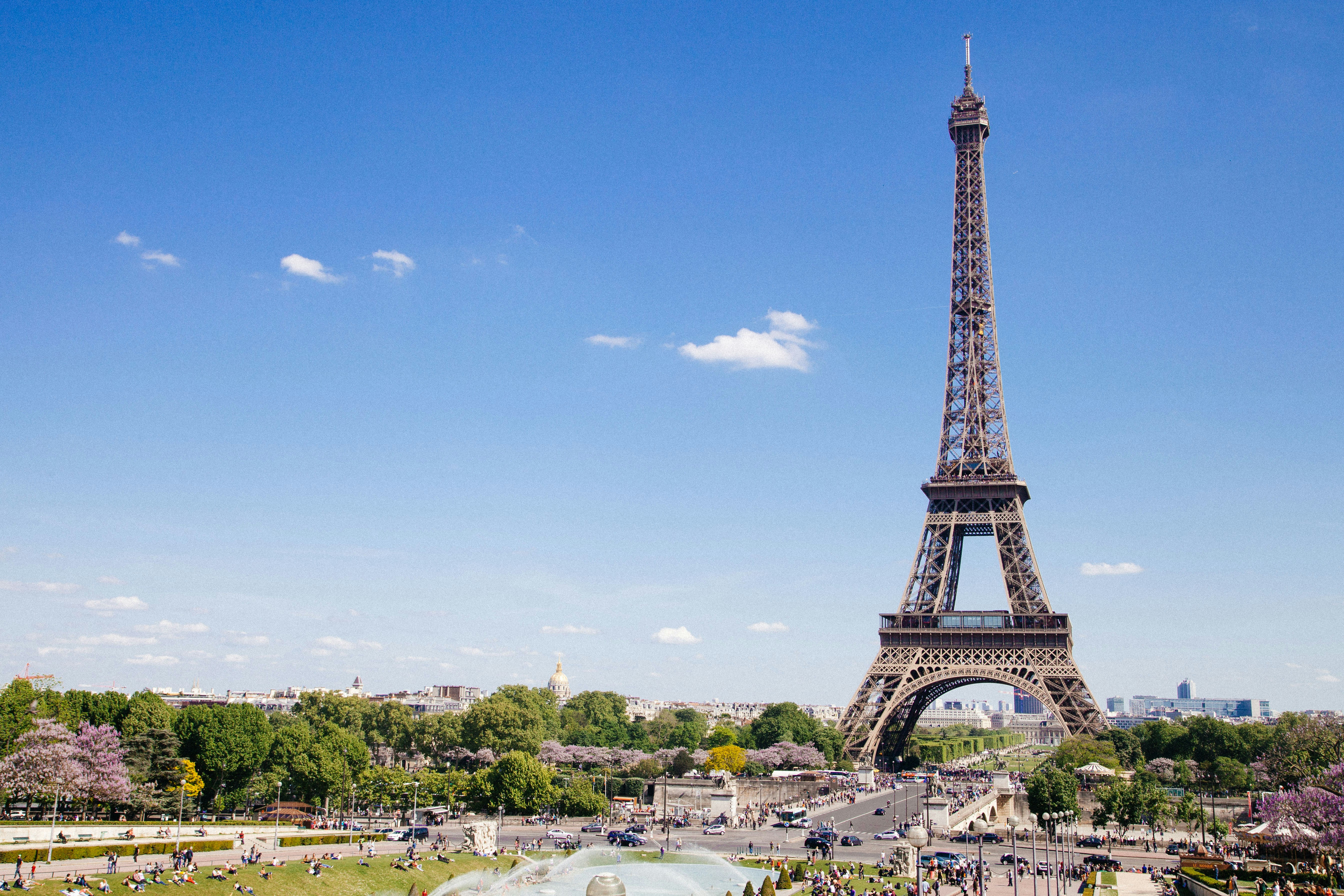
The Dome Climb — 300 steps, 40 km of Paris
300 steps up a narrow spiral, no lift, no shortcut. Entry is outside via the moat on the left side of the basilica — descend into the douve, buy a ticket (€8 adult, €5 child), and start climbing. Mid-climb you pass close to the dome's masonry, sculpted ribs and travertine detail invisible from the parvis below.
At the top: the highest publicly accessible viewpoint in Paris after the Eiffel Tower and Tour Montparnasse — and the only one that lets you look down on central Paris from the north. On a clear day, 40 kilometers of visibility. Pompidou, Notre-Dame, Montparnasse, the Eiffel itself, all laid out beneath you.
Go at opening (10h15) in summer or you'll bake in the stairwell. Blue hour is the secret — climb late, watch the city switch from gold to indigo, catch the Eiffel's sparkle on the hour.
The Self-Cleaning Stone (and Other Hidden Details)
Sacré-Cœur is built from Château-Landon travertine, a limestone that secretes calcite when wet. Every rain bleaches the façade whiter — the opposite of normal Parisian stone, which darkens with grime. Touch the wall in the moat after a shower and you'll feel the chalk-bright bloom on your fingertips.
Inside, find the bronze St Peter statue near the ambulatory — a replica of the Vatican original, his foot polished mirror-smooth by 130 years of pilgrim hands. Slip into a side chapel and follow the ring of mosaics, one saint per bay. Then walk down to Place du Tertre three minutes north, but watch the portrait artists — the scam reviews are real.
One piece of context the basilica won't tell you: it sits directly above the site of the 1871 Commune uprising, built as expiation for what the National Assembly's 1873 vow called the "crimes which have crowned our sorrows." Left-wing Paris has never forgiven it. The white stone glows; the politics underneath stays bitter.
Photo Gallery
Explore Sacré-Cœur Basilica in Pictures

Sacré-Cœur Basilica rises above Montmartre under pink evening clouds. Visitors gather along the hillside railings as the domes turn dark against the sky.
Sebastian Luna on Pexels · Pexels License

Sacré-Cœur Basilica crowns Montmartre above a dense sweep of Paris rooftops. Bright daylight gives the white domes and bell tower a clear silhouette against the blue sky.
Synth Rydr on Pexels · Pexels License

Sacré-Cœur Basilica rises over Montmartre with its pale stone domes and sculpted facade against a bright blue Paris sky.
Pixabay on Pexels · Pexels License

Stone arches rise toward the dome inside Sacré-Cœur Basilica, where pale window light falls over the apse mosaic and altar. The vast interior feels solemn, shadowed, and theatrical.
Zekai Zhu on Pexels · Pexels License

Sacré-Cœur Basilica rises above Montmartre with its pale stone domes and arched terraces. Visitors gather along the hillside under a soft blue sky.
Fernanda W. Corso on Pexels · Pexels License

Sacré-Cœur Basilica rises above Montmartre with its pale stone domes and arched facade. Visitors gather across the wide steps under a soft grey Paris sky.
Antonio Miralles Andorra on Pexels · Pexels License
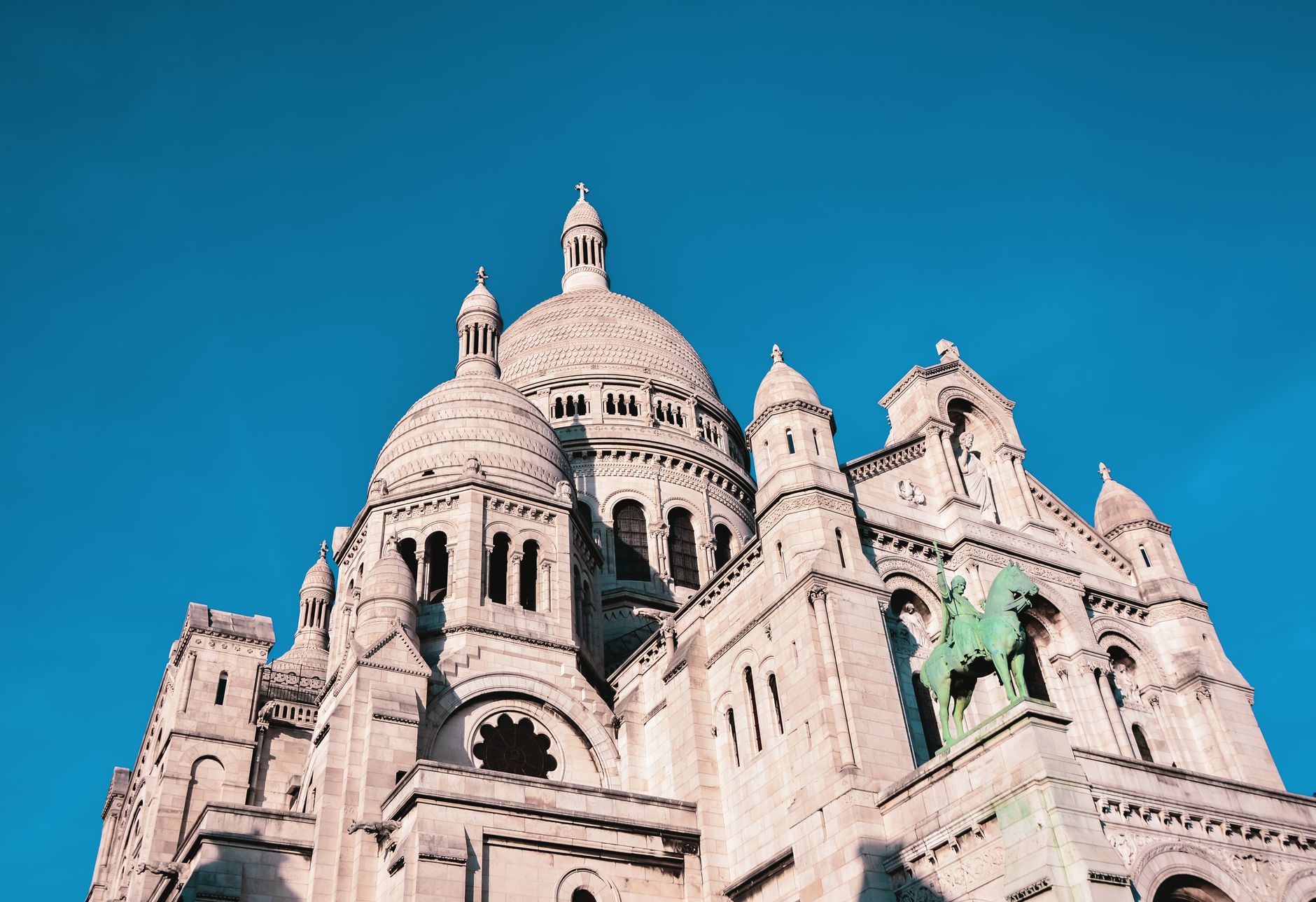
Sacré-Cœur Basilica rises against a clear blue Paris sky, its pale stone domes and arched facade catching bright daylight. A bronze equestrian statue marks the front of the basilica.
Tove Liu on Pexels · Pexels License

Sacré-Cœur Basilica rises above Montmartre with its pale stone domes, carved arches, and bronze equestrian statues catching the clear daylight.
MAIROL JOSSUÈ ROJAS CALDERÒN on Pexels · Pexels License

A close view of Sacré-Cœur Basilica shows its pale stone domes, arched windows, and sculpted details under clear Paris daylight.
Mert Oraklı on Pexels · Pexels License
Touch the facade after a rain shower: the Château-Landon travertine secretes calcite when wet, which is why Sacré-Cœur stays unnaturally white while every other Paris monument grays. Look low on the south wall for the cleanest white streaks.
Visitor Logistics
Getting There
Métro line 2 to Anvers is closest — exit, walk Rue de Steinkerque about 2 minutes to the base of the butte, then either climb the 197 steps or take the funicular (one standard métro ticket, 90 seconds, wheelchair-accessible at both ends). Line 12 Abbesses sits 5 minutes downhill via Rue Yvonne le Tac. Locals skip the front stairs entirely and approach via Rue Lepic or Rue des Saules from the back to dodge the scam gauntlet.
Opening Hours
As of 2026, the basilica interior is free and open daily 6:30 to 22:30, no exceptions, year-round. The dome climb runs daily 10:15 to 19:00 (last admission 18:30) with a midday hostess break and weather-dependent closures — check the official site the day before. Mass times restrict tourist circulation in the nave.
Time Needed
Quick interior visit plus the parvis viewpoint runs 30–45 minutes. Add the 300-step dome climb and you're at 1.5–2 hours including the queue. Pair with Montmartre wandering — Place du Tertre, Rue Lepic, the Clos Montmartre vineyard — and budget a half-day.
Cost & Tickets
Nave entry is free, always. Dome climb costs €8 adult / €5 child (under 16) as of 2026, sold on-site only at the ticket office in the moat — no advance booking, no skip-the-line option. Bring small cash or card; queues self-regulate via staff.
Accessibility
Basilica grounds reached via side entrance (not the main stairs); funicular is fully step-free with elevators at both stations. The dome is not accessible — 300 narrow stairs, no lift, skip if claustrophobic or with mobility issues. Anvers and Abbesses métro stations have stairs only; bus 40 (Montmartrobus) stops directly at the basilica entrance and takes wheelchairs via middle-door ramp.
Tips for Visitors
Bracelet scam alert
Front stairs and funicular base swarm with men running the friendship-bracelet grab — they tie string on your wrist then demand €15–€100 with intimidation. Walk with hands in pockets, firm "non," don't break stride; petition clipboards and shell-game cups on the parvis are pickpocket fronts.
Climb the back way
Skip the front steps entirely. Come up via Rue Lepic past the café from Amélie, or the 222 free stairs of Rue Foyatier — same view, no scammers, and you pass real Montmartre instead of the trinket gauntlet.
Photography forbidden inside
Perpetual Eucharistic adoration has run uninterrupted since 1 August 1885, so silence and no photos or filming inside the nave — staff will stop you. Outside the basilica is free for personal shots; drones are banned across all Paris airspace.
Dress modestly
Shoulders and knees covered, no shorts or short skirts — it's a working sanctuary, not a viewpoint. Bag screening at the entrance, so leave large luggage at Gare du Nord (2 km away) or a Nannybag drop in Montmartre.
Eat off the parvis
Skip Place du Tertre and La Mère Catherine — overpriced, mediocre. Walk five minutes to Le Moulin de la Galette on Rue Lepic for traditional French in Renoir's old windmill (€€€), La Bossue for budget café fare (€), or Café Francoeur for solid mid-range bistro (€€).
Sunset, not sunrise
Come 45 minutes before sunset — Paris turns gold from the parvis and the white travertine glows. The stone secretes calcite when wet, so the basilica self-bleaches in rain and looks cleanest after a downpour.
October wine festival
Fête des Vendanges de Montmartre in early October harvests the tiny Clos Montmartre vineyard on Rue des Saules — about 1,000 bottles a year, auctioned for charity. Parade, fireworks over the basilica, food stalls; the only time the quarter feels like a village again.
Hear the Cavaillé-Coll
The 1898 great organ by Aristide Cavaillé-Coll is one of Europe's most important and itself a classified Monument Historique. Time your visit for Friday 11am or 3pm, or Sunday Vespers at 4pm to hear it played.
Where to Eat
Don't Leave Without Trying
Le Poulbot
local favoriteOrder: The lamb is exceptional, and their classic French onion soup is arguably the best in the city.
This cozy, character-filled spot feels like a true Parisian hidden gem, offering high-quality, generous portions that avoid the typical tourist-trap pitfalls of the area.
La Taverne de Montmartre
local favoriteOrder: The hearty raclette or the rich cheese fondue are the stars of the menu here.
A charming, tucked-away tavern that feels authentic and welcoming; it's the perfect place to warm up with traditional Alpine comfort food that locals love.
Chez Eugène
cafeOrder: The escargot is a classic starter, perfectly paired with a crisp glass of white wine.
Located right in the bustling heart of Place du Tertre, this is the ultimate spot for people-watching with a view of the Sacré-Cœur dome.
La Halte du Sacré Coeur
quick biteOrder: Their burger is widely considered one of the best in Paris—surprisingly better than many stateside favorites.
A convenient and friendly neighborhood stop perfect for a quick, high-quality bite or a casual drink while navigating the steps of Montmartre.
Dining Tips
- check Service is included by law (15%); you are not required to tip, though rounding up or leaving ~10% for exceptional service is appreciated.
- check Bistros often close on Mondays and Tuesdays—check your plans in advance.
- check Lunch is generally served between 12:00 and 14:30.
- check Dinner service usually begins at 19:00 or 19:30, with peak dining hours occurring between 20:00 and 21:30.
- check Cards are widely accepted, but keep some cash handy for smaller independent stalls or boulangeries.
- check Boulangeries typically offer fresh baguette batches in the early morning and again between 17:00 and 20:00.
Restaurant data powered by Google
Historical Context
The Vow That Came First
The story most tour groups receive begins on 28 May 1871 with the bodies of Communards in the rue des Rosiers, and ends with a punitive basilica raised by victorious Versaillais. Tidy. Wrong by months.
The wound that produced the Sacré-Cœur was older and stranger. France had just been crushed at Sedan, Napoleon III was a Prussian prisoner, and a wealthy Catholic in Poitiers convinced himself the country had been punished by God for forgetting the Sacred Heart. He picked up a pen four months before the Commune existed.
Alexandre Legentil's Pen
The story most tour groups tell at the door is simple revenge. Adolphe Thiers crushed the Paris Commune in May 1871; eighteen months later, the Catholic right began raising a white basilica directly above the place where the Commune was born. Stand at the door and the symbolism looks airtight — the Church planting a flag over its enemies, paying for the Commune in stone and gold.
Look at the dates. The Vœu National is the founding text the whole project rests on, and Alexandre Legentil drafted it on 8 December 1870. The Paris Commune did not begin until 18 March 1871. Legentil was a wealthy Vincentian philanthropist who spent the autumn of 1870 watching France collapse and convincing himself his own piety had failed his country. His brother-in-law Hubert Rohault de Fleury rewrote the text in January 1871. Cardinal Guibert approved it on 18 January 1872. None of those dates is about the Commune.
What Legentil meant by 'crimes' was the 1789 Revolution, the moral collapse he believed had cost France the war, and the 1870 imprisonment of Pope Pius IX in Rome. None of that involved the Commune. That theme came later, when the 1873 National Assembly bolted it on by voting construction 'of national interest' to 'efface the crimes that have crowned our sorrows.' Cardinal Guibert then picked Montmartre as the site. That hill was exactly where the Commune had begun. Two stories laminated onto one church. Today the basilica's own historians publicly call the pure-Commune-expiation reading 'une idée fausse à balayer.'
Knowing this changes what you see. The white travertine is not a victor's monument but a stranger document: a private 19th-century anxiety about modernity, retrofitted onto the most politically charged hill in Paris by a state that needed its symbolism more than its theology. At the foot of the steps, a public garden carries the name of the Communarde Louise Michel. The basilica above her was not built to crush her memory; it was finished long after she died, by people who had mostly forgotten what Legentil was praying about.
The Mountain Beneath
Montmartre is a hill of gypsum honeycombed by centuries of mining. Paul Abadie, who won the 1874 design competition over 76 rivals, faced foundations that wouldn't hold a parish chapel let alone a basilica. His solution was brutal and invisible: 83 wells sunk roughly 30 metres deep, each filled with rock and concrete, forming an underground forest of pillars that carries the entire weight overhead. Walk the floor and you stand on a buried church no visitor will ever see. Abadie died in 1884 without seeing his dome rise; five successor architects finished the work.
139 Years Without a Pause
On 1 August 1885, while the dome was still a wooden scaffold, Eucharistic adoration began inside the unfinished basilica. It has not stopped since. Two world wars, the bombings of 1944, the lockdowns of 2020 — none of it broke the chain. Benedictine Sisters of the Sacred Heart sing the Divine Office, and lay relay teams sleep in the basilica's guesthouse to take hour-slots through the night. The homepage carries a public counter: 1,238,615 hours, 51,608 nights. Longest unbroken adoration in France.
The basilica was finally classified as a Monument Historique only on 8 December 2022, after earlier proposals failed on Commune-symbolism objections. The same year, PCF deputy Ian Brossat called for tearing it down and replacing it with an 'espace de solidarité' — the argument over whether the church belongs on this hill is still alive.
If you were standing on this exact spot on 18 March 1871, you would hear the rasp of artillery ropes scraping cobblestones as troops try to drag 200 cannons down the slope. The crowd presses in. The soldiers refuse to fire. Within the hour, two generals lie dead in a garden on rue des Rosiers, on ground that today holds up the basilica's nave, and the Paris Commune is born under your feet.
Listen to the full story in the app
Your Personal Curator, in Your Pocket.
Audio guides for 1,100+ cities across 96 countries. History, stories, and local insight — offline ready.
Audiala App
Available on iOS & Android
Join 50k+ Curators
Frequently Asked
Is Sacré-Cœur Basilica worth visiting? add
Yes — and not for the reason most guidebooks give. The interior holds one of the largest mosaics in the world (475 m² Christ in Majesty) and unbroken Eucharistic adoration running since 1 August 1885, never interrupted by either world war. The dome panorama reaches 40 km on a clear day, the only spot in Paris where you look down on the city from the north.
How long do you need at Sacré-Cœur? add
Plan 30–45 minutes for the interior plus the parvis viewpoint, or 1.5–2 hours if you climb the dome. Add half a day to wander Montmartre's back streets — rue Lepic, rue des Saules, the Clos Montmartre vineyard — which is where the neighbourhood actually feels like itself rather than the tourist scrum at Place du Tertre.
How do I get to Sacré-Cœur from central Paris? add
Take Métro line 2 to Anvers, then walk two minutes up rue de Steinkerque to the base of the butte. From there, climb the 197 steps or ride the Funiculaire de Montmartre (one standard metro ticket, 90 seconds, wheelchair-accessible at both stations). Line 12 to Abbesses also works — slightly longer walk but a prettier approach.
Is Sacré-Cœur free to visit? add
The basilica interior is free, every day, 6:30–22:30. The dome climb costs €8 for adults and €5 for children, paid on-site only — no advance booking, no skip-the-line. There's no public toilet at the dome ticket office, so plan accordingly.
What is the best time to visit Sacré-Cœur? add
Arrive at opening (6:30) or just before sunset to dodge midday security queues that hit 20–40 minutes in summer. Autumn gives the clearest 40 km views from the dome; after rain, the Château-Landon travertine façade visibly bleaches whiter — the stone secretes calcite when wet, so the building actually gets cleaner with age.
What should I not miss inside Sacré-Cœur? add
Look down-left in the apse mosaic for Joan of Arc kneeling at Christ's feet offering her crown — most visitors stare straight up at the central figure and miss the nationalist subtext. Touch the polished foot of the bronze Saint Peter (a replica of the Vatican original), and read the donor initials carved into individual stones around the ambulatory. Photography is forbidden inside — silence is enforced because adoration runs 24/7.
Why was Sacré-Cœur built? add
It was built to fulfil the Vœu National, a vow drafted by Alexandre Legentil on 8 December 1870 — three months before the Paris Commune, contrary to popular belief. The Vœu repented French defeat at Sedan and the Revolution's legacy, not the Commune. But the choice of Montmartre — directly above where Generals Lecomte and Thomas were shot on 18 March 1871, sparking the uprising — layered Commune-expiation meaning onto the project, and that contested memory is still alive: it was only classified Monument Historique on 8 December 2022.
Is climbing the Sacré-Cœur dome worth it? add
Worth it if you can handle ~300 narrow spiral stairs with no lift — skip if claustrophobic, pregnant, or with very young children. The reward is a 360° panorama spanning Pompidou, Notre-Dame, Tour Montparnasse, and the Eiffel Tower, plus a mid-climb walk between the inner and outer dome shells where you see sculpted ribs invisible from ground level.
Sources
-
verified
Sacré-Cœur de Montmartre — Le Vœu National (official)
Official basilica account confirming the Vœu was drafted 8 December 1870, before the Commune
-
verified
Sacré-Cœur de Montmartre — Grandes étapes de la construction (official)
Construction timeline: Abadie's 1874 competition win, 83 foundation wells, successor architects
-
verified
Sacré-Cœur de Montmartre — Homepage (official)
Hours (6:30–22:30), perpetual adoration counter, organ restoration through 2027
-
verified
Sacré-Cœur — Mass schedule (official)
Daily mass times including the rare 10pm Paris mass and Friday Votive Mass
-
verified
Sacré-Cœur — Pilgrimages and group hospitality (official)
Overnight adoration relay practicalities, guesthouse check-in, group retreat structure
-
verified
Mérimée PA75180004 — pop.culture.gouv.fr
State Monument Historique notice confirming 8 December 2022 classification covering basilica plus Square Louise-Michel
-
verified
Wikipedia — Paris Commune
18 March 1871 cannon affair, Generals Lecomte and Thomas, Bloody Week casualty estimates
-
verified
Montmartre Footsteps — The Paris Commune and Montmartre
Geography of the Commune trigger: Rue des Rosiers executions on the ground beneath the basilica
-
verified
Le Monde — Le vœu rédigé trois mois avant la Commune (24 June 1971)
Press confirmation that the Vœu predates the Commune
-
verified
Novo19 / Ouest-France — Le Sacré-Cœur, mégastructure historique
Architect Paul Abadie biography, hostile reception, sabotage claims
-
verified
Exp1 — The Dark Side of Sacré-Cœur
Commune death-toll debates and political contestation
-
verified
Bénédictines de Montmartre
Benedictine Sisters maintaining sung Divine Office and adoration
-
verified
Diocèse de Paris — Sacré-Cœur de Montmartre
Diocesan framing of Sacred Heart consecration and feast
-
verified
L'Humanité — Mémoire: les sacrées polémiques du Sacré-Cœur
Left-wing critique of the 2022 classification, 'verrue versaillaise' framing
-
verified
UFAL — Sacré-Cœur classé Monument Historique
Laïque association statement opposing the classification
-
verified
La Croix — Mémoire communarde et victimes catholiques
Catholic counter-memory framing: Archbishop Darboy and Revolutionary victims
-
verified
Time Out Paris — Le Sacré-Cœur et la Commune: conflit de mémoires
Historians Godineau and Fournier on the ongoing memory conflict
-
verified
Paris by Pierre — Sacré-Cœur Basilica
Local guide notes on travertine self-cleaning, scams, dress code
-
verified
Culturez-vous — Little-known history of Montmartre
Background on the butte's pre-Christian and martyr-cult layers
Last reviewed:


