Introduction
The square named for harmony is the same one where 1,118 people lost their heads. Place de la Concorde, the largest public square in Paris, France, sits at the hinge point between the Tuileries Garden and the Champs-Élysées — a position that has made it both a stage for national pageantry and a killing floor for national rage. Come for the 3,400-year-old Egyptian obelisk, the twin fountains catching afternoon light, and the axis of vision that stretches from the Louvre to the Arc de Triomphe. Stay because no other piece of pavement in Europe holds this much contradictory meaning underfoot.
At roughly 8.6 hectares, the square is larger than most village centers. Traffic circles it relentlessly — eight lanes of Parisian driving at its most theatrical — so your first impression may be sheer noise. But step toward the center, near the obelisk, and the geometry takes over. Architect Ange-Jacques Gabriel designed the original layout in the 1750s as an open-ended composition, flanked by two palatial buildings to the north and otherwise bounded only by sky. That openness still works. You can see the Eiffel Tower to the southwest, the Madeleine church due north, and the Palais Bourbon across the river.
What makes the Concorde genuinely different from other grand Parisian squares is its refusal to settle into one identity. It has been a royal showcase, a revolutionary abattoir, a Napoleonic parade ground, a site of Nazi occupation, and a venue for Olympic events in 2024. Each era has left its mark — or tried to erase the previous one. The obelisk itself was chosen in the 1830s precisely because it carried no French political baggage whatsoever.
Visit at dusk if you can. The fountains — modeled on those in St. Peter's Square in Rome — light up a deep green-gold, and the obelisk's gilded pyramidion catches the last sun. The traffic noise fades into a kind of white hum. For a few minutes, the name almost fits.
Place de la concorde, les secrets sous l'Obélisque - Au cœur du patrimoine français
Un Max de Patrimoine & Découvertes.What to See
The Luxor Obelisk and the World's Largest Sundial
Most people glance at the 23-metre-tall pink granite column and think: Egyptian monument, nice. What they miss is under their feet. The entire 8.64-hectare square — roughly the size of 12 football pitches — functions as a giant sundial, with bronze hour-lines etched into the pavement radiating from the Obelisk's base. The shadow of a 3,400-year-old monolith, carved during the reign of Ramesses II in the 13th century BC, still tells the time in Paris.
Look closely at the hieroglyphics. Recent studies have revealed inscriptions that aren't ancient prayers but practical instructions — notes left for posterity about how the monument was transported and installed. A golden pyramidion cap, added in 1998, catches afternoon light and throws a warm flash across the limestone facades. Stand at the south-facing bronze marker around 2 p.m. in summer and you'll see the shadow land almost perfectly on the line. Thousands of tourists walk over these markers daily without realizing they're stepping on functional astronomical instruments.
The Twin Fountains of Hittorff
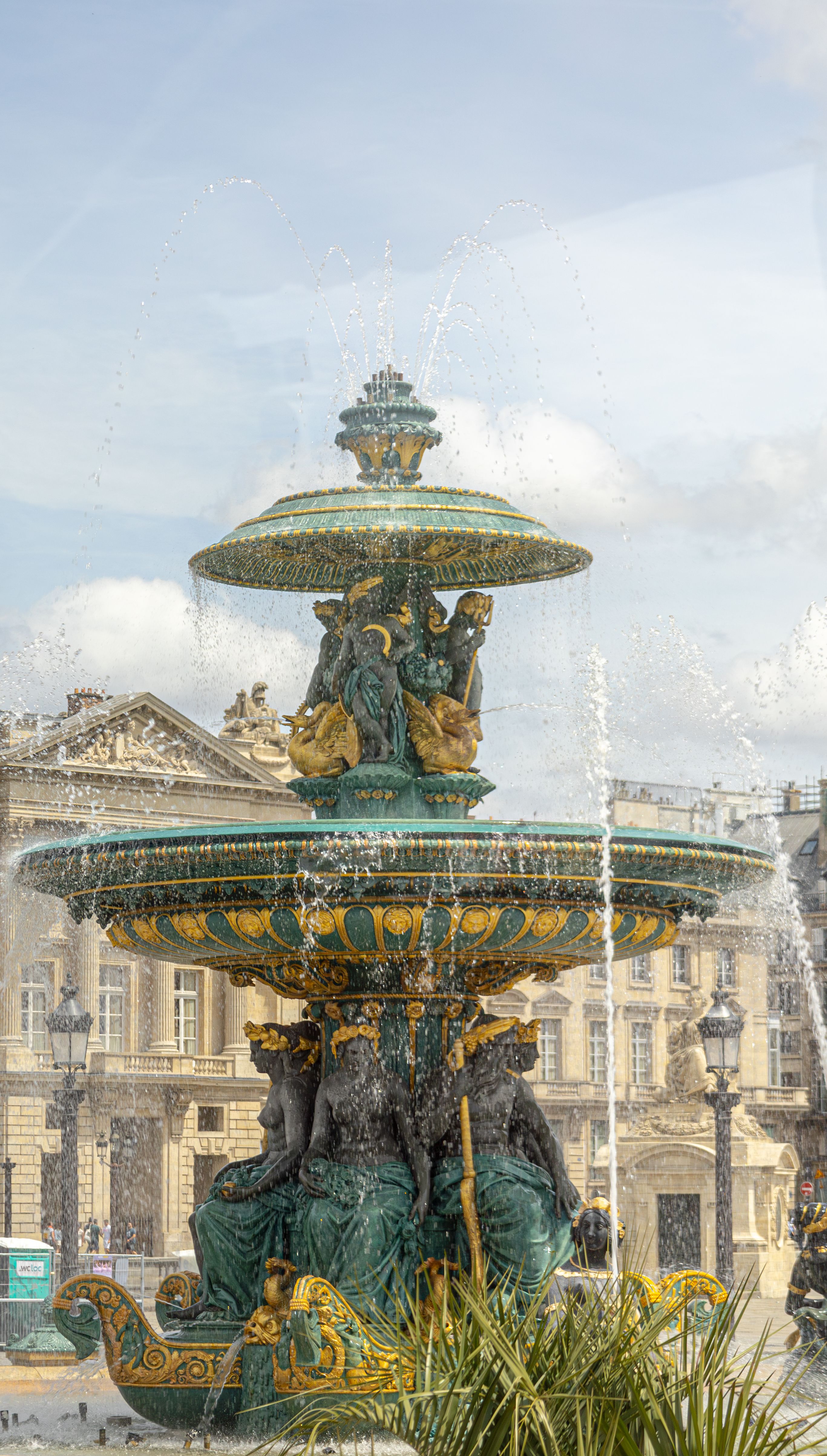
Architect Jacques Ignace Hittorff designed the Fontaine des Mers and the Fontaine des Fleuves in the 1830s, and they remain two of the most theatrical pieces of public sculpture in Paris. Six tritons and six nereids in dark patinated bronze hold golden fish, shells, and coral aloft while water cascades over their bodies into wide basins. The gold leaf on the figures glows differently depending on the hour — warm amber at midday, almost copper at dusk.
Here's what makes them genuinely useful, beyond beauty. The fountains produce a constant rush of falling water that creates an auditory pocket, masking the roar of traffic that circles the square. Stand within three metres of either basin and the city drops away. At night, when the fountains are illuminated from below, the effect is something closer to opera staging than urban planning. The Fontaine des Fleuves, on the river side, represents inland navigation; the Fontaine des Mers, closer to the Rue Royale, represents maritime power. Hittorff understood spectacle — these aren't decorations, they're arguments about French ambition cast in bronze and water.
The Hôtel de la Marine
The twin colonnaded buildings flanking the Rue Royale are Ange-Jacques Gabriel's 1755 masterpieces, and the eastern one — the Hôtel de la Marine — reopened to the public in 2021 after a meticulous restoration. For over 200 years it served as the headquarters of the French Navy, and before that it housed the royal furniture collection. The 18th-century salons have been returned to their original state: gilded paneling, parquet floors that creak under your weight, and windows that frame the Obelisk so precisely you'd swear Gabriel designed the square from this room.
The immersive audio guide is genuinely good — not the usual droning narration but a layered soundscape that fills each room with period-appropriate conversation and music. From the loggia on the upper floor, you get what might be the best elevated view of the square without paying for a rooftop bar. You can see the axis running from the Louvre through the Tuileries to the Eiffel Tower in one slow pan. It costs €17, and it's the single best way to understand why this square was designed the way it was.
A Walk Through Three Centuries: Obelisk to Tuileries Gate
Start at the Obelisk and face east. You're standing where the guillotine blade fell on Louis XVI on January 21, 1793, and on Marie-Antoinette nine months later — over 1,100 people were executed on this spot during the Terror. The square was renamed Place de la Révolution for those years, then Place de la Concorde in a deliberate act of civic forgetting. Walk slowly toward the Tuileries, passing between the eight allegorical statues representing French cities — find Strasbourg on the northeast corner, which was draped in black mourning cloth from 1871 to 1918 after Alsace was lost to Germany.
As you pass through the ornamental gate into the Tuileries Garden, the noise drops sharply. Gravel replaces asphalt. The chestnut trees close overhead. In 200 metres you've walked from a place of public execution to a place of private contemplation, from revolutionary violence to royal leisure. That compression — blood and beauty occupying the same axis — is the thing about Paris that no photograph captures. Do this walk at golden hour, when the limestone turns the colour of weak tea, and the Obelisk's shadow stretches long across the pavement like a clock hand marking the end of the day.
Photo Gallery
Explore Place De La Concorde in Pictures

A stunning view of the iconic Place de la Concorde in Paris, France, showcasing the historic Luxor Obelisk and the Eiffel Tower in the distance.
Svitlana Shakalova on Pexels · Pexels License

The magnificent Fontaine des Fleuves stands as a centerpiece of the historic Place de la Concorde in Paris, France.
Pia G on Pexels · Pexels License

The golden glow of sunset illuminates the historic Place de la Concorde in Paris, with the Eiffel Tower visible in the background.
Céline | on Pexels · Pexels License

The magnificent Fontaine des Fleuves stands as a centerpiece of the historic Place de la Concorde in Paris, France.
David Henry on Pexels · Pexels License

The magnificent Fontaine des Mers glows at night in the heart of Paris at the historic Place de la Concorde.
Marcus Herzberg on Pexels · Pexels License

The iconic Place de la Concorde in Paris is beautifully illuminated at night, featuring a vibrant Ferris wheel standing beside the historic Luxor Obelisk.
Luciano Teixeira on Pexels · Pexels License

The grand neoclassical architecture of the Hôtel de la Marine stands prominently at the historic Place de la Concorde in Paris, France.
Alejandro Aznar on Pexels · Pexels License

The magnificent Fontaine des Fleuves stands as a centerpiece in Paris's historic Place de la Concorde, showcasing intricate bronze sculptures and cascading water.
Baptiste Guillier on Pexels · Pexels License

The magnificent Fontaine des Fleuves glows at twilight in the heart of Paris at the historic Place de la Concorde.
David Henry on Pexels · Pexels License
Videos
Watch & Explore Place De La Concorde
Paris Explained
Aux origines de la place de la Concorde La Voix des lieux
The Place de la Concorde is one of the major public squares in Paris, France.
Look closely at the golden pyramid cap crowning the Luxor Obelisk — added only in 1998, it gleams distinctly brighter than the ancient pink granite below. The tip is also engraved with hieroglyphics that continue the inscriptions on the shaft, a detail almost invisible from street level but visible through a zoom lens or binoculars.
Visitor Logistics
Getting There
Take Metro Line 1, 8, or 12 to the "Concorde" station — you'll surface right onto the square. Walking from the Eiffel Tower takes about 25 minutes along the Seine quays, or you can stroll down from the Arc de Triomphe via the full length of the Champs-Élysées in roughly 30 minutes. Driving is possible but pointless — the square is a roaring traffic roundabout with no dedicated parking.
Opening Hours
As of 2026, Place de la Concorde is a public square open 24 hours a day, 365 days a year. No tickets, no gates, no closures. That said, the adjacent Hôtel de la Marine museum has its own hours and requires a separate ticket if you want to step inside.
Time Needed
A quick loop around the Obelisk and fountains takes 15–20 minutes. To properly read the hieroglyphics, photograph the eight city statues, and absorb the scale of the place, budget a full hour. Pair it with a walk through the neighboring Tuileries Garden and you've got a satisfying 2-hour morning.
Accessibility
The square is flat and mostly paved, making it wheelchair accessible. However, some sections are cobblestoned, and crossing the surrounding roads requires navigating busy traffic signals — allow extra time at crosswalks. There are no stairs or elevators since it's entirely open-air.
Tips for Visitors
Arrive Before 8 AM
The square transforms completely at dawn — almost no traffic, golden light on the Obelisk, and you can actually hear the fountains. By 9 AM, the roar of cars reclaims everything.
Watch for Scams
The "gold ring" trick is alive and well here: someone "finds" a ring at your feet and pressures you to pay for it. Also steer clear of aggressive petition-clipboard carriers near the metro exits — they're after your wallet, not your signature.
Drone-Free Zone
Personal photography is unrestricted, but drones are strictly illegal over Paris without authorization from the Préfecture de Police. Stick to ground-level shots — the low morning light on the 3,400-year-old hieroglyphics is reward enough.
Eat Nearby, Not Here
For budget bites, grab a sandwich from a bakery on Rue Saint-Honoré and eat in the Tuileries Garden. Mid-range, try Café Marly near the Louvre for a proper terrace. For a splurge, the Bar Les Ambassadeurs inside the Hôtel de Crillon sits right on the square — cocktails start around €30, but you're drinking where diplomats once negotiated treaties.
Combine with Orangerie
The Musée de l'Orangerie sits at the southwest corner of the Tuileries, a 5-minute walk from the Obelisk. Monet's enormous Water Lilies panels inside make a perfect counterpoint to the square's grand-scale outdoor drama.
Find the Strasbourg Statue
Eight statues ring the square, each representing a French city. The Strasbourg figure was draped in black mourning veils for over 40 years after France lost Alsace to Germany in 1870 — look for it on the northeast corner and imagine the grief woven into stone.
Where to Eat
Don't Leave Without Trying
L'Ecrin
fine diningOrder: The tasting menu showcases seasonal market ingredients with refined technique—this is where Parisians go when they want serious cooking without the formality.
L'Ecrin delivers haute cuisine that actually tastes like food, not theater. The 4.8 rating from serious diners (not tourists) says everything.
Les Ambassadeurs
fine diningOrder: The à la carte menu emphasizes classic French technique with modern sensibility—ask your server about the day's market finds.
A serious restaurant for serious diners, housed in a historic building steps from Concorde. This is where you go when you want to understand why Paris still matters for food.
Jardin d'Hiver
local favoriteOrder: Classic brasserie fare—try the seasonal vegetables and grilled fish. The lunch menu is excellent value for the location.
Right on the square with long hours (7 AM–10 PM), this is where you actually eat at Place de la Concorde without the tourist trap markup. Locals know about it.
Café Lapérouse Concorde
quick biteOrder: The croque-monsieur is exactly what it should be. Come for coffee and a croissant at breakfast, or a light lunch—this is honest café food.
A proper Parisian café with 2,200+ reviews that actually maintains quality. Open early to late (8 AM–11 PM), it's the real deal for a casual meal with a view.
Dining Tips
- check The Madeleine district (just north of Concorde) has luxury food shops (épiceries fines) if you want to explore high-end provisions.
- check For authentic open-air markets, head to Marché Saint-Honoré in the 1st arrondissement—Place de la Concorde itself is monumental, not residential.
- check Book fine dining restaurants in advance; L'Ecrin and Les Ambassadeurs fill up quickly.
- check Many restaurants focus on 'Cuisine du Marché' (market-fresh cuisine), so ask what's seasonal and local on the day you visit.
Restaurant data powered by Google
Historical Context
A Square That Changed Its Name to Forget What It Did
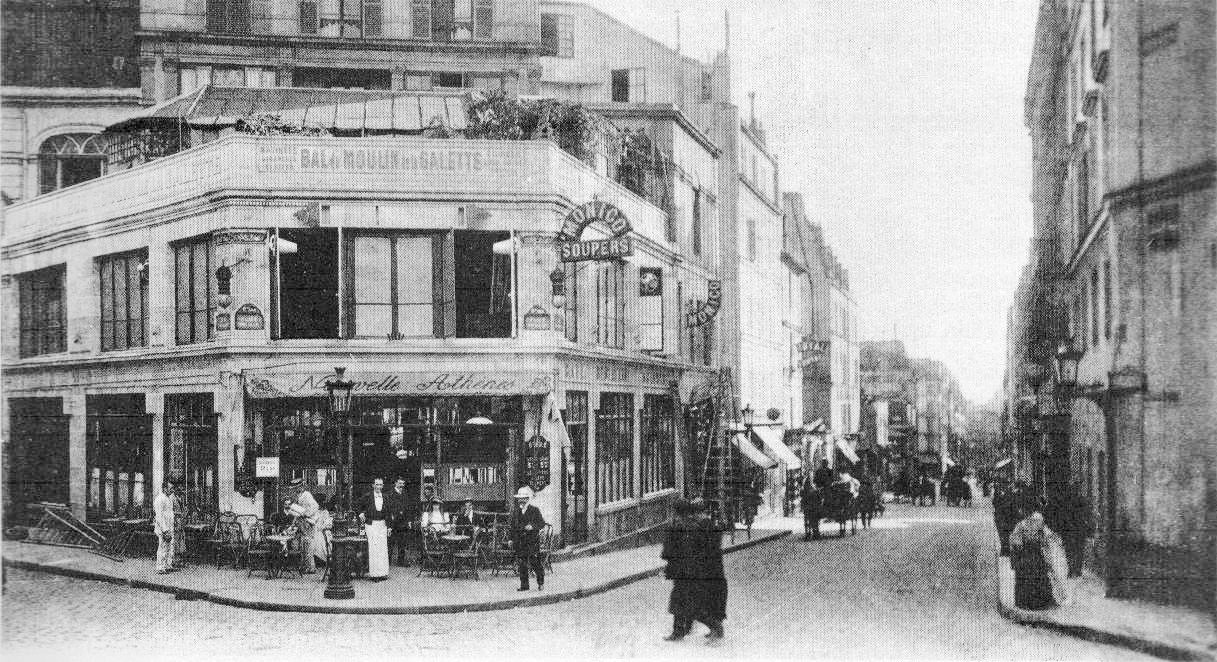
The ground beneath the Place de la Concorde has been reinvented more often than almost any public space in Europe. In 1748, the city of Paris launched a competition to create a grand setting for an equestrian statue of Louis XV. Ange-Jacques Gabriel, the king's own architect, won with a radical proposal: instead of an enclosed square in the traditional manner, he designed a vast open esplanade on the western edge of Paris, bordered by dry moats and balustrades rather than buildings. The facades of his twin palaces on the north side weren't completed until 1775, and the square's identity was already beginning to slip.
From royal vanity project to revolutionary scaffold to diplomatic symbol of reconciliation, the square has cycled through at least four official names. Each renaming was an act of political will — an attempt to overwrite what happened here with what the current regime wished the place to mean. The stone didn't change. The memories didn't leave.
The Morning a King's Blood Became a Souvenir
On January 21, 1793, Louis XVI — stripped of his crown, now addressed simply as Citoyen Louis Capet — was driven in a closed carriage from the Temple prison to the Place de la Révolution, as the square was then known. He was 38 years old. His personal stakes could not have been higher: he had attempted to flee France with his family in 1791, been caught at Varennes, and spent the intervening months watching his authority dissolve. The National Convention had voted 361 to 360 to deny him a reprieve. One vote.
Records describe a cold, overcast morning. Somewhere between 20,000 and 80,000 people filled the square and the surrounding streets; the estimates vary wildly. Louis reportedly tried to address the crowd from the scaffold, declaring his innocence, but the drums were ordered to roll and his words were drowned out. The blade fell at approximately 10:22 a.m. According to multiple contemporary accounts, spectators surged forward to dip handkerchiefs and scraps of cloth in the king's blood — relics of the old world, collected at the birth of the new.
The execution didn't end the violence; it accelerated it. Over the next 18 months, the guillotine on this square claimed Marie-Antoinette, the chemist Antoine Lavoisier, the poet André Chénier, the revolutionary leaders Danton and Robespierre, and roughly 1,100 others. When the Terror finally exhausted itself in July 1794, the square was renamed Place de la Concorde — 'concord,' 'harmony' — as if a word could wash the paving stones clean.
Charlotte Corday and the Blade's Reversal
Among the condemned who mounted the scaffold here, Charlotte Corday stands apart. A 24-year-old from Normandy and a sympathizer of the moderate Girondin faction, she traveled to Paris in July 1793 with a single purpose: to kill the radical journalist Jean-Paul Marat, whom she believed was driving the Terror. She stabbed him in his medicinal bath on July 13 and made no attempt to flee. Four days later, on July 17, she was guillotined at the Place de la Révolution. The executioner reportedly slapped her severed head, and witnesses claimed the cheek reddened — a detail that sparked a genuine medical debate about consciousness after decapitation that persisted for over a century.
Hittorff's Diplomatic Redesign
By the 1830s, the square was politically toxic. King Louis-Philippe commissioned architect Jacques Hittorff to redesign it entirely, and Hittorff's solution was inspired: place at the center a monument with zero connection to French politics. The Luxor Obelisk — a 230-ton, 3,400-year-old granite column from the Temple of Ramesses II — arrived by barge in 1833 and was erected in 1836 using an elaborate system of ropes and winches. Hittorff then added the two monumental fountains, completed by 1846, and ringed the square with eight statues representing French cities. The transformation worked. The obelisk gave the square a focal point that predated every French grievance by three millennia.
Listen to the full story in the app
Your Personal Curator, in Your Pocket.
Audio guides for 1,100+ cities across 96 countries. History, stories, and local insight — offline ready.
Audiala App
Available on iOS & Android
Join 50k+ Curators
Frequently Asked
Is Place de la Concorde worth visiting? add
Absolutely — it's the largest square in Paris at 8.64 hectares (roughly the size of 12 football pitches), and it sits at the exact axis between the Louvre and the Arc de Triomphe. You're standing where Louis XVI and Marie-Antoinette were guillotined, staring at a 3,400-year-old Egyptian obelisk, flanked by gold-plated fountains modeled after those in St. Peter's Square in Rome. The square is also free and open around the clock, so there's zero reason to skip it.
How long do you need at Place de la Concorde? add
A quick look at the obelisk and fountains takes 15–30 minutes, but allow 1–2 hours if you want to read the hieroglyphics, spot the sundial markings in the pavement, and walk into the adjacent Tuileries Garden. Pairing it with a visit to the Hôtel de la Marine museum, which sits directly on the square, makes for a rich half-day.
How do I get to Place de la Concorde from Paris? add
Take the Metro to the "Concorde" station, served by Lines 1, 8, and 12 — it drops you right at the edge of the square. You can also walk there in about 10 minutes from the Louvre along the Tuileries Garden, or stroll down the Champs-Élysées from the Arc de Triomphe. Driving is possible but genuinely inadvisable; the square is a notorious traffic roundabout.
What is the best time to visit Place de la Concorde? add
Early morning before 8:00 AM is the only time the square feels calm — traffic is light, the golden tip of the obelisk catches the first sun, and you can actually hear the fountains. At night, the obelisk and fountains are dramatically spotlit and the traffic thins out, creating an entirely different, more theatrical atmosphere. Midday is the worst: loud, congested, and crawling with pickpockets.
Can you visit Place de la Concorde for free? add
Yes, completely free. It's a public square, open 24/7, with no tickets or reservations required. The only cost nearby is the Hôtel de la Marine museum, which charges an entry fee but offers excellent context for the square's history.
What should I not miss at Place de la Concorde? add
Look down. Bronze lines etched into the pavement around the Luxor Obelisk form the world's largest sundial — the 22-meter stone column casts a shadow that actually tells the time, and almost everyone walks right over the markings without noticing. Then check the obelisk's pedestal: carved diagrams show the exact machinery used to hoist the 230-ton monument in 1836, essentially a technical manual in stone. The eight statues around the perimeter each represent a French city; the one for Strasbourg was draped in black mourning veils for decades after Germany annexed the city in 1870.
What happened at Place de la Concorde during the French Revolution? add
The square, then called Place de la Révolution, became the primary site of the guillotine during the Reign of Terror from 1792 to 1795. King Louis XVI was executed here on January 21, 1793 — witnesses reportedly dipped handkerchiefs in his blood as souvenirs. Marie-Antoinette followed on October 16 of that year, and Robespierre himself met the blade on July 28, 1794, with an estimated 1,100+ total executions on this spot.
What is the obelisk at Place de la Concorde? add
It's the Luxor Obelisk, a 22-meter-tall, 230-ton monolith carved in Egypt around the 13th century BC — making it roughly 3,400 years old and by far the oldest monument in Paris. It was a gift from Egypt, erected here in 1836 under King Louis-Philippe partly to give the square a politically neutral centerpiece after its bloody revolutionary history. A gold-leafed pyramid cap was added to the top in 1998, which architectural purists still argue about.
Sources
-
verified
Hôtel de la Marine — History of Place de la Concorde
Detailed history of the square's founding, Ange-Jacques Gabriel's design, and the 1755 inauguration.
-
verified
Sortiraparis — Anecdotes on Place de la Concorde
Naming evolution from Place Louis XV through Place de la Concorde, Luxor Obelisk details, and the 1998 pyramidion.
-
verified
Tripadvisor — Place de la Concorde Reviews
Visitor experiences, execution history, and information on the eight provincial city statues.
-
verified
Paris-anecdote — La Place de la Concorde
Execution counts during the Terror and historical anecdotes about the square.
-
verified
Trip.com — Place de la Concorde Guide
Details on the Fontaine des Fleuves and Fontaine des Mers, and general visitor orientation.
-
verified
Wikipedia — Place de la Concorde
General history, naming timeline, and dimensions of the square.
-
verified
Paris-Promeneurs — La Place de la Concorde
Architectural details, facade construction timeline, and French Classical design elements.
-
verified
Chatillon Architectes — Place de la Concorde
Jacques Hittorff's 19th-century redesign, including fountain and obelisk installation.
-
verified
France Channel — Gory Facts from French History
Charlotte Corday's execution, Louis XVI's final moments, and the blood-soaked handkerchief detail.
-
verified
HistoryExtra — French Revolution
Debunking the Marie-Antoinette 'Let them eat cake' myth.
-
verified
Wikipedia — Reign of Terror
Execution count debates and the broader context of Terror-era Paris.
-
verified
Storyhunt.io — Place de la Concorde
Confirmation of 24/7 public access and 2026 visitor information.
-
verified
Le Routard — Place de la Concorde
Practical visitor details including free access and opening hours.
-
verified
Paris Je T'aime — Transport to Place de la Concorde
Metro lines, walking routes, and transit connections.
-
verified
Toploc — Visite de la Place de la Concorde
Nearby restaurant and dining suggestions.
-
verified
France-Voyage — Place Concorde
Square dimensions and general significance as Paris's largest square.
-
verified
Ville de Paris — La Concorde
Sensory experience, scale, and the square's role as an urban space.
-
verified
RTBF — Hidden Messages in the Obelisk
Recently deciphered hieroglyphic inscriptions on the Luxor Obelisk.
-
verified
UNESCO SOC 2025 — Banks of the Seine
Ongoing revitalization project and potential access restrictions.
-
verified
UNESCO — Banks of the Seine World Heritage Listing
World Heritage context for the square and the Seine riverbanks.
-
verified
GenerationVoyage — Place de la Concorde Guide
Hittorff fountain details, Strasbourg mourning veils, and Ramses II hieroglyphics.
-
verified
FrenchMoments — Place de la Concorde Early Morning
Best time to visit for a serene experience, local perspective on the square.
Last reviewed: