An introduction.
Researched by the Audiala editorial team from historical records, architectural archives, and local expertise.
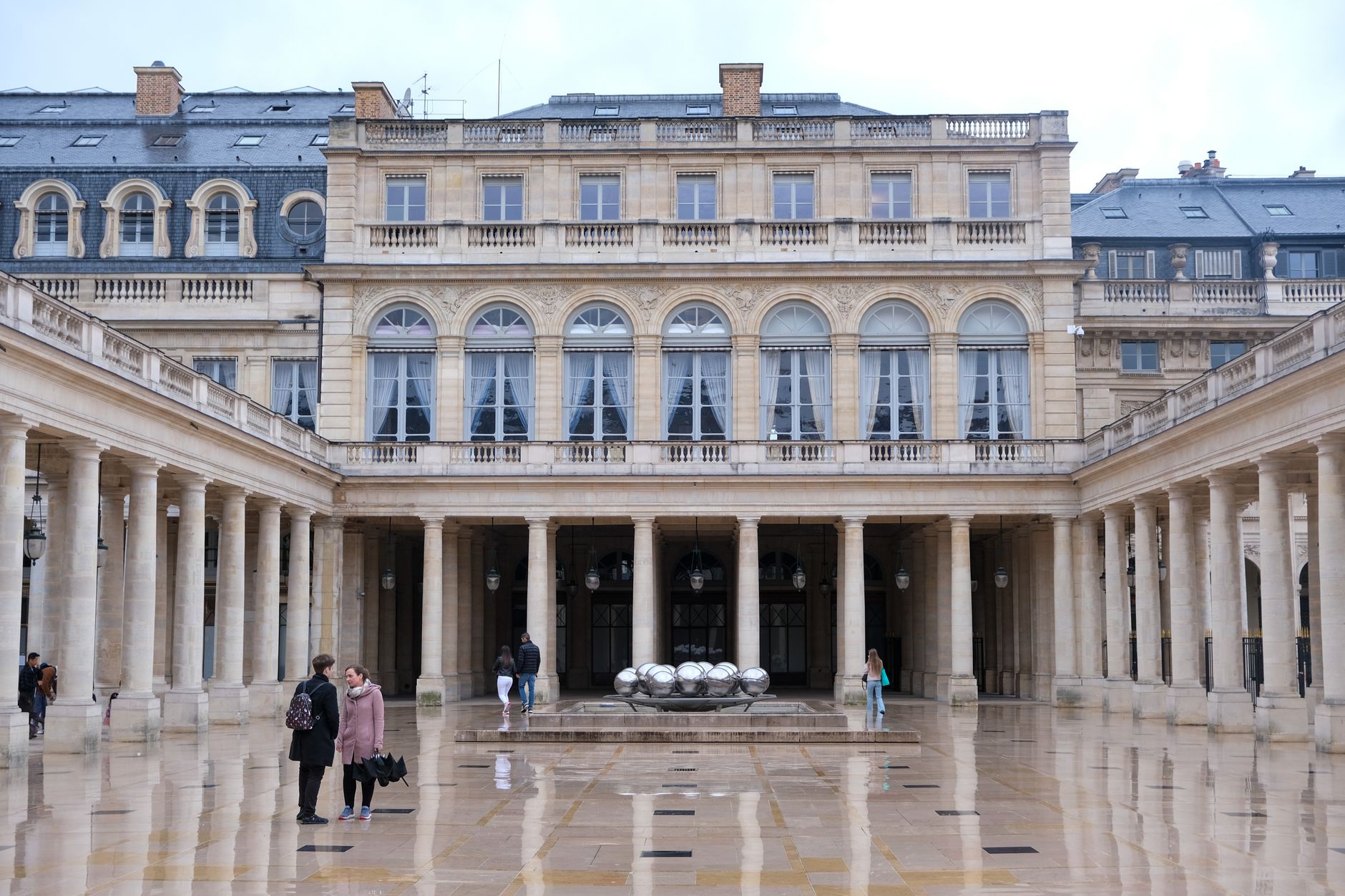
HHow does a place built for a cardinal become a shopping arcade, a revolutionary tinderbox, and one of the calmest corners in Paris, France? Palais-Royal makes that contradiction visible the moment you step under its arcades: clipped linden trees, gravel crunching underfoot, black-and-white columns full of children climbing, and a hush that feels improbable this close to the Louvre Museum. Visit because few places in Europe let you read four centuries of French power, theatre, gossip, and revolt in a single courtyard.
The surprise is not that Palais-Royal is beautiful. Paris has beauty to spare. The surprise is that this elegant rectangle of gardens and stone once held gambling dens, radical newspapers, royal apartments, and the speech that helped send a crowd toward the Bastille.
What you see today is a working civic compound disguised as a refuge. Records show the domain still houses the Ministry of Culture, the Conseil d'État, the Conseil constitutionnel, and the Comédie-Française, while the garden remains free to anyone who wants a bench, a patch of shade, or ten minutes away from the traffic of Rue de Rivoli.
Stand here long enough and the place starts to split in two. One half is serenity: pigeons pecking at the gravel, clipped box hedges, the measured rhythm of footsteps under the Galerie de Valois. The other half is memory, still close to the surface.
01 What to see.
Cour d'honneur and Buren's Columns
The Garden and Arcades
A Palais-Royal Circuit for Late Afternoon
02 In pictures.




Plan and listen to Palais-Royal with Audiala.
Audio guide in your pocket, itinerary in your browser. Built for the way you actually visit.
03 Visitor logistics.
The practical scaffolding for a good visit — kept short.
Getting There
Palais-Royal sits at 8 rue Montpensier, directly across from the Louvre Museum. The cleanest route is Metro lines 1 or 7 to Palais-Royal - Musee du Louvre; if line 14 suits your route, get off at Pyramides and walk about 8 to 10 minutes. From Tuileries Garden, the walk is about 9 minutes, and from Opera Garnier it is about 16 minutes through the 1st arrondissement's polished grid.
Opening Hours
As of 2026, the Domaine national du Palais-Royal is open daily, with no regular weekly closing day listed. Hours are 8:00-22:30 from 1 April to 30 September, then 8:00-20:30 from 1 October to 31 March; the garden stays open later than many Paris courtyards, which changes the whole mood after dinner when the arcades go quiet and footsteps start to echo.
Time Needed
Give it 20 to 30 minutes for the Buren columns, the courtyard, and a quick pass under the arcades. Most visitors need 45 to 60 minutes, while 1 to 1.5 hours gives you time to sit in the garden, notice the poem-benches, and feel how this block shifts from striped-photo stop to one of Paris's strangest calm pockets.
Accessibility
As of 2026, official accessibility information says the sidewalks and galleries are easier to access than the historic setting suggests, with built sandy ramps into the garden and a portable ramp available on request at +33 1 47 03 92 16. Guide and assistance dogs are allowed, benches are plentiful, but no public toilets and no reserved PMR parking spaces are listed nearby; the route works for many wheelchair users, though the stone surfaces and level changes are not perfectly smooth.
Cost & Tickets
As of 2026, entry to the public Palais-Royal domain is free, and you do not need a standard ticket or timed reservation. That makes it one of central Paris's best-value heritage stops by a wide margin, though some guided visits or heritage events require advance booking and the expensive part begins only if you let the arcades tempt you into lunch at Le Grand Vefour.
05 Tips for visitors.
Small things that change the day.
Photo Strategy
Take your casual photos early or near closing, when the black-and-white Buren columns stop feeling like a playground and start reading as geometry against 17th-century stone. Handheld photography is generally fine, but professional shoots need authorization from the official filming office, and a drone here is a bad idea in central Paris airspace.
Watch Your Bag
The quiet garden can fool you into relaxing too much; the risk sits at the edges, around Louvre-bound foot traffic and the metro exits. Keep phones zipped away when someone approaches with a clipboard or a too-friendly question, because fake petitions and distraction scams still work in this part of town.
Eat Nearby
For a quick stop, Cafe Kitsune under the arcades is the smart pick, budget to lower mid-range, with coffee and pastries that beat most location-tax options nearby. Cafe de la Regence at 167 rue Saint-Honore is practical budget-to-mid-range fuel, while Le Grand Vefour at 17 rue de Beaujolais is the historic splurge and Maison Ruggieri in the Galerie de Valois is the newer high-end play.
Best Time
Come soon after 8:00 if you want the place before the striped columns fill with poses and school groups. Late afternoon also works well: the light slides under the arcades, the gravel smell rises from the garden beds, and the courtyard starts to feel more like a lived Paris quarter than a checklist stop.
Pair It Well
Palais-Royal works best as a hinge, not a destination in isolation. Pair it with the Louvre Museum or the Louvre Pyramid across the road, then continue west to Tuileries Garden or east toward Place de la Concorde if you want a longer central-Paris walk.
Plan the Basics
Do not count on toilets or luggage storage inside the domain; official accessibility pages explicitly say there are no public toilets on site. Use the bathroom before you arrive, and if you are carrying bags after the Louvre Museum, leave them with a third-party storage service before coming here.
Where to Eat
Don't Leave Without Trying
Dining Tips
- check In Paris, lunch usually runs between 12:00 and 13:30, while dinner commonly starts between 20:00 and 22:30.
- check Many restaurants close on Sunday or Monday.
- check A lot of kitchens stop serving after 10:30pm.
- check Outside regular meal hours, cafes and brasseries are the safest bet for snacks, but not every place serves full meals all day.
- check If a restaurant says service continu, it serves meals continuously through the day.
- check Service is included in Paris restaurant prices, along with tax; the service portion is roughly 15 percent.
- check Food markets are generally closed on Monday.
- check Morning food markets usually run 07:00-13:30 on weekdays and up to 14:30 on weekends, while afternoon markets typically run 10:00-20:00.
Restaurant data powered by Google
04 A history of reinvention.
Where Power Still Shares a Garden With Performance
Palais-Royal has changed owners, facades, and moral reputation more than once, yet one function has held: this has remained a place where authority stages itself in public. Records show Cardinal Richelieu began building his Palais-Cardinal here after buying the site in 1624, close enough to the Louvre to watch the court and be watched in return.
That habit never quite stopped. Kings gave way to administrators, court theatre to the Comédie-Française, aristocratic promenades to ordinary Parisians on lunch break, but the same three forces still meet inside the enclosure: power, performance, and sociability.
The Duke Who Turned a Palace Into a Machine
At first glance, the arcades look like old aristocratic elegance, the sort of stone regularity Paris does better than anyone. Most visitors assume the shops, cafés, and promenades were always part of the plan, as if Palais-Royal had simply matured into a refined urban square.
But the dates don't behave. Records show those uniform commercial galleries were largely added between 1780 and 1784, when Louis Philippe Joseph d'Orléans, better known later as Philippe Égalité, was sinking under debt and needed cash fast. For him this was personal, not decorative: creditors were closing in, court prestige cost money he did not have, and the palace had to start earning like a business.
The turning point came when he hired Victor Louis and opened the grounds to rental arcades, shops, cafés, and entertainments. The revelation is almost rude in its clarity: the polished symmetry tourists admire was built as a revenue device, and that money-making enclave then became one of the freest speech zones in Paris, where pamphleteers, gamblers, courtesans, and agitators mixed under the same roof. On 12 July 1789, Camille Desmoulins used that charged atmosphere at the Café de Foy to call Parisians to arms; Philippe Égalité had tried to save his fortune, and instead helped finance the mood that destroyed his world.
Once you know that, the galleries stop looking merely graceful. They look like camouflage. Every repeated arch becomes part shopping mall, part political fuse, and the quiet garden at the center feels less innocent than composed.
What Changed
What Endured
Listen to the full story in the app
The whole Palais-Royal,
told well.
Audio guides for 1,100+ cities across 96 countries. History, stories, and local insight — offline ready.

06 Frequently asked.
The questions travellers send us most about Palais-Royal.
Is Palais-Royal worth visiting?
Yes, especially if you want one Paris stop that shifts from royal power to revolutionary gossip to near-monastic calm in under an hour. The surprise is that this polished courtyard and garden once housed gambling dens, radical pamphlets, and the speech that helped ignite July 1789. Go for the black-and-white Buren columns, stay for the hush under the arcades and the clipped garden that feels tucked behind the Louvre Museum like a secret second room.
How long do you need at Palais-Royal?
Most visitors need 45 to 60 minutes. That gives you time for the Cour d'Honneur, the striped columns, the garden basin, and a slow walk through the Valois, Beaujolais, and Montpensier arcades, where footsteps echo off stone like a covered stage set. If you only want photos, 20 to 30 minutes works; if you plan to sit with the poem benches or linger over details, allow up to 90 minutes.
How do I get to Palais-Royal from Paris?
The easiest route is the Paris Metro to Palais-Royal - Musee du Louvre on lines 1 or 7, then a short walk to 8 rue Montpensier in the 1st arrondissement. Line 14 works too, with access via nearby Pyramides, and the site also sits directly opposite the Louvre Museum, so it pairs naturally with the Tuileries Garden or Place de la Concorde. Central Paris buses including 21, 27, 39, 48, 69, 72, 81, and 95 also stop nearby.
What is the best time to visit Palais-Royal?
Early morning is best if you want the courtyard before the photo crowd, while late afternoon and early evening are best if you want softer light and a slower garden mood. Spring and early summer are the prettiest, when roses and magnolias soften the hard geometry of the arcades and the garden stays open until 22:30 from 1 April to 30 September. Winter has its own appeal: bare branches, sharper lines, and more audible footsteps under the galleries.
Can you visit Palais-Royal for free?
Yes, the Domaine national du Palais-Royal is free to enter. The public garden, courtyard, and arcades are open daily, with official hours of 8:00 to 22:30 from 1 April to 30 September and 8:00 to 20:30 from 1 October to 31 March. You do not need a standard ticket or advance booking unless you are joining a special guided event.
What should I not miss at Palais-Royal?
Do not miss the clash between Daniel Buren's Les Deux Plateaux and the old stone facades in the Cour d'Honneur. Then look for the quieter details most people miss: the Galerie des Proues with its carved prows and anchors, the little meridian cannon in the garden, and the poem chairs and benches that turn a formal garden into a place to sit and listen. And give the garden time; its long axis and central basin make the whole site read less like a monument than a room built at the scale of a city block.
Verified, and shown.
Researched and written by the Audiala editorial team from historical records, architectural archives, and local expertise.
Official opening hours, free admission, address at 8 rue Montpensier, and transport lines serving Palais-Royal.
Official historical overview of Richelieu's 1624 purchase and the palace's long political role.
Official 400th-anniversary history used for the site's transformation from royal residence to revolutionary and civic setting.
Official garden history and atmosphere, including layout, seasonal character, and the enclosed-garden experience.
Practical visit-length estimate supporting the 30-minute to 1.5-hour timing range.
Local transit detail confirming the nearest metro station and serving lines.
Official visitor guide used for Buren's Les Deux Plateaux, the arcades, and overlooked details such as the Galerie des Proues.
Official source for the meridian cannon, one of the site's most distinctive details.
Official source for the literary layer of the garden, including poem seating and the site's quieter cultural details.
Supplementary visitor information confirming free entry, seasonal hours, and the public-facing profile of the domain.
Last reviewed
Researched from Wikidata, Wikipedia & official sources · fact-checked · How we make our guides →