Introduction
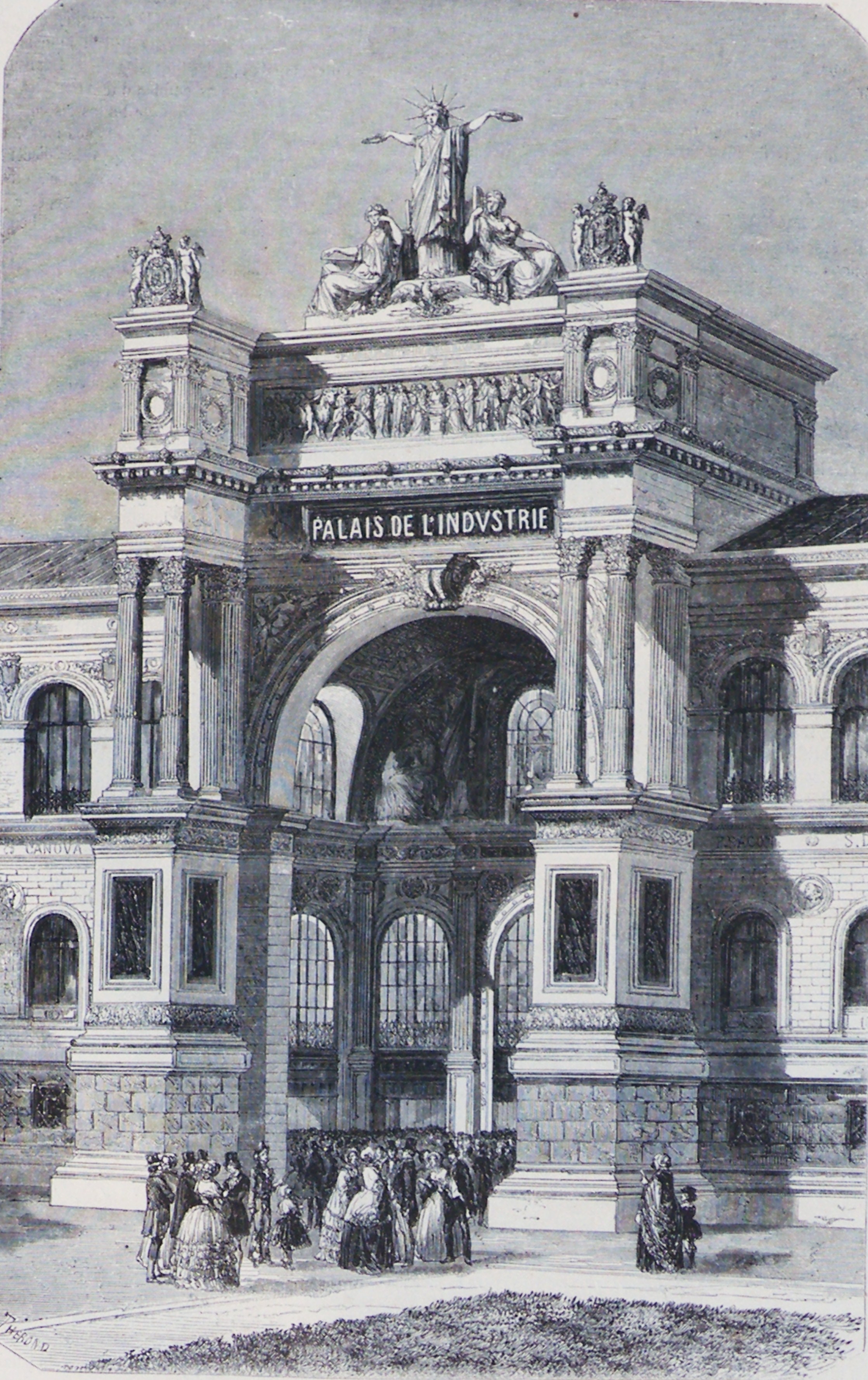
The Palais de l’Industrie, once an emblem of 19th-century French industrial and artistic achievement, played a pivotal role in the history of Paris world expositions. Built for the 1855 Exposition Universelle, this monumental structure showcased the fusion of tradition and modernity, blending classical stone with pioneering iron and glass engineering. Although demolished in 1897 to make way for the Grand Palais and Petit Palais, its legacy is vividly preserved through these successor landmarks. Today, visitors can explore the Grand Palais’s glass nave and the Petit Palais’s fine arts collections, both situated on the original site along the Champs-Élysées. This guide provides a detailed overview of the Palais de l’Industrie’s history, architectural significance, and practical visitor information for its successors and nearby historical sites.
For more on current exhibitions, visiting hours, and ticketing, consult the official pages of the Grand Palais and Petit Palais, and delve deeper into the site's history at Paris 1900 and BIE Paris.
Origins and Conception
Commissioned by Emperor Napoleon III, the Palais de l’Industrie was France’s answer to London’s Crystal Palace, aiming to display national achievements in industry and the arts at the 1855 Exposition Universelle. A design competition in 1852 selected Jean-Marie-Victor Viel (architect) and Alexis Barrault (engineer), who envisioned a structure combining masonry with cast iron supports. The result was a vast exhibition hall strategically placed between the Seine and the Champs-Élysées, marking a new era in Parisian architecture and urban planning (BIE Paris; Paris 1900).
Architectural Significance
The Palais de l’Industrie measured approximately 260 meters in length and 105 meters in width, featuring an expansive central nave with a glass ceiling supported by iron beams. Its exterior, built in stone, provided a stately façade with sculptural adornments by Élias Robert and Georges Diebolt. This blend of iron, glass, and stone was innovative for its time, influencing future exhibition halls and foreshadowing the architectural advances of the Grand Palais (Musée d'Orsay).
Major Events and Uses
Exposition Universelle of 1855
The Palais de l’Industrie was the focal point of the 1855 Exposition Universelle, welcoming over five million visitors and exhibitors from 34 nations. Showcased within its halls were innovations such as Saint-Gobain’s giant mirror, Foucault’s pendulum, early washing machines, and Samuel Colt’s revolver. The central nave displayed monumental objects, while annexes housed large machinery and engines. The event also marked the creation of the Bordeaux Wine Official Classification, a system still influential today (BIE Paris).
Later Uses
Following 1855, the Palais became the site for annual art Salons and specialty expositions, including the first International Exhibition of Electricity in 1881. These events reinforced its status as a cultural and technological hub in Paris (Paris 1900).
Decline and Demolition
By the late 19th century, the Palais de l’Industrie was considered outdated, with issues like insufficient space and poor ventilation. Demolition began in 1896, paving the way for the construction of the Grand Palais and Petit Palais, completed for the 1900 Exposition Universelle. The new avenue created along the site, Avenue Winston Churchill, established a grand urban axis from the Champs-Élysées to Les Invalides (Paris 1900).
Visiting Today: Grand Palais, Petit Palais, and Nearby Historical Sites
The Site Today
- Grand Palais: An architectural marvel of Beaux-Arts style, the Grand Palais is renowned for its glass nave and iron framework. It hosts major art exhibitions, fashion events, and cultural gatherings.
- Petit Palais: Directly across Avenue Winston Churchill, the Petit Palais houses the City of Paris Museum of Fine Arts, offering permanent collections and temporary exhibitions in a tranquil setting.
Both buildings are situated on the Champs-Élysées, close to the Seine, and continue the Palais de l’Industrie’s legacy as vibrant cultural institutions (Grand Palais; Petit Palais).
Visiting Hours and Tickets
-
Grand Palais:
- Open Tuesday to Sunday, 10:00 AM–6:00 PM (late opening Thursdays until 10:00 PM for select exhibitions).
- Closed Mondays and certain holidays.
- Ticket prices: Generally €15–€20 for adults, with discounts for students, seniors, and EU residents under 26.
- Advance online booking recommended (Grand Palais Tickets).
-
Petit Palais:
- Open Tuesday to Sunday, 10:00 AM–6:00 PM; closed Mondays.
- Free entry for permanent collections; temporary exhibitions may require a ticket (Petit Palais Tickets).
Accessibility and Travel Tips
- Accessibility: Both venues are wheelchair accessible and offer adapted facilities. Wheelchairs are available on request.
- Getting There:
- Metro: Champs-Élysées – Clemenceau (Lines 1, 13), Franklin D. Roosevelt (Lines 1, 9)
- Bus: Lines 28, 42, 72, 73, 80, 83, 93
- RER: Line C (Invalides)
- Tips:
- Arrive early or visit late for fewer crowds.
- Non-flash photography is generally allowed, but check for exhibition-specific rules.
- Combine your visit with the Petit Palais or a stroll along the Seine for a full day of exploration.
Other Paris Historical Sites Nearby
- Champs-Élysées: Paris’s iconic avenue, home to luxury shops, theaters, and cafés.
- Place de la Concorde: Historic square with fountains and the Luxor Obelisk.
- Musée d’Orsay: Famed museum hosting Impressionist masterpieces in a converted railway station.
- Pont Alexandre III: Ornate bridge offering panoramic views of the Grand Palais and Eiffel Tower.
Frequently Asked Questions (FAQ)
Is the Palais de l’Industrie still standing?
No, the original building was demolished in 1896–97. The Grand Palais and Petit Palais now occupy the site.
Can I visit the Palais de l’Industrie?
While the structure no longer exists, its successors—the Grand Palais and Petit Palais—are open to visitors and continue its legacy.
What are the Grand Palais visiting hours and ticket prices?
Typically open Tuesday to Sunday, 10:00 AM–6:00 PM, with late openings on Thursdays. Tickets for major exhibitions range from €15–€20.
Are guided tours available?
Yes, both venues offer guided tours and audio guides in multiple languages. Advance booking is advised for peak periods.
Is the Grand Palais accessible for people with disabilities?
Yes, both the Grand Palais and Petit Palais provide accessible entrances, elevators, and adapted restrooms.
Can I take photos inside?
Non-flash photography is usually permitted in public areas; some exhibitions may restrict photography.
Listen to the full story in the app
Your Personal Curator, in Your Pocket.
Audio guides for 1,100+ cities across 96 countries. History, stories, and local insight — offline ready.
Audiala App
Available on iOS & Android
Join 50k+ Curators
Sources
- verified
- verified
- verified
- verified
- verified
- verified
- verified
- verified
Last reviewed:


