An introduction.
Researched by the Audiala editorial team from historical records, architectural archives, and local expertise.
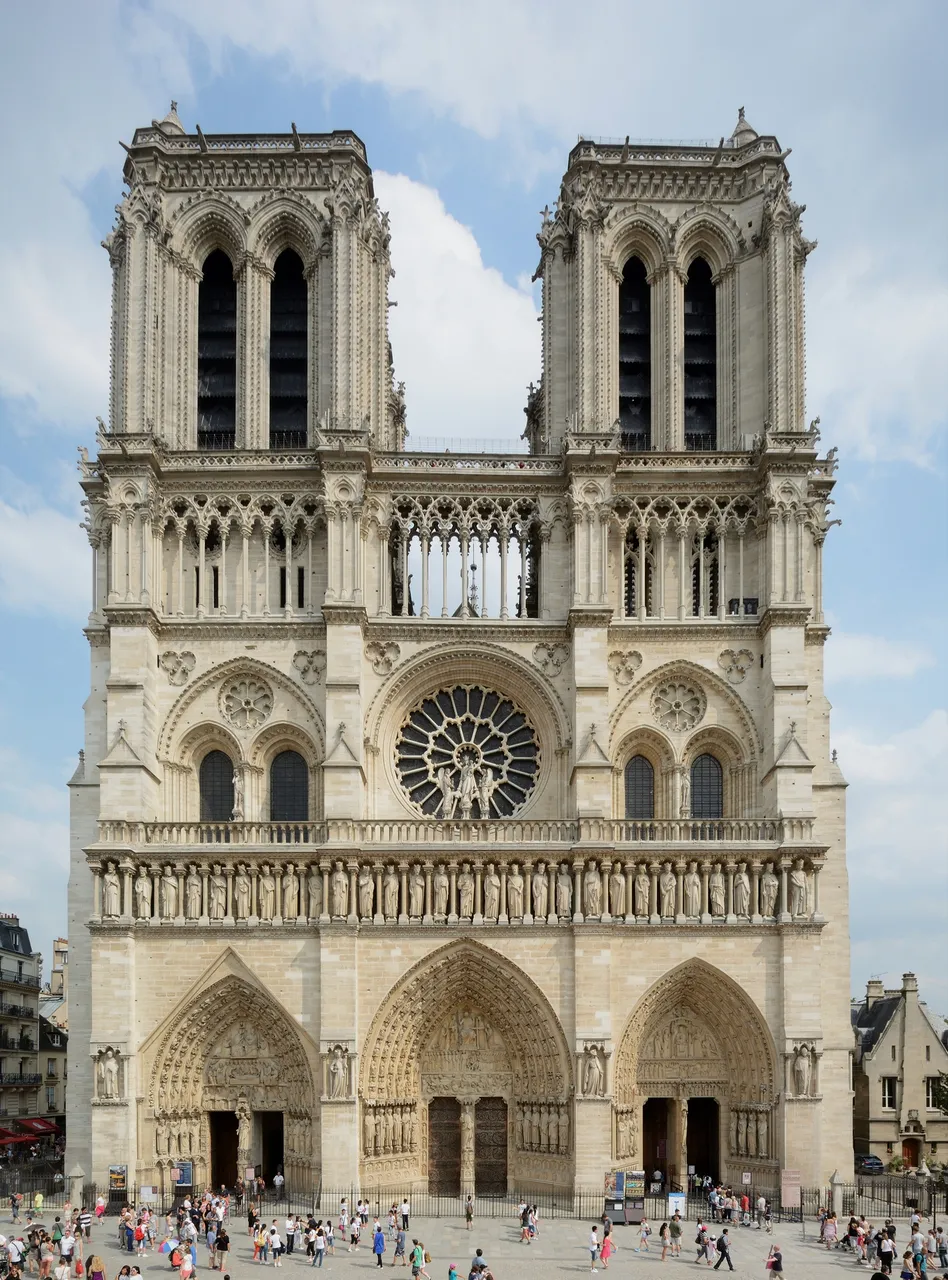
LLook up at the spire of Notre-Dame de Paris and you're looking at a 19th-century invention rebuilt in 2024 — and at the face of the man who designed it, sculpted into the saint at its base, signing his own cathedral. The medieval Notre-Dame everyone comes to see is half a brilliant 1860s reimagining, and that's before you reach the chimeras, the gallery of kings, or the gargoyles. Today the cathedral on the Île de la Cité smells of fresh oak and beeswax, its limestone scrubbed back to cream after eight centuries of soot, the choir of the Maîtrise filling a nave that's been rebuilt twice in two hundred years. You should come for the most argued-over building in France — a working cathedral that survived revolution, a novelist, a fire, and the very architects who saved it.
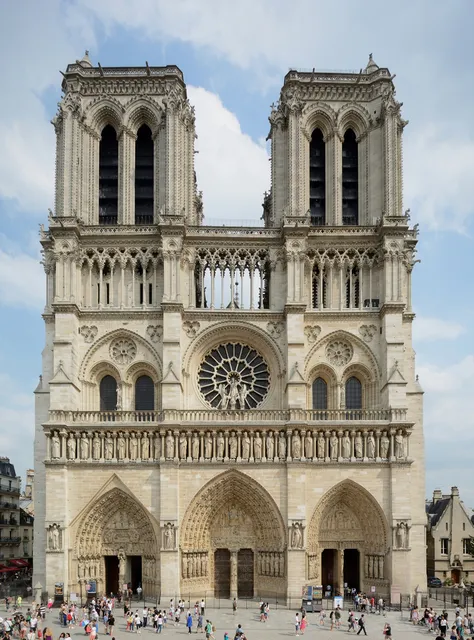
Construction began in 1163 under Bishop Maurice de Sully, with Pope Alexander III in attendance. Records show the choir, ambulatory, nave and aisles rose between 1163 and 1225; the high galleries, first spire and twin western towers followed by 1250. The rest — transept arms, rose windows, choir chapels — trickled on for centuries. Île de la Cité had carried Christian worship since the 4th century, layered over a Gallo-Roman temple. Notre-Dame was the latest church on a very old plot.
Free entry, no ticket, no exception. The official site is resa.notredamedeparis.fr — every other 'skip-the-line' page is a scam, and there are many. Optional reservations open only hours before each slot, deliberately, to favour visitors already in Paris over tour aggregators. Show up at the parvis, queue, walk in. Worshippers have their own queue opposite the Last Judgement portal — that one moves faster but it's for people coming to pray, not to photograph the rose windows.
Time the visit around the music. Sunday Gregorian Mass at 10am is a thread back to the 12th-century Notre-Dame School that birthed Western polyphony — the same building where Léonin and Pérotin worked out how to stack voices. Friday afternoons, 3pm to 6.30pm, the Crown of Thorns is brought out for veneration. Whatever you think of relics, the procession is theatre 800 years deep.
01 What to see.
The North Rose Window
Walk into the transept around midday and look left. The north rose, built circa 1250, still holds most of its original 13th-century glass — the only one of the three roses where the medieval blues survive nearly untouched. That deep cobalt isn't a color you've seen before. It's almost underwater, almost bruised, and on a bright day it spills across the cleaned limestone floor in pools you can step through.
Get close and the irregularities give the glass away. Tiny bubbles, ripples, thicknesses that catch light differently across a single petal. Eight centuries of hand-blown imperfection, doing exactly what the glaziers wanted.
Most visitors face the altar and miss it. Don't.
The Spire and the Apostles Who Cheated Death
The new flèche went up in 2023, an exact replica of Viollet-le-Duc's 1859 oak-and-lead spire that collapsed live on television in April 2019. 96 metres, capped by a golden rooster containing a thorn from the Crown, a relic of Saint Geneviève, and a parchment listing the 2,000 workers who rebuilt her.
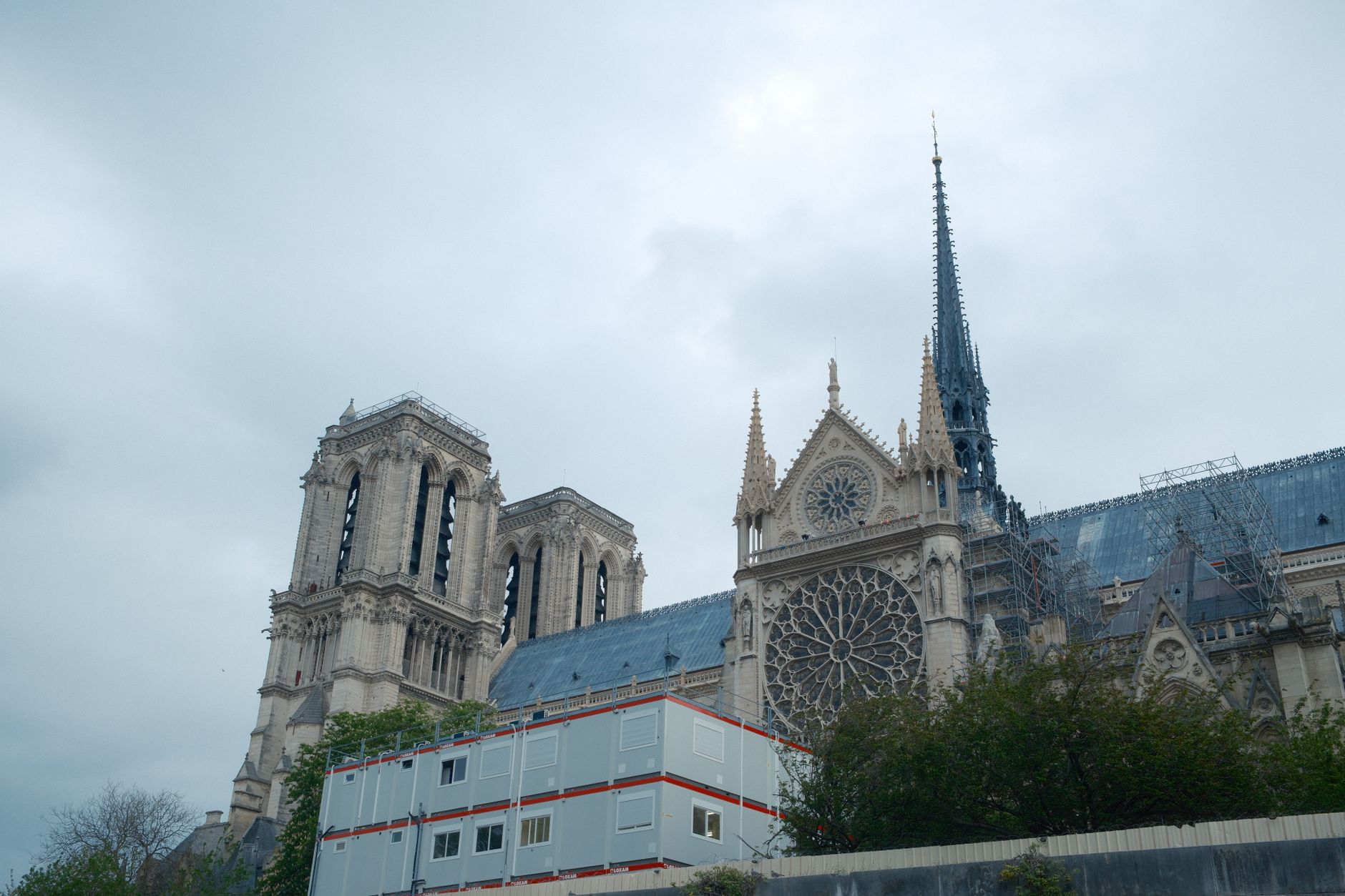
The sixteen copper apostles ringing the spire's base have a stranger story. Four days before the fire, they were craned down for restoration. Four days. Look closely at Saint Thomas, patron of architects — that's Viollet-le-Duc's own face, turned sideways to admire his own spire. The best view is from the apse garden behind the cathedral, where the flying buttresses fan out like a rib cage.
A Walk Around the Île de la Cité
02 In pictures.




Plan and listen to Notre-Dame de Paris with Audiala.
Audio guide in your pocket, itinerary in your browser. Built for the way you actually visit.
Tickets & tours.
These are guided options from our partners — same price as booking direct.
Prices are indicative — final pricing and availability are confirmed at checkout. Audiala may earn a commission from bookings made through these links.
Also on GetYourGuide
More tours for Notre-Dame de Paris
Curated from GetYourGuide. Same price as official, free cancellation on most.
 GetYourGuide
Paris: Big Bus Hop-On Hop-Off Tour with Optional Cruise
from
€39
 GetYourGuide
Paris:Notre Dame Premium Guided Tour and Free Entry Included
from
€10
 GetYourGuide
Paris:Notre-Dame Cathedral Interior and Exterior Guided Tour
from
€19
 GetYourGuide
Paris: Notre Dame Cathedral Tour with a French-Speaking Live Guide
from
€10
Prices shown are indicative — final pricing and availability are confirmed at checkout. Audiala may receive a commission from bookings made via these links.
03 Visitor logistics.
The practical scaffolding for a good visit — kept short.
Getting There
Metro line 4 to Cité drops you 90 seconds from the parvis; RER B/C to Saint-Michel–Notre-Dame is the fastest from the airports. From the Right Bank, walk via Pont d'Arcole; from the Latin Quarter, cross Pont au Double for the postcard approach. Skip the car — Île de la Cité parking is paid and scarce, with Lutèce–Cité (Bd du Palais) the closest garage.
Opening Hours
As of 2026, the cathedral opens Mon–Wed and Fri 8:00–19:00, Thu late until 22:00, and weekends 8:15–19:30. The towers (separate CMN ticket) run 9:00–23:00 from April through September and 9:00–17:30 October through March, last entry one hour before close. Sat 9 May 2026 is Nuit des Cathédrales — free entry until 22:00, no reservation needed.
Time Needed
A focused walk through the nave, ambulatory chapels, and rose windows runs 30–45 minutes. Add the Treasury and you're at 90 minutes to two hours. Tack on the 424-step tower climb for another full hour, including the timed-entry queue.
Cost & Tickets
Cathedral entry is 100% free, no ticket required. Reservation via resa.notredamedeparis.fr is optional and only opens two days out — anything claiming advance paid tickets is a scam. Treasury costs €10, towers €16 (CMN), and disabled visitors plus one companion enter the Treasury free with proof.
Accessibility
Wheelchair entry is via the central Portal of Last Judgment; exit through the north Portal of the Virgin with staff assist. A lift platform reaches the ambulatory, ramps serve the side chapels via call buttons, and hearing loops sit at both welcome desks. The cathedral does not loan wheelchairs — bring your own — and there are no public toilets inside (free ones on rue d'Arcole).
04 Tips for visitors.
Small things that change the day.
Petition Scam
The parvis is ground zero for the fake deaf-mute clipboard hustle — a woman thrusts a petition while an accomplice works your back pocket. Wave them off without breaking stride and keep your phone out of your hands when crossing the square.
Better Camera Angle
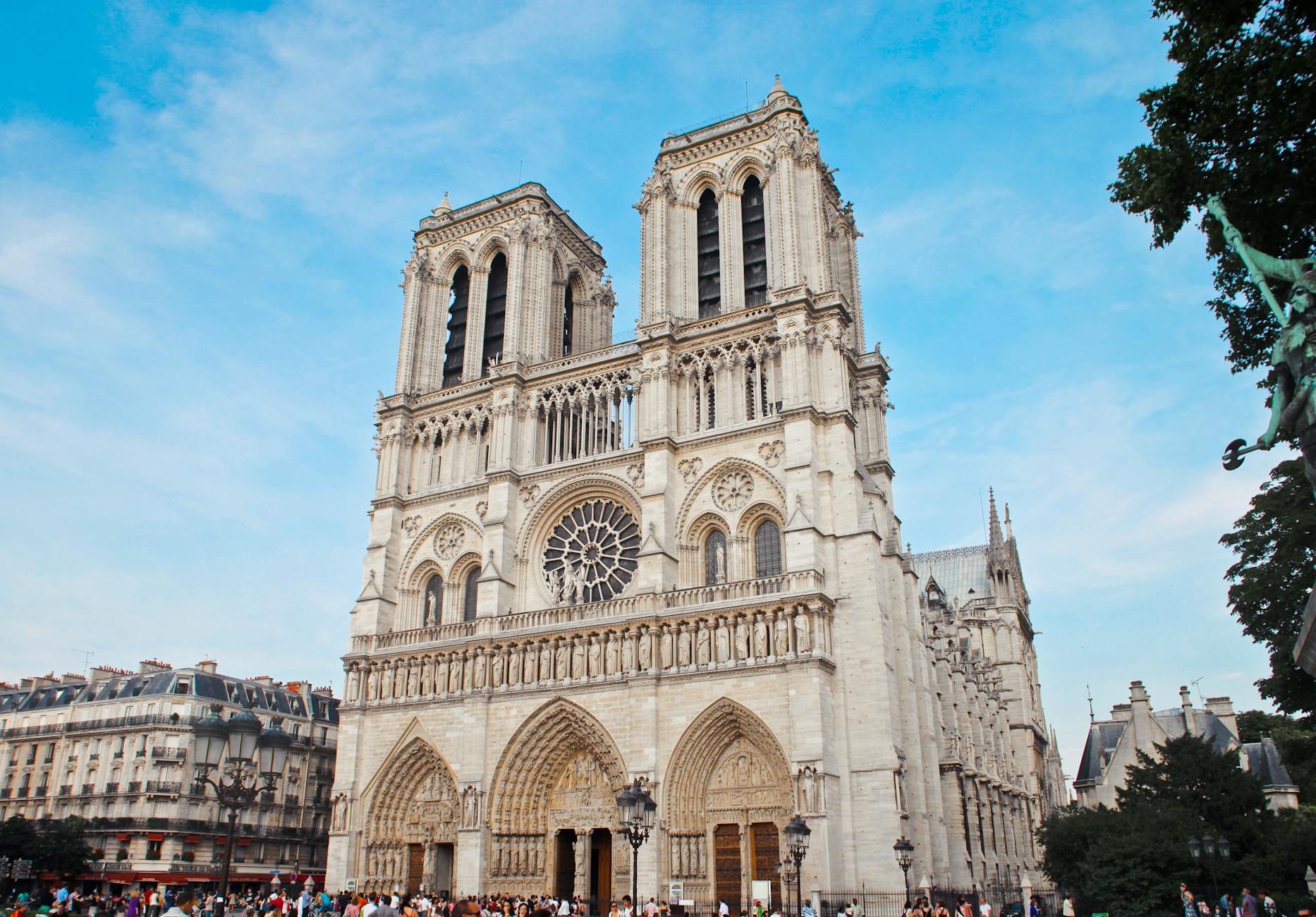
The parvis gives you a flat headshot of the façade with 400 selfie sticks in frame. Walk five minutes to Pont de la Tournelle for the chevet view — flying buttresses fanning out over the apse, the spire rising clean above the roof.
Dress Modestly
Cover shoulders and torso, hats off inside, no transparent or tight clothing — staff at the door will turn you back. Phones on silent; the nave amplifies every notification ping straight to the rose windows.
No Flash, No Tripod
Personal photos are fine in the cathedral, but flash and tripods are banned, especially during the 8h, 12h, and 18h masses. Drones are forbidden across all of Île de la Cité — the Préfecture de Police is next door and they enforce it.
Where Locals Actually Eat
Skip every café on the parvis and rue d'Arcole — overpriced tourist traps with English-only menus. Cross Pont Saint-Louis to Île Saint-Louis for Berthillon ice cream at 31 rue Saint-Louis-en-l'Île (~€5/scoop), or walk five minutes south into the Latin Quarter for a bistro lunch formule at €18–28.
Beat the Crowds
Slip in for the 8h weekday mass or after 18h on Thursday's late opening — between 10h and 17h the nave moves at shuffle pace. Square Jean-XXIII behind the apse is your free quiet bench when you need to sit.
Combine Nearby Monuments
A single Centre des Monuments Nationaux ticket covers Sainte-Chapelle (the stained-glass jewel two minutes away) and the Conciergerie (Marie-Antoinette's cell) — both on the same island as Notre-Dame. Tower tickets are sold separately and must be reserved online.
Step on Point Zéro
The brass star embedded in the parvis is Kilomètre Zéro — every road distance in France is measured from this spot. Parisian superstition says step on it and make a wish to guarantee your return to Paris.
Where to Eat
Don't Leave Without Trying
Les Deux Colombes
local favoriteOrder: The duck confit is the undeniable star of the show, followed by their buttery escargot.
This is an intimate, authentic gem where the menu is strictly French and the atmosphere feels like a true Parisian neighborhood secret.
Kozy
cafeOrder: The Sexy Benny Egg and the cherry pancakes are absolute musts.
It draws a crowd for a reason—the coffee is high-quality and the brunch plates are as photogenic as they are delicious.
La Crème de Paris Notre-Dame
quick biteOrder: Their traditional French crêpes are the main attraction, perfect for a sweet or savory meal.
Perfectly positioned for a post-Notre Dame treat, this spot delivers the classic Parisian crêperie experience with reliable consistency.
Loulou
local favoriteOrder: The Bali Bowl with poached eggs is a standout for a healthy, satisfying start to your day.
A friendly, vintage-style diner that is exceptionally accommodating to dietary restrictions like gluten-free needs.
Dining Tips
- check A 15% service charge is included by law; tipping is not required, though rounding up for good service is appreciated.
- check Cash is preferred at market stalls, even when card terminals are present.
- check Monday is a common closing day for many restaurants and food markets in Paris.
- check Lunch service peaks sharply around 13:00.
- check When buying bread, look for pointed ends—these signify an artisan-made baguette.
Restaurant data powered by Google
05 Eight Centuries of the Same Prayer
Notre-Dame has burned, been ransacked, been turned into a Temple of Reason, hidden behind cardboard for Napoleon's coronation, and lost its roof to flames twice. What hasn't changed is the function. Records show this site has hosted Christian worship since the 4th century — first a Gallo-Roman temple, then an early Christian basilica, then the cathedral whose first stone Maurice de Sully laid in 1163. Bishops have governed Paris from this spot for over a thousand years; archbishops since 1622.
The continuity is liturgical, not architectural. Every weekday at 8am, noon and 6pm, Mass is said. Every Sunday at 10am, the choir of the Maîtrise sings Gregorian chant — the institutional descendant of the school that invented polyphony here in the 1100s. Every Friday afternoon, the Crown of Thorns, in Paris since Louis IX bought it in 1239, is exposed for veneration. The stones change. The schedule does not.
Eugène Viollet-le-Duc and the Cathedral That Wasn't
What appears true: the Notre-Dame you photograph — chimeras leering from the towers, gallery of kings above the portals, the slim lead spire — is the medieval cathedral Victor Hugo wrote about in 1831. The novel saved the building from demolition; the rest is original Gothic.
What doesn't add up: Hugo's novel is from 1831, but the restoration commission only opened in 1844, and most of the 'medieval' detail you see was carved between 1844 and 1865. Auguste Rodin accused the restoration architects of 'destroying Notre-Dame with their fantasies.' A 1914 paper said they had 'delivered a cathedral which had never existed, at any time.' Why would the most famous medieval church in France be largely a 19th-century reconstruction?
The revelation: by 1844 Notre-Dame was a wreck. The 1st spire had been dismantled in 1792, the kings of Israel above the portals decapitated, the treasure melted, the building used as a Temple of Reason in 1793 and then a warehouse. For Napoleon's 1804 coronation it was so dilapidated they hid the walls behind wood, cardboard, stucco and silk drapery. After the 1830–31 riots smashed the stained glass and torched the archbishop's palace, the state seriously considered demolition. Eugène Viollet-le-Duc (1814–1879) and Jean-Baptiste-Antoine Lassus won the restoration competition in 1844; Lassus died in 1857; Viollet-le-Duc finished alone, working from an office in the south tower, supervising stonemasons, sculptors, glassmakers, carpenters. He didn't restore — he invented. The chimeras are his. The Stryge with its tongue out is his, sculpted in the 1850s after a name borrowed from Roman vampire-witches. The 96-metre spire unveiled on 18 August 1859 was 18 metres taller than the medieval one. The gallery of kings is his reconstruction. He even sculpted himself as Saint Thomas, patron of architects, on the spire base, holding a ruler and gazing up at his own work. He signed the cathedral.
What changes when you know: the gargoyles aren't medieval and that's the point. You're standing in a building that was salvaged by being reimagined — twice. After the fire of 15 April 2019 melted Viollet-le-Duc's spire, Macron announced an international competition for a contemporary replacement. Public outcry forced him to abandon it. The new spire, rooster placed on 16 December 2023 and unveiled on 13 February 2024, is an identical rebuild of the 1859 reinvention. The man Rodin said had destroyed Notre-Dame is now considered so untouchable that France rebuilt his fantasy beam-for-beam. Look up. Saint Thomas is still there, still holding his ruler, still signing.
What Changed
What Endured
Listen to the full story in the app
The whole Notre-Dame de Paris,
told well.
Audio guides for 1,100+ cities across 96 countries. History, stories, and local insight — offline ready.
06 Frequently asked.
The questions travellers send us most about Notre-Dame de Paris.
Is Notre-Dame de Paris worth visiting after the fire?
Yes, more than ever. The post-fire restoration cleaned 42,000m² of stone back to cream-gold limestone, so the interior glows in a way no living visitor has seen before. Entry is free, and the rebuilt spire and roof are already in place.
How long do you need at Notre-Dame de Paris?
Plan 30–45 minutes for the nave and ambulatory, 1.5–2 hours if you add the treasury, plus another hour for the towers. Mass and Vespers add 45–60 minutes if you want to hear the Maîtrise choir under the restored 6–8 second reverb.
Do you need to book tickets for Notre-Dame de Paris?
No ticket is required and entry is 100% free. A free reservation via resa.notredamedeparis.fr is recommended and only opens a day or two before your visit, never weeks ahead. The treasury costs €10 and the towers around €16, both managed separately.
How do I get to Notre-Dame de Paris?
Metro line 4 to Cité or Saint-Michel drops you on the Île de la Cité, two minutes from the parvis. RER B and C stop at Saint-Michel–Notre-Dame, and bus 47 runs along the island. Address: 6 Parvis Notre-Dame, 75004.
What is the best time to visit Notre-Dame de Paris?
Arrive at the 8h weekday Mass or after 18h on Thursdays when the cathedral stays open until 22h. The 10h–17h window draws the heaviest crowds, and autumn light through the rose windows beats peak summer for both atmosphere and queues.
What should I not miss at Notre-Dame de Paris?
The north rose window holds mostly original 13th-century glass, the deepest blue you'll see in Paris. Look up at the choir vault for the Virgin standing on a crescent moon, find Viollet-le-Duc's self-portrait as Saint Thomas at the spire base, and step on the Point Zéro brass marker on the parvis.
Can you climb the towers of Notre-Dame de Paris?
Yes, the towers reopened 20 September 2025 with mandatory online reservation. The climb is 422–424 steps to the Galerie des Chimères and the south tower, where the 1681 bourdon Emmanuel still rings in F#. Tickets run around €16 and are managed by the Centre des Monuments Nationaux, separate from cathedral entry.
What scams should I avoid at Notre-Dame de Paris?
The parvis is one of Paris's worst spots for the fake-petition and deaf-mute clipboard scam, where a distraction lets an accomplice pickpocket you. Watch for the three-cup shell game, fake metro staff at Saint-Michel, and watch-snatching at terrace cafés. Buy metro tickets only at machines, and keep valuables zipped on lines 4 and RER B/C.
Verified, and shown.
Researched and written by the Audiala editorial team from historical records, architectural archives, and local expertise.
Official heritage notice — construction phases, Robert de Cotte choir, archbishopric 1622, Viollet-le-Duc restoration end 1865
Heritage notice confirming foundation 1163 under Maurice de Sully
Mass times, Vespers, confession hours
Booking window rules and fake-ticket warning
Metro, RER, bus, Vélib' and parking around the cathedral
Wheelchair access, lift, ramps, treasury pricing, no public toilets inside
Daily opening hours and Thursday late-night opening to 22h
Door-knocking rite, organ awakening dialogue, 7–8 December 2024 program
Friday veneration schedule for the Crown of Thorns
Tower opening hours, last entry, seasonal schedule
Updated 2025–2026 hours, Mass schedule, animations
Octave of reopening, communities honored each day, Crown return 13 Dec 2024
Three-spire history, Bellu, Viollet-le-Duc Saint Thomas, rooster relics
Spire debate, lead toxicity, contemporary stained glass row
Bardet liturgical furniture and interior modernization debate
Cleaned limestone, light, restored 12-second reverberation
Choir vault keystone Virgin and Child oculus and other interior details
Le Stryge, Galerie des Chimères, Viollet-le-Duc's 19th-century inventions
Local sentiment, Point Zéro tradition, Viollet-le-Duc share, Cluny king heads
Neighborhood character, Marché aux Fleurs, Crypte Archéologique
Alternate opening-hours variant and visit timing
Towers reopening 20 Sep 2025, abords redesign by Bas Smets, restoration to 2027
Parvis café traps, formule lunch tip, watch-theft caution at terraces
Petition, shell game, fake metro staff scams centered on Notre-Dame area
Pickpocket hotspots on metro line 4 and RER B/C Saint-Michel
Accessible bus and metro routing toward Île de la Cité
Tower ticket price reference and reopening phasing
1991 inscription including Notre-Dame in the property
ICOMOS/ICCROM advisory mission and conservation oversight
Official ostension dates and rules of veneration
Choir school heritage from 12th-century Notre-Dame School polyphony
Researched from Wikidata, Wikipedia & official sources · fact-checked · How we make our guides →