Introduction
The Fontaine des Mers, located on the southern side of Place de la Concorde, is one of Paris’s most celebrated monuments. This 19th-century neoclassical fountain is not only a masterpiece of artistic and engineering achievement but also a vibrant symbol of France’s maritime legacy. Designed by Jacques-Ignace Hittorff and adorned with allegorical figures, it stands as a testament to the city’s urban transformation and cultural aspirations during the era of King Louis-Philippe. This comprehensive guide covers the fountain’s historical significance, artistic features, practical visiting information—including hours, accessibility, and nearby attractions—and tips for making the most of your experience at this iconic landmark.
For further exploration, see sources such as Culture Themes, Wikipedia, and C'est en France.
Photo Gallery
Explore Fontaine Des Mers in Pictures

Historic evening photograph of the fountain at Place de la Concorde in Paris taken in 1935 by Willem van de Poll, showcasing urban fountains and cityscape in France.

Photograph of the Place de la Concorde in Paris featuring the central obelisk and ornate fountain, with surrounding palaces, Rue Royale, and the Church of the Madeleine visible in the background.
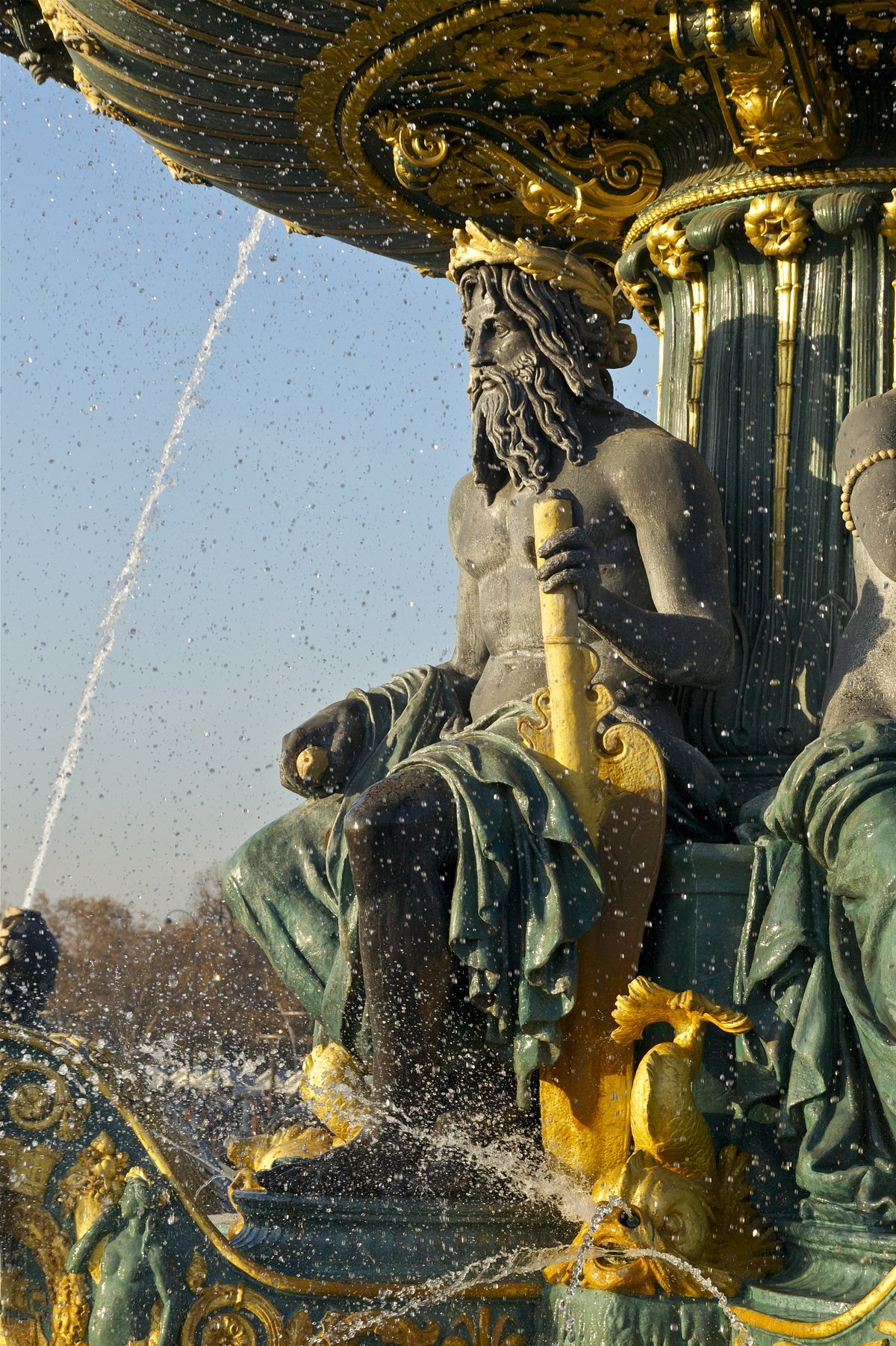
Close-up detail of the Fountain of the Seas, located at the southern part of Concorde Square in Paris, designed by Hittorff and Debay.

Close-up of a dolphin sculpture featured in the Fountain of the Seas located at Place de la Concorde in Paris, showcasing intricate artistic details.

Detailed view of the Fountain of the Seas located in Concorde Square, Paris, showcasing its intricate sculptures and water features.

Detailed view of the ornate Fountain of the Seas located at Place de la Concorde in Paris, showcasing sculptures and intricate design elements.

Close-up detail of the Fountain of the Seas located at Concorde Square in Paris, showcasing ornate marine-themed sculptures.
Historical Background and Urban Context
The Fontaine des Mers is one of two monumental fountains that grace Place de la Concorde—Paris’s largest and historically most significant public square. Conceived as part of a major urban redesign led by architect Jacques-Ignace Hittorff between 1836 and 1846, it was inspired by the harmonious layouts of Roman piazzas such as Piazza Navona and St. Peter’s Square (Culture Themes; Wikipedia). This redesign brought together neoclassical architecture, innovative waterworks, and grand symbolism.
The Luxor Obelisk and Fountain Placement
Central to the square is the Luxor Obelisk, a 3,300-year-old monument gifted by Egypt in 1831 and erected in 1836 (Wikipedia). Hittorff placed the Fontaine des Mers to the south (toward the Seine), and its twin—the Fontaine des Fleuves—to the north, creating a symmetrical ensemble that frames the obelisk and anchors the vast open space.
Artistic Design, Materials, and Allegorical Themes
Architectural Design and Materials
Completed in 1840, the Fontaine des Mers rises nearly nine meters above its circular basin. It is constructed primarily from cast iron with a bronze finish and gilded highlights, ensuring both durability and intricate sculptural detail (Travel France Online). Water cascades from a central pedestal through two superimposed basins, creating a dynamic display that animates the heart of the square.
Allegorical Program
The fountain’s iconography pays tribute to France’s maritime achievements:
- Upper Basin: Figures represent Maritime Navigation, Astronomy, and Trade, each holding appropriate attributes.
- Lower Basin: Six seated female allegories symbolize the Mediterranean and Atlantic oceans and the industry of fishing.
- Decorative Details: Tritons and nereids, classical sea deities, hold dolphins that spout water. These figures, rich in marine motifs—coral, shells, fish—are adorned with intricate jewelry and textiles, showcasing the artistry of sculptors such as Jean-François-Théodore Gechter and François Lanno (C'est en France).
Symbolism and National Identity
The maritime theme reflects both the nearby Ministry of the Navy and France’s reliance on the sea for commerce and defense. The inclusion of Paris’s coat of arms on the boats beneath the allegorical figures ties the monument to the city’s identity (Travel France Online).
Lighting and Nighttime Ambience
At night, the fountain is dramatically illuminated. Spotlights highlight the bronze forms and the shimmering water, enhancing its sculptural beauty and creating an enchanting atmosphere ideal for evening strolls and photography (Evendo).
Integration with Surrounding Landmarks
The Fontaine des Mers harmonizes with the neoclassical facades of the Hôtel de la Marine and Hôtel de Crillon, both designed by Ange-Jacques Gabriel. The nearby Tuileries Garden and the start of the Champs-Élysées further reinforce Place de la Concorde’s role as a nexus of Parisian art and history (Paris by Emy).
Visiting Fontaine des Mers: Hours, Tickets, and Accessibility
- Visiting Hours: As an outdoor monument, Fontaine des Mers is accessible 24 hours a day, seven days a week.
- Tickets: There is no entry fee; access is free at all times.
- Accessibility: The square and the area around the fountain are generally wheelchair accessible, with smooth pavements and curb ramps. Some cobblestone and uneven surfaces exist, so visitors requiring assistance may benefit from a companion or accessible guided tours.
- Getting There:
- Metro: Concorde station (Lines 1, 8, 12) is directly adjacent.
- Bus: Lines 24, 42, 52, 72, 73, 84, and 94 serve Place de la Concorde.
- Walking/Bicycle: Easily reached from the Tuileries Garden, the Louvre, and the Champs-Élysées. Vélib’ bike stations are nearby.
Guided Tours, Photography Tips, and Nearby Attractions
Guided Tours
Many Paris walking tours include Place de la Concorde and the Fontaine des Mers. These tours provide deeper insights into the fountain’s history and symbolism. Accessible options can be arranged through the Paris tourism office or specialized providers (Discover Walks).
Photography Tips
- Best Times: Early morning and late evening are ideal for photography thanks to softer light and fewer crowds.
- Night Photography: The illuminated fountain offers striking photo opportunities after dusk. Bring a tripod for long exposures.
Nearby Attractions
- Obelisk of Luxor: Ancient Egyptian monument at the center of the square.
- Tuileries Garden: Historic park with sculptures and seasonal flower displays.
- Musée de l’Orangerie: Renowned for Monet’s Water Lilies, just across the garden.
- Champs-Élysées: World-famous avenue beginning at Place de la Concorde.
- Hôtel de la Marine: Newly restored historic building open for tours.
Cultural Significance and Urban Mythology
The fountain’s allegorical figures, marine motifs, and grand scale narrate France’s relationship with the sea, commerce, and navigation. Urban legends tell of illuminated figures seeming to come alive during the fountain’s inauguration, adding to its mythical aura (Secret Parisien). Its location—once a site of revolutionary executions—now symbolizes harmony and civic pride.
Symbolic Dialogue with Fontaine des Fleuves
Fontaine des Mers forms a symbolic pair with the Fontaine des Fleuves on the northern side of Place de la Concorde. While the southern fountain celebrates maritime pursuits, the northern honors France’s rivers and agricultural bounty. Together, they embody the dual foundations of the nation’s prosperity (Wikipedia; Klook).
Sustainability and Preservation
Maintained by the City of Paris, the fountain undergoes regular cleaning and restoration. Visitors are encouraged to help preserve this heritage by not littering and respecting public space guidelines.
Official information is available through the Paris tourism website.
Frequently Asked Questions (FAQ)
Q: What are the visiting hours for Fontaine des Mers?
A: The fountain is accessible 24/7 as it is an outdoor public monument.
Q: Is there an entry fee or tickets required?
A: No, visiting Fontaine des Mers is free.
Q: Are guided tours available?
A: Yes, both free and paid walking tours often include the fountain.
Q: Is the site wheelchair accessible?
A: The area is generally accessible, with flat terrain and ramps; some uneven pavements may be present.
Q: What is the best time to visit?
A: Early mornings and evenings offer the best lighting and fewer crowds; nighttime illumination is particularly beautiful.
Q: What attractions are nearby?
A: Obelisk of Luxor, Tuileries Garden, Champs-Élysées, Musée de l’Orangerie, and the Louvre.
Listen to the full story in the app
Your Personal Curator, in Your Pocket.
Audio guides for 1,100+ cities across 96 countries. History, stories, and local insight — offline ready.
Audiala App
Available on iOS & Android
Join 50k+ Curators
Sources
- verified
- verified
- verified
- verified
- verified
- verified
- verified
- verified
Last reviewed: