Introduction
How does a man get a building named after him that he never saw? Georges Pompidou announced this cultural centre on Plateau Beaubourg in October 1972, died in April 1974, and missed the inauguration entirely — his rival Valéry Giscard d'Estaing cut the ribbon on 31 January 1977. The Centre Pompidou stands now at the medieval heart of Paris, France: 166 metres of blue ducts, yellow conduits, green pipes and red pedestrian tubes worn on the outside like a body turned inside out. Come for Picasso, Kandinsky, Matisse and Brancusi inside the MNAM. Stay for panoramic city views from the glass caterpillar escalator. Linger on the sloped piazza where buskers have pulled crowds since opening day.
Critics hated it. They called it 'Notre-Dame des Tuyaux' — Notre-Dame of the Pipes — and 'la raffinerie', the refinery. One of the day's establishment architects, Louis Arretche, told French radio in 1971 that the Centre Pompidou would be 'the error of the century'. On inauguration day, black-market invitation tickets sold for 250 francs on the piazza outside. Half a century later three million people a year showed up, and Parisians say 'on se retrouve à Beaubourg' — meet me at Beaubourg — as if the medieval district name had absorbed the building entirely.
Inside, the architecture keeps the promise of the May '68 spirit it was born from. Ten levels of 7,500 m² each, all flexible, all reconfigurable. Floors hang off cantilevered cast-steel rocker-arms so the interior holds no columns. Air-conditioning runs blue, electricity yellow, water green, people red — the architects' colour code, not decoration but a maintenance ID. The MNAM occupies levels 4 and 5, temporary exhibitions level 6, the Bibliothèque publique d'information (BPI) the lower floors, two cinemas and a 384-seat theatre below grade.
You may be reading this at the wrong moment. The Centre Pompidou closed to the public on 22 September 2025 for a five-year, €460M renovation: asbestos removal, fire safety, accessibility, the rest. It reopens in 2030. Until then the institution has gone nomadic — the BPI library has moved to a new home in the 12th arrondissement, the cinema migrated to mk2 Bibliothèque, and a Centre Pompidou Francilien opens in Massy in spring 2027. IRCAM, Pierre Boulez's underground music-research lab beneath the Stravinsky Fountain, stays put. The piazza stays open. Buskers keep busking.
What to see
The Caterpillar and the color-coded facade
Renzo Piano called the building "a heart, a muscle, a pump breathing in and out." Stand on the sloping Piazza and you see why. Blue ducts move air, green pipes carry water, yellow conduits push electricity, red tubes carry people — the architects turned a museum inside-out, hung its organs on a white steel skeleton 166 metres long and 42 metres tall, and let Parisians read the building like an anatomy chart.
The red diagonal climbing the west face is the Chenille, the caterpillar. Ride it slowly. Wind cuts through the plexiglass, the chain clicks under your feet, and Paris peels back frame by frame — Saint-Merri's spire, then Marais rooftops, then the whole city flattening toward Montmartre. The fire-safety code forced the escalators outside; the view is the accidental gift.
When you step off at level 6, the rooftop terrace gives you a 360° sweep — Sacré-Cœur north, Eiffel west, Notre-Dame de Paris south. Best at golden hour, when the yellow electrical conduits flare against the stone city below.


Place Igor-Stravinsky and the fountain next door
Slip around the south flank and the mood snaps. The Stravinsky Fountain (1983) is sixteen kinetic sculptures by Niki de Saint Phalle and Jean Tinguely, spitting and clanking on a shallow black pool — a red pair of lips, a blue elephant, a gold treble clef, all in primary colors that rhyme with the pipes overhead. Tinguely's metal armatures whirr and clack; you hear them before you see them.
The fountain is its own destination — see the dedicated Stravinsky Fountain page — but it works best read against the building. Three eras stack here: the Gothic spire of Saint-Merri from the 1500s, the high-tech pipework from 1977, the kinetic pop-art water from 1983. Few squares in Paris compress so much architectural argument into one glance.
Look for the small brick-and-glass pavilion at the south edge. That's the entrance to IRCAM, Pierre Boulez's electroacoustic research institute — most of it buried beneath your feet, anechoic chambers carved into the rock. Renzo Piano added the discreet "Tour Piano" extension in 1990. Easy to miss. That's the point.
Beaubourg walk: medieval streets to high-tech shock
Approach from Rue Aubry-le-Boucher or Rue Saint-Martin — narrow medieval lanes that suddenly open onto the Piazza, the white frame and red tubes detonating at the end of the perspective. That juxtaposition is the whole point of Beaubourg: the building was dropped onto one of the oldest plateaus in Paris in 1977 and critics called it "Notre-Dame des Tuyaux" — Notre Dame of the Pipes. They meant it as an insult. It stuck as a compliment.
Note: the Centre is closed for asbestos removal and full renovation through 2030. The galleries, the Caterpillar, and the rooftop are inaccessible until then. The Piazza, the Stravinsky Fountain, the gerberette brackets you can touch at ground level, and the urban quarter remain open — and the building itself, read from outside, is half the experience anyway.

Photo Gallery
Explore Centre Pompidou in Pictures

The Centre Pompidou turns its machinery outward, showing blue service pipes, steel frames, and oversized white vents on a busy Paris street.
Shvets Anna on Pexels · Pexels License

Glass escalator tubes cross the exposed steel facade of the Centre Pompidou in Paris. The close view highlights the building's industrial structure and red exterior accents.
Olivia on Pexels · Pexels License

The Centre Pompidou shows its famous inside-out structure, with glass tubes, steel bracing, and visitors crossing the facade in bright Paris light.
Magda Ehlers on Pexels · Pexels License

The Centre Pompidou turns its structure inside out, with blue, green, and white service pipes forming one of Paris's most recognizable facades. The close view catches the building's industrial rhythm in soft daylight.
Flo Dnd on Pexels · Pexels License

The Centre Pompidou turns its structure inside out, with blue ducts, steel bracing, and service pipes covering the facade. Small visitors at street level show the scale of this radical Paris landmark.
Ulrick Trappschuh on Pexels · Pexels License

The Centre Pompidou turns its structure inside out, with blue ducts, green pipes, and exposed steel crossing the facade. Even in close view, the building behaves like a machine on display.
Killian Eon on Pexels · Pexels License
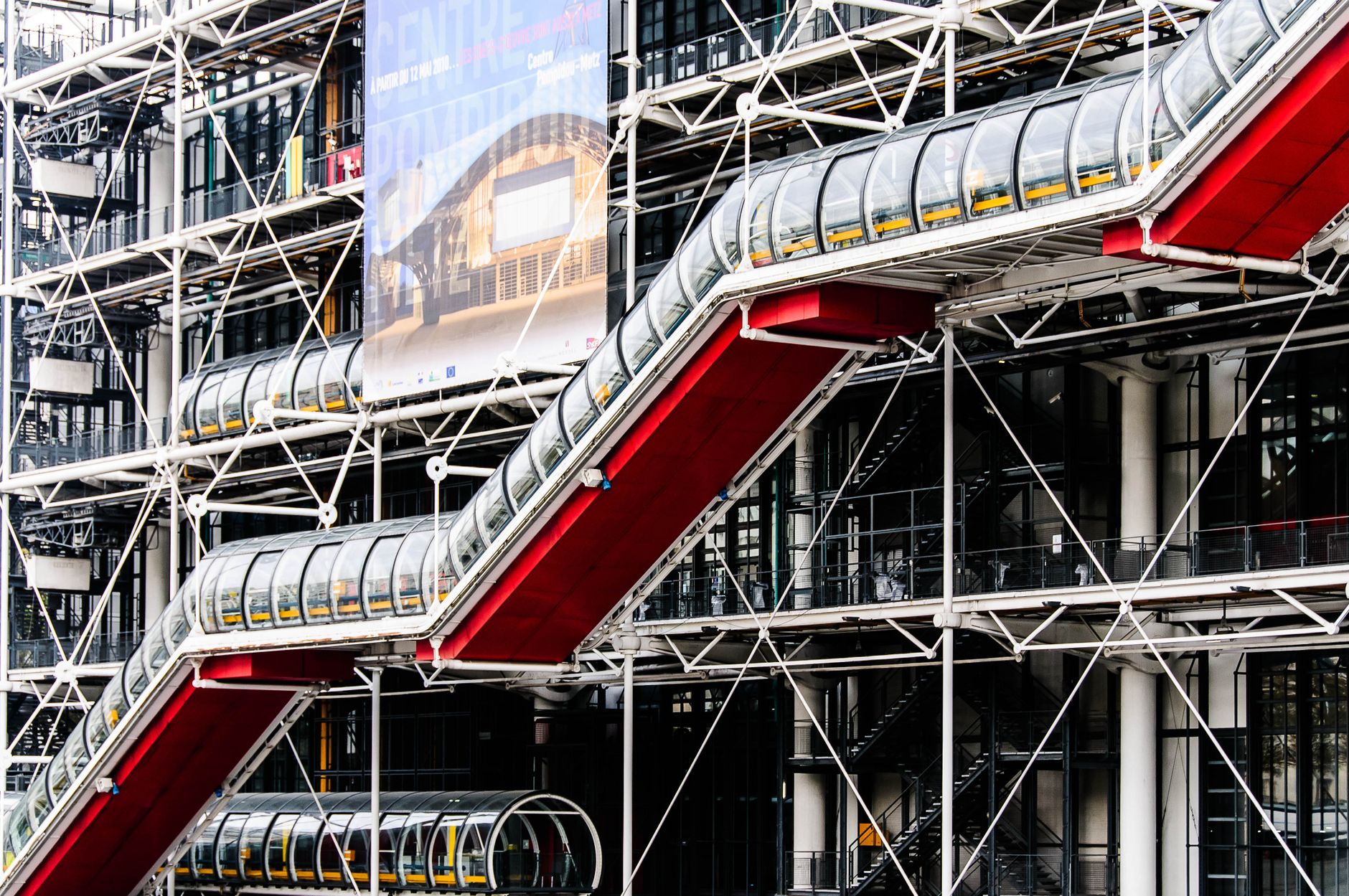
The Centre Pompidou shows its inside-out architecture, with glass escalator tubes and exposed steel bracing across the facade. Daylight catches the red undersides of the moving walkways.
Pixabay on Pexels · Pexels License

The Centre Pompidou turns its structure inside out, showing blue, green, and red service pipes across its high-tech facade. Visitors pass below the steel framework in bright Paris daylight.
Ulrick Trappschuh on Pexels · Pexels License

The Centre Pompidou shows its famous inside-out architecture, with blue service pipes and exposed steel along a Paris street. Pedestrians pass in bright daylight beside the museum facade.
Shvets Anna on Pexels · Pexels License

The Centre Pompidou turns its structure inside out, with white steel bracing and glass escalators crossing the facade. People gather below in the open plaza under soft daylight.
Daniela Ruiz on Pexels · Pexels License
Trace the colored pipes on the facade: blue = air, yellow = electricity, green = water, red = pedestrian flow. Stand on the Piazza and follow one red escalator tube up the west face — it's the only museum where the plumbing is the artwork.
Visitor Logistics
Getting There
Métro Rambuteau (line 11) drops you 80m from the piazza; Hôtel de Ville (lines 1, 11) is a flat 5-minute walk and has elevator access. Bus 29 stops directly out front on rue Rambuteau — RATP buses have ramps. From Notre-Dame de Paris it's a 750m walk north, no cobblestones.
Opening Hours
As of 2026, the building is closed. Centre Pompidou shut on 22 September 2025 for a five-year asbestos-removal and accessibility overhaul, scheduled to reopen around 2030. Pre-closure hours were Wed–Mon 11:00–21:00, Thursday until 23:00, closed Tuesdays — expect similar when it returns.
Time Needed
Moot until 2030. When it reopens: 1.5–2h for highlights plus the rooftop, 3–4h to do the permanent collection, a temporary show and the BPI library properly. Rooftop alone is a 30-minute panorama of Sacré-Cœur and the Eiffel Tower with a fraction of the crowd.
Accessibility
One of Paris's most accessible museums when open: 100% step-free, elevators to all six floors including the rooftop. Accessible entrance sits at the south corner of rue du Renard / rue Saint-Merri; the piazza slopes, so wheelchair users approach from flat rue Saint-Martin. Free loaner wheelchairs at the welcome desk, and disabled visitors plus one companion enter free.
Cost & Tickets
Pre-closure standard adult was €15 booked direct at billetterie.centrepompidou.fr, €17+ through resellers. Free first Sunday of the month under the standard French national-museum rule. During the 2025–2030 closure, off-site programming runs under the "Constellation" banner at the Grand Palais and partner venues — check centrepompidou.fr for current locations and prices.
Tips for Visitors
Closed Until 2030
Don't make the trip in 2026 expecting to enter — the building is a construction site. Walk the piazza, photograph the exterior tubes from rue Beaubourg × rue Rambuteau, then redirect your day to the Louvre Museum or the Marais.
Stravinsky Fountain Still Runs
Niki de Saint Phalle and Jean Tinguely's 1983 fountain on the south side keeps spinning and spitting through the closure. Golden hour is when the red lips and black mechanical sculptures look best — see Stravinsky Fountain.
Photo Rules
Inside the museum (when open): photos fine, no flash, no tripod, no selfie sticks. Drones are banned across central Paris by prefectural order, so don't try the rooftop angle from above.
Piazza Scams
The sloped square draws pickpockets and the gold-ring scam — a stranger "finds" a ring and insists it's yours. Walk past clipboard "petitions" for deaf charities and string-tying bracelet hustlers without breaking stride. Keep phones out of back pockets on métro Rambuteau and Châtelet.
Eat Around the Corner
Skip rue Saint-Martin's tourist-trap "18€ best French meal" boards. Café Beaubourg (43 rue Saint-Merri, mid-range) for the Portzamparc interior and piazza terrasse, Comptoir Gourmet for solid Neapolitan, or walk 15 minutes north to Marché des Enfants Rouges (1615, oldest covered market in Paris) for 10–15€ Moroccan, Lebanese or Italian stall plates.
Call It Beaubourg
Locals say "on se retrouve à Beaubourg," almost never "Centre Pompidou." Older Parisians still use the opening-day insults — "Notre-Dame des Tuyaux" and "la raffinerie" — affectionately now.
BPI Was the Local Secret
When it reopens, the Bibliothèque publique d'information has its own entrance on rue du Renard and needs no card — students queued for hours during exam season. Cinemas 1 and 2 on level –1 ran a curated, cheap programme that most guidebooks ignored entirely.
Sunset, Not Dinner
Le Georges on level 6 is overpriced for the food but unbeatable for a drink at sunset across the rooftops to Sacré-Cœur. Go for one cocktail, then descend to the Marais for dinner — when the building reopens in 2030.
Where to Eat
Don't Leave Without Trying
C’est Comme À La Maison - CCALM
local favoriteOrder: Trust the chef's daily selection based on the freshest seasonal ingredients.
This tiny, 100-sq.ft. gem feels like dining at a talented friend's home; Chef Mathieu’s creative, daily-changing menu is the definition of a local hidden treasure.
Bouillon République
local favoriteOrder: The duck parfait and perfectly cooked steak frites.
An iconic, bustling institution that offers an unbeatable old-world vibe and high-quality French classics at prices that are nearly impossible to find elsewhere in Paris.
Café Mélia.
cafeOrder: The Cuisse de canard confit is a rich, comforting, and perfectly cooked highlight.
A genuinely welcoming neighborhood spot where the owner’s warmth makes you feel like a regular; it’s the perfect place for a relaxed, authentic French meal.
Kozy Pompidou | All-week Brunch | Coffee
cafeOrder: The 'sexy egg benny' or the salmon and avocado pancakes.
A go-to destination for a hearty, reliable brunch with a modern touch, perfect for when you need a generous, high-quality start to your day in the city.
Dining Tips
- check Service is included by law; tipping is not required, though 5-10% for exceptional service is appreciated.
- check Always tip in cash, as most card terminals do not have a tip option.
- check Lunch is served strictly between 12pm and 2pm; kitchens often close between 2:30pm and 7pm.
- check Dinner rarely starts before 8pm; trying to find a full meal after 10:30pm can be difficult.
- check Reservations are highly recommended for dinner, especially at popular spots.
- check Bread is provided on the table at no extra charge; do not ask for substitutions on composed dishes.
- check Keep your knife and fork in hand throughout the meal and your wrists on the table.
Restaurant data powered by Google
Historical Context
The Error of the Century
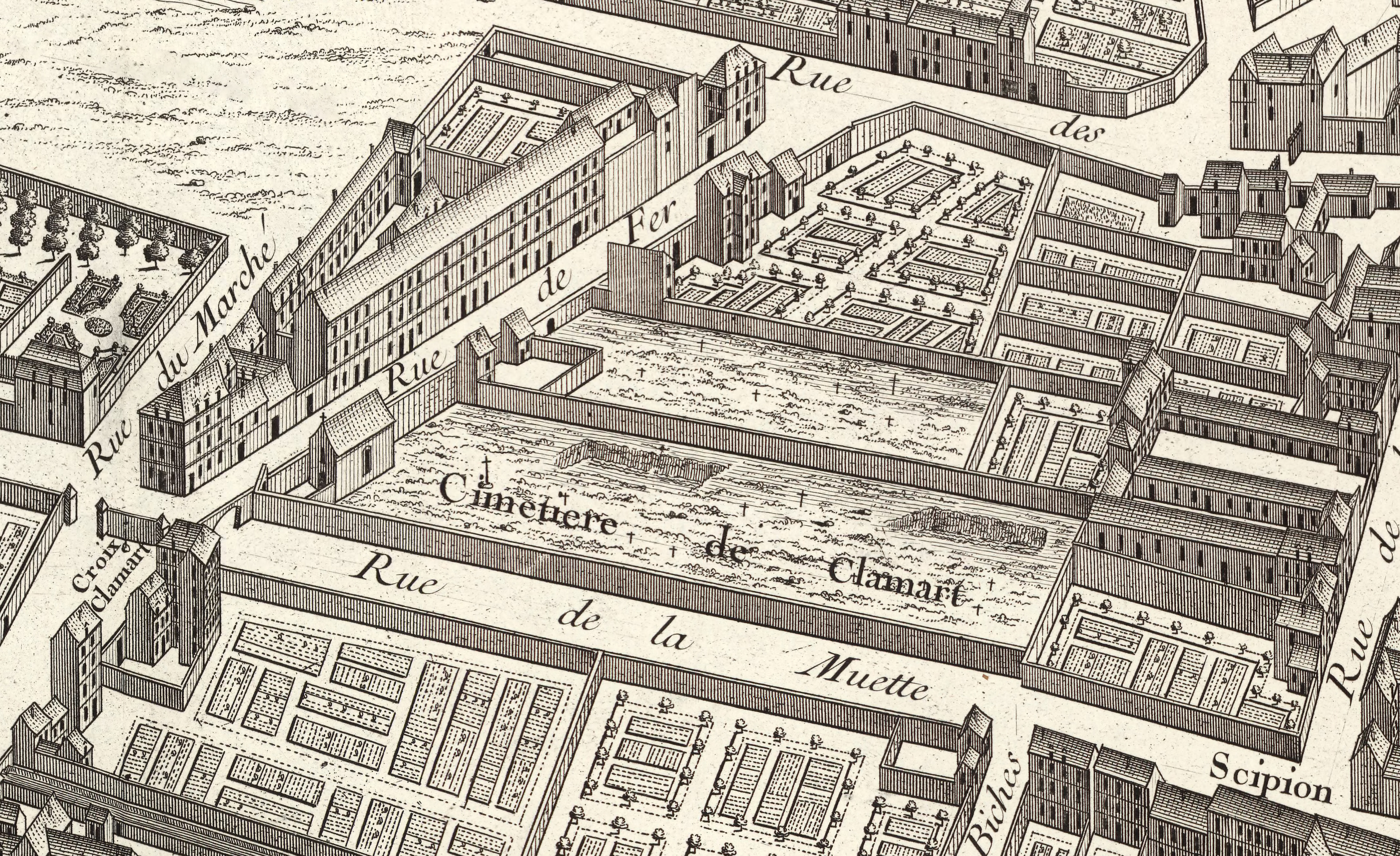
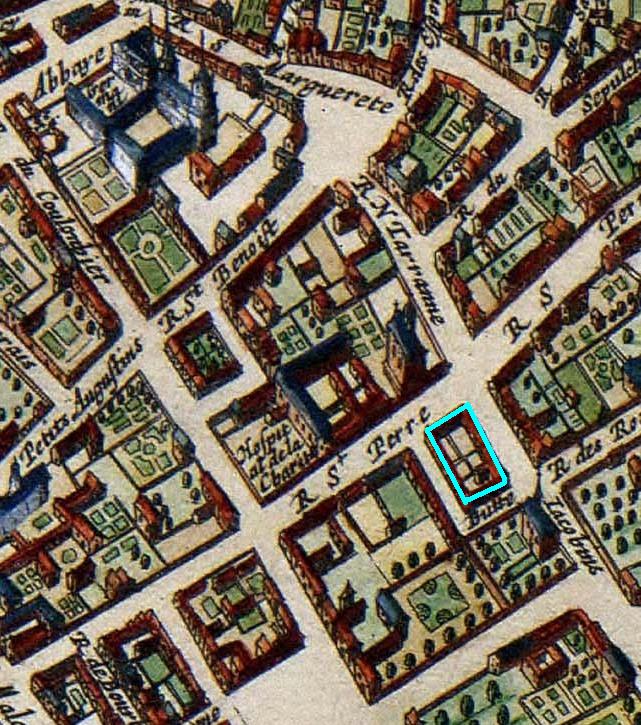
Before the Pompidou there was Plateau Beaubourg, the medieval beating heart of the Right Bank, classified by early-20th-century authorities as 'îlot insalubre n°1' — Paris's most unsanitary block. Records show the 1937 hygiene plan razed it, displaced the tenants, and turned the cleared site into a car park. The cars stayed for 35 years.
In 1971 an international competition drew 681 entries from Argentina to Japan. The jury included Jean Prouvé, Oscar Niemeyer and Philip Johnson. They picked 'Project 493' on 16 July 1971 — a young Italian-British team: Renzo Piano (33), Richard Rogers (37), Gianfranco Franchini, and the British engineer Ted Happold. None of them were famous. Piano, when phoned, thought the caller was congratulating him on graduating.
The engineer's gamble
Most tourists credit Piano and Rogers. Both were unknowns when they entered. Piano was 33, Rogers 37. 'With Beatles haircuts', as Piano later put it. The strange thing is that they almost didn't submit. Rogers wavered through January 1971: a divorce, a Glasgow museum keeping his firm busy, plus distrust of being co-opted by a French right-wing project to centralise culture. So who pushed Project 493 onto the deadline?
Ted Happold. A British engineer at Ove Arup in London, obsessed since late 1970 with a radical cast-steel structure he wanted to test at scale, hunting architects to front his vision. The cantilever rocker-arms he designed weighed about 10 tons each and held each floor off slim columns at the perimeter. Engineers call them gerberettes. They honour Heinrich Gerber, the 19th-century German engineer who pioneered the form. Records show fire protection ran water inside the structural steel itself. None of this had been built at this size before; failure meant collapse in central Paris. The submission tube went out on the 28 June 1971 deadline, came back stamped 'insufficient postage', and a UK postal strike was about to disqualify every British entry. Piano and Rogers re-stamped it, smudged the postmark illegible, posted it again. It slipped through.
Now look at the facade. Those white cast-steel arms cantilevering each floor off the slim outer columns aren't sculpture. They're Happold's gamble. The most photographed feature of the whole building, almost never named. Pompidou himself never saw them tested. He died in April 1974 with the steel still going up.
The plateau before the pipes
Plateau Beaubourg was the medieval beating heart of the Right Bank. The densest block in Paris, a tangle of streets between Les Halles and the Marais. By the early 20th century authorities had classified it 'îlot insalubre n°1', the city's most unsanitary block. The 1937 hygiene plan razed it. Tenants left. The cleared site became a car park for 35 years, until the 1970 decision to relocate the modern art museum here from the Palais de Tokyo. The remaining medieval fabric came down between 1971 and 1972 — old Paris, erased to clear the site. The Musée Carnavalet still keeps photographs of the destruction.
Notre-Dame des Tuyaux
Critics savaged it. Newspapers called it the 'gas factory', the 'refinery', 'Notre-Dame of the Pipes'. The architect Louis Arretche told French radio in 1971: 'I believe the Centre Pompidou will be the error of the century.' On inauguration day, 31 January 1977, black-market invitation tickets sold for 250 francs on the piazza outside. Three years after Pompidou's death from cancer, his rival Valéry Giscard d'Estaing cut the ribbon. Giscard pointedly skipped the cultural charter contemporaries expected. The building was reviled. Then, slowly, three million people a year started showing up. Parisians began calling the whole neighbourhood 'Beaubourg'. The building had eaten its own district.
The €460M renovation underway is officially a return to Piano and Rogers's 'original utopian vision', but critics ask why a building under 50 years old needs a five-year overhaul, and whether stripping the asbestos and treating the corroded main steel will leave much that is truly original behind. Whether the seamless piazza-to-Forum flow the architects first sketched in 1971 will finally be built in 2030 also remains open.
If you were standing on this exact spot on 31 January 1977, you would see Valéry Giscard d'Estaing arriving for the inauguration of the building his rival commissioned. Black-market invitation tickets change hands on the piazza for 250 francs each. Behind the press cameras, Parisians point at the blue ducts and the red escalator tube and mutter 'la raffinerie' — the refinery. The smell of fresh paint and cold January hangs in the air.
Listen to the full story in the app
Your Personal Curator, in Your Pocket.
Audio guides for 1,100+ cities across 96 countries. History, stories, and local insight — offline ready.
Audiala App
Available on iOS & Android
Join 50k+ Curators
Frequently Asked
Is the Centre Pompidou open in 2026? add
No. The building closed to the public on 22 September 2025 and stays shut until roughly 2030 for a €460M renovation covering asbestos removal, fire safety, and energy upgrades. Collections have moved into a 'Constellation' diaspora — BPI library to the Lumière building in the 12th, cinema to mk2 Bibliothèque, exhibitions touring Lille, Metz, and Monaco.
Is the Centre Pompidou worth visiting? add
When open, yes — and not only for the art. Locals come for the free BPI library, the cheap level –1 cinemas, the rooftop view rivaling Sacré-Cœur Basilica, and the Stravinsky Fountain round the south flank. The building itself — 166m of color-coded pipes Parisians once called 'Notre-Dame des Tuyaux' — is the exhibit.
How long do you need at the Centre Pompidou? add
Plan 1.5–2 hours for highlights plus the rooftop, 3–4 hours if you want the permanent collection, a temporary show, and the BPI. Rooftop alone takes 30 minutes and gives a 360° sweep — Eiffel Tower west, Sacré-Cœur north, Notre-Dame de Paris south. Skip Le Georges restaurant; go up for a sunset drink instead.
How do I get to the Centre Pompidou? add
Closest metro is Rambuteau on Line 11, two minutes' walk to the Piazza. Hôtel de Ville (Lines 1, 11) has elevator access; Châtelet is a seven-minute walk through old streets. Bus 29 stops directly in front at 'Centre Pompidou' and RATP buses have been 100% wheelchair-accessible since 2015. Address: Place Georges Pompidou, 75004.
What is the best time to visit the Centre Pompidou? add
Weekday mornings, doors at 11:00 — Tuesdays closed. Thursday late-night runs to 23:00, perfect for skipping the school groups. Rain transforms it: red caterpillar escalator glistening, glass facades mirroring grey clouds, the exact mood Willy Ronis caught in his 1981 photograph 'Jour de pluie'.
Can you visit the Centre Pompidou for free? add
The Piazza, the Stravinsky Fountain, and the Atelier Brancusi pavilion west of the entrance are free year-round. Disabled visitors plus one companion enter the museum free with a card. The first Sunday of each month is free for permanent collections — standard French national-museum rule, worth confirming once it reopens in 2030.
What should I not miss at the Centre Pompidou? add
The gerberettes — Peter Rice's 8-ton cast-steel rocker arms cantilevering the floors off slim columns, touchable from the Piazza side. The color code reads as a circulatory diagram: blue is air, yellow electricity, green water, red people. Ride the 'Caterpillar' escalator slowly; Paris unfolds frame by frame through plexiglass, wind audible all the way up.
Why is the Centre Pompidou inside-out? add
Engineer Ted Happold pushed for radical structural flexibility — services on the outside meant 7,500m² floor plates with no internal walls, infinitely reconfigurable. The colors were a maintenance ID system, not decoration. Critics called it a refinery in 1977; architect Louis Arretche predicted 'the error of the century.' He was wrong.
Sources
-
verified
Centre Pompidou — Renovation Project 2030
Official closure timeline, €460M renovation scope, Constellation diaspora program, 2030 reopening
-
verified
Centre Pompidou — Transformation Page
22 Sept 2025 closure date, 'Because Beaubourg' farewell event, BPI/cinema/Studio 13-16 relocations
-
verified
POP Mérimée — Centre Pompidou Architectural Notice (ACR0000721)
Structural details (gerberettes, cast-steel frame, 14 portal frames), 31 Jan 1977 inauguration, IRCAM history, color code documentation
-
verified
Wheelie Guides — Centre Pompidou
Opening hours, €15 standard ticket, closure status, accessible entrance details
-
verified
Sage Traveling — Pompidou Accessibility
Step-free routing, accessible south entrance at Rue du Renard / Rue St-Merri, free wheelchair loaners, walking distances to Marais and Notre-Dame
-
verified
Museos — Centre Pompidou
Wed–Mon 11:00–21:00 and Thursday 11:00–23:00 hours confirmation
-
verified
Come to Paris — Pompidou Tickets
Skip-the-line ticket pricing and access information
-
verified
Billetterie Centre Pompidou
Official ticketing portal, EN/FR booking
-
verified
Paris Je t'aime — Pompidou Accessibility Guide (PDF)
Detailed accessibility guide, accessible toilets, guided tour schedule
-
verified
Paris Insiders Guide — Accessible Metro Stations
Hôtel de Ville Line 1 elevator access, Châtelet hub information
-
verified
Mediation Centre Pompidou — Visit Regulations (PDF)
Cloakroom rules, photography (no flash), prohibited items
-
verified
Centre Pompidou Tickets FAQ
Reseller pricing, photography rules, mandatory cloakroom items
-
verified
POP Mémoire — Willy Ronis 'Jour de pluie' (1981)
Iconic rainy-day photograph of Centre Pompidou — visual reference for rain mood
-
verified
Change.org — Pompidou Closure Petition
Staff intersyndicale strike since 16 Oct 2023, 2022 visitor stats (3M visits, 1.1M BPI entries)
-
verified
Centre Pompidou — French Homepage
Live operational status verification
Last reviewed: