An introduction.
Researched by the Audiala editorial team from historical records, architectural archives, and local expertise.
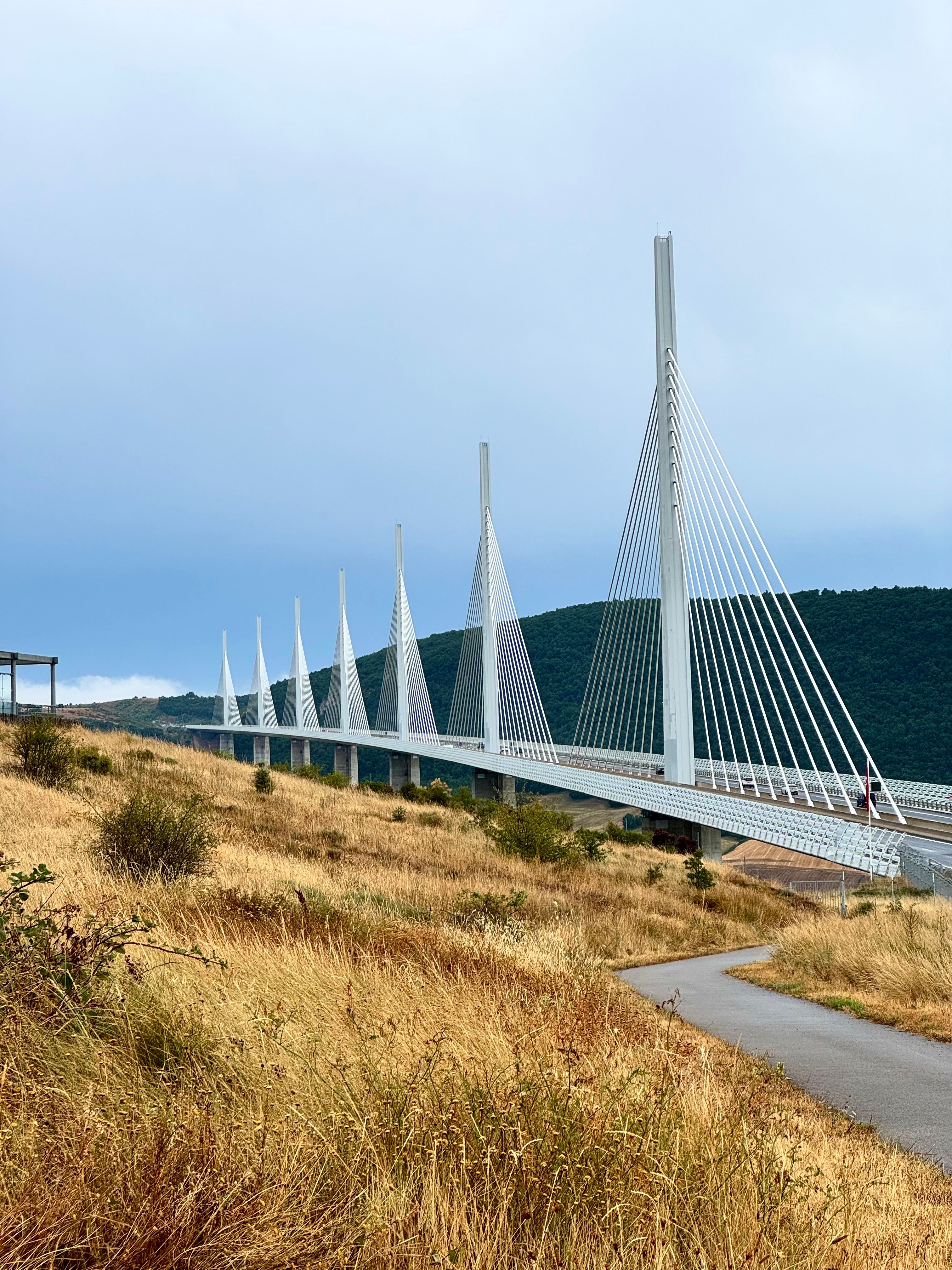
WWhy does the Millau Viaduct in Millau, France, feel less like a bridge than a dare written across the sky? You come for that shock: a roadway 2,460 meters long, almost the span of 25 football fields laid end to end, carried so high above the Tarn valley that the deck can seem to float in cloud. From the belvedere today, the white pylons rise out of pale limestone and scrub oak, traffic whispers across the deck, and the wind smells of hot grass, dust, and sun-baked rock.
Most famous bridges announce weight. This one hides it. Norman Foster shaped the silhouette, but the real seduction is restraint: the deck runs with a slight curve, the cables fan out like drawn lines, and the piers narrow as they climb, so the whole thing looks improbably light for a structure built to carry motorway traffic across one of southern France's deepest road bottlenecks.
That matters because the viaduct is best visited twice. First from below, where the scale hits you in the ribs and pier P2 climbs 245 meters from its foundation, taller than a 70-storey tower. Then from the service area above, where the bridge stops being an object and starts behaving like an argument about how infrastructure can alter a landscape without bullying it.
Millau itself gives the bridge its tension. This was once the place drivers dreaded, trapped in summer queues on the road south; now it is the place people pull over on purpose. Few modern structures so neatly reverse their own reputation, and fewer still reward a detour with views this sharp.
01 What to see.
Aire du Viaduc and the Main Belvedere
Le Sentier des Explorateurs
Peyre, the Viaduct, and Sunset from the Old Road
Videos
Watch & Explore Millau Viaduct
Millau Viaduct: The World's Tallest Bridge
Engineering Above Clouds | World's Tallest Bridge Construction
Crossing the Millau Viaduct
Plan and listen to Millau Viaduct with Audiala.
Audio guide in your pocket, itinerary in your browser. Built for the way you actually visit.
03 Visitor logistics.
The practical scaffolding for a good visit — kept short.
Getting There
The bridge hides from drivers; the real visit starts off the motorway. From Millau centre, drive the D911 to A75 Exit 45 for the Aire du Viaduc in about 12 minutes, take the D992 toward Albi to reach Peyre under the deck in about 10 minutes, or go via Creissels and the first left to Brunas for another lookout in about 15 minutes. No regional bus serves the viewpoints as of 2026, and walking or cycling on the A75 deck is not allowed.
Opening Hours
As of 2026, the Viaduc Expo and visitor centre at the Aire du Viaduc are generally open daily from 09:00 to 19:00, with shorter off-season hours possible. The belvedere viewpoints stay open 24/7 all year, while guided tours run by reservation only and Pier P2 interior visits are limited to July and August. High wind, dense fog, rain, or maintenance can cause temporary closures, so check the official site or call before setting out.
Time Needed
Give it 30 to 45 minutes for the quick version: park at Brocuéjouls, walk up to the belvedere, take your photos, and skim the free expo. A better visit takes 2 to 2.5 hours with the 40-minute guided tour plus one extra viewpoint such as Peyre or Brunas. Half a day feels right if you want the long tour, river-level views, or sunset, when the pylons catch light like seven stone needles pulled into the sky.
Accessibility
As of 2026, accessibility is partial rather than seamless. The Aire du Viaduc has disabled parking, but the main belvedere requires a short uphill walk on paved, gravel, and compacted-stone surfaces, and current visitor material does not confirm a fully step-free route or lifts to the viewpoints. Wind can be fierce on the causse, and paths get slick after rain.
Cost & Tickets
As of 2026, the Viaduc Expo is free, which is the best bargain on site. Guided tours cost about €6 for adults, €4 for children aged 6 to 17 and students, €14 for a family of four, and are free for children under 6; booking is required. Driving across the A75 viaduct is separate and tolled, with Class 1 cars usually around €10 to €14 depending on season.
05 Tips for visitors.
Small things that change the day.
Best Light
Go early or go late. September to November mornings and late-afternoon light turn the deck pale silver above the Tarn valley, while summer midday flattens the whole thing and packs Brocuéjouls with motorway-stop crowds.
Photograph From Below
Driving across feels oddly empty because the bridge disappears beneath your wheels. For the photograph that actually explains the structure, head to Peyre or Brunas, or get under it by boat, where the pylons rise higher than many cathedral spires and the deck seems to hover.
Drone Warning
Casual drone flying is a bad idea here. The viaduct sits over major road infrastructure, commercial image use is regulated, and unauthorized flights near the bridge have drawn police attention; personal ground photography is fine, but anything airborne or commercial needs prior clearance.
Road Safety First
The main risk here is traffic, not scams. Police controls around the A75 and toll area are common, winds can shove car doors wide open on exposed parking areas, and tired drivers tend to treat the stop like a quick photo break when it deserves a calmer pace.
Eat Something Local
Skip a forgettable motorway snack and order the capucin at the Aire du Viaduc, Michel Bras's cone of local fillings. For a proper meal after the viewpoints, try Le Golf Café in Millau for budget-to-mid-range menus, Au Jeu de Paume in the old town for mid-range Aveyron cooking, or Château de Creissels for a splurge dinner close to the bridge.
Pair It Well
Peyre makes the smartest second stop: a semi-troglodyte village of pale stone tucked under a work of pure engineering arrogance. If you have more time, add Creissels or a Bateliers du Viaduc river outing, because the bridge changes character completely when you hear water below it instead of traffic above.
Save Your Euros
If you want views rather than the crossing itself, use the free official viewpoints at Brocuéjouls, Peyre, Brunas, or Luzençon and skip paying the motorway toll just for the drive-over. The free expo also gives context that the deck alone does not; otherwise you leave with a receipt and not much understanding.
Pack For Wind
This site has no dress code, but the causse writes its own rules. Bring a windproof layer and shoes that handle gravel and short climbs, especially for the belvedere path or guided visits, and leave bulky gear behind because the operator can refuse awkward or unsafe equipment.
04 A history of reinvention.
The Bridge That Began With a Refusal to Go Down
The Millau Viaduct was born from irritation, not romance. By the 1980s, documented traffic jams through Millau turned the town into a choke point on the route between northern France and the Mediterranean, with holiday traffic spilling into streets never meant to absorb it.
Records show the first serious studies for a Tarn crossing near Millau began in 1987, but the project that followed was never just a road scheme. It became a fight over route, prestige, money, and the old French question of whether a giant public work can sit in a celebrated landscape without wrecking it.
Michel Virlogeux's Moment of Doubt
At first glance, the story seems simple: a brilliant bridge appears, Norman Foster gives it elegance, and modern France proves what it can build. That is the postcard version, and most visitors accept it because the finished viaduct looks inevitable, as if the valley had been waiting for exactly this line.
But one detail does not fit. Michel Virlogeux, the French engineer who conceived the structure, later recalled that planners had spent years assuming the road had to descend toward the Tarn before crossing. Why were they so certain? Because they had, in his blunt phrase, censored themselves. Virlogeux had his reputation tied to a national project already under scrutiny, and a wrong call here would not have meant a minor miscalculation; it would have meant disfiguring a valley, losing the design argument, and watching the scheme collapse into one more French infrastructure quarrel.
Then came the turning point. According to Virlogeux's own account, a road engineer asked why everyone was so determined to go back down into the valley at all, and within about fifteen days the very-high crossing emerged: seven piers, a multi-span cable-stayed deck, and a bridge that would pass over the Tarn instead of wrestling through it. Knowing that changes your gaze. The lightness you see now is not decorative; it is the built trace of one decision to stop thinking small.
A British architect, a French nerve
From chantier to symbol
Listen to the full story in the app
The whole Millau Viaduct,
told well.
Audio guides for 1,100+ cities across 96 countries. History, stories, and local insight — offline ready.
06 Frequently asked.
The questions travellers send us most about Millau Viaduct.
Is Millau Viaduct worth visiting?
Yes, especially if you stop below or beside it instead of only driving across. The deck stretches 2.46 kilometers, about the length of 27 football fields laid end to end, and the highest pier rises 343 meters, taller than the Eiffel Tower. Best surprise: under the deck, the bridge stops looking like a line in the sky and turns into sound, wind, and a low metallic tremor above your head.
How long do you need at Millau Viaduct?
Give it 2 to 3 hours for a satisfying first visit. That covers the free Viaduc Expo, the 470-meter walk to the public belvedere, and one more viewpoint such as Peyre or Brunas. If you book the longer guided route into pier P2, half a day feels right.
How do I get to Millau Viaduct from Millau?
The easiest way is by car, and it takes about 10 to 15 minutes depending on the viewpoint. From central Millau, take the D911 toward Exit 45 for the Aire du Viaduc, or the D992 toward Peyre if you want the old-village-and-bridge view. Public transport does not reliably serve the viewpoints, so this is one place where a car saves time and bad language.
What is the best time to visit Millau Viaduct?
Late summer or autumn mornings are the most rewarding, especially when low cloud turns the viaduct into a ship above a white sea. Sunset also works beautifully from Pont Lerouge or Peyre, when the light thins and the cables look almost penciled onto the sky. Midday in high summer is harsher, brighter, and busier.
Can you visit Millau Viaduct for free?
Yes, the main visit can be free if you use the Aire du Viaduc, the Viaduc Expo, and the public belvedere. You only pay if you cross the bridge by car on the A75 toll, or if you book a guided tour, which starts around 6 euros for adults. Free does not mean second-rate here; the public viewpoint already gives you the bridge's full theatrical entrance.
What should I not miss at Millau Viaduct?
Do not miss the under-deck view, whether on the Sentier des Explorateurs or from a viewpoint that puts you close to the structure's belly. From a distance the bridge looks almost weightless; from below you hear the traffic overhead and feel how much force that elegance is hiding. Also make time for Peyre, where the viaduct cuts across the valley behind a cliffside village like a piece of the 21st century dropped into an older France.
Verified, and shown.
Researched and written by the Audiala editorial team from historical records, architectural archives, and local expertise.
Core facts on the viaduct's dimensions, designers, opening dates, and overall visitor framing.
Construction milestones, including the 28 May 2004 deck junction and details about how the structure was built into the valley.
Best visiting seasons, viewpoint access, free belvedere information, and practical arrival guidance from the Millau side.
Visitor-center details, guided tour pricing, and realistic visit planning for first-time visitors.
Details on the guided under-deck route, duration, and the experience of getting beneath the structure.
Named viewpoints such as Peyre and Pont Lerouge, plus the short walk to the main public belvedere.
Visitor amenities, reservations, and seasonal access to special guided experiences including pier visits.
Practical transport notes, travel times from Millau, toll context, and suggested visit durations.
Design interpretation, especially the slight curve of the deck and how the bridge shapes the traveler's view of the valley.
Context on how the viaduct changed Millau's identity and how locals now see it.
Last reviewed
Researched from Wikidata, Wikipedia & official sources · fact-checked · How we make our guides →