
Place
France Updated Jul 2026
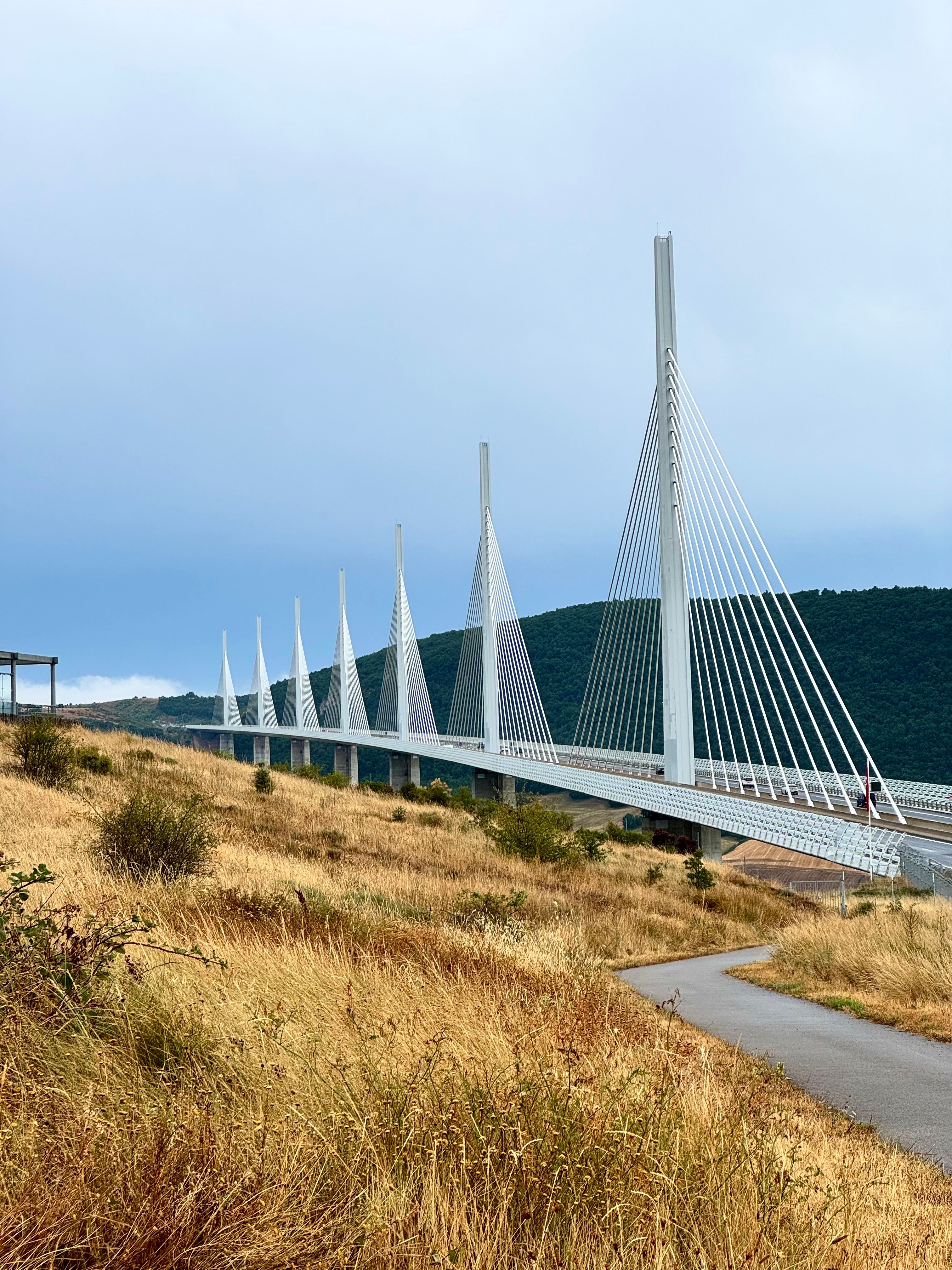
Cowbells, river water, and the thin whistle of paragliders arrive before the skyline does. Millau, France, sits where the Tarn and Dourbie rivers meet, boxed in by limestone plateaus and suddenly overshadowed by a bridge so tall its highest pylon reaches 343 meters, higher than the Eiffel Tower. The surprise is scale: a small southern town with Roman pottery kilns underfoot, glove workshops behind shopfronts, and one of Europe's great feats of engineering hanging over the valley like a clean pencil stroke.
 Photo: juv / Pexels
Built from cited sources · see the method · How we make our guides →
Millau works best when you stop treating it as a viaduct pit stop. Walk Rue Droite past corbelled houses, climb the Belfry for the roofscape, then head down to the old bridge where the Tarn moves slow and green below the stone arches. The town has weight to it. Roman-era La Graufesenque once produced sigillata pottery for an empire, and the leather trade left behind a civic pride that still feels practical rather than nostalgic.
The local rhythm is half market town, half mountain base camp. Wednesday and Friday mornings bring stalls onto Place Foch; by afternoon, kayaks, climbing ropes, and hiking boots start to make more sense than shopping bags. A place inside a regional natural park lives differently. Millau does, with pebble beaches at Gourg de Bades, the Larzac rising close by, and the Pouncho d'Agast sending gliders into the same airspace as the swifts.
What stays with you is the way industry, landscape, and stubborn local craft never quite separate. One hour you are looking at 1st-century pottery remains or a glove-maker's window display; the next, you are under Foster and Virlogeux's viaduct, staring up at concrete and steel from the riverbank near Peyre. That contrast is the whole point. Millau is not a postcard town polished into one mood, but a place where geology, labor, and ambition keep talking to each other.
Not every monument, just the ones we'd walk you past ourselves.
Where to wander, by quarter — each with its own rhythm.
Before you go
From the red-gloss kilns of Condatomagus to the white sweep of the viaduct
Most scholars date Millau's first fortified settlement to the heights of La Granede, above the rivers and wind-scoured limestone plateaus. Long before the town dropped into the valley, people were already choosing this spot for the oldest reason in history: you could see trouble coming.
Between the 2nd and 1st centuries BCE, settlement shifted down from the hilltop to the left bank of the Tarn. The Gallic name Condatomagus meant "market at the confluence," which tells you exactly what mattered here: trade, crossroads, and the meeting of two rivers with two tempers.
Across the Tarn, the workshops of La Graufesenque began turning out terra sigillata, that glossy red tableware Roman households loved. Kilns glowed day and night. For about 150 years, Millau's potters shipped bowls and plates across the empire, from Gaul to North Africa, making this valley town feel improbably connected to the wider Roman world.
By the 2nd century, competition from other production centers cut into La Graufesenque's trade. The industrial roar faded. What had been one of the empire's great ceramic engines slipped into decline, leaving layers of wasters, stamps, and kiln ash for archaeologists to sort out centuries later.
As Roman order frayed in the 4th and 5th centuries, settlement drew back to the left bank and the name Amiliavum entered the story. That shift mattered. Millau's center moved toward the shape the modern town still keeps, pressed between river, street grid, and defensive logic.
A written mention from 875 gives the town its first firm foothold in the documentary record. Cold ink, dry parchment, huge consequence. Once a place is named in an archive, it stops being only an archaeological problem and starts speaking in its own voice.
Bernard became the first viscount of Millau, anchoring local power in a feudal world of loyalties, tolls, and stone defenses. The town already had value worth fighting over. Rivers, roads, and livestock from the Causses made sure of that.
Pope Urban II consecrated Notre-Dame de l'Espinasse, tying Millau to one of the great papal circuits of the age. Imagine the scene: bells, incense, packed nave, the smell of wax in cold stone air. A provincial town, suddenly touched by the central machinery of Latin Christendom.
Douce of Millau, heiress of the viscounty, married Ramon Berenguer III of Barcelona and pulled the town into the Catalan-Aragonese orbit. This was dynastic politics at its most efficient. One marriage shifted Millau's allegiance more decisively than a siege might have done.
The King of Aragon granted Millau its consular charter, seal, and communal liberties, confirming the authority of the town's six consuls. That gave the place an unusually early habit of civic self-government. Millau's independent streak did not appear from nowhere.
After the death of Jeanne of Toulouse, Millau passed definitively into the hands of the French crown under Philip III. The town's arms gained three fleurs-de-lys. Heraldry can look decorative from a distance; in practice, it meant a new political master and a new administrative future.
During the Hundred Years' War, Sir John Chandos took possession of Millau and the town fell under English control. For locals, this was not abstract diplomacy. It meant garrison life, foreign authority, and the hard mathematics of survival in a contested kingdom.
Millau's inhabitants expelled the English garrison and returned the town to French rule. That act has the sharp, satisfying feel of civic memory because it was a local reversal, not a distant treaty. A town that had long managed its own affairs did not enjoy being managed by others.
By 1560, Millau had embraced the Reformation and become one of the strongest Protestant towns in southern France, earning the nickname "Little Geneva." That changed worship, politics, and daily sound. Sermons replaced old certainties, and confessional tension settled into the streets like weather.
In December 1573, Millau hosted the assembly that created the Union of Protestants of the Midi under the protection of Henri de Condé. This was bigger than local drama. For a moment, the town sat near the center of a Protestant political network bold enough to behave like a state within the state.
After the royal victory sealed by the Peace of Alès, Protestant political power was broken and Millau's fortifications were ordered demolished. Stones came down; so did a way of life. The town kept its memory of resistance, but the crown made sure the ramparts would not argue back.
Poet Jean-Claude Peyrot was born in Millau in 1709 and later became one of the sharpest literary voices of Rouergat Occitan. His work fixed local speech on the page without polishing the life out of it. That matters in a town where identity has always lived as much in language as in stone.
Louis de Bonald was born at Millau's Château du Monna and would become one of the great counter-revolutionary thinkers of Europe. Before the grand theories, he was a local politician here, serving as mayor. Millau shaped him first, then he spent a lifetime arguing against the age that followed.
An arch of the medieval Pont Vieux collapsed in 1757 after years of poor maintenance. The old 17-arch crossing had once carried traders over the Tarn on a major route through southern France. After the fall, only a fragment endured, and even that surviving arch feels like a sentence cut short.
The French Revolution remade Millau as a district capital and dragged local elites into national upheaval. Bonald, then prominent in town life, broke with the new order and resigned rather than accept the Civil Constitution of the Clergy. You can read that split as philosophy if you like. It was also family, parish, and power torn open at close range.
On 12 and 13 September 1875, the Tarn rose 10.30 meters and drowned much of Millau. Bridges upstream were swept away, streets turned violent brown, and the river reminded everyone who really owned the valley floor. Flood marks are history written at eye level.
Millau inaugurated its covered market, Les Halles, in 1899, with the airy metal-and-glass confidence of the Baltard age. This was prosperity made visible. Leather money, commercial ambition, and urban pride all met under one roof where voices, produce, and damp market smells collected beneath the frame.
When wages in the glove and skin-dressing trades were slashed by 25 to 30 percent, Millau entered a bitter social conflict that stretched through the winter of 1934 and 1935. The town had lived off leather for generations. Now the industry that fed it was turning on its own workers.
Millau was liberated on 22 August 1944 after the strain of occupation, roundups, fear, and clandestine rescue. On the same day, 23 maquisards from the Saint-Affrique resistance were killed at La Pezade. Freedom arrived, but it did not arrive gently.
When the French state announced the expansion of the Larzac military camp from 3,000 to 17,000 hectares, farming families and activists around Millau began the long nonviolent struggle that would become the Fight for the Larzac. Sheep fields turned into political theater. The town's old habit of resisting Paris had found a new stage.
José Bové settled on the Larzac above Millau in 1976 and became one of the movement's most recognizable voices. His politics grew from this stony plateau of sheep, wind, and stubborn farmers. Millau gave him a cause with local roots and global echoes.
Activists led by José Bové dismantled the McDonald's under construction in Millau to protest American tariffs on Roquefort, themselves tied to the hormone-beef dispute. The target looked absurdly specific, which is why it worked. A small town in Aveyron suddenly stood at the noisy intersection of trade law, farming, and anti-globalization anger.
The Millau Viaduct opened in December 2004, designed by Norman Foster with engineer Michel Virlogeux. Its tallest pylon rises 343 meters, higher than the Eiffel Tower, and the deck floats about 270 meters above the Tarn valley like a clean line drawn across empty air. The bridge ended the traffic choke that once strangled the town center and gave Millau a new silhouette the Romans would have understood immediately: infrastructure as power.
The Causses and Cévennes cultural landscape, shaped by Mediterranean agropastoralism, entered the UNESCO World Heritage list in 2011. Millau's setting was part of that inscription. The honor was not just for scenery; it was for centuries of human labor written into dry-stone walls, grazing routes, and the hard logic of living on limestone plateaus.
Philosopher and politician · 1754–1840
Born and died in Millau; mayor of Millau 1785–1790
Louis de Bonald was born at the Chateau du Monna and returned to die in the same town after a life spent arguing for monarchy, Catholic order, and a world suspicious of revolution. Walk Millau's quieter streets and you can imagine him admiring how stubbornly this place keeps its old bones, even if the viaduct above the valley might have tested his appetite for modernity.
Opera singer · 1858–1942
Lived her final years in Millau and is buried here
Emma Calve, the great Carmen of the Belle Epoque, ended her life in Millau after filling opera houses from Paris to New York. Her last chapter here gives the town a faint theatrical afterglow; one can picture her appreciating the drama of the Tarn light at dusk, then finding the souvenir version of herself a little thin.
Farmer and political activist · born 1953
Worked from the Larzac above Millau; central figure in the 1999 Millau McDonald's protest
Jose Bove made Millau world news on August 12, 1999, when the dismantling of a McDonald's under construction turned a small Aveyron town into a symbol of anti-globalization. The protest could only have happened here, on the edge of the Larzac, where farming, defiance, and spectacle have long shared the same table.
Philosopher · born 1944
Born in Millau
Gilles Lipovetsky, the sharp observer of consumer society and hypermodern life, was born in Millau before building his career elsewhere. A town of glove makers and market squares was an unlikely starting point for a thinker of fashion and excess, which is exactly why the connection sticks.
Occitan poet · 1709–1795
Born in Millau
Jean-Claude Peyrot wrote in Occitan when the language still carried the grain of everyday speech, not just heritage prestige. His presence reminds you that Millau was never merely French in one register; the place still speaks with older echoes if you listen to names like Larzac, Dourbie, and causse.
General · 1773–1850
Born in Millau
Jean-Baptiste Solignac left Millau for the armies of the Revolution and Empire, and his name ended up carved on the Arc de Triomphe. That leap, from a small town in Aveyron to stone in Paris, says something about how far ambition once had to travel from these valleys.
Art collector · 1898–1977
Born in Millau
Domenica Walter was born in Millau before becoming one of the key figures behind the Walter-Guillaume collection that now anchors the Musee de l'Orangerie. Her path from Aveyron to Renoir, Cezanne, Picasso, and Matisse gives Millau an unexpectedly direct thread into the story of modern art.
Downhill mountain biker · born 1997
Born in Millau
Marine Cabirou grew up in a place where cliffs, tracks, and steep edges are not abstract sporting scenery but the daily shape of the ground. Her downhill career feels perfectly native to Millau: speed, control, and a calm relationship with terrain that scares other people.
Where locals actually book dinner — not the tourist menus.
Roquefort-sur-Soulzon sits close enough to Millau that the town almost borrows its cheese perfume. Try it where the texture can do its full trick: chalky at first, then creamy, then sharp with that cave-aged blue tang that lingers longer than you expect.
These Aveyronnais herb fritters look humble and then win you over fast. Parsley, chard or spinach, eggs, and a soft batter hit the pan and come out crisp at the edges, the sort of market food that tastes better eaten standing up.
This is mashed potato stretched with tome fraiche until it pulls like melted rope. Around Millau it often arrives with sausage, and the point is less elegance than warmth, salt, and the pleasure of food that knows exactly what hill country feels like.
Aveyron still takes tripe seriously, and tripous are the local proof: parcels of lamb tripe slow-cooked with veal, ham, herbs, and stock until the whole thing turns dark, rich, and deeply savory. Not for the cautious eater. Very much for the curious one.
This regional tart uses fresh ewe's milk cheese, often scented with orange blossom. The texture lands somewhere between cheesecake and custard, but lighter, with a faint floral note that makes sense after a meal built on sheep's milk and mountain pastures.
Millau's markets and halles are the right place to build a picnic: dry sausage, country ham, fresh bread, olives, and a bottle of Marcillac, the iron-tinged red from farther north in Aveyron. Wednesday and Friday mornings are the liveliest for this kind of edible reconnaissance.
The Halles de Millau are less about one signature dish than about the smell of cheese, roast chicken, cured meat, and ripe fruit gathering under one roof. Go early, then carry your haul down toward the river and let lunch happen on a bench.
Small things that change how the city treats you.
Yes, especially if you like places where serious engineering, river swimming, and old stone streets sit within a few kilometers of each other. The viaduct alone is worth the detour, but Millau works because it is more than a bridge: glove-making history, Roman remains, limestone plateaus, and the Tarn cutting through the middle.
Two to three days works well for most travelers. One day covers the viaduct and old town, but an extra day lets you add Peyre, a gorge drive, a river swim, or one proper hike without rushing.
The cheapest way is usually a liO regional coach from Montpellier Saint-Roch, with journeys around 2 hours 5 minutes. Driving on the A75 takes under 90 minutes in good conditions, but remember the viaduct toll if you cross it.
Not for the center itself. Millau's old town is compact, the Mio bus network is free, and the train and bus stations are together; a car only becomes useful if you plan to roam the gorges, Larzac, or scattered viewpoints on your own schedule.
Yes, Millau is generally a low-crime small town, but the real risks are outdoors. Watch for narrow winding roads, heat on exposed plateaus, and river-swimming alerts tied to storms or cyanobacteria rather than worrying about city-center trouble.
No, by French standards it can be fairly kind to your budget. Town buses are free, liO regional coaches cost €2, many viaduct viewpoints cost nothing, and more than 1,000 parking spaces in town are free.
September is the sweet spot. Days are often dry and warm, the summer crush has eased, and you can still swim, hike, and catch the viaduct in that clean late-season light.
Yes. You can see it for free from places like Peyre, Brocuéjouls, and hillside viewpoints above Creissels; the paid part is mainly the motorway crossing toll and some guided experiences.
Saved and recently read places — kept on this device only.
Photos may have been resized or cropped.