Type 2+ letters to search all countries, cities, and places
/Ctrl KEsc
travel_explore
Type 2+ letters to search all countries, cities, and places
Press Enter to open the top result
Palace of Fontainebleau
Fontainebleau·France·48° N · 2° E·Updated Jul 2026
A royal palace built around the spring that gave Fontainebleau its name, with free gardens, imperial rooms, and a calmer mood than Versailles on most days.
Why does the Palace of Fontainebleau in Fontainebleau, France feel less like one royal home than a whole argument about power? That’s the reason to come: few places show, room by room, how French kings, queens, a captive pope, and a fallen emperor kept rewriting the same stage. Today you cross courts of pale stone, hear gravel crack underfoot, and move from the horseshoe staircase to galleries where gilded wood, hunting light, and the smell of old wax still make politics feel physical.
Most visitors arrive expecting a French palace with a tidy origin story. Fontainebleau refuses that. A medieval keep still hides inside the Cour Ovale, François I turned the place into a Renaissance experiment loaded with Italian art, and Napoleon used those same rooms to perform both glory and defeat.
The scale keeps shifting. One minute you are in a courtyard shaped by fortification and mud-ground survival; the next you are in a gallery built to flatter a king with mythological frescoes whose full meaning still escapes scholars. That tension is what makes Fontainebleau worth your train ride from Paris.
And the setting helps. Forest air presses close to the walls, the gardens stretch with courtly geometry, and the palace never lets you forget that this was a hunting seat before it became a theater of the French state.
Researched by the Audiala editorial team from historical records, architectural archives, and local expertise.
What to see
The Francois I Gallery and Royal Apartments
Fontainebleau makes sense the moment you step into the Francois I Gallery, where Rosso Fiorentino wrapped the walls between 1533 and 1540 in painted myth, carved stucco, and royal self-invention. The room feels less like a corridor than a jeweled thought stretched long enough for a king to walk through it, and the apartments beyond keep shifting the mood from ceremony to private habit, with upholstery, wood, and gilding softening the echo of all that stone. Versailles shouts; Fontainebleau murmurs, then traps you into listening harder.
The Cour des Adieux and Napoleon's Fontainebleau
Few palace courtyards carry a title as blunt as the Cour des Adieux, and once you stand on that open stone, the place stops being decoration and turns into theatre with the actors gone home. This is the Fontainebleau of Napoleon I, whose presence still clings to the imperial rooms and museum, and the contrast is the point: after salons dressed for power, the courtyard feels bare, almost cold, with footsteps snapping back off the walls as if the building were repeating the last goodbye. Stay a minute longer than you think you should.
Walk From the Oval Courtyard to the English Garden
Start in the Cour Ovale, where the medieval keep still shows through the later palace like an old bone under silk, then let the plan's five irregular courtyards pull you outward instead of trying to understand everything at once. The route works because Fontainebleau keeps changing its mind: formal lines in Le Notre's garden, then softer paths in the English Garden, where the Belle-Eau spring gave the place its name and 130 hectares of parkland spread wider than 180 football pitches. By the time you reach the trees, the palace feels less like a monument than a royal habit of retreat.
Plan your visit
Getting There
From Paris, take Transilien Line R from Gare de Lyon toward Montargis, Montereau, or Laroche-Migennes to Fontainebleau-Avon; the train ride runs about 40 minutes, roughly the length of crossing Paris east to west once. From the station, bus 1 or 3401 reaches the palace area in about 15 minutes; get off at Château, Bibliothèque, or Cour des Adieux, or walk the signed 2.9 km route through town and park in 30 to 40 minutes. By car, follow the A6 to Fontainebleau, then signs for the château; Parking Château on Rue de Ferrare has 534 spaces and sits within a short walk.
Opening Hours
As of 2026, the palace opens Wednesday to Monday, 9:30 am to 6:00 pm from April 1 to September 30, with last admission at 5:15 pm, and 9:30 am to 5:00 pm from October 1 to March 31, with last admission at 4:15 pm. Tuesdays are closed, as are January 1, May 1, and December 25. The park stays open all day and all night, but some rooms inside the palace close before the headline closing hour, so arriving before 3:00 pm makes the visit feel far less rushed.
Time Needed
Give the interiors 2 hours at minimum if you want the Grands Appartements and the Napoleon I Museum without sprinting past them. A better visit takes 2.5 to 3.5 hours once you add the courtyards and gardens, and 4 to 5 hours if you want lunch, the park, or one of the guided add-ons. Fontainebleau is less a quick hit than a long exhale.
Cost & Tickets
As of 2026, general admission is €17, with a reduced rate of €15; the ticket covers the Grands Appartements route and the Napoleon I Museum. Entry is free on the first Sunday of each month except July and August, and also for under-18s, EU residents aged 18 to 25, disabled visitors with one companion, and some pass holders. Paris Museum Pass is accepted, and buying online saves the ticket-office stop, though security lines can still slow you down.
Accessibility
Wheelchair access is possible with assistance, but this is a Renaissance and imperial palace, not a frictionless modern museum. The main Grands Appartements route has elevator access and accessible toilets, while the Napoleon I Museum still involves 8 steps and some doorways run narrow; outside, gravel paths, slight slopes, and uneven garden surfaces can feel harder than the interiors. Fontainebleau-Avon station currently has PMR lifts, which helps at the start.
Photo Gallery
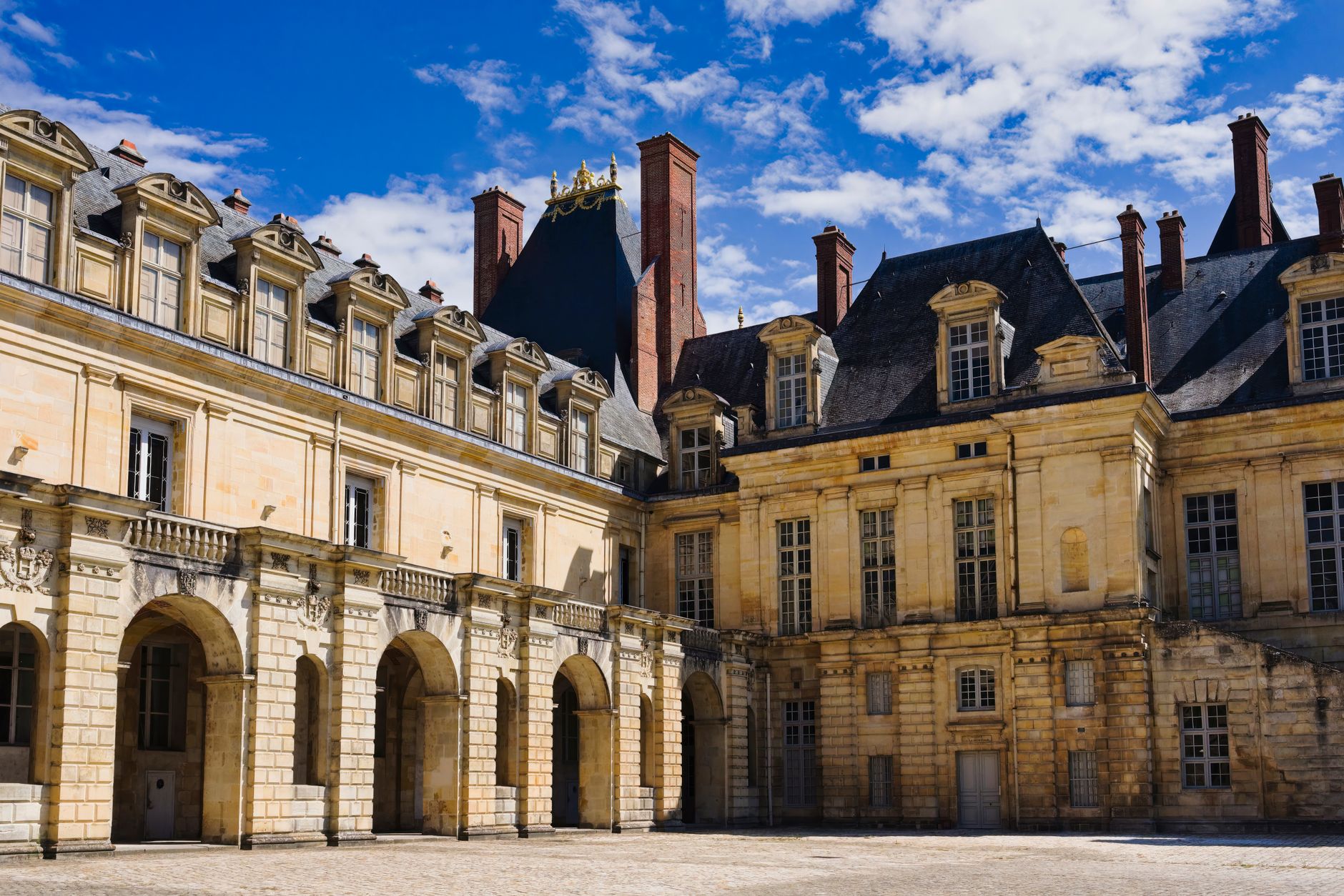
The Palace of Fontainebleau rises behind clipped trees and a garden filled with grasses and purple flowers. Dramatic clouds sharpen the contrast between the pale stone, slate roofs and sunlit planting. · Eric Prouzet on PexelsRowboats rest beside the lake as sunlight catches the waterside pavilion and tree-lined grounds of the Palace of Fontainebleau. · Lewis Bedar on PexelsThe Palace of Fontainebleau rises beyond a cobbled courtyard and symmetrical gardens under dramatic clouds. Bright daylight reveals its ornate stonework and slate roofs. · Edoardo Colombo on PexelsThe Palace of Fontainebleau rises behind clipped trees and flower beds as visitors cross the gardens beneath gathering storm clouds. · Eric Prouzet on PexelsA classical pavilion rises from the lake at the Palace of Fontainebleau, surrounded by dense trees and mirrored in the calm water. Swans and geese animate the quiet garden scene. · Gabriel Chamak on PexelsSunlight reveals the pale stone arcades, sculpted dormers and tall brick chimneys of the Palace of Fontainebleau. The empty courtyard draws attention to the building's layered Renaissance architecture. · Eric Prouzet on Pexels
History
Where French Power Kept Changing Costume
Records show a royal residence at Fontainebleau by 1137, but the palace people picture today began as something rougher: a fortified hunting base on wet ground at the edge of the forest. UNESCO and the château’s own history both confirm that the medieval core still survives inside the present complex, which matters because Fontainebleau was never built in one clean burst.
That layered beginning explains the place better than any postcard view. François I made it dazzling after 1528, the Bourbons used it to stage dynasty, Louis XIV signed one of the kingdom’s darkest religious acts here in 1685, and Napoleon turned a half-abandoned royal shell into an imperial residence before losing everything on its steps.
The turning point
The Staircase That Was Built for Majesty and Remembered for Collapse
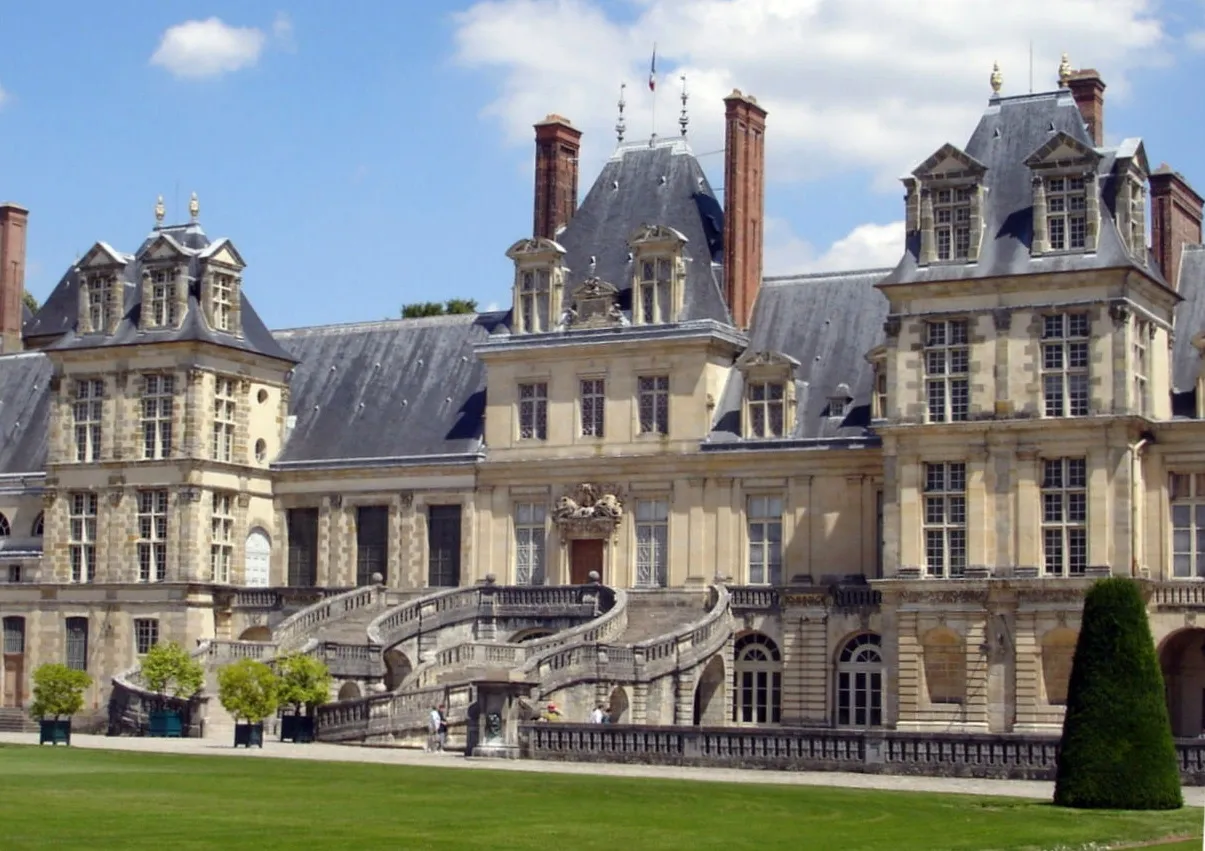
At first glance, the horseshoe staircase looks like pure royal theater: a grand outdoor flourish built to lift monarchs above the crowd and turn an arrival into spectacle. Tourists often read it that way, as one more elegant set piece in a palace designed to glorify kings.
But the date breaks that easy story. The present staircase was rebuilt between 1632 and 1634, long after François I, and its most famous scene came on 20 April 1814, when Napoleon I stood there after his abdication, with his throne gone and his son’s future slipping out of reach. Eight days earlier, records in the palace collections show, he had even attempted suicide in the château.
That is the revelation: Fontainebleau’s best-known image is not really about ascent but about a ruler discovering that ceremony cannot save him. Napoleon had revived the palace after the Revolution and made it one of his official residences in 1804; then the same setting became the stage for his farewell to the Old Guard before exile to Elba.
Once you know that, the staircase changes. You no longer see only carved stone and symmetry. You see a machine built to display permanence, and a man using it to act out the exact moment permanence failed.
From Hunting Lodge to New Rome (1137–1570)
The earliest secure anchor is a royal charter of 1137, while archaeologists and palace historians agree the medieval castle already stood here in the 12th century. After 1528, François I and architect Gilles Le Breton transformed that old stronghold into a Renaissance court, bringing in Rosso Fiorentino and Primaticcio to create the artistic language later called the First School of Fontainebleau. The palace became France’s gateway for Italian Mannerism, which was less decoration than propaganda in paint, stucco, walnut, and gold.
Dynasty, Danger, and Royal Ritual (1570–1789)
Fontainebleau hardened as France grew more unstable. Under Henri IV, the palace regained splendor after the Wars of Religion, the Grand Canal was dug between 1606 and 1609, and Marie de Médicis gave birth here to the future Louis XIII on 27 September 1601. Then came a darker turn: Louis XIV revoked the Edict of Nantes here in October 1685, so these elegant rooms also belong to the history of religious coercion, not just court ceremony.
Empire, Captivity, and Reinvention (1804–1981)
After the Revolution, Fontainebleau had been stripped so thoroughly that Napoleon had to refurnish it almost from scratch before making it an imperial residence in 1804. The palace then became a gilded prison for Pope Pius VII from 19 June 1812 to 23 January 1814, and within months it witnessed Napoleon’s abdication, suicide attempt, and farewell to the Guard. A fire in 1856 destroyed the Belle-Cheminée wing, which is why the palace’s apparent continuity hides real absences, before UNESCO recognized the Palace and Park of Fontainebleau in 1981.
Tips for visitors
Arrive Early
Morning light suits Fontainebleau: courtyards stay quieter, and the sandstone facades catch a pale gold that feels softer than Versailles' glare. Aim for the first train from Paris or at least arrive before 3:00 pm, because some rooms close ahead of the official shutdown.
Photo Rules
Personal photography is generally allowed, but skip the flash, tripod, and selfie stick indoors. Drone use around the estate is a bad idea unless you have explicit clearance; palace rules and local air restrictions make that a fast way to spoil the day.
Eat Nearby
For a proper lunch, Rue Montebello is the smart move: Le Bistrot 9 is a reliable mid-range choice, and La Petite Ardoise usually lands in the same band, with a recent 3-course menu noted at €39. If you want something quicker, Le France at 3 rue de France works for budget-to-mid-range brasserie food, while Les Petites Bouches de l’Empereur inside the domain wins on setting rather than thrift.
Pair With Town
Do not treat the palace as an isolated trophy. After the apartments, walk to Place de la République for the Fontainebleau market on Tuesday, Friday, or Sunday mornings, then try the local Fontainebleau cream-cheese specialty in town; that combination tells you more about Bellifontain life than the gift shop ever will.
Watch Your Car
Central Fontainebleau feels manageable by day, but standard caution still applies: keep bags close on café terraces and leave nothing visible in the car. Parking Château is convenient, yet convenience is not the same thing as invisibility.
Rules Matter
Staff enforce palace and garden rules more firmly than the dreamy setting suggests, so follow barriers, keep hands off surfaces, and expect museum-level oversight. Dogs are not allowed in the château or gardens, only in parts of the park, which catches out more people than you might think.
Where to Eat
local_dining
Don't Leave Without Trying
Fontainebleau, the town's namesake dessert made from fromage blanc and whipped creamBrie de Melun and other regional cheeses from the Seine-et-Marne areaPastries and chocolates sold around the town and marketSeasonal market produce from the Fontainebleau market
L’ecailler du château
local favorite
Seafood-focused French restaurant€€star4.5(1539)
Order: Go for the lobster or the half-lobster portion, which regulars call generous and beautifully prepared without blowing the budget.
This one wins on location and confidence: it sits right opposite the palace, yet reviewers keep coming back for the seafood rather than the view. Service gets called out again and again, and that matters after a long château day.
Order: Order the snail risotto or the caramel prawns to start, then the duck breast if you want the dish reviewers mention most warmly.
The cellar dining room keeps showing up in reviews, and for good reason: it gives dinner some atmosphere without turning the place into a gimmick. The menu sounds playful but the cooking reads as serious.
Contemporary French restaurant with strong vegetarian options€€star4.7(471)
Order: If panisse is on, try it, and vegetarians should pay attention here because multiple reviews mention the strength of the meat-free options.
ADMA feels like the small-room, big-care kind of place. Reviews praise the presentation, the wine list, and the cozy atmosphere, though a few recent comments suggest consistency can wobble, so this is the more ambitious pick rather than the safest one.
Order: Come for the Ukrainian dishes and save room for dessert; one review praises both the cooking and the sweets in the same breath.
Fontainebleau does not have an endless supply of places with real personality, and this one sounds like it has some. Reviewers talk about warm service, local art on the walls, and food made with care rather than standard-issue brasserie autopilot.
checkLunch in Fontainebleau usually runs around 12:00-14:00, and dinner often starts around 19:00-21:00.
checkMany restaurant kitchens close between lunch and dinner, often roughly from 14:30 until early evening.
checkDo not assume Monday dinner will be easy; full-service restaurants in Fontainebleau often close on Monday, or on Sunday and Monday, or on Monday and Tuesday.
checkBrasseries and places near the château and hyper-centre are more likely to stay open daily or keep longer hours.
checkThe main Fontainebleau market takes place at Place de la République on Tuesday, Friday, and Sunday mornings.
checkMarket timing varies by source, but the safe read is that the market is a morning market finishing around 13:00, with Sunday sometimes running slightly later.
Food districts:Rue Royale by the château, especially for a palace-day lunch or seafood dinnerThe hyper-centre around Rue de la Paroisse and Rue de FrancePlace de la République behind Église Saint-Louis for the main food market
Restaurant data powered by Google
Watch & Explore Palace of Fontainebleau.
Explore Fontainebleau
Fontainebleau : le mégafeu de l'été
C dans l'air - France Télévisions11 min76K
Explore Fontainebleau
Fontainebleau: el palacio de todos los reyes de Francia | Guía Documental
Alaya Viaja17 min37K
Frequently asked
Is Palace of Fontainebleau worth visiting?
Yes, especially if Versailles feels too polished and too crowded for your taste. Fontainebleau compresses eight centuries of French power into one place: a medieval keep in the Oval Court, François I's mannerist gallery, and Napoleon's farewell staircase all inside one estate. The rooms still feel furnished rather than emptied out, and the 130-hectare grounds spread wider than roughly 180 football pitches, so the palace breathes.
How long do you need at Palace of Fontainebleau?
Give the palace at least 2 hours, and 3 to 4 hours if you want the gardens to sink in. The standard route covers the Grands Appartements and Napoleon I Museum, but Fontainebleau rewards slower walking: stone courtyards that throw back your footsteps, then long garden views where the place suddenly loosens its collar. Arriving before 3:00 pm is the safer move because some rooms close earlier than the headline closing time.
How do I get to Palace of Fontainebleau from Paris?
Take a Transilien Line R train from Paris Gare de Lyon to Fontainebleau-Avon, then catch bus 1 or 3401 to the château area. The train ride is about 40 minutes, and the last stretch by bus is short; if you walk from the station instead, expect 2.9 km, roughly 30 to 40 minutes on foot through town and park edges. Drivers can come via the A6, but the train saves you the parking arithmetic.
What is the best time to visit Palace of Fontainebleau?
Spring and early autumn are the sweet spots, with softer light, fewer weather extremes, and enough time to split the day between interiors and gardens. April to September brings the longer palace schedule, 9:30 am to 6:00 pm, while October to March cuts that to 5:00 pm. Tuesday won't work at all because the château closes then.
Can you visit Palace of Fontainebleau for free?
Yes, in part or in full, depending on when you go and who you are. The park and gardens are free every day, and the palace itself is free on the first Sunday of each month except July and August; free entry also applies to under-18s and to EU residents aged 18 to 25 on the better-supported partner guidance. Everyone else pays €17 full price or €15 reduced.
What should I not miss at Palace of Fontainebleau?
Do not skip the François I Gallery, the Horseshoe Staircase, the Cour des Adieux, and at least one slow loop through the gardens. The gallery is the palace at its most intellectually strange, packed with stucco, painted myth, and royal self-invention; the staircase and farewell court carry the chill of April 1814, when Napoleon's empire cracked in public. Then go find the older bones of the place in the Oval Court, where the medieval keep still lurks inside all that royal theater.
Sources & attribution12
Researched and written by the Audiala editorial team from historical records, architectural archives, and local expertise. Last updated July 2026.
UNESCO World Heritage Centre — UNESCO inscription, overall significance, five irregular courtyards, Renaissance transformation, and major interiors such as the François I Gallery and ballroom.
Saved and recently read places — kept on this device only.
Photo credits (13)
Escalier du Fer-à-cheval Fontainebleau — Ymblanter — CC BY-SA 4.0 (https://creativecommons.org/licenses/by-sa/4.0/) — Source: https://commons.wikimedia.org/wiki/File:Escalier_du_Fer-à-cheval_Fontainebleau.jpg
Grand Parterre du Château de Fontainebleau - 2017-09-24 — Jvillafruela — CC BY-SA 4.0 (https://creativecommons.org/licenses/by-sa/4.0/) — Source: https://commons.wikimedia.org/wiki/File:Grand_Parterre_du_Château_de_Fontainebleau_-_2017-09-24.jpg
Chateau de Fontainebleau 07 — Nicolas Vigier — CC BY 2.0 (https://creativecommons.org/licenses/by/2.0/) — Source: https://commons.wikimedia.org/wiki/File:Chateau_de_Fontainebleau_07.jpg
Evans Joel — Pexels License (https://www.pexels.com/license/) — Source: https://www.pexels.com/photo/28437309/
Palace of Fontainebleau, France - July 2011 — Diliff — CC BY-SA 3.0 (https://creativecommons.org/licenses/by-sa/3.0/) — Source: https://commons.wikimedia.org/wiki/File:Palace_of_Fontainebleau,_France_-_July_2011.jpg
Le Grand Escalier à Fer de Cheval — user:Carolus — CC BY 2.5 (https://creativecommons.org/licenses/by/2.5/) — Source: https://commons.wikimedia.org/wiki/File:Le_Grand_Escalier_à_Fer_de_Cheval.jpg
Eric Prouzet — Pexels License (https://www.pexels.com/license/) — Source: https://www.pexels.com/photo/17461738/
Lewis Bedar — Pexels License (https://www.pexels.com/license/) — Source: https://www.pexels.com/photo/37725896/
Strictly necessary cookies keep the site working. Analytics (PostHog, Google Analytics) measures how each visitor uses our pages. Marketing loads YouTube videos and walking-route maps without a tap and lets Google Analytics set advertising cookies. We never sell your data. You can change this any time from the footer.
Analytics and marketing cookies are optional and only load if you agree. Details under Customize.
Privacy
Cookie preferences
Pick what you're okay with. You can change this any time from the footer.
Strictly necessary
Always on
Sign-in, language, navigation. Always on.
Product analytics
PostHog (EU) and Google Analytics record which pages you view and how you use them, under a random identifier stored in your browser. Helps us see which pages work and which need fixing. Google's ad personalisation stays off. No selling.
Marketing
Loads YouTube videos and the walking-route maps (OpenFreeMap) without a tap; without it, they load only when you tap them. If analytics is also on, Google Analytics may set advertising cookies. Ad personalisation stays off.