


Place
France Updated Oct 2026
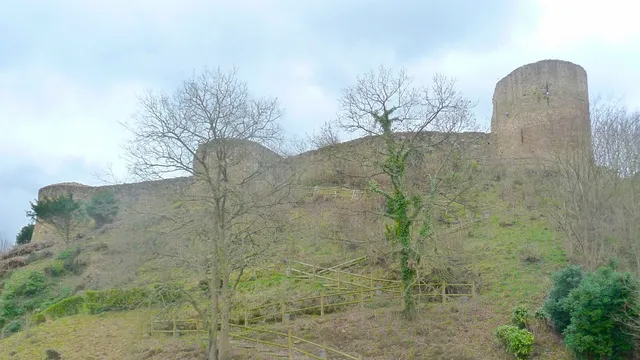
The Rance carries the damp smell of river mud beneath Dinan, France, where a 2.7-kilometer circuit of medieval walls still encloses the upper town. Ten towers and four stone gates survive from fortifications begun in the 13th century. Take the steep cobbled route down to the old port, then look back at the town rising above the water.
Built from cited sources · see the method · How we make our guides →
Dinan’s defenses were built over centuries, not as a single grand gesture: work on the ramparts began in the 13th century and continued into the 16th. In the 1380s, Duke John IV commissioned a 30-meter keep whose stone mass still stands above the surrounding roofs.
The route between town and river runs down Rue du Jerzual and Rue du Petit Fort, where the cobbles pitch sharply beneath timber-framed houses. Weavers and tanners once worked here; today, glassblowers, sculptors, and other artisans occupy the old workshops.
Dinan’s food belongs as much to Brittany as its architecture: buckwheat galettes arrive with salted butter and cider, while kouign-amann crackles with caramelized sugar. On Thursday mornings, around 200 stalls fill Place Duguesclin and Place du Champ Clos; Dinan feels less like a preserved set once you hear the market crowd spill through its medieval streets.
Not every monument, just the ones we'd walk you past ourselves.



Where to wander, by quarter — each with its own rhythm.
Before you go
From a feudal stronghold to a carefully guarded medieval town
Dinan enters the written record when Josselin de Dinan appears as a witness to a donation to Saint-Georges Abbey in Rennes. Remembered as the town’s founding lord, he represents the beginning of Dinan’s feudal history.
The Bayeux Tapestry shows Norman forces besieging Dinan’s early timber fortification during William of Normandy’s campaign in Brittany. Conan II surrenders the keys, held out on the point of a lance—a small, sharp image of how power changed hands.
A written mention dates the foundation of Saint-Sauveur to 1123, traditionally following Lord Rivallon le Roux’s return from the Crusades. Its Romanesque stonework would become the oldest layer of a church repeatedly reshaped over the next centuries.
Duke Jean I of Brittany acquired the lordship of Dinan, beginning a protracted dispute over the town’s hereditary rights. By the 1280s, Dinan had been drawn firmly into the Breton ducal domain, strengthening its role as a northern stronghold.
Under ducal rule, work began on the fortifications that would grow into a 2.7-kilometre circuit around the upper town. Four main gates and, originally, 14 towers guarded the streets and the high ground above the Rance.
The Champ aux Chevaux was laid out as an open square for horse fairs and regional trade. Its market tradition endured, with Thursday trading still tied to the place centuries later.
Bertrand du Guesclin was born at Château de la Motte-Broons, near Dinan, before becoming one of the leading French commanders of the Hundred Years’ War. He asked to be remembered in Dinan; his heart was brought back and entombed in Saint-Sauveur.
During the Breton Succession conflict, English forces besieged Dinan, and Bertrand du Guesclin fought the English knight Thomas of Canterbury on the Champ. The duel answered a breach of truce involving du Guesclin’s captured brother, turning the town square into a stage for military honor and public judgment.
Duke Jean IV commissioned a grand keep, built under architect Étienne Le Tur, to make ducal authority impossible to miss. Its Tour Ducale combined princely rooms with the hard geometry of a fortress.
Dinan’s burghers began raising the Tour de l’Horloge as a civic watchtower and a secure place for municipal records. At 45 metres, it put the town’s own authority into stone, above streets still governed by the old walls.
Construction began on the intra-muros Church of Saint-Malo under Viscount Jean II de Rohan. Its Flamboyant Gothic choir and later Renaissance portals register a town still building ambitiously at the close of the Middle Ages.
Clockmaker Hamzer of Nantes made a mechanical clock for Dinan’s belfry. Its workings gave civic time a public voice, distinct from the bells and schedules of the town’s religious houses.
Duchess Anne of Brittany issued letters patent authorizing Dinan’s municipal clock and belfry, and sponsored its great bronze bell. The civic bell, named Anne, gave the town a sound—and a symbol—of its own.
The Edict of Union formally brought Brittany into the Kingdom of France under Francis I. Dinan remained a walled Breton town, but its political horizon now reached beyond the duchy.
Dinan became a Catholic League stronghold under the Duke of Mercœur, who strengthened its defenses with artillery works, the Tour de Coëtquen, and an underground passage. Royal troops entered on January 31; the remaining garrison held out in the keep until surrendering on February 13.
Dinan’s linen makers produced fine cloth and sailcloth for export through Saint-Malo, reaching ports across northern Europe, Spain, and Spanish America. The trade enriched local merchants, whose half-timbered houses and granite townhouses still make their fortunes legible in the streets.
During the War of the Spanish Succession, the crown turned the old ducal keep into a prison for captured British officers. The slate roof gave way to a flat artillery terrace, a practical alteration that changed the building’s profile for good.
Charles Pinot Duclos was born in Dinan before making his name as a writer, historian, and member of the Académie française. The town’s son became its link to the intellectual arguments of the Enlightenment.
François-René de Chateaubriand studied at Dinan’s collège during his youth. Before he became a defining voice of French Romanticism, the town’s schoolrooms formed part of his early education.
The Revolution remade Dinan’s institutions as the old religious houses were nationalized and put to civic, military, or industrial use. Saint-Sauveur was secularized and used as a storehouse before Catholic worship resumed there in 1800.
After serving as a military prison, the keep became a departmental civil prison. Its austere rooms held prisoners until the institution closed in 1904.
Auguste Pavie was born in Dinan, in the house now associated with his name. He later became an explorer and diplomat whose work in Indochina helped establish the French protectorate over Laos.
Dinan’s new viaduct opened with ten granite arches, stretching 250 metres across the valley and rising 40 metres above it. The bridge offered a direct route to the upper town, bypassing the punishing climb of Rue du Jerzual.
A railway connection linked Dinan to the wider French network, changing the pace of travel and trade. Agricultural goods and manufactured wares could move farther and faster, while visitors found the town easier to reach.
After the demolition of the Porte de Brest in 1881 provoked public anger, Dinan’s ramparts were classified as Monuments Historiques. The loss had made the stakes plain: modernization could erase the very fabric that gave the town its shape.
Dinan purchased the keep from the French State for 30,000 francs and opened a municipal museum there in 1908. A building once used to project ducal power, hold enemy officers, and imprison civilians began a new life as a record of the town’s past.
German occupation, which had begun in June 1940, ended when Allied forces liberated Dinan in early August 1944. The town escaped the catastrophic destruction suffered by nearby Saint-Malo, leaving its medieval streets largely intact.
Dinan received France’s Ville d’Art et d’Histoire designation and established a protected historic sector. More than 115 timber-framed houses came under the care of preservation rules, keeping the old town’s everyday architecture in use rather than turning it into a mere backdrop.
On January 1, Dinan merged administratively with neighboring Léhon, an abbey village on the Rance. The enlarged commune joined two places whose histories had long met along the same river.
Breton knight and Constable of France · c. 1320–1380
Fought a famous duel in Dinan; his heart is entombed in the Basilica of Saint-Sauveur
Dinan remembers him as the knight who faced Thomas of Canterbury on Place du Champ in 1357; his heart is entombed in Saint-Sauveur. He might find the square’s market crowds a gentler audience than the two armies that watched his duel.
Duchess of Brittany and Queen of France · 1477–1514
Authorized Dinan’s municipal clock and bell in 1507
In 1507, Anne authorized Dinan’s municipal clock and its great bell, giving civic time a voice above the rooftops. She might approve that the Tour de l’Horloge still marks ordinary days in the old center.
Writer and historian · 1704–1772
Born in Dinan
Born in Dinan, Duclos went on to become an Enlightenment writer and the perpetual secretary of the Académie française. He might enjoy that the town’s medieval streets still make room for readers, conversation and the unhurried pleasures of a café.
Explorer and diplomat · 1847–1925
Born in Dinan
Pavie was born in Dinan before a career of exploration and diplomacy carried him across Southeast Asia. After years far from Brittany, he might have found the familiar granite and close-set streets a striking contrast to the places he mapped.
Painter, draughtswoman and ceramist · 1895–1993
Lived at La Grande Vigne in Dinan
Jean-Haffen lived and worked at La Grande Vigne, where Dinan and the Rance were close at hand for an artist’s eye. She might still recognize the shifting light that softens the stone and timber as the day moves toward the river.
Novelist · 1894–1957
Lived, taught and died in Dinan
Vercel lived and taught in Dinan before winning the Prix Goncourt in 1934 for Capitaine Conan; he died here, too. The town might have suited a writer who knew that a place can hold both the quiet of daily life and the weight of history.
Small things that change how the city treats you.
The city, as it actually looks.
Yes—especially if you like medieval streets you can explore on foot, rather than a town built around a single monument. The 2.7-kilometre ramparts, half-timbered houses and steep Rue du Jerzual lead down to the Rance port.
Allow one to two days. One day gives you time for the old town, ramparts and port; a second lets you visit the Château de Dinan and linger over the Thursday market or a longer meal.
Yes: Rue du Jerzual links the fortified upper town with the port. The cobbled descent is 502 metres long, with gradients of 12–18%, so wear sturdy shoes and expect a steep walk back up.
The main market is Thursday, from 8 a.m. to 1 p.m., on Place Duguesclin and Place du Champ Clos. A smaller market for local producers takes place on Saturday morning.
The main practical hazard in the historic center is the steep, uneven footing, especially on Rue du Jerzual. Wear grippy shoes, take the cobbled slopes slowly and use ordinary precautions with valuables in busy market areas.
Admission is €8 for adults, €5 at the reduced rate, and free for children under six. Plan about one to one and a half hours for the visit, including the steep internal staircases and panoramic terrace.
28 places to discover




Saved and recently read places — kept on this device only.