Dijon
France Updated Apr 2026
Church bells, market chatter, and the sharp smell of mustard hit you within a few blocks in Dijon, France. The surprise is scale: this is a compact city, yet it holds a ducal palace big enough to swallow an afternoon, a cathedral crypt built around the year 1000, and a food culture that treats blackcurrants and gingerbread with the seriousness other places reserve for monuments. Dijon feels intimate until you start paying attention. Then it keeps widening.
 Photo: Zola PALMER / Pexels
- Attractions
- 30
- Trip length
- 2-3 days
- Best season
- Late spring and early fall (May-June, September-early October)
Why Dijon
Built from cited sources · see the method · How we make our guides →
Dijon works because its pleasures overlap. The Palace of the Dukes houses the free Musée des Beaux-Arts, where the tombs of the Dukes of Burgundy and their carved mourners turn political power into something almost unnervingly human, while outside the same old center runs on wine bars, market lunches, and the scrape of café chairs across stone squares.
Wine explains more of the city than first-time visitors often realize. UNESCO did not list the Climats of Burgundy simply as pretty vineyard country: Dijon matters because this was one of the places where Burgundy's wine system was administered, argued over, and given shape, which is why the old parliamentary streets and ducal buildings feel tied to the vineyards south of town.
What makes Dijon linger in the mind is the mix of grandeur and daily life. You can climb the 46-meter Tour Philippe le Bon by its 316 steps, look out over terracotta roofs, then come back down for market oysters under Les Halles or a plate of oeufs en meurette near Place Emile Zola. A city with that range doesn't play the museum piece for long.
Ducal Power, Still Intact
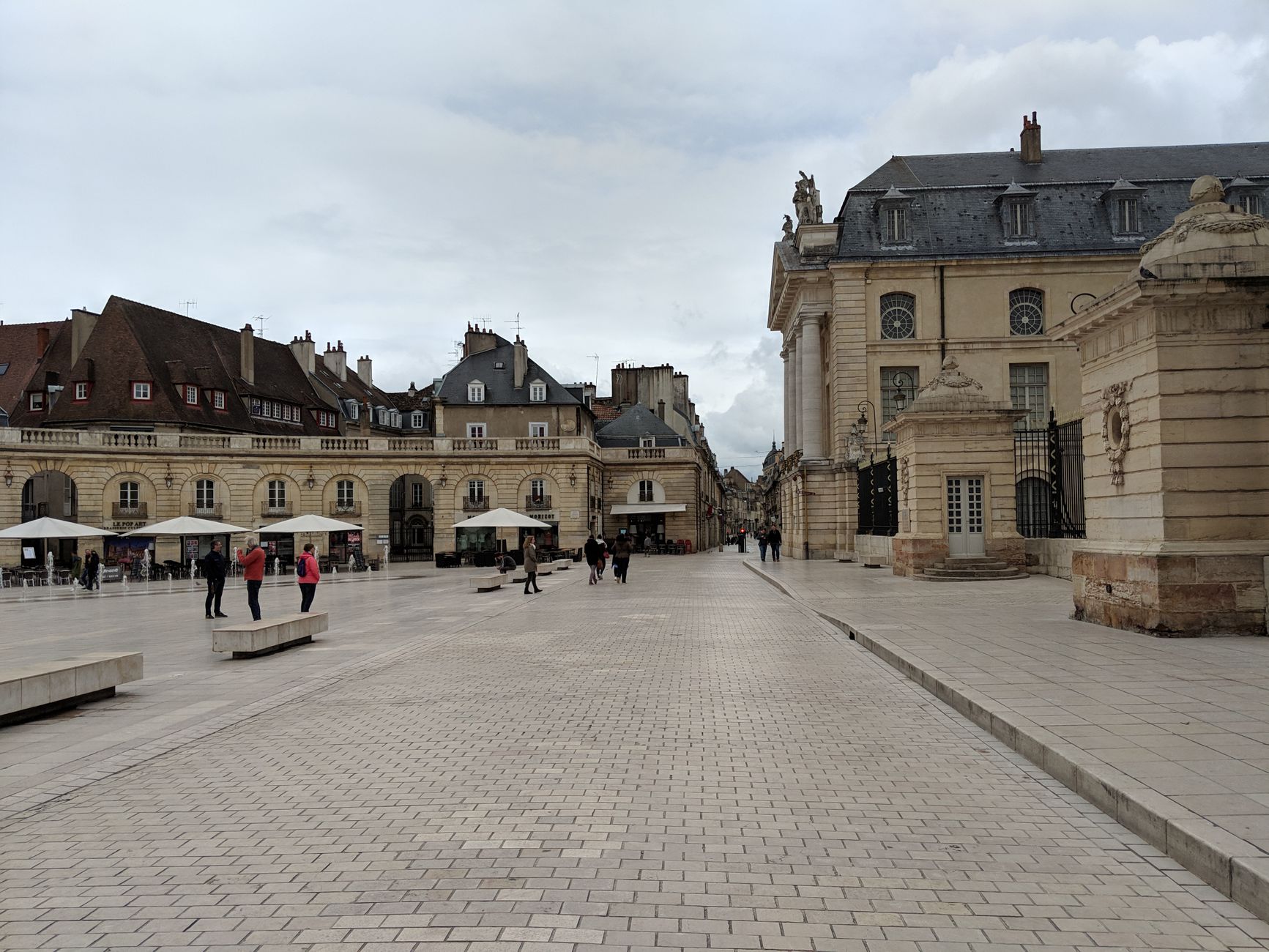
Dijon’s old center feels unusually coherent because power stayed put: the Palace of the Dukes, the former States of Burgundy, parliament mansions, church facades, half-timbered houses. Start at the free Musée des Beaux-Arts inside the palace, where the dukes’ tombs and their alabaster mourners turn medieval politics into something almost theatrical.The Owl Trail
The city’s best first walk is practical, not gimmicky: the 22-stop Owl Trail threads through Notre-Dame, market streets, carved doorways, and quiet courtyards in about an hour if you keep moving. Most people don’t keep moving, because Dijon keeps slipping small rewards in your path: a Gothic facade here, the smell of gingerbread there, a roof tiled like a jewel box.Capital of Burgundy’s Wine Story
Dijon is not just near Burgundy wine country; UNESCO treats it as part of the system, the administrative brain behind the Climats vineyards to the south. That changes the city’s meaning: the palace, parliament quarter, and old trading streets read less like static heritage and more like the machinery that shaped one of the world’s most codified wine cultures.A City With Breathing Room
Dijon knows when to step away from stone. Jardin de l’Arquebuse folds a botanical garden, biodiversity museum, planetarium, and more than 70 grape varieties into one stop, while Parc de la Colombière and Lac Kir show what locals do when they are done admiring dukes and ready for shade, water, and long evening light.
Neighborhoods
Where to wander, by quarter — each with its own rhythm.
Ducal Center
Around the Palace of the Dukes, Place de la Liberation, and Rue de la Liberte, Dijon shows its public face. You'll find the Musée des Beaux-Arts, grand civic facades, polished shopping streets, mustard and gingerbread shops, and terraces that fill fast on mild evenings; this is the quarter to choose when you want the city's ceremonial history without giving up a good apéro.Notre-Dame and the Owl Quarter
The lanes around Notre-Dame hold the Dijon most people imagine and the one worth keeping. Half-timbered houses lean over narrow streets, the little stone owl on the church wall gets rubbed for luck, and the 22-stop Owl Trail threads the area together, but the better reason to wander here is the texture of the place: carved doorways, cool church interiors, and façades that reward slow walking.Les Halles
The market quarter around Les Halles is where Dijon sounds most alive. On market mornings the metal-and-glass halls fill with oysters, cheeses, jambon persillé, and the damp smell of vegetables just unloaded, while the surrounding streets turn into a practical circuit of bistros, wine bars, and afterwork tables rather than a staged food district.Saint-Benigne Quarter
South of the old core, the Saint-Benigne area has more gravity and fewer distractions. The cathedral's Romanesque crypt, remains of a rotunda built around 1000, gives the quarter its depth, and the Archaeological Museum in the former abbey buildings adds a quieter kind of richness than the ducal center, with old stone, cloister air, and objects that make Burgundy feel older than its wine labels.Place Emile Zola and Rue Monge
This pocket of the center loosens the collar a little. Place Emile Zola and nearby Rue Monge are good for casual dinners, beer bars, and younger evening energy, with enough distance from the palace zone to feel less polished and more lived in; if you want Burgundy on the plate without the formal room, start here.Antiquaires Quarter
The Antiquaires quarter trades on old-shop windows, secondhand curiosities, and a slower pace. By day it suits anyone who likes browsing more than buying, and by night it shifts into a mellow bar-and-pub area where the streets feel slightly less choreographed than those around the main squares.Cite Internationale de la Gastronomie et du Vin
Set in and around the former hospital site, the Cité is Dijon in curated mode. You'll find restaurants, La Cave de la Cité with 250 wines by the glass, food programming, cinema, and a rooftop cocktail bar; it can feel designed rather than accidental, but that is exactly the point, and for visitors trying to understand Burgundy through food and wine in one place, it works.Lac Kir and the Western Edge
Lac Kir is less a postcard district than a release valve. West of the center, the lake and its 30 hectares of green space draw joggers, swimmers, families, and anyone who wants to see how Dijonnais use the city when they are not discussing dukes, and the light toward evening, with water in front and low hills behind, changes the mood completely.
Plan your trip
Before you go
- Getting There
- In 2026, Dijon Bourgogne Airport serves mainly business, training, and medical traffic rather than mainstream scheduled tourism, so most visitors arrive by rail from a larger hub. The cleanest air-rail options are Lyon-Saint Exupéry Airport (LYS), which has an SNCF/TGV station at the airport, and Paris Charles de Gaulle (CDG), with trains from Aéroport Charles de Gaulle 2 TGV to Dijon in about 4h15 at the fastest; Dijon Ville is the main station, with Dijon-Porte-Neuve also useful for some regional routes, and the city sits on the A31 and A39 motorway axes.
- Getting Around
- Dijon has no metro in 2026. The backbone is Divia’s 2 tram lines, T1 and T2, plus Lianes bus routes L3 to L9, a free city-center shuttle running Monday to Saturday about every 10 minutes from 8:00 to 19:00, and a historic core that is better on foot than by car. A 1-hour Bus&Tram ticket costs €1.40, a 24-hour pass €4.20, and the Dijon City Pass includes free public transport on the physical pass; cyclists can use DiviaVélodi with 40 stations and 440 bikes, with a 24-hour pass at €1.50.
- Climate & Best Time
- Dijon runs cool to mild rather than dramatic: spring usually sits around 5 to 20 C, summer around 13 to 27 C, autumn around 8 to 22 C, and winter around -0.2 to 5.6 C. Rain falls through the year, with May tending to be the wettest month, so the sweet spot is late May to June or September to early October, when the city is easy to walk and the vineyard country south of town is at its most persuasive; July and August are warmer and busier, while January and February are quieter and grayer.
- Language & Currency
- French is the language of daily life, and a simple bonjour before any question still opens more doors than people expect. France uses the euro, card payment is routine, contactless bank-card payments are officially capped at €50 per transaction, and Dijon’s tourist infrastructure is multilingual enough for visitors, with English offered at major sights such as the Tour Philippe le Bon climb.
- Safety
- Dijon is manageable for most visitors in 2026, but the usual urban habits still matter: keep your phone off café tables, watch pockets on trams and buses, and stay sharper around Gare SNCF and late-night bar streets. French emergency numbers are 112 for general emergencies, 15 for medical help, 17 for police, 18 for fire, and 114 for SMS or video access if you are deaf or hard of hearing.
A City Tempered by Dukes, Parliament, and Vineyards
From Roman roadside settlement to the ceremonial capital of Burgundy
- 1st century BCE
Divio Appears on the Roman Road
Dijon began as Divio, a small settlement on the route linking Lyon to the north. Roads made the place matter before monuments did. Traders, soldiers, and carts of wine and grain passed through, leaving the first outline of a city that would keep profiting from movement.
- c. 179
Saint Bénigne Enters the Story
According to tradition, Bénigne came to the region as a Christian missionary and was martyred here. Documented facts are thin, but the legend mattered enormously. For centuries the city built its religious identity around his memory, and cold stone crypts still carry that echo.
- late 3rd century
Walls Rise Around the Town
By the late 3rd century, the Gallo-Roman settlement pulled tighter and fortified itself. That usually means fear was in the air: invasions, instability, the sense that open roads could bring danger as easily as trade. Dijon learned early that survival sometimes starts with stone.
- 1001
Saint-Bénigne Is Rebuilt in Stone
The great abbey church of Saint-Bénigne was rebuilt at the start of the 11th century, anchoring Dijon in monastic Burgundy. Pilgrims came for the saint's cult, and monks shaped the city with prayer, landholding, and discipline. Incense, candle smoke, damp masonry: medieval power had a smell.
- 1031
Dijon Becomes Duçal Capital
Robert I made Dijon the capital of the Duchy of Burgundy, and the city's fortunes changed at once. This was the political promotion that turned a provincial settlement into a seat of power. Courts, clerics, merchants, and builders followed.
- c. 1220
Notre-Dame Takes Gothic Shape
Most scholars date the main Gothic building campaign of Notre-Dame de Dijon to the early 13th century. Its western facade, crowded with carved detail, feels compact and almost urban in temperament, a church built for a city already thinking in tight streets and sharp corners. The famous owl would come later, but the attitude was already there.
Show the full timeline (29 moments)
- 1342
Philip the Bold Is Born
Philip the Bold, born in 1342, would become the duke who launched Dijon into a richer and more theatrical age. His court understood display as politics. Stone, ceremony, and patronage became instruments of rule.
- 1365
The Ducal Palace Expands
Under Philip the Bold, the ducal residence began its transformation into the palace complex that still dominates central Dijon. This was architecture as statecraft. Every new hall and facade announced that Burgundy meant to rival kings, not merely serve them.
- 1371
John the Fearless Is Born
John the Fearless was born in the ducal palace at Dijon, a reminder that this city was not some quiet back office of medieval France. Dynastic drama began here in nursery rooms and chapel aisles. He would carry Burgundian ambition into some of the bloodiest politics of the age.
- 1386
Champmol Recasts Ducal Memory
Philip the Bold founded the Charterhouse of Champmol just outside Dijon as a dynastic monastery and burial place. The site fused prayer, art, and propaganda with almost indecent confidence. Its sculpted tombs and mourners later became among the city's finest survivors from Burgundian power at full volume.
- 1396
Philip the Good Is Born
Philip the Good, born in Dijon, would preside over the duchy's brightest and most polished court. He understood prestige the way a jeweler understands light. Under him, Dijon stood at the center of a political world that stretched far beyond Burgundy's vineyards.
- 1430
The Golden Fleece Signals Power
Philip the Good founded the Order of the Golden Fleece in 1430, and the Burgundian court sharpened its image as one of Europe's grand stages. Chivalry was not quaint decoration here. It was branding, diplomacy, and a warning wrapped in velvet.
- c. 1455
Philip the Good's Tower Rises
In the mid-15th century, the Tour Philippe le Bon rose above the palace, eventually reaching 46 meters and 316 steps. A tower like that is half lookout, half boast. From its summit, the city spreads in red and glazed tile, and the old ducal message is still legible: we are here, and we intend to be seen.
- 1477
The Duchy Falls to the Crown
Charles the Bold died in 1477 at Nancy, and with him the Valois Burgundian project collapsed. Louis XI moved quickly to absorb Dijon and the duchy into the French royal domain. The courtly dream ended hard, like a door slammed by a king.
- 1513
The Siege Tests the City
Swiss and Imperial forces besieged Dijon in 1513, pressing the city during the wars of the early 16th century. Governor Louis II de la Trémoille helped save it through defense and negotiation, and local memory credited divine help as much as military skill. Fear leaves traces; so does relief.
- 1627
Bossuet Is Born in Dijon
Jacques-Bénigne Bossuet was born here in 1627 before becoming one of France's great preachers and royal theologians. Dijon gave him his first schooling and his first public world. The city was producing not just officials and merchants, but voices trained to command a room.
- 1683
Rameau Hears the City First
Jean-Philippe Rameau was born in Dijon in 1683, son of the organist at Saint-Étienne. Before Paris heard him, Dijon did: church music, lessons, keyboards, the disciplined mathematics of sound. You can still imagine the vibration of notes under stone vaults.
- late 17th century
Mansart Gives the Palace Its Classical Face
In the reign of Louis XIV, Jules Hardouin-Mansart reshaped parts of the palace and the Estates of Burgundy with a calmer, more classical language. Medieval Burgundy had liked display. Royal France preferred symmetry, control, and long facades that looked as if they had never raised their voice.
- 1783
The Tower Turns to the Stars
The Tour Philippe le Bon began a second life as an astronomical observatory in 1783. A ducal watchtower became a place for measuring the heavens. Dijon has always liked buildings that refuse to stay in one century.
- 1789
Revolution Breaks the Old Order
The French Revolution stripped Dijon of much of the world that had made it a provincial capital of rank: church wealth, parliamentary privilege, inherited ceremony. Some monuments were damaged, some institutions dissolved, and the city had to reassemble itself from the debris. Old Burgundy did not vanish quietly.
- 1803
Henry Darcy Is Born
Henry Darcy, born in Dijon, would later give the city one of its least glamorous and most decisive improvements: clean water. Engineers rarely get statues equal to their impact. They should.
- 1832
Gustave Eiffel Is Born
Gustave Eiffel was born in Dijon in 1832, long before his name became shorthand for iron ambition in Paris. The connection matters less as hometown trivia than as proof that 19th-century Dijon was producing minds fit for an industrial century. Burgundy did not only grow wine.
- 1840s
Darcy Brings Clean Water
In the 1840s, Henry Darcy designed a modern water supply for Dijon, drawing spring water into the city with a rigor that felt almost moral. Clean water changed daily life more than any triumphal arch could. Streets, fountains, kitchens, and public health all became less precarious.
- 1856
Modern Dijon Mustard Is Defined
Jean Naigeon replaced vinegar with verjuice in mustard making, giving the local condiment the sharper profile now tied to Dijon. This was not a quaint kitchen anecdote. It was food chemistry, commerce, and identity in a jar.
- 1870
War and Occupation Return
The Franco-Prussian War brought occupation to Dijon, reminding the city that modern conflict still marched through old streets. Boulevards and railways had changed the urban fabric by then, but anxiety sounded much the same. Boots on stone keep their own rhythm.
- 1936
The Climats Gain Legal Shape
The Appellation d'Origine Contrôlée system codified the Burgundy Climats in the 1930s, giving legal force to vineyard distinctions shaped over centuries. Dijon mattered here as an administrative and commercial brain of the region. Lines on paper helped protect lines on hillsides.
- 1944
Dijon Is Liberated
After occupation and wartime bombing, Dijon was liberated on 11 September 1944 by French forces and the Resistance. Liberation is never abstract when it happens in streets people know by name. Bells ring differently after fear.
- 2015
UNESCO Recognizes the Burgundy System
UNESCO inscribed the Climats of Burgundy in 2015, and Dijon was included as part of the urban network that gave this vineyard culture its language, law, and trade. The honor was not for pretty scenery alone. It recognized a patient human ordering of land, parcel by parcel, over centuries.
- 2022
The Gastronomy City Opens
The Cité Internationale de la Gastronomie et du Vin opened in Dijon in 2022 on the site of a former hospital. That location says everything. A place once meant to heal bodies now stages the long Burgundian argument that food and wine are part of civilization, not decoration.
Who lived here
-
Engineer · 1832–1923
Gustave Eiffel
Born here
Eiffel was born in Dijon before he filled other skylines with iron nerve and mathematical elegance. He'd probably recognize the city at once: orderly streets, serious stone, and a quiet confidence that doesn't need Paris to validate it.
-
Composer · 1683–1764
Jean-Philippe Rameau
Born here and worked here early in life
Rameau was born in Dijon and stepped into his father's organist world before Paris claimed him. You can still imagine him hearing the city's churches not as monuments but as instruments, each nave built to hold a note a little longer than common sense demands.
-
Engineer · 1803–1858
Henry Darcy
Born here
Darcy did something less glamorous than writing operas or ruling duchies: he helped give Dijon clean water. That practical act changed daily life more than most statues ever will, and the city still carries his kind of intelligence in its calm, well-run bones.
-
Duke of Burgundy · 1396–1467
Philip the Good
Born here
Philip the Good turned Dijon into the nerve center of a state that rivaled kings. Walk through the palace and the tomb sculpture today, and his ambition still feels close enough to touch, polished into stone and ceremony.
-
Sculptor · 1784–1855
François Rude
Born here
Rude was born in Dijon and trained in the old ducal palace before carving his way into French public memory with the Arc de Triomphe's fierce relief. Dijon keeps the quieter version of him: the student before the thunder, learning how stone can move.
-
Priest and politician · 1876–1968
Félix Kir
Mayor here after World War II
Félix Kir helped shape postwar Dijon and left his name attached to a drink so famous many people forget he was a real man. He'd likely be amused that blackcurrant and white wine became his afterlife, though Lac Kir is the more durable memorial.
-
Chemist · 1777–1838
Bernard Courtois
Born here
Courtois, the discoverer of iodine, was born in Dijon and came out of the city's scientific orbit rather than its ducal glamour. That suits Dijon perfectly: beneath the carved facades runs a stubborn, Enlightenment habit of figuring out how things work.
-
Neuroscientist · 1924–2024
Roger Guillemin
Born here and studied here
Guillemin was born in Dijon, studied at Lycée Carnot, and began medicine here before winning a Nobel Prize far from Burgundy. His path says something useful about the city: Dijon can look modest until you notice how many people it taught to think at a very high level.
Where to Eat
Where locals actually book dinner — not the tourist menus.
-
Boeuf bourguignon
This is Burgundy in a pot: beef cooked slowly in red wine until the sauce turns dark, glossy, and almost spoonable on its own. Order it where the kitchen has patience, not a laminated tourist menu, and you get depth rather than heaviness.
-
Œufs en meurette
Poached eggs in a red-wine sauce sound odd until the first bite lands: silk from the yolk, sharpness from the wine, little jolts of bacon and onion. It’s one of those dishes that explains the region’s love affair with sauce better than any lecture could.
-
Jambon persillé
Cold ham set in parsley-flecked aspic has an old-school Burgundy confidence to it. Try it as a starter with a glass of local white and it makes immediate sense, especially on a warm lunch when you want something savory without the sleepiness of a heavier plate.
-
Escargots de Bourgogne
Yes, the famous snails. In Dijon, the point is less the snail than the butter: garlic, parsley, warmth, and the smell that drifts across the table before the plate lands.
-
Pain d’épices
Dijon’s gingerbread tradition often gets overshadowed by mustard, which is unfair. A good pain d’épices carries honey, spice, and a faint chew, and Mulot & Petitjean has been making the case for it since 1796.
-
Dijon mustard
The city’s emblem is sharper and more varied than the yellow squeeze-bottle version most visitors grew up with. Taste a few styles, especially alongside charcuterie or in market halls, and you notice how mustard here acts less like a condiment than a regional signature.
-
Blackcurrant and kir
Dijon gave the world crème de cassis and the kir, the apéritif that mixes it with white wine. Drink one before dinner and the city’s fruit-and-wine logic becomes obvious, especially when cassis sweetness meets the dry edge of a Burgundian pour.
-
Les Halles market grazing
Les Halles is where Dijon stops posing and starts eating. Go for cheese, charcuterie, seasonal produce, and small bites rather than a single grand meal; the iron-and-glass market hall gives you the smell of ripe Époisses, fresh bread, and roast chicken all at once.
Insider tips
Small things that change how the city treats you.
Pick Your Pass
A 24-hour Divia pass costs €4.20, while the Dijon City Pass starts at €22 and includes public transport only on the physical version. If you're planning several museums and a tower climb, the City Pass can pay off fast; if you're mostly walking, plain Divia tickets are cheaper.Use The Shuttle
Dijon has no metro, but the tram network is easy and the free city-center shuttle runs every 10 minutes from 8:00 a.m. to 7:00 p.m., Monday to Saturday. Save your paid tram ticket for longer hops like Lac Kir or the station.Climb Early
Tour Philippe le Bon has 316 steps and guided access, so book ahead rather than assuming you can wander in. Morning climbs give you cleaner light on the terracotta roofs and spare you the hottest part of the day.Lean On Freebies
Dijon's permanent collections at the Musée des Beaux-Arts are free, and the Musée archéologique and Musée de la Vie bourguignonne are free too. That's a rare bargain in a city with this much serious heritage.Start With Bonjour
In shops, cafés, and market stalls, open with "bonjour" before asking for anything. French service feels smoother when you do this, and in Dijon the difference is immediate.Watch The Station
Dijon is manageable, but stay sharp around Gare SNCF, on crowded trams, and in busy market streets. Keep your phone off café tables and your bag closed; French government guidance puts petty theft, not dramatic crime, at the top of the list.
Gallery
The city, as it actually looks.


Frequently asked
Is Dijon worth visiting?
Yes, especially if you want a compact French city with real substance rather than a checklist of postcard sights. Dijon gives you ducal history, free museums, strong food markets, and direct access to Burgundy's wine country without the scale or cost of Paris or Lyon.
How many days in Dijon?
Two days is enough for the old center, the Palace of the Dukes, Les Halles, and a tower climb. Give it three if you want the museums properly, a slower market lunch, and time for Lac Kir or a Burgundy wine excursion.
How do you get around Dijon without a car?
Very easily. The historic center is walkable, the Owl Trail links 22 key stops, and Divia's two tram lines, buses, and free center shuttle cover the rest.
Does Dijon have a metro?
No, Dijon does not have a metro. The city runs on two tram lines, buses, a free city-center shuttle, and a bike-share system with 40 stations.
What is the best time to visit Dijon?
Late May to June and September to early October are the sweet spots. Days are long, temperatures are easier on foot than in high summer, and wine-country side trips make more sense when the vines are active rather than bare.
Is Dijon expensive for tourists?
No, not by French city-break standards. Free permanent museum collections, a €4.20 day transport pass, and plenty of market-based eating make it easier on the wallet than Paris, Bordeaux, or much of Provence.
Is Dijon safe for tourists?
Yes, generally. Standard city caution is enough for most visitors, with extra attention around the train station, on crowded trams, and in busy shopping or market areas.
What airport should I use for Dijon?
Lyon-Saint Exupéry or Paris Charles de Gaulle usually make more sense than Dijon Bourgogne Airport. Dijon Bourgogne mainly serves business, medical, military, and leisure aviation, while Lyon and CDG connect much better to onward rail.
Can you visit Dijon on a weekend?
Yes, and Dijon suits weekends unusually well. A Saturday market at Les Halles, the Beaux-Arts museum, the Owl Trail, and one good Burgundy dinner already make a full, satisfying two-day break.
Pick up where you left off
Saved and recently read places — kept on this device only.
Photo credits (4)
- Zola PALMER — Pexels License (https://www.pexels.com/license/) — Source: https://www.pexels.com/photo/31954094/
- Riandy Saputra — Pexels License (https://www.pexels.com/license/) — Source: https://www.pexels.com/photo/35805551/
- Ad Thiry — Pexels License (https://www.pexels.com/license/) — Source: https://www.pexels.com/photo/29866704/
- Ferdinand F Eman — Pexels License (https://www.pexels.com/license/) — Source: https://www.pexels.com/photo/30763567/
Photos may have been resized or cropped.