An introduction.
Researched by the Audiala editorial team from historical records, architectural archives, and local expertise.
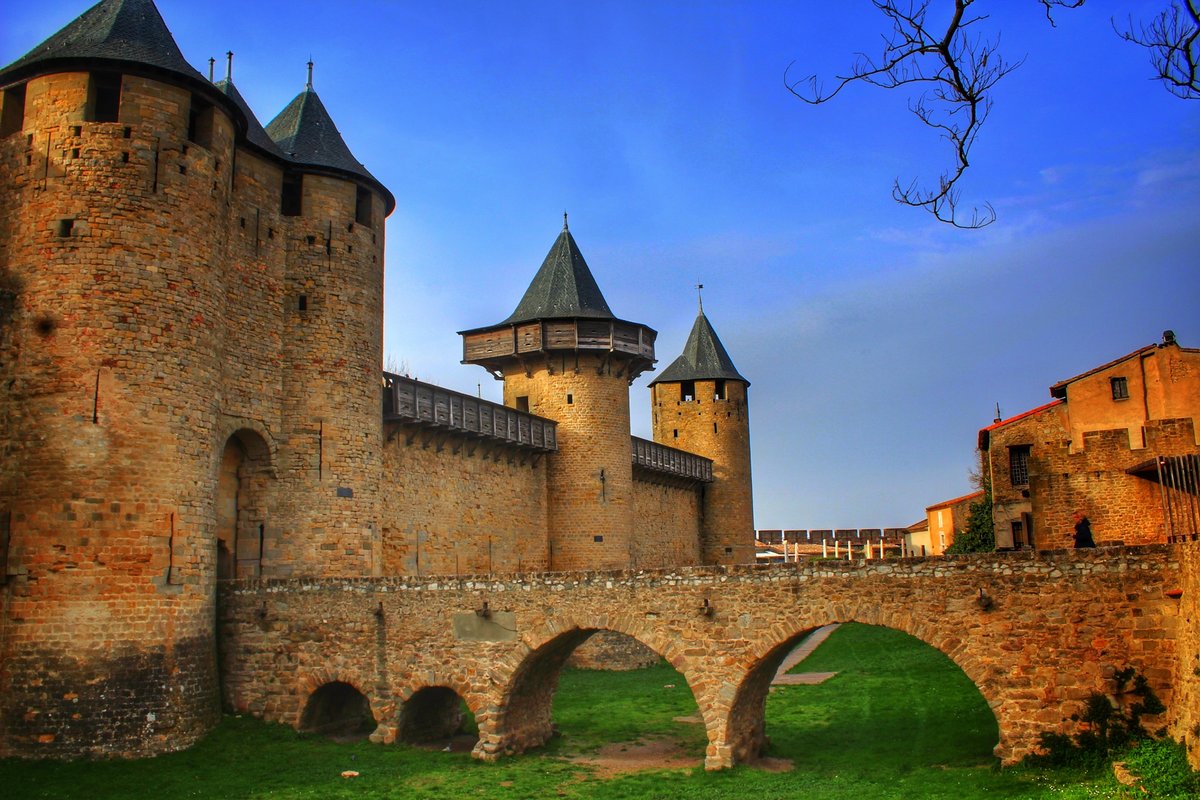
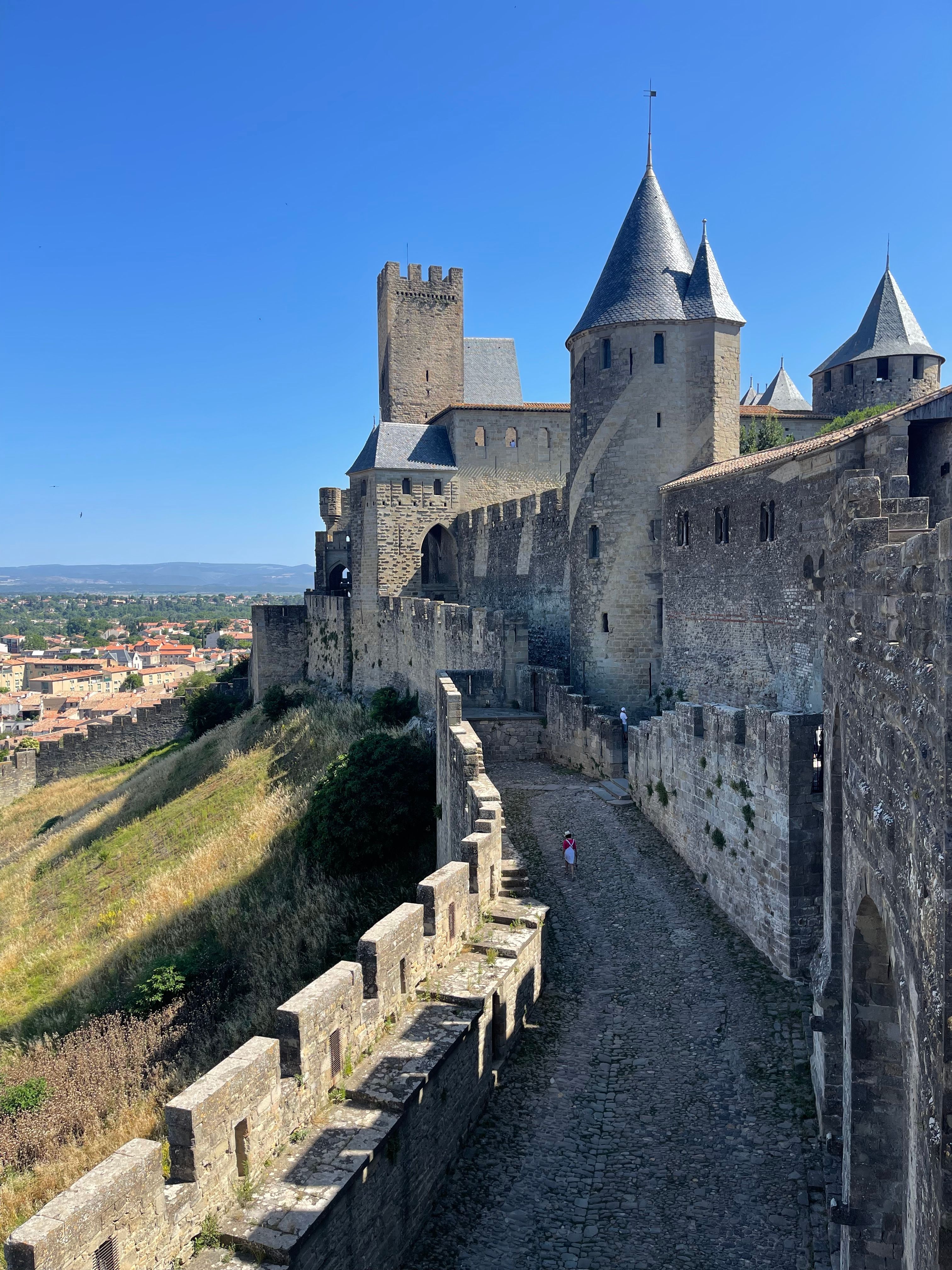
WWhy does every guide tell you Charlemagne besieged Carcassonne when Charlemagne never came near it? The Saracens held this hilltop from 725 to 759, and it was Pépin le Bref — Charlemagne's father — who took it back. Yet the bronze bust of Dame Carcas still smiles at you from the Porte Narbonnaise, the stone keeper of a story that scholars have known to be backwards for at least three centuries. Walk through that gate today and you enter a walled city in southern France whose 3 kilometres of double ramparts, 52 towers, and conical slate roofs look almost too medieval to be true — because in places, they aren't.
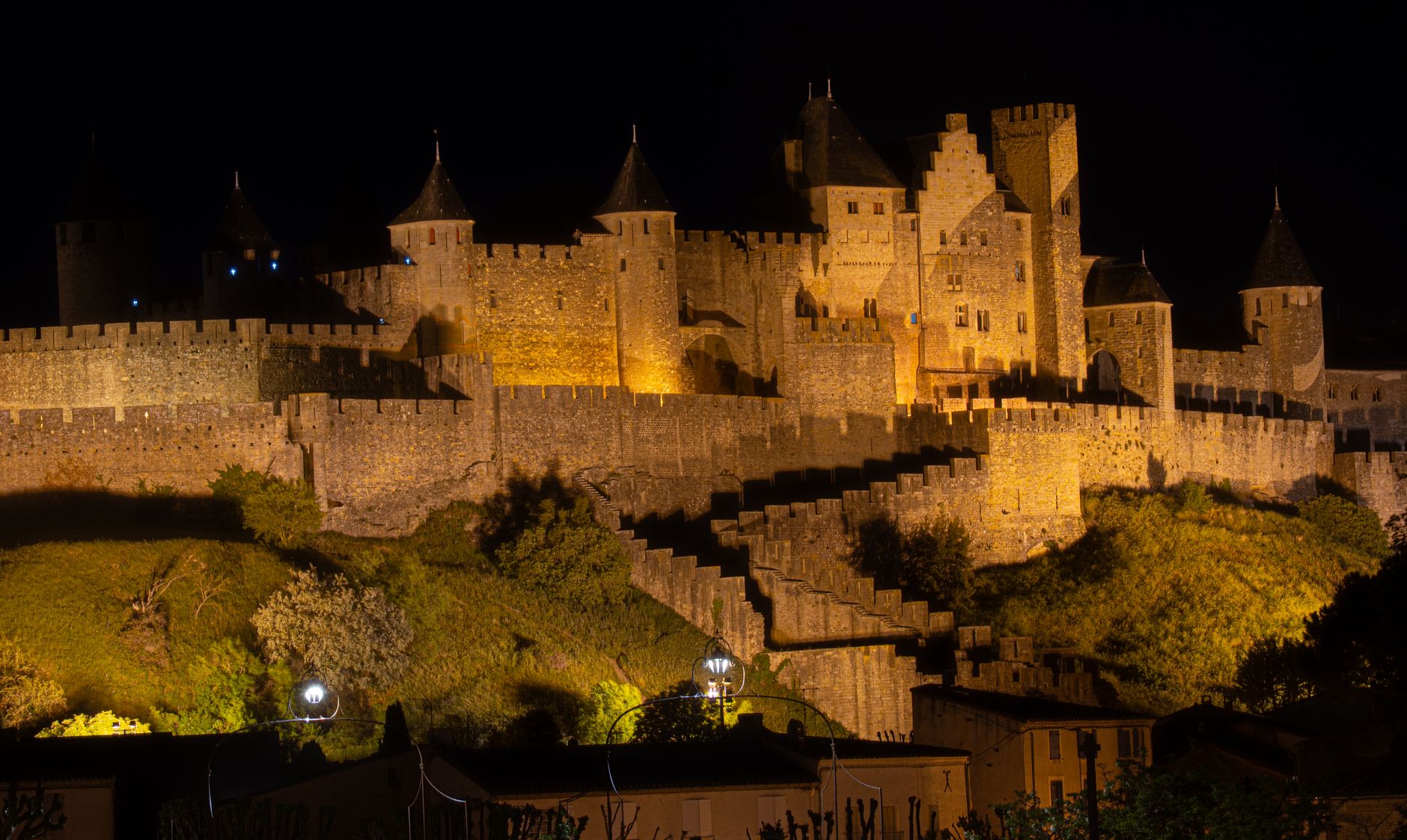
Carcassonne sits on a limestone bluff above the river Aude, in the Languedoc, two hours by train from Toulouse. The Cité — the fortified upper town — is what you've come to see. Below it spreads the Bastide Saint-Louis, the grid of streets the French king built in 1262 after expelling the inhabitants from the hill. Most visitors never cross the Pont Vieux to look back; they should. From the lower bank at dusk the citadel reads as a single silhouette, fifty-two towers in profile, and you finally understand why Walt Disney lifted the shape for Sleeping Beauty's castle.
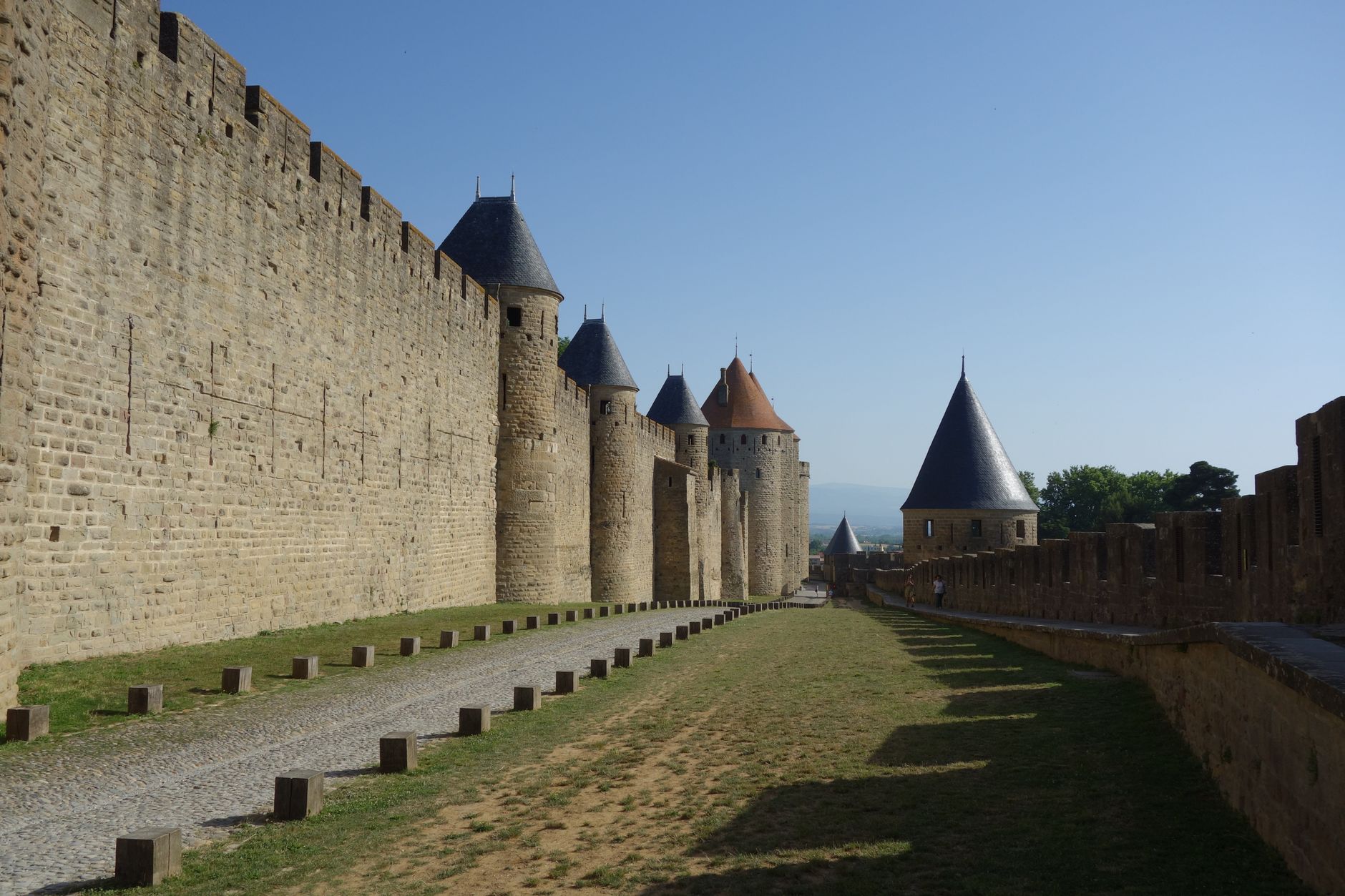
Inside the walls, footsteps echo on cobbles polished by eight centuries of feet. The lices — the corridor between the inner and outer ramparts — runs like a dry moat where archers once paced and, less romantically, where 19th-century shanty-dwellers lived in shacks until Eugène Viollet-le-Duc evicted them. The Château Comtal anchors the western flank. The Basilique Saint-Nazaire holds 14th-century stained glass that Viollet-le-Duc himself called the finest in southern France. Mass is still said there at 11:00 every Sunday.
Come for the ramparts. Stay for the layered fraud and truth of them — Roman base, medieval ashlar, 19th-century roof, all welded into one of Europe's most argued-over monuments. Tour the Hôtel De Rolland afterward in the lower town for the civic counterpoint to all this military stone, and use the Carcassonne city page to plan the rest.
01 What to see.
Château Comtal and the Hoarding Galleries
The 12th-century Trencavel seat sits braced against the western Roman wall, and the visit opens with something most castles can't offer: a 1/100 scale wooden model of the entire Cité, carved over 40 years by Louis Lacombe between the 1850s and 1930s. Look closely. He hid tiny contemporary figures among the medieval crowd.
Upstairs in the keep, a late-12th-century mural shows Christian knights charging Saracens — one of the rare in-situ Romanesque secular paintings left in France. Then you climb. Spiral stairs dished into shallow grooves by 800 years of feet deliver you onto the wooden hoarding galleries that link six towers along the inner curtain.
Run a finger along the stirrup-shaped loopholes — the widened base braced a crossbowman's foot. Wind whistles through them even in August. Footsteps on the planks sound nothing like footsteps on stone, and that small acoustic shift is the closest most of us get to hearing what a 13th-century sentry heard.
Basilique Saint-Nazaire-et-Saint-Celse
Two churches grafted into one. The Romanesque nave is squat, thick-walled, dim — built when stone had to do all the work. Walk east and the building changes century. The Gothic Rayonnant chancel and transept open into 13th- and 14th-century stained glass, among the oldest sets in southern France.
Mid-morning is when it pays off. Sun hits the central choir window — the Life of Jesus, late 13th century — and throws shifting blue and red carpets across the flagstones. Blue dominates, which is unusual; most French glass of that era leans toward red.
No flying buttresses hold any of it up. The internal vaults bear the entire thrust, which is why the exterior reads almost as a fortress. Sit toward the back of the nave for ten minutes. The light moves faster than you'd expect.
The Lices and the Roman Wall
Skip the main rue Cros-Mayrevieille for an hour and walk the lices instead — the dusty corridor between the inner and outer ramparts. Most of the four million annual visitors never come down here. Early morning it's near silent, gravel crunching underfoot, swallows working the towers above.
This is where the Cité reveals its real age. Near the Tour du Vieulas, look at the lower courses of the inner wall: small regular ashlar interrupted by herringbone brick — Late Roman opus mixtum, 3rd to 4th century, sitting beneath medieval limestone added a thousand years later. Roman towers are horseshoe-shaped and low. Medieval ones round and tall. Adjacent in the same wall, the construction gap is visible to the naked eye.
Exit at Porte Saint-Nazaire. Cypress trees, no crowds, the locals' route back down to Carcassonne.
02 In pictures.



Plan and listen to Carcassonne Citadel with Audiala.
Audio guide in your pocket, itinerary in your browser. Built for the way you actually visit.
Tickets & tours.
These are guided options from our partners — same price as booking direct.
Prices are indicative — final pricing and availability are confirmed at checkout. Audiala may earn a commission from bookings made through these links.
03 Visitor logistics.
The practical scaffolding for a good visit — kept short.
Getting There
Carcassonne SNCF station (TGV + Intercités from Toulouse, Montpellier, Paris) sits 2.5 km below the walls. Bus Line 4 (RTCA) runs station to Cité gates; on foot it's 15–20 minutes across Pont Vieux with a steep final climb to Porte Narbonnaise. Drivers from Toulouse take A61 exit 23, from Perpignan A61 exit 24 — park at P. Cité near Porte Narbonnaise (paid, fills by mid-morning July–August).
Opening Hours
As of 2026, Château Comtal and the inner ramparts open 10:00–18:30 from 1 April to 30 September (last entry 17:30), and 09:30–17:00 from 1 October to 31 March (last entry 16:00). Closed 1 January, 1 May, 25 December. The Cité streets and outer walls themselves are free and open 24/7 — only the castle circuit needs a ticket.
Time Needed
Quick wander through the lanes, free outer walls and Basilique Saint-Nazaire: 1.5–2 hours. Add the Château Comtal self-guided route plus inner ramparts walk and you're at 3–4 hours. A full day with cassoulet lunch, lapidary museum and a stroll down to the Bastide runs 5–6 hours.
Cost & Free Days
As of 2026, Château Comtal entry is €19 high season (1 Apr–30 Sep), €13 low season; audioguide €4 in five languages. Under-18s free always; 18–25 EU residents free; free for all on the first Sunday of each month November–March, and during European Heritage Days in September. Show a TGV or Intercités ticket under 5 days old for €16.50/€11.50.
Accessibility
Wheelchair access inside Château Comtal is limited to the cour d'honneur and barbacane; the rampart route is officially flagged "éprouvant" — many steps, narrow spirals, uneven medieval cobbles. Free wheelchair loan at the Cité tourist office, and the Handi'Bus adapted shuttle serves the upper town. Disabled visitor plus one companion enter free.
04 Tips for visitors.
Small things that change the day.
Real Cassoulet Test
Avoid Cité places serving cassoulet in tinned cassoles — locals rate Le Trivalou in the Bastide (mid-range, ~€20) above anything inside the walls, with La Demeure du Cassoulet (mid/splurge, mains €19–43) the strongest option at the gates. Look for "fait maison" and a real terracotta cassole.
Pont Vieux Pickpockets
Confirmed pickpocket reports on Pont Vieux between the Bastide and the Cité, plus the Porte Narbonnaise queue and ticket barbicans. Bag in front, zipped, and ignore anyone asking you to sign a petition or accept a "friendship bracelet."
Basilique Saint-Nazaire Manners
Saint-Nazaire is still an active parish, not a museum. Cover shoulders and knees, hats off for men, no flash, and stay quiet — the 14th-century stained glass set rewards five silent minutes near the southern transept more than any selfie.
No Drones, No Flash
Drones are banned over the Cité — UNESCO status, classified monument, and proximity to Carcassonne airport mean a Préfecture de l'Aude permit is required. Inside Château Comtal, no flash and no tripods without a CMN permit; outside on the lices, tripods are fine in low-traffic moments.
Beat the Coach Wave
Day-trip coaches from Toulouse and Mediterranean cruise ports flood the Cité between 11:00 and 16:00 in summer. Arrive at opening (10:00 high season) or after 17:00, when light hits the conical tower roofs from the west and most groups have left for their hotels.
Shoes Over Style
Cobbles run the length of the Cité, the approach from the lower town is steep, and tower staircases are narrow spirals worn smooth. Sturdy soles with grip — flat sandals and heels turn slippery the moment it rains.
Sleep in the Bastide
The Cité empties of tourists by 19:00 and feels half-staged after dark; the Bastide Saint-Louis across the river is where Carcassonnais actually live, eat and drink. Book somewhere like Hôtel De Rolland and walk up to the floodlit walls at night.
Three-Year Ticket Trick
Tickets bought through the Carcassonne tourist office stay valid for three years within the same season window — useful if weather turns or you only have an hour. Book the Château Comtal slot online in advance from June to September; capacity is capped and walk-ups get turned back on busy afternoons.
Where to Eat
Don't Leave Without Trying
LA DEMEURE DU CASSOULET
local favoriteOrder: The gourmet cassoulet with foie gras, a rich and traditional stew of beans, sausage, pork, and preserved goose.
This is the quintessential spot for your first authentic cassoulet experience inside the Citadel. It feels like stepping into a cozy, historic slice of Southern France.
La Table de Marie
local favoriteOrder: The guinea fowl or the burger with local duck; round off the meal with their excellent cheesecake or tiramisu.
A true local favorite that sidesteps the typical tourist traps, offering well-executed regional dishes and a genuinely warm atmosphere.
Jungle Taverne
quick biteOrder: Grab a selection of local craft beers and one of their generous sharing boards.
This is your go-to spot for a relaxed evening. It feels like a cool, quirky discovery with an impressive selection of French and Belgian ales.
La table du vatican
local favoriteOrder: The menu changes, but look for the seasonal specials—and don't miss the pavlova if it's on the dessert list.
A hidden gem with a camp, eclectic interior that feels worlds away from the standard tourist path. It's well worth the walk for the atmosphere alone.
Dining Tips
- check Service is legally included in the price; tipping is not required, though rounding up for good service is appreciated.
- check Reservations are highly recommended for dinner, especially in La Cité during the tourist season.
- check The Place Carnot market is excellent on Saturday mornings for fresh local produce.
- check Look for 'service compris' or 'prix nets' on menus to confirm service is already included.
Restaurant data powered by Google
05 Eight Centuries of the Same Stones, Watching
Carcassonne's particular genius is that it has never stopped being a fortress, even when no one was attacking it. Every wave — Gallo-Roman castrum, Visigothic stronghold, Saracen emirate outpost, Trencavel viscounty, royal French frontier post, Viollet-le-Duc's restoration laboratory, UNESCO showpiece — found the same hilltop already fortified and added another layer. The walls were never abandoned; they were re-purposed. Sentinel duty has just changed employers.
What endures here is the act of guarding itself. Sunday mass at the Basilique Saint-Nazaire has been sung continuously since the 11th century. The Embrasement de la Cité — the 22:30 fireworks on every 14 July — has set the ramparts ablaze annually since 1898. The 14th-century Grand Puits in the Château Comtal courtyard still has the same stone margelle, even if scholars argue whether the well bottoms at 30.20 metres or 39.45. The function of this hill — to be watched, to be lit, to be the place where the town gathers and looks up — has held.
The Day the Walls Stopped Belonging to the Trencavels
For most of the 12th century the Cité belonged to the Trencavel viscounts, southern lords who tolerated Cathars in their towns and traded in Occitan, not French. The official tourist story makes 1209 a tidy date — the year the Albigensian Crusade arrived, the year Carcassonne fell — and moves on. Fortress falls, kingdom expands, history continues.
The detail that doesn't add up is what happened to Raymond-Roger Trencavel himself. He was 24 years old. After the crusader army cut off the Aude wells in the August heat and dysentery began spreading among the Béziers refugees crammed inside his walls, he walked out under safe-conduct on 15 August 1209 to negotiate with the papal legate Arnaud Amalric — the same Amalric who, three weeks earlier at Béziers, had reportedly told his soldiers "caedite eos, novit enim Dominus qui sunt eius": kill them all, God will know his own. Trencavel was promptly seized. His population was expelled "in shirts and breeches only" — nudi in camisiis, the chronicler wrote. The young viscount was thrown into a dungeon in his own castle. He died there on 10 November, three months later. The crusader cause said dysentery. Almost no one in Languedoc believed it then. Scholars still debate it now.
The revelation is that the perfectly preserved medieval city you walk through today is not the souvenir of a glorious siege survived. It is the trophy of a 24-year-old's broken safe-conduct. Simon de Montfort took the title; the French crown swallowed the south within a generation; the Occitan language began its long retreat. Once you know this, the Tour Pinte in the Château Comtal stops being just another tower. It is the room where a young man died of either fever or murder, and the Cité has been French ever since.
What Changed: The 19th-Century Resurrection
What Endured: A Hill That Refuses to Stop Watching
Listen to the full story in the app
The whole Carcassonne Citadel,
told well.
Audio guides for 1,100+ cities across 96 countries. History, stories, and local insight — offline ready.
06 Frequently asked.
The questions travellers send us most about Carcassonne Citadel.
Is Carcassonne Citadel worth visiting?
Yes, but go in knowing roughly half of what you see is Viollet-le-Duc's 1853-1879 restoration, not pure medieval fabric. The double curtain wall, 52 towers, and 13th-century stained glass in Saint-Nazaire are unmatched in Europe. Skip the tourist-trap crêperies on the main drag and you'll find a fortress most travelers only half-understand.
How long do you need at Carcassonne Citadel?
Plan 3-4 hours to do it properly: Château Comtal and ramparts walk (around 2 hours), Basilique Saint-Nazaire (30 minutes for the stained glass), plus the lices and a meal. A quick walk through the free streets and basilica takes 1.5-2 hours. Add a full day if you want the Bastide Saint-Louis and dinner.
How do I get to Carcassonne Citadel from the train station?
It's a 15-20 minute walk: cross the Pont Vieux, climb through the lower town, and approach via the Porte Narbonnaise — the final stretch is steep. Bus Line 4 (RTCA) runs from the SNCF station to the Cité gates if you'd rather skip the climb. The free electric shuttle only circulates the Bastide and won't take you up.
How much does it cost to enter Carcassonne Citadel?
The Cité streets, outer walls and basilica are free; the paid ticket (€19 high season 1 Apr-30 Sep, €13 low season 1 Oct-31 Mar) covers Château Comtal, the inner ramparts walk and lapidary museum. Under-18s and EU residents 18-25 are free, and entry is free on the first Sunday of each month from November to March. Audioguide is €4 extra and worth it.
What is the best time to visit Carcassonne Citadel?
Early morning or late afternoon in May, June or September — soft light on honey limestone, manageable crowds, comfortable temperature on exposed ramparts. Avoid midday in July-August unless you've come for the Festival de Carcassonne or the 14 July Embrasement (fireworks fired from the walls themselves, running since 1898). Winter mornings give you near-empty lices and occasional snow on the slate cones, which is rare and photogenic.
Can you visit Carcassonne Citadel for free?
The walled streets, lices, outer ramparts and Basilique Saint-Nazaire are free and open 24/7 — only Château Comtal and the inner rampart walk require a ticket. Free entry to the paid zone applies to under-18s, 18-25 EU residents, disabled visitors plus a companion, and on the first Sunday of every month from November to March. European Heritage Days in mid-September also waive the fee.
What should I not miss at Carcassonne Citadel?
The 13th-century stained glass in Basilique Saint-Nazaire (among the oldest in southern France), the Romanesque mural of Christian knights versus Saracens inside the keep, and Louis Lacombe's 1/100 scale wooden model that took 40 years to carve. Walk the lices — the quiet barrier zone between the two walls — at sunrise; almost no one does. And find the seam where Late Roman opus mixtum meets 13th-century ashlar near the Tour de la Marquière.
Is Carcassonne Citadel really medieval?
Partly. The Late Roman base survives along two-thirds of the inner wall, and the 13th-century royal works under Saint-Louis are real, but the conical slate roofs, the Porte Narbonnaise drawbridge and much of the crenellation are Viollet-le-Duc's 19th-century reinvention. Slate was a northern French choice — Languedoc traditionally roofed in flat terracotta tile. Hippolyte Taine called it a scandal at the time.
Verified, and shown.
Researched and written by the Audiala editorial team from historical records, architectural archives, and local expertise.
Inscription details, dating of Roman and 13th-century defenses, restoration history, integrity issues.
Detailed nomination file covering tower counts, missing barbican, restoration debates.
Official CMN account of the 1844-1879 restoration, Cros-Mayrevieille's role, Boeswillwald continuation.
Official opening hours, ticket prices, last admission, closure dates.
Wheelchair access details for Château Comtal courtyard and barbican.
Official online ticketing for Château Comtal.
Alternative ticket resale, valid 3 years in chosen season.
Free electric shuttle and Bastide circulation info.
Parking lots near Porte Narbonnaise, coach fees, access routes.
Wheelchair loan, Handi'Bus adapted transport service.
April 2025 launch of new accessibility program.
Saracen control 725-759, debunking of Charlemagne siege legend.
Folk etymology, scholarly debate over historical kernel of legend.
Recognition of Dame Carcas as intangible cultural heritage; Karine-Larissa Basset's Saracen-origin reading.
Stained glass, Romanesque nave, Gothic chancel, light effects on stone floor.
Architecture details, Tree of Jesse window.
19th-century misreading and incorrect completion of one window's iconography.
Pont Vieux, Pont Neuf, Belvédère, photo viewpoints.
Sunday Mass at 11:00, opening hours, active worship status.
14 July fireworks since 1898, timing, viewing locations.
July festival, IN and OFF programming, Théâtre Jean-Deschamps history.
Modern review of slate vs tile controversy.
2017 tentative-list extension linking Cité to Cathar mountain châteaux.
Researched from Wikidata, Wikipedia & official sources · fact-checked · How we make our guides →