Prehistory of Biarritz
science
c. 100,000 BCE
Early Footprints on the Cliffs
Worked stone tools found on Biarritz’s clifftops and coastal terraces point to Middle Paleolithic habitation, perhaps around 100,000 BCE. Wind, salt, and open sightlines made these high shelves useful long before hotels and promenades altered the shore.
Roman Antiquity
castle
c. 1st century CE
Roman Foundations on Atalaye
Foundations uncovered on the Atalaye promontory point to a Roman presence on the coast. The same high ground later carried a medieval fortress and whalers’ lookout, so Biarritz’s famous view began as a practical military asset.
Medieval Labourd
gavel
1023–1152
Biarritz Enters Written History
A document generally dated to 1023 gives the settlement the Basque or Gascon name Bayarrits, the earliest written form tied to Biarritz. In 1152, Eleanor of Aquitaine’s marriage to Henry Plantagenet brought Labourd under English suzerainty, beginning roughly three centuries of Plantagenet rule.
castle
1284
Whaling Rights Become Law
Authorities in Labourd and the Duchy of Aquitaine reaffirmed Biarrot fishermen’s rights to hunt whales after disputes with Bayonne. Harpoons, rendered blubber, and whale oil supported the small port, while lookouts on the Atalaye watched for dark backs beyond the breakers.
gavel
1342
Fish Charter, Fortress Recorded
A royal charter dated May 26, 1342, allowed Biarrots to carry and sell fresh saltwater fish directly in Bayonne. The same record mentions Château de Belay, or Ferragus, a four-towered English fort with a drawbridge above the harbor.
swords
1451–1453
French Crown Reclaims Labourd
French forces took Bayonne and Labourd between 1451 and 1453, ending English rule along this coast after the Hundred Years’ War. Biarritz now answered to the French Crown, though its boats, markets, and speech kept their Basque character.
Early Modern Biarritz
castle
1603–1739
Ferragus Becomes a Sea Beacon
Henry IV’s letters patent of 1603 confirmed Château de Ferragus as an observation and defense post. After most of the fortress vanished, its surviving tower carried a daymark by 1739, a signal against the reefs of the Bay of Biscay.
public
1765–1767
Bathing Roads Open the Coast
Road improvements between Bayonne and Biarritz in 1765 made sea bathing easier for visitors arriving from inland. In 1767, magistrate Malesherbes praised the ocean’s therapeutic effects, helping turn salt water from a fisherman’s workplace into a fashionable prescription.
Revolutionary France
gavel
1790
Revolution Recasts the Commune
The Revolution abolished Labourd as a historic province in 1790 and placed Biarritz in the new Basses-Pyrénées department. Administrative borders changed; the surf, fishing coves, and Basque speech did not.
Imperial Biarritz
castle
1834
The Lighthouse Begins Its Vigil
Biarritz’s lighthouse began operating in 1834 on Pointe Saint-Martin, where the sandy Landes coast gives way to the rockier Basque shore. Its tower rises 73 meters above sea level, and 248 steps lead through the salt-bright interior to the lantern.
person
1835
Eugénie Finds Her Coast
Eugénie de Montijo first visited Biarritz in 1835 with her mother, years before she became Empress of the French. She remembered the coast’s light and dunes; after her marriage, that affection would draw an imperial court to the town.
person
1843
Victor Hugo Fears Fashion
Victor Hugo visited in 1843, when Biarritz was still a small whaling and fishing port. He admired its greenery and sea air, then warned that fashion might make the village hideous—a complaint the future seems to have treated as a building brief.
person
1854
Napoleon Buys the Dunes
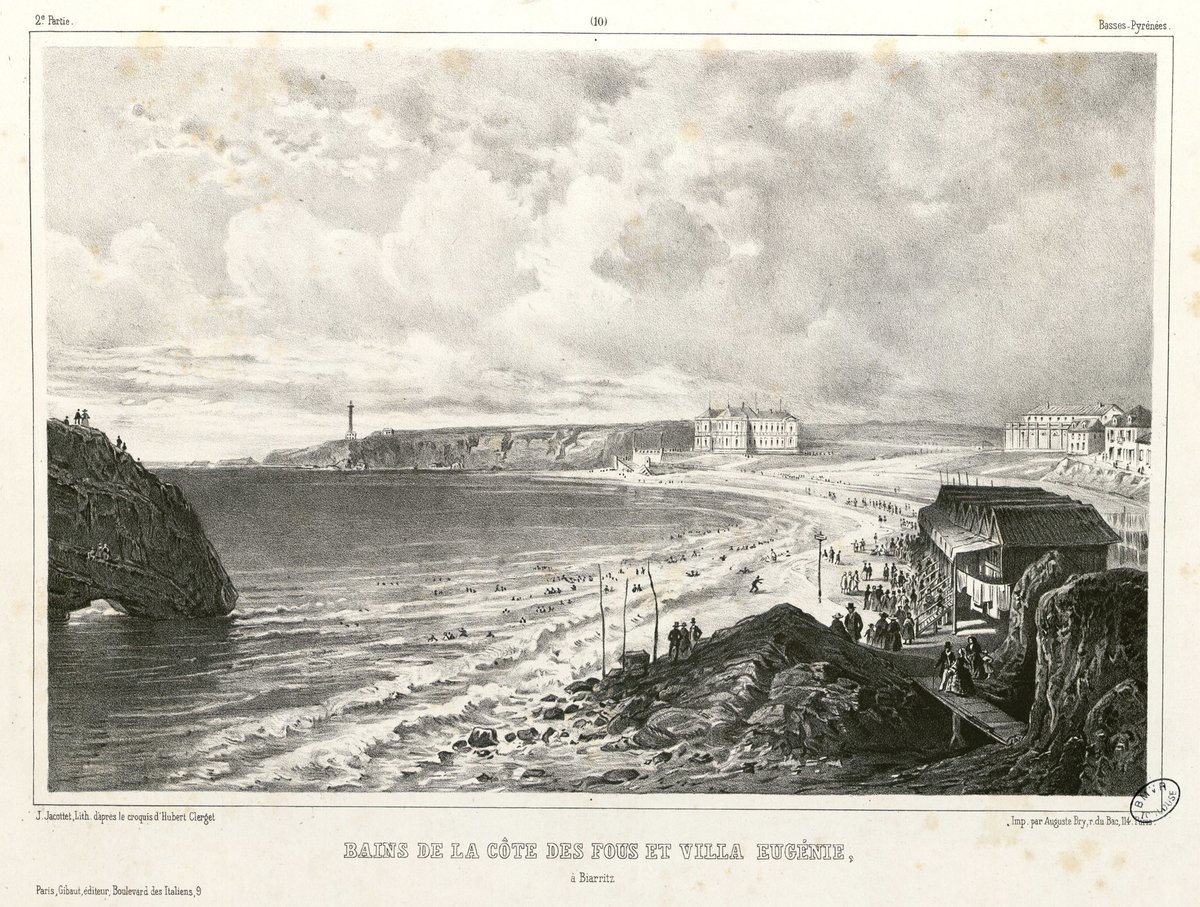
In 1854, Napoleon III bought nearly 50 acres of coastal dunes facing the Grande Plage for a summer residence for Eugénie and their court. His decision shifted Biarritz’s economy toward palaces, roads, and imperial display; the sand itself became valuable real estate.
castle
1855
Villa Eugénie Opens
Villa Eugénie rose in 1855 in Second Empire style, its red-brick and pale-stone façade facing the Atlantic. The imperial family returned for many summer seasons, drawing European royalty, diplomats, and an expensive new clientele behind them.
person
1862
Bismarck Visits the Imperial Court
Prussian minister Otto von Bismarck visited Napoleon III in Biarritz in October 1862 for talks that touched the balance of power in Europe. Behind the palace’s polished rooms, diplomacy moved through cigar smoke, sea wind, and calculations about German unity.
church
1865
The Virgin Arrives on Rock
A statue of the Virgin Mary was installed on the Rocher de la Vierge in 1865. Local tradition says it honored whalers who survived a violent gale, and the white figure still faces the boats as if keeping watch over the Bay of Biscay.
Belle Époque Biarritz
castle
1881
Bridge Reaches the Virgin’s Rock
In 1881, a 75-meter metal footbridge linked the mainland to the offshore rock. Records and local accounts attribute the work to the Schryvers workshops in Hautmont, although popular retellings often attach Eiffel’s name to it.
church
1892
Russian Church Serves the Court
The Russian Orthodox Church of Saint Alexander Nevsky was consecrated in 1892 for the Russian aristocracy vacationing on the coast. Its domes and incense-filled interior gave Biarritz’s resort society a distinctly eastern courtly accent.
castle
1893
Villa Eugénie Becomes a Hotel
Villa Eugénie reopened as the Hôtel du Palais in 1893 after Empress Eugénie sold the property to a private consortium. The former summer residence became a hotel where imperial memory was folded into room keys, dining rooms, and Atlantic-facing balconies.
local_fire_department
1903
Fire Rewrites the Palace
Fire gutted the Hôtel du Palais on February 1, 1903, tearing through its roof and interior. Édouard-Jean Niermans rebuilt and enlarged it in an E-shaped plan for Eugénie, turning disaster into the palace’s Belle Époque silhouette.
Modernist Biarritz
person
1915
Chanel Opens Her Biarritz Salon
In 1915, Gabrielle “Coco” Chanel opened her first couture house at 2 avenue Édouard VII, serving wealthy clients displaced or sheltering during the First World War. Biarritz’s seaside ease suited the looser clothes she was beginning to cut, far from the stiff etiquette of an imperial ballroom.
palette
1918
Picasso Paints the Basque Coast
Pablo Picasso spent the summer of 1918 in Biarritz with Olga Khokhlova, staying at the villa of art patron Madame Errázuriz. He painted beach scenes and bathers influenced by the coast, including work associated with the lighthouse, while Europe was still at war.
Interwar Biarritz
palette
1929–1933
Art Deco Arrives by the Sea
The Art Deco Casino Municipal opened on the Grande Plage in 1929, as the old luxury economy struggled through the Great Depression. The Musée de la Mer followed in 1933, putting aquariums, sea creatures, and ocean science behind a façade above the Rocher de la Vierge.
Occupation and Liberation
swords
1940
Occupation Fortifies the Coast
German troops entered Biarritz on June 27, 1940, requisitioning hotels and the Parme airfield. Concrete bunkers, coastal guns, and tunnels then threaded the shore as part of the Atlantic Wall, giving holiday architecture an abrupt military underside.
swords
March 27, 1944
The Bombing Misses Its Target
On March 27, 1944, American B-24 Liberators dropped roughly 44–45 tonnes of bombs aimed at Parme airfield and Latécoère factories, but drift sent much of the raid over Biarritz. Between 117 and 145 civilians died, 375 houses were destroyed, and about 1,200 people lost their homes; the target was damaged, too.
gavel
August 24, 1944
Freedom Returns to Biarritz
French Resistance fighters and Allied units liberated Biarritz on August 24, 1944, as German forces withdrew from southwestern France. In 1945–46, the former resort hosted Biarritz American University, where more than 10,000 U.S. servicemen took university courses while waiting for demobilization.
Surfing Biarritz
palette
1956
Surfing Crosses the Atlantic
In 1956, American screenwriter Peter Viertel brought a Californian surfboard to the Côte des Basques while visiting for The Sun Also Rises. He left the board behind, and local riders such as Joël de Rosnay and Georges Hennebutte turned an imported curiosity into a durable Biarritz culture.
Contemporary Biarritz
castle
2011
The Palace Receives Palace Status
The Hôtel du Palais received France’s official Palace distinction in 2011, joining a small group of top luxury establishments recognized beyond the five-star rating. Its imperial bees, grand staircases, and rebuilt E-shaped plan now carry a modern business: selling the memory of Napoleon III’s summers.
public
August 24–26, 2019
G7 Leaders Gather by the Atlantic
Biarritz hosted the 45th G7 Summit from August 24 to 26, 2019, with meetings at the Hôtel du Palais and Bellevue Casino. Security closures reached across roads, beaches, and the sea, briefly turning the resort into a guarded diplomatic compound.
public
October 23–29, 2022
Pelota Championships Fill the Courts
From October 23 to 29, 2022, Biarritz hosted the World Pelota Championships, bringing about 600 athletes for 18 medal disciplines. The crack of balls in the courts reasserted a Basque sporting tradition beside the town’s more famous surfboard.